AC voltage applied to a resistor
NCERT Class 12 Physics Chapter 7 Section 7.2
Quick answer
With an sinusoidal voltage v = vm sin ωt across an ideal constant resistor R, the current is i = im sin ωt with im = vm/R, so the current and voltage are in phase. The current averages zero over a cycle, but the power does not: its average is im2 R/2. Defining the rms current I = im/√2 and rms voltage V = vm/√2 gives the dc forms P = I2 R and V = IR; mains of 220 V rms peaks at about 311 V.
With your textbook
NCERT Physics Part I (Class 12), Chapter 7 “Alternating Current”, Section 7.2 “AC Voltage Applied to a Resistor”, pages 178–180.
Open the official NCERT chapter (PDF, 2.4 MB, ncert.nic.in) (opens in a new tab)
Checked against the 2026-27 reprint on .
What happens when an ac voltage is applied to a resistor?
AC voltage applied to a resistor
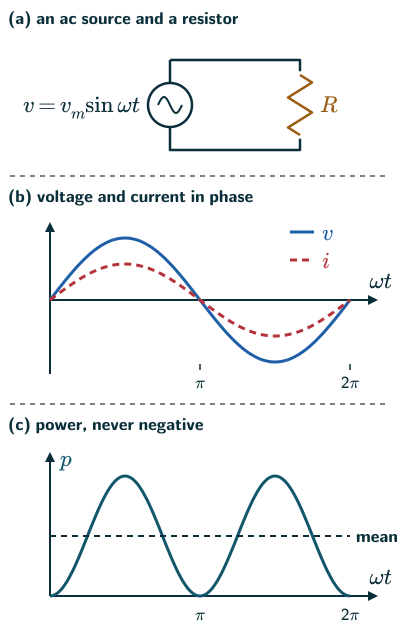
An ac source gives a potential difference that varies sinusoidally, v = vm sin ωt, where vm is the amplitude and ω the angular frequency (NCERT Section 7.2, page 178). Across a resistor R, the current follows the voltage exactly:
Clearly, the voltage and current are in phase with each other.
NCERT Physics Part I (Class 12), Section 7.2, page 178
The current averages zero over a cycle, but the power does not, because Joule heating depends on i2. To write ac power in the dc form I2R, NCERT defines the root mean square (rms) current, I = im/√2 (NCERT pages 179–180).
In plain words: a resistor does not care which way the current flows; it heats up either way. The current swings back and forth in step with the voltage, and the heating comes in pulses twice every cycle. The rms current is the steady current that would heat the resistor just as much.
Model used throughout: sinusoidal ac across an ideal, constant resistance, with negligible inductive and capacitive effects. AC need not always be sinusoidal. Bulb and iron examples use the resistance at their stated operating temperature.
Current in phase with the voltage
- A resistor is joined to an ac source, v = vm sin ωt (NCERT Eq. (7.1), page 178, Figure 7.1).
- Kirchhoff’s loop rule gives vm sin ωt = iR, so (NCERT Eqs. (7.2)–(7.3), page 178):
Current in a resistor (NCERT Eqs. 7.2–7.3)
- This is Ohm’s law, which for resistors works equally well for ac and dc voltages (page 178).
- The voltage and current reach zero, their maxima and their minima at the same times: they are in phase (NCERT page 178, Figure 7.2).
- The current takes positive and negative values in each cycle, so its average over a cycle is zero (page 178). That does not mean no energy is used.
Average power over a cycle
- Joule heating depends on i2, which is never negative. The instantaneous power is (NCERT Eq. (7.4), page 179):
Instantaneous power (NCERT Eq. 7.4)
- Using sin2 ωt = ½(1 − cos 2ωt), and the fact that cos 2ωt averages to zero over a cycle, the average of sin2 ωt is ½ (NCERT page 179). So the average power is (NCERT Eq. [7.5(c)], page 179):
Average power (NCERT Eq. 7.5c)
RMS current and voltage
- To write ac power in the dc form P = I2R, NCERT defines the root mean square (rms) or effective current (NCERT Eq. (7.6), page 180):
RMS current (NCERT Eq. 7.6)
- Then the average power is P = ½im2R = I2R (NCERT Eq. (7.7)). Likewise the rms voltage is V = vm/√2 = 0.707 vm (NCERT Eq. (7.8)), and V = IR (NCERT Eq. (7.9), page 180).
- So in rms values, power and Ohm’s law look just as they do for dc: P = I2R = V2/R = IV (page 180), the same forms as for electrical power in dc circuits.
- The rms current is the dc current that would produce the same average power loss as the alternating current (page 180).
- Ac quantities are customarily given as rms values: household mains of 220 V is an rms value, with a peak of √2 × 220 ≈ 311 V (page 180).
- The name means what it says: square the current, take the mean over a cycle, then the square root. The mean of im2 sin2 ωt is im2/2, whose square root is im/√2 (NCERT Eq. (7.6), page 180).
- NCERT slip: NCERT’s boxes on pages 178 and 179 spell the inventor’s name “Nicola Tesla”; it is Nikola Tesla (Nikola Tesla Museum, biography).
Solved examples
Example 1: A light bulb (NCERT Example 7.1)
A bulb is rated 100 W for a 220 V supply. Find (a) its resistance, (b) the peak voltage of the source, (c) the rms current.
Answer: (a) R = V2/P = 2202/100 = 484 Ω. (b) vm = √2 × 220 ≈ 311 V. (c) I = P/V = 100/220 ≈ 0.455 A; NCERT writes 0.454 A, cutting off the last figure instead of rounding (NCERT page 180).
Example 2: Peak and rms
An ac current has a peak value of 5.0 A. Find its rms value and the average power it delivers to a 20 Ω resistor.
Answer: I = 5.0/√2 ≈ 3.5 A, and P = ½im2R = ½ × 5.02 × 20 = 250 W, the same as I2R with the unrounded I (NCERT Eqs. (7.6)–(7.7), page 180).
Example 3: The current at an instant
A 50 Ω resistor is connected to a source v = 311 sin(100πt) V. Find the current at t = 2.5 ms and its rms value.
Answer: im = 311/50 ≈ 6.22 A. At t = 2.5 ms, 100πt = π/4, so i = 6.22 × sin(π/4) ≈ 4.4 A. The rms current is 6.22/√2 ≈ 4.4 A too, since sin(π/4) = 1/√2 (NCERT Eqs. (7.2)–(7.6), pages 178–180).
Example 4: Why the average current is zero but the power is not
Over one full cycle, what are the average current and the average of i2 for i = im sin ωt?
Answer: the current is positive for half the cycle and negative for the other half, so its average is zero. But i2 = im2 sin2 ωt is never negative, and its average is im2/2. Heating depends on i2, so energy is used (NCERT pages 178–179).
Common mistakes to avoid
Common mistake
Using the peak value as the rms value
Meters and ratings give rms values. 220 V mains has a peak of about 311 V; P = I2R and V = IR use rms values (NCERT page 180).
Common mistake
Thinking zero average current means zero power
The current averages zero over a cycle, but the power i2R does not, since i2 is never negative (NCERT pages 178–179).
Common mistake
Taking the half-cycle average as the rms value
Over a full cycle the current averages zero; over the positive half cycle it averages 2im/π ≈ 0.637 im. The rms value, 0.707 im, is a different number (reasoned: the mean of sin ωt from 0 to π is 2/π).
Common mistake
Using 0.707 for every waveform
I = im/√2 holds for a sinusoidal current. Other waveforms have other ratios (reasoned from the definition).
Quick revision summary
- With v = vm sin ωt across a resistor, i = im sin ωt with im = vm/R: current and voltage are in phase.
- The current averages zero over a cycle, but the power does not: p = im2R sin2 ωt, with average ½im2R.
- RMS values: I = im/√2 = 0.707 im and V = vm/√2; then P = I2R = V2/R = IV and V = IR, as for dc.
- Ac ratings are rms values: 220 V mains has a peak of about 311 V.
Formula sheet
- v = vm sin ωt, i = im sin ωt, im = vm/R
- average power: im2 R/2 = I2 R
- I = im/√2, V = vm/√2
- P = I2 R, V = IR, P = IV
Questions students ask
Why is the rms value of alternating current used instead of its average value?
The rms value of an alternating current is used because it measures what the current does in a resistor: a sinusoidal current averages zero over a full cycle yet heats the resistor, and the rms value is the steady current that heats it at the same average rate, so P = IR and V = IR keep their dc forms (NCERT pages 178–180). A half-cycle average suits effects of charge carried one way, such as the charge a full-wave rectified current gives a battery, and for a sine wave the rms value is 1.11 times it (beyond the NCERT text: charge = average current × time; US Department of Energy, DOE Fundamentals Handbook: Electrical Science, 1992, Module 7).
What is the rms value of an alternating current over half a cycle?
The rms value of a sinusoidal current over any half cycle, or over a quarter cycle from a zero to a peak, is the same as over a full cycle, im/√2 ≈ 0.707 im, because the mean of sin ωt over each of these intervals is ½ (reasoned from NCERT page 179). Over other intervals it differs: from t = 0 to T/8 the mean of sin ωt is ½ − 1/π ≈ 0.18, so the rms value over that eighth of a cycle is only about 0.43 im (beyond the NCERT text, reasoned from the definition of rms). The rms current that NCERT defines is the value over whole cycles; ordinary ac ratings use this convention, and a meter must be suitable for the waveform being measured (NCERT page 180).
What is the rms value of a square wave or a triangular wave?
A square wave that switches between +V0 and −V0 has an rms value equal to its peak, V0, since its square is V02 at every instant, while a triangular or sawtooth wave ramping uniformly between −V0 and +V0 (or between zero and V0) has an rms value of V0/√3 ≈ 0.577 V0 (beyond the NCERT text, reasoned from the definition of rms, NCERT page 180). So NCERT’s 1/√2 cannot be assumed for other shapes: with the same 24 V peak, a square wave heats a resistor like 24 V dc, a sine wave like 17.0 V and a triangular wave like 13.9 V. A square wave at +V0 for half of each cycle and zero for the rest gives V0/√2 too.
What is the rms value of a current such as i = 3 + 4 sin(ωt + π/3) A?
A current made of a steady part I0 and a sinusoidal part of peak im has the rms value √(I02 + im2/2), because the mean of its square is I02 + im2/2: the cross term 2I0im sin(ωt + φ) averages to zero over a cycle (beyond the NCERT text, reasoned from NCERT pages 179–180). For i = 3 + 4 sin(ωt + π/3) A this gives √(9 + 8) = √17 ≈ 4.1 A, not 3 + 4 = 7 A or 3 + 4/√2 ≈ 5.8 A, and the phase π/3 makes no difference. Such a current heats a resistor as a steady 4.1 A would.
Are peak and rms values of alternating current in the JEE Main and NEET syllabus?
Yes, peak and rms values of alternating current are named in both syllabuses: Unit 14 of the JEE Main syllabus lists “Alternating currents, peak and RMS value of alternating current/voltage”, and Unit 14 of the NEET (UG) 2026 syllabus has the same words. NCERT covers them with the resistor in Section 7.2 of Class 12 Physics Part I (pages 178–180), where the average power ½im2R leads to the rms current I = im/√2. Neither syllabus names the average value over a half cycle, which NCERT does not define either: its only average current is the one over a full cycle, which is zero (NCERT page 178).
Practice questions
Try each question first, then open the answer to check your working.
-
Q1. What is the phase difference between the current and the voltage in a purely resistive ac circuit?
Show answerHide answer
Zero: they are in phase (NCERT page 178).
-
Q2. A 110 V rms supply is connected to a 55 Ω resistor. Find the rms current and the peak current.
Show answerHide answer
I = V/R = 110/55 = 2.0 A rms, and im = √2 × 2.0 ≈ 2.8 A (NCERT Eqs. (7.6) and (7.9), page 180).
-
Q3. Why is the rms value of an ac current called its effective value?
Show answerHide answer
It is the dc current that would produce the same average power loss in a resistor as the alternating current (NCERT page 180).