Transformers
NCERT Class 12 Physics Chapter 7 Section 7.8
Quick answer
A transformer transfers energy by mutual induction between windings linked by changing flux; an ideal transformer has Vs/Vp = Ns/Np and Is/Ip = Np/Ns. A step-up transformer raises voltage and lowers current while conserving real power; average power is VI times the load power factor. Winding resistance and core losses cause heating, while leakage flux reduces coupling; high-voltage transmission reduces I2 R losses.
With your textbook
NCERT Physics Part I (Class 12), Chapter 7 “Alternating Current”, Section 7.8 “Transformers”, pages 194–196.
Open the official NCERT chapter (PDF, 2.4 MB, ncert.nic.in) (opens in a new tab)
Checked against the 2026-27 reprint on .
What is a transformer?
Transformer
A transformer transfers electrical energy by induction, usually changing an alternating voltage to a larger or smaller one; equal-turn windings can instead provide 1:1 isolation (NCERT Section 7.8, page 194):
This is done with a device called transformer using the principle of mutual induction.
NCERT Physics Part I (Class 12), Section 7.8, page 194
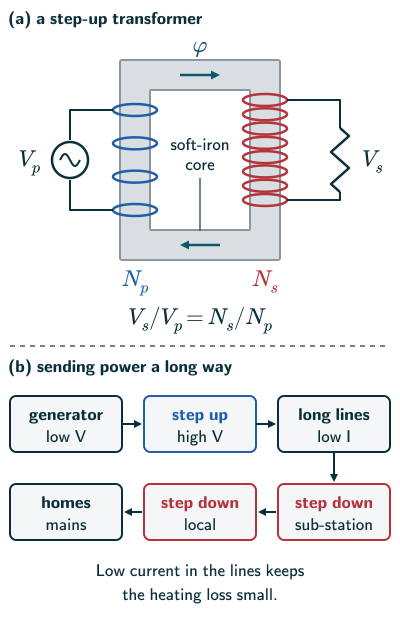
In NCERT’s two-winding model, two insulated coils are wound on a soft-iron core. Other designs use different magnetic materials or an air core. The alternating current in the primary coil (Np turns) makes an alternating flux in the core, which links the secondary coil (Ns turns) and induces an emf in it. For an ideal transformer Vs/Vp = Ns/Np (NCERT pages 194–195).
In plain words: the core carries the same changing flux through every turn of both coils, so each turn gets the same emf. More turns on the secondary means more emf in total: the voltage is stepped up. Energy is not created, so the current is stepped down in the same ratio.
Use the ratios carefully: V and I denote rms magnitudes. For an ideal transformer VI = VI equates apparent powers (VA). Real average power is VI cos φ; the ideal transformer preserves load power factor and real power. Writing power = VI in watts requires unity power factor. Loaded primary current balances the secondary ampere-turns, in addition to the small magnetising current of a real core.
Step-up and step-down transformers
- The two coils are wound on a soft-iron core, either one on top of the other or on separate limbs of the core (NCERT page 194, Figure 7.16). Soft iron is used because it is easily magnetised, so it carries nearly all the flux from one coil to the other, and it has a low hysteresis loss (reasoned from NCERT pages 194–196).
- In an ideal transformer both windings have zero resistance, all core flux links both windings, core losses vanish and magnetising current is negligible. With φ the flux in each turn, the emfs are (NCERT Eqs. (7.31)–(7.32), page 194) εs = −Ns dφ/dt in the secondary, by mutual induction, and the back emf εp = −Np dφ/dt in the primary, by self-induction. Both follow from Faraday’s law.
- The primary back emf opposes the applied voltage: with a consistent loop direction, vp + εp = 0. Their magnitudes are equal. With negligible winding drops, the secondary terminal-voltage magnitude equals its induced-emf magnitude. Choosing corresponding winding polarities gives the following voltage ratio; reversing one winding reverses its phase. Dividing (NCERT Eq. (7.33), page 195):
Voltage ratio (NCERT Eq. 7.33)
- NCERT page 195 motivates an approximation with small currents and negligible resistance. More precisely, winding voltage drops and leakage must be negligible; ideal-transformer ratios do not require the load current itself to be small.
- If no energy is lost, the power in equals the power out, ipvp = isvs (NCERT Eq. (7.34), page 195), so ip/is = vs/vp = Ns/Np (NCERT Eq. (7.35), page 195). A well-designed transformer can be more than 95% efficient, so this is a good approximation (NCERT page 195).
- The same ratios hold for amplitudes and rms values (NCERT Eq. (7.36), page 195):
Secondary current (NCERT Eq. 7.36)
- A transformer changes the voltage and the current but not the frequency: both sides oscillate at the source frequency (NCERT page 195).
- Step-up: Ns > Np, so Vs > Vp and Is < Ip. Step-down: Ns < Np, so Vs < Vp and Is > Ip (NCERT page 195).
- Stepping up the voltage does not break the conservation of energy: the current is reduced in the same proportion (NCERT Points to Ponder 11, page 199).
- A transformer needs changing flux. An ordinary ac transformer cannot continuously transform steady dc: after switching transients it has no secondary emf. Pulsed supplies can drive suitably designed transformers during changing flux, with core reset between pulses (reasoned from Faraday’s law).
Energy losses in a transformer
NCERT lists four departures from ideal transformer operation (NCERT pages 195–196):
- Flux leakage: not all the primary’s flux passes through the secondary, because of poor core design or air gaps in the core. Winding the two coils one over the other reduces it. Leakage flux itself stores and returns magnetic energy rather than necessarily dissipating it; it reduces coupling and causes reactive voltage drops. Additional stray-field heating can occur in real construction.
- Resistance of the windings: the wires heat up (I2R). In high-current, low-voltage windings this is kept down by using thick wire.
- Eddy currents: the alternating flux induces eddy currents in the iron core, heating it. A laminated core reduces them.
- Hysteresis: the core’s magnetisation is reversed again and again by the alternating field, and the energy spent appears as heat. It is kept small by using a core material with a low hysteresis loss.
Long-distance transmission
- Electrical energy is transmitted and distributed over long distances using transformers. The generator’s voltage is stepped up, so that the current, and with it the I2R loss in the lines, is reduced (NCERT page 196). The linked page on electrical energy and power works out with numbers how a higher voltage cuts the loss.
- Near the consumers, the voltage is stepped down at an area sub-station, then again at distributing sub-stations and on utility poles, before it reaches homes (NCERT page 196).
- NCERT inconsistency: page 196 says a supply of 240 V reaches our homes, and NCERT Points to Ponder 1 (page 198) also calls the outlet voltage 240 V, but page 180 calls the household line voltage 220 V, the value the chapter’s examples and exercises use. In a problem, use the voltage the question gives.
Solved examples
Example 1: Stepping up (NCERT, page 195)
An ideal transformer feeding a resistive load has 100 primary turns and its secondary 200 turns. The input is 220 V at 10 A. Find the output voltage and current.
Answer: Ns/Np = 2, so Vs = 2 × 220 = 440 V and Is = 10/2 = 5.0 A. The power, 2200 W, is the same on both sides (NCERT page 195).
Example 2: A step-down transformer
A transformer steps 2200 V down to 220 V and has 3000 turns on its primary. How many turns are on its secondary? If the secondary supplies 11 A, what current does the primary draw (ideal transformer)?
Answer: Ns = 3000 × 220/2200 = 300 turns. Ip = Is × Ns/Np = 11 × 300/3000 = 1.1 A (NCERT Eq. (7.36), page 195).
Example 3: Efficiency
A transformer takes 1000 W from the mains and delivers 950 W to a resistive load (power factor 1) at 50 V rms. Find its efficiency and the output current.
Answer: efficiency = 950/1000 = 95%, and Is = 950/50 = 19 A (NCERT page 195).
Example 4: A station transformer
In an ideal single-phase, unity-power-factor transmission model, a transformer takes 33 MW at 11 kV and steps the voltage up to 132 kV. Find Ns/Np and the current on each side.
Answer: Ns/Np = Vs/Vp = 132/11 = 12. With no losses the power is the same on both sides: Ip = 33 × 106/(11 × 103) = 3000 A and Is = 33 × 106/(132 × 103) = 250 A, twelve times smaller, so in the same lines the I2R loss is 122 = 144 times smaller than at 11 kV (NCERT Eqs. (7.33)–(7.35), page 195; the loss is reasoned from NCERT page 196).
Common mistakes to avoid
Common mistake
Thinking a step-up transformer increases power
It raises the voltage but lowers the current in the same ratio; the output power is at best equal to the input (NCERT page 195; Points to Ponder 11, page 199).
Common mistake
Getting the current ratio upside down
The voltage goes as the turns, Vs/Vp = Ns/Np, but the current goes the other way, Is/Ip = Np/Ns (NCERT Eq. (7.36), page 195).
Common mistake
Expecting a transformer to work on dc
A steady current gives a steady flux, and a steady flux induces no emf in the secondary. With no back emf, only the small resistance of the winding limits the primary current, so the coil can overheat (reasoned from Faraday’s law). NCERT page 177 gives easy conversion of ac voltages by transformers as the main reason ac is preferred.
Quick revision summary
- A transformer uses mutual induction: an alternating flux in a soft-iron core links a primary of Np turns and a secondary of Ns turns.
- Ideal transformer: Vs/Vp = Ns/Np and Is/Ip = Np/Ns, so VpIp = VsIs.
- Step-up: Ns > Np, more voltage, less current. Step-down: the reverse.
- The output has the same frequency as the input.
- Nonideal effects: flux leakage reduces coupling; winding resistance, eddy currents (reduced by lamination) and hysteresis cause heating; a well-designed transformer may exceed 95% efficiency.
- Power is transmitted at high voltage and low current to cut I2R losses, then stepped down near consumers.
Formula sheet
- Vs/Vp = Ns/Np
- Is/Ip = Np/Ns
- ideal: Vp Ip = Vs Is
- efficiency = output power/input power
Questions students ask
Why is a transformer rated in kVA and not in kW?
A transformer is rated in kVA because its limit is the heating from its losses, which depend on its current and voltage, whatever the load’s power factor: winding loss grows as IR and core loss depends on the voltage and frequency (beyond the NCERT text: US DOE Fundamentals Handbook: Electrical Science, 1992, Module 13, where the rating is VsIs in kVA). Not knowing the load, the maker states the largest VI it can carry safely. The real power delivered is that times the load’s power factor: at full current a 2.0 kVA transformer gives 2.0 kW to a heater but 1.7 kW to a load of power factor 0.85.
What are copper loss and iron loss in a transformer, and which one stays constant?
Copper loss and iron (core) loss are engineering names for the heating among the nonideal effects NCERT lists: copper loss is the IR heating of the windings, iron loss the heating of the core by hysteresis and eddy currents (NCERT pages 195–196; beyond the NCERT text: US DOE Fundamentals Handbook: Electrical Science, 1992, Module 13). Iron loss depends on the core flux, set by the supply voltage and frequency, so it hardly changes with the load, while copper loss grows as the square of the load current. At fixed supply voltage, frequency and load power factor, with approximately constant core loss, winding resistance and negligible other losses, efficiency peaks where copper and iron losses are equal: with 80 W of iron loss and 180 W of copper loss at full load, at two-thirds of full load (reasoned).
Where does the transformer emf equation E = 4.44 fNΦm come from?
The transformer emf equation E = 4.44 fNΦm is NCERT’s ε = −N dφ/dt (Eq. (7.31), page 194) for a core flux φ = Φm sin ωt: the emf of N turns then has the amplitude NωΦm = 2πfNΦm, and dividing by √2 for the rms value gives about 4.44 fNΦm (beyond the NCERT text, reasoned from NCERT page 180). The emf per turn, 4.44 fΦm, is the same in both windings, so it fixes the number of turns: a flux peaking at 2.25 mWb at 50 Hz gives about 0.50 V per turn, so a 230 V winding needs about 460 turns and a 9.0 V winding 18.
What is the difference between a transformer and a generator?
A generator converts mechanical energy into electrical energy by turning a coil in a magnetic field or a magnet inside coils, while a transformer changes an ac voltage to a larger or smaller one with coils and a core that do not move: its flux varies because of electrical excitation, the primary’s alternating current setting up a changing flux that also threads the secondary (NCERT pages 171–172 and 194). Both work by Faraday’s law, but a transformer only passes on the electrical energy it is given, in ordinary sinusoidal operation gives out the frequency it takes in, while a generator’s frequency is set by how fast it turns (NCERT pages 171 and 195). An AC generator makes the voltage; transformers step it up or down.
Is the transformer in the JEE Main and NEET syllabus, or has it been deleted?
The transformer has not been deleted: both syllabuses name it in Unit 14, Electromagnetic Induction and Alternating Currents, the JEE Main syllabus ending with “wattless current, AC generator and transformer.” and the NEET (UG) 2026 syllabus with “AC generator and transformer.” In NCERT it is Section 7.8 of Chapter 7, Alternating Current, in the 2026–27 Class 12 Physics Part I (pages 194–196): the principle of mutual induction, Vs/Vp = Ns/Np, step-up and step-down transformers, the four nonideal effects and long-distance transmission. Neither syllabus names copper and iron losses or kVA ratings, which are beyond the NCERT text.
Is the turns ratio of a transformer Ns/Np or Np/Ns?
The turns ratio of a transformer is written both ways, so check which one a question uses: NCERT writes the ratios with Ns/Np, greater than 1 for a step-up transformer (NCERT Eqs. (7.33) and (7.36), page 195), while the US DOE handbook defines the turns ratio as Np/Ns, greater than 1 for step-down (beyond the NCERT text: US DOE Fundamentals Handbook: Electrical Science, 1992, Module 13, Equation (13-1)). The physics is the same whichever is used, Vs/Vp = Ns/Np. So a 230 V to 9.2 V transformer has Ns/Np = 0.04 but a turns ratio of 25, written 25 : 1.
Practice questions
Try each question first, then open the answer to check your working.
-
Q1. On what principle does a transformer work?
Show answerHide answer
Mutual induction (NCERT page 194).
-
Q2. A transformer has 500 primary turns and 50 secondary turns. With 230 V on the primary, what is the secondary voltage?
Show answerHide answer
Vs = 230 × 50/500 = 23 V: a step-down transformer (NCERT Eq. (7.36), page 195).
-
Q3. Why is the core of a transformer laminated?
Show answerHide answer
To reduce the eddy currents induced in it by the alternating flux, and so the heating (NCERT page 196).