AC generator
NCERT Class 12 Physics Chapter 6 Section 6.8
Quick answer
In the simple AC-generator model, a coil rotates at constant angular speed about an axis in its plane perpendicular to a uniform magnetic field. Starting with its normal along B, the flux per turn is ΦB = BA cos ωt and the emf is ε = NBAω sin ωt, with ε0 = NBAω. The emf reverses every half turn and can drive alternating current through a load, converting mechanical energy into electrical energy.
With your textbook
NCERT Physics Part I (Class 12), Chapter 6 “Electromagnetic Induction”, Section 6.8 “AC Generator”, pages 170–172.
Open the official NCERT chapter (PDF, 2.4 MB, ncert.nic.in) (opens in a new tab)
Checked against the 2026-27 reprint on .
What is an AC generator?
AC generator
In the simple AC-generator model, a coil turns in a magnetic field. As the coil turns, the flux through it keeps changing, so an emf is induced whose polarity reverses every half turn (NCERT Section 6.8, pages 170–171):
An ac generator converts mechanical energy into electrical energy.
NCERT Physics Part I (Class 12), Section 6.8, page 171
For a coil of N turns and area A turning at constant angular speed ω about an axis in its plane perpendicular to a uniform field B, starting with its normal along the field, the emf is ε = NBAω sin ωt (NCERT Eq. (6.19), page 171).
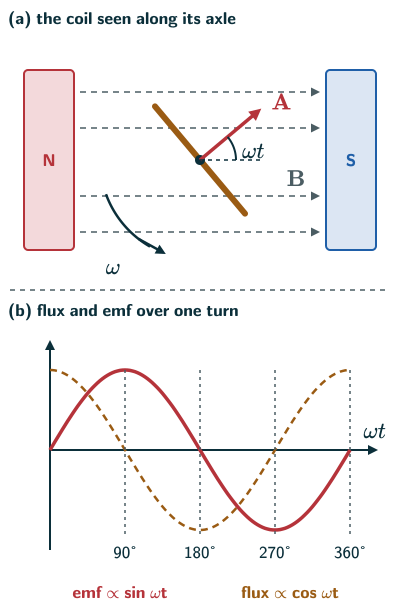
In plain words: spin a coil between the poles of a magnet. Face-on to the field it holds the most flux, edge-on it holds none, and in between the flux keeps rising and falling. Faraday’s law turns that rise and fall into an emf that swings back and forth and can drive alternating current through a load.
A coil rotating in a magnetic field
- The parts (NCERT Figure 6.13, page 170): a coil, called the armature, mounted on a rotor shaft whose axis is perpendicular to the uniform field B. Something outside turns it. Its ends connect to the external circuit through slip rings and brushes (NCERT page 171).
- It uses one of the ways of changing flux: changing the angle between the coil and the field. The effective area facing the field is A cos θ, where θ is the angle between the area vector A and B (NCERT pages 170–171).
- Turning at constant angular speed ω, with θ = 0 at t = 0, the angle is θ = ωt, so the flux through each turn is (NCERT page 171):
Flux through the rotating coil (NCERT page 171)
- In practice (NCERT pages 171–172): the energy to turn the armature comes from falling water (hydro-electric generators), or from steam made using coal (thermal) or nuclear fuel (nuclear power generators). In most generators the coils are held still and electromagnets are rotated instead. The frequency is 50 Hz in India and 60 Hz in some countries, such as the USA.
- NCERT slip (page 170): NCERT calls Nikola Tesla, spelled there “Nicola”, a “Yugoslav inventor”. Beyond the NCERT text: Tesla was born in 1856 in Smiljan, then in the Austrian Empire and now in Croatia; he was an Austrian subject until 1891 and then a US citizen, and is described as a Serbian-American engineer (Wikipedia, “Nikola Tesla”). Yugoslavia honoured him late in life (the Order of the Yugoslav Crown, 1931, same article), but he was never its citizen (reasoned from those citizenships). If asked who devised the modern ac generator, name Nikola Tesla.
Emf ε = NBAω sin ωt
- By Faraday’s law the emf of the N-turn coil is ε = −N dΦB/dt = −NBA d(cos ωt)/dt (NCERT page 171), which gives (NCERT Eq. (6.19)):
Emf of an AC generator (NCERT Eq. 6.19)
- The peak value is ε0 = NBAω; the emf reaches ±ε0 when sin ωt = ±1, so ε = ε0 sin ωt (NCERT Eq. (6.20)). With ω = 2πν, where ν is the number of revolutions per second, ε = ε0 sin 2πνt (NCERT Eq. (6.21), page 171).
- The emf is extreme at θ = 90° and 270°, when the plane of the coil lies along the field, because the flux is then changing fastest (NCERT page 171). It is zero at 0° and 180°, when the coil faces the field and the magnitude of flux is largest (reasoned from NCERT Eq. (6.19)).
- Watch the angle and the start: θ is measured between B and the area vector (the normal to the coil), not the plane of the coil. If timing starts with the plane of the coil along the field, the emf is ±ε0 cos ωt instead, with sign fixed by the chosen rotation and normal (reasoned from NCERT Eq. (6.19)).
- The basic numerical examples below use this fixed-area, uniform-field, perpendicular-axis model. Since sin ωt swings between +1 and −1, the emf reverses periodically and drives alternating current in a connected load (NCERT page 171); in an inductive or capacitive load the current can be out of phase with the emf (reasoned; NCERT Chapter 7 takes up such circuits).
- Doubling the speed of rotation doubles both the peak emf, NBAω, and the frequency (reasoned from NCERT Eqs. (6.19)–(6.21)).
- When the generator drives a current, the field exerts a torque on the current loop that opposes rotation for a purely resistive load. More generally, positive average electrical output requires opposing torque on average, while reactive loads can return energy during part of a cycle; this is where the electrical energy comes from (reasoned with Lenz’s law, NCERT page 160).
Solved examples
Example 1: Pedal power (NCERT Example 6.10)
Kamla pedals a stationary bicycle that turns a 100-turn coil of area 0.10 m2 at half a revolution per second, in a uniform field of 0.01 T perpendicular to the axis of rotation. What is the maximum voltage generated?
Answer: ν = 0.5 Hz, so ε0 = NBA(2πν) = 100 × 0.01 × 0.1 × 2π × 0.5 ≈ 0.314 V (NCERT page 172).
Example 2: A 50 Hz generator
A coil of 50 turns, each of area 0.020 m2, turns at 50 revolutions per second in a field of 0.40 T. Find the peak emf.
Answer: ω = 2π × 50 ≈ 314 rad/s, so ε0 = NBAω = 50 × 0.40 × 0.020 × 314 ≈ 126 V (NCERT Eq. (6.19), page 171).
Example 3: The emf at an instant
A generator has a peak emf of 100 V and a frequency of 50 Hz, and its emf is zero and rising at t = 0. Find the emf at t = 1/600 s.
Answer: ε = ε0 sin 2πνt = 100 sin(2π × 50/600) = 100 sin(π/6) = 50 V (NCERT Eq. (6.21), page 171).
Example 4: Flux and emf in step
At the moment the coil of a generator faces the field squarely, is the emf largest or zero? What about a quarter turn later?
Answer: facing the field, the flux is largest but momentarily not changing, so the emf is zero. A quarter turn later the coil lies along the field: the flux is zero but changing fastest, so the emf is largest (NCERT page 171).
Common mistakes to avoid
Common mistake
Expecting the largest emf when the flux is largest
The emf depends on the rate of change of flux. It is largest in size when the plane of the coil lies along the field, where the flux is zero (NCERT page 171).
Common mistake
Using the rotation rate in place of ω
In ε0 = NBAω, ω is in radians per second. A coil making ν revolutions per second has ω = 2πν (NCERT Eq. (6.21), page 171).
Common mistake
Thinking a generator creates energy
It converts mechanical energy into electrical energy; the turning force must do work against the magnetic torque on the induced current, as Lenz’s law requires (NCERT pages 160 and 171).
Quick revision summary
- An AC generator turns a coil (the armature) in a uniform field, about an axis perpendicular to the field; slip rings and brushes connect it to the circuit.
- With θ = ωt, the flux through each turn is BA cos ωt, and the emf is ε = NBAω sin ωt.
- The emf reaches +ε0 at 90° and −ε0 at 270°, where ε0 = NBAω; the emf is zero when the flux is largest.
- The emf alternates in sign, giving alternating current; ω = 2πν.
- Generators convert mechanical energy into electrical energy: hydro-electric, thermal and nuclear.
Formula sheet
- ΦB = BA cos ωt
- ε = NBAω sin ωt
- ε0 = NBAω, ω = 2πν
Questions students ask
What is the difference between an AC generator and a DC generator?
An AC generator connects its turning coil to the circuit through slip rings, so its output alternates like the coil’s emf, while a DC generator uses a split-ring commutator that swaps the coil’s connections every half turn, as the emf reverses, so its output keeps one polarity, rising and falling between zero and a peak (beyond the NCERT text: US Department of Energy, DOE Fundamentals Handbook: Electrical Science, 1992, Modules 5 and 10). In both, the emf induced in the coil itself alternates, as ε = NBAω sin ωt (NCERT Eq. (6.19), page 171), and NCERT describes only the slip-ring kind. So the basic difference lies in the connection to the circuit, not in how the emf is induced.
Is an alternator the same as an AC generator?
Yes, an alternator is an AC generator, a machine that converts mechanical energy into electrical energy as an alternating emf (NCERT page 171); ‘alternator’ is simply its usual engineering name (beyond the NCERT text: US Navy, NEETS Module 5, 1998, page 3-1). Large alternators, like most generators in NCERT’s account, hold the coils still and turn electromagnets inside them (NCERT page 172), so the output comes from fixed windings with no sliding contacts in the load circuit, which suits high voltages and currents (US Department of Energy, DOE Fundamentals Handbook: Electrical Science, 1992, Module 10). Small machines often turn the coil instead, as in NCERT’s Figure 6.13.
Is the AC generator deleted from Class 12, and is it in the JEE Main and NEET syllabus?
No, the AC generator is not deleted: it is NCERT Section 6.8 in the 2026–27 Class 12 Physics Part I (pages 170–172), at the end of Chapter 6, Electromagnetic Induction, with Example 6.10. Both exams name it in Unit 14, Electromagnetic Induction and Alternating Currents: the JEE Main syllabus ends the unit with “wattless current, AC generator and transformer.”, and the NEET (UG) 2026 syllabus with “AC generator and transformer.” What the generator’s alternating emf does in a circuit, from rms values to the transformer, is covered in the next chapter, Alternating Current.
Does a generator have to turn 50 times a second to give 50 Hz AC?
A generator must turn 50 times a second for India’s 50 Hz only if it has two poles, like NCERT’s coil between one pair of poles, which gives one cycle of emf per turn (NCERT Eq. (6.21), page 171, and page 172). A machine with more poles gives one cycle each time a pair of poles passes a coil, so its frequency in hertz is the number of poles times the revolutions per minute, divided by 120: a four-pole machine turns at 1500 rpm and a 40-pole machine at 150 rpm for 50 Hz (beyond the NCERT text: US Department of Energy, DOE Fundamentals Handbook: Electrical Science, 1992, Module 10, Equation (10-1)). NCERT’s “frequency of rotation is 50 Hz” fits the two-pole case.
What is the difference between an AC generator and an electric motor?
An AC generator and an electric motor do opposite jobs: a generator converts the mechanical energy that turns it into electrical energy, while a motor is fed a current and turned by the torque on its current loop; as NCERT puts it, “In generators and motors, the roles of input and output are reversed” (NCERT Chapter 7, Points to Ponder 10, page 199). A DC machine can run as either, and a motor’s coil has a back emf against its supply (beyond the NCERT text: US Department of Energy, DOE Fundamentals Handbook: Electrical Science, 1992, Module 5), just as a generator delivering current feels an opposing torque.
Practice questions
Try each question first, then open the answer to check your working.
-
Q1. What energy conversion takes place in an AC generator?
Show answerHide answer
Mechanical energy is converted into electrical energy (NCERT page 171).
-
Q2. A 200-turn coil of area 0.050 m2 turns at 100 rad/s in a field of 0.20 T. Find the peak emf.
Show answerHide answer
ε0 = NBAω = 200 × 0.20 × 0.050 × 100 = 200 V (NCERT Eq. (6.19), page 171).
-
Q3. What is the frequency of the AC supply in India?
Show answerHide answer
50 Hz (NCERT page 172).