Magnetic flux
NCERT Class 12 Physics Chapter 6 Section 6.3
Quick answer
Magnetic flux through a flat area A in a uniform field B is ΦB = B · A = BA cos θ, where θ is the angle between B and the area vector, the normal to the surface. For a curved surface or a non-uniform field the contributions B · dA of small pieces are added. Flux is a scalar measured in weber (Wb), one tesla metre squared; it is largest when B is along the normal and zero when B lies in the surface.
With your textbook
NCERT Physics Part I (Class 12), Chapter 6 “Electromagnetic Induction”, Section 6.3 “Magnetic Flux”, pages 156–157.
Open the official NCERT chapter (PDF, 2.4 MB, ncert.nic.in) (opens in a new tab)
Checked against the 2026-27 reprint on .
What is magnetic flux?
Magnetic flux
Magnetic flux ΦB measures how much magnetic field passes through a surface. Before stating Faraday’s law, NCERT introduces it by analogy (NCERT Section 6.3, page 156):
Magnetic flux is defined in the same way as electric flux is defined in Chapter 1.
NCERT Physics Part I (Class 12), Section 6.3, page 156
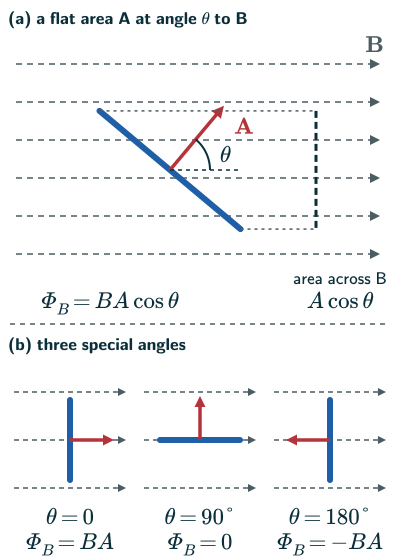
For a flat area A in a uniform field B, the flux is ΦB = B·A = BA cos θ, where θ is the angle between B and the area vector A (NCERT Eq. (6.1), page 157). Its SI unit is the weber (Wb), and it is a scalar (page 157).
In plain words: count the field lines that pass through a loop. A loop facing the field square-on catches the most; tilt it and it catches fewer; turn it edge-on and it catches none. This is a visual analogy: drawn field lines are arbitrary; the exact quantity is the surface integral of B.
Flux Φ = B·A
- An area is treated as a vector A: its size is the area and its direction is normal to the surface, as for electric flux (NCERT page 157, referring to Chapter 1).
- For a plane area A in a uniform field B (NCERT Eq. (6.1), page 157, Figure 6.4):
Magnetic flux through a plane area (NCERT Eq. 6.1)
- θ is the angle between B and the normal to the surface, not between B and the surface itself.
- A cos θ is the signed projection of the area on a plane at right angles to B, the area the field meets square-on; the flux is B times this projected area (reasoned from NCERT Eq. (6.1)).
- Special cases: at θ = 0, B along the normal, ΦB = BA, the largest value; at θ = 90°, B in the plane of the surface, ΦB = 0; at θ = 180°, ΦB = −BA (reasoned from NCERT Eq. (6.1)).
- Curved surfaces and non-uniform fields: split the surface into small area elements, each with its own field, and take the limit of the sum as the elements shrink (NCERT Eq. (6.2), page 157, Figure 6.5):
Flux through any surface (NCERT Eq. 6.2)
- Closed surfaces: the net magnetic flux through any closed surface is zero, because B has no local sources or sinks and isolated magnetic poles are not known to exist (Gauss’s law for magnetism, NCERT Section 5.3, pages 142–143).
- Changing the flux: from NCERT Eqs. (6.1) and (6.2), the flux through a coil changes if B, A or θ changes: moving a magnet nearer, shrinking or stretching the coil, or rotating it in the field (NCERT page 158). An emf results when the net flux actually changes; simultaneous changes can cancel. This is what Faraday’s law shows (NCERT Section 6.4).
- For a coil of N closely wound turns, the same flux passes through each turn, which is why Faraday’s law for a coil carries a factor N (NCERT Eq. (6.4), page 158).
Unit: the weber
- The SI unit of magnetic flux is the weber (Wb), equal to a tesla metre squared (NCERT page 157):
Unit of magnetic flux (NCERT page 157)
- Magnetic flux is a scalar (page 157). Its sign depends on which way the normal is chosen; for a loop, the normal is usually taken by the right-hand rule from the direction in which the loop is traversed (a standard convention; NCERT does not state it here).
- Its dimensions are [M L2 T−2 A−1] (NCERT Chapter 5 table, page 151).
- Since ΦB = BA when B is along the normal, 1 T = 1 Wb m−2, a unit NCERT uses in Exercise 6.6 (page 176); this is why B is also called the magnetic flux density (NCERT Chapter 5 table, page 151).
- Since Faraday’s law gives an emf as a rate of change of flux, 1 Wb = 1 V s (reasoned from NCERT Eq. (6.3)).
Solved examples
Example 1: Tilting a loop
A rectangular loop 20 cm × 10 cm is in a uniform field of 0.50 T. Find the flux through it when its normal makes (a) 0°, (b) 60°, (c) 90° with the field.
Answer: A = 0.20 × 0.10 = 0.020 m2. (a) ΦB = 0.50 × 0.020 = 0.010 Wb. (b) 0.010 × cos 60° = 5.0 × 10⁻³ Wb. (c) cos 90° = 0, so zero: the field lies in the plane of the loop (NCERT Eq. (6.1), page 157).
Example 2: A loop in a north-east field (from NCERT Example 6.2)
A square loop of side 10 cm stands vertically in the east-west plane. A uniform field of 0.10 T points north-east. Find the flux through the loop.
Answer: A = (0.10)2 = 0.010 m2. Take the loop’s normal pointing north: it makes 45° with a north-east field (a south-pointing normal makes 135° and only flips the sign). ΦB = BA cos 45° = 0.10 × 0.010 × 0.707 ≈ 7.1 × 10⁻⁴ Wb (NCERT page 159, which writes it as 0.1 × 10⁻²/√2 Wb).
Example 3: Turning a coil round (from NCERT Example 6.3)
A circular coil of radius 10 cm has its plane perpendicular to the horizontal component of the earth’s field, 3.0 × 10⁻⁵ T. Find the flux through each turn before and after it is turned through 180° about a vertical diameter.
Answer: A = π(0.10)2 = π × 10−2 m2. Before, θ = 0: ΦB = 3.0 × 10⁻⁵ × π × 10−2 = 3π × 10−7 ≈ 9.4 × 10⁻⁷ Wb. After, θ = 180°: −9.4 × 10⁻⁷ Wb. The magnitude of the change is 6π × 10−7 ≈ 1.9 × 10⁻⁶ Wb per turn (NCERT page 159). The vertical component of the earth’s field lies in the plane of the coil throughout, so it adds no flux (reasoned).
Example 4: A field that is not uniform
A flat surface has two parts. On 0.020 m2 the field is 0.30 T along the normal; on the other 0.030 m2 it is 0.10 T at 60° to the normal. Find the total flux.
Answer: add the parts: 0.30 × 0.020 × cos 0° + 0.10 × 0.030 × cos 60° = 6.0 × 10⁻³ + 1.5 × 10−3 = 7.5 × 10⁻³ Wb (NCERT Eq. (6.2), page 157).
Common mistakes to avoid
Common mistake
Measuring θ from the surface instead of the normal
In Φ = BA cos θ, θ is the angle between B and the area vector, the normal to the surface. With B lying in the surface, θ = 90° and the flux is zero (NCERT page 157).
Common mistake
Treating flux as a vector
Magnetic flux is a scalar, though it can be positive or negative depending on the angle between B and the chosen normal (NCERT page 157).
Common mistake
Forgetting the number of turns
BA cos θ is the flux through one turn. In Faraday’s law for a coil of N turns, the rate of change of flux is multiplied by N (NCERT Eq. (6.4), page 158).
Quick revision summary
- Magnetic flux through a flat area in a uniform field: ΦB = B·A = BA cos θ, with θ between B and the normal.
- It is largest (BA) when B is along the normal, zero when B lies in the surface and −BA when B is opposite to the normal.
- For curved surfaces or non-uniform fields, integrate B·dA over the oriented surface.
- Flux is a scalar; its SI unit is the weber, 1 Wb = 1 T m.
- Changing B, A or θ can change the flux; emf appears only if their combined effect changes the linked flux.
Formula sheet
- ΦB = B · A = BA cos θ
- general surface: ΦB = ∫ B · dA
- unit: 1 Wb = 1 T m
Questions students ask
What is the difference between magnetic flux and magnetic flux density?
Magnetic flux ΦB is a scalar that belongs to a whole surface and is measured in webers, while magnetic flux density is another name for the magnetic field B, a vector defined at each point and measured in teslas (NCERT page 157; NCERT Chapter 5, page 151). B is the flux per unit area through a small area held normal to it, so 1 T = 1 Wb m: a uniform field of 0.35 T normal to a loop of 0.060 m sends 0.021 Wb through it. Tilting the loop changes the flux, BA cos θ, but not B; for magnetic versus electric flux, see electric flux.
What is the CGS unit of magnetic flux?
The CGS unit of magnetic flux is the maxwell (Mx), with 1 Mx = 10 Wb, so 1 Wb = 10 Mx (beyond the NCERT text, NIST Guide to the SI, Special Publication 811, Table 10 and Appendix B.8). It goes with the CGS unit of magnetic field, the gauss, which NCERT also uses, 1 G = 10 T (NCERT Chapter 5, page 151; NCERT Example 6.7, page 165): a field of 1 G through 1 cm gives 1 Mx, since 10 T × 10 m = 10 Wb. The same NIST guide does not accept the maxwell or the gauss for use with the SI.
How is magnetic flux measured?
Magnetic flux is measured with Faraday’s law: a search coil of N turns is pulled out of the field, and the charge Q driven round its circuit of resistance R gives the magnitude of the flux change per turn, |ΔΦB| = |Q|R/N, for constant R and a complete event with the same initial and final current (beyond the NCERT text, reasoned from NCERT Eq. (6.4)). So 4.0 × 10 C round 36 Ω from a 60-turn coil means 2.4 × 10 Wb per turn, or B = 0.048 T if each 5.0 cm turn faced the field. Also beyond NCERT, CERN’s CMS magnet is checked with coils round its steel yoke, and Hall probes give B (B. Curé and others, arXiv:1611.02299).
What is the formula for magnetic flux in terms of current?
For fixed geometry and a linear magnetic medium, magnetic flux is proportional to the source current: in the central region of an ideal long air-filled solenoid with n turns per unit length, B = μ0nI, so the flux through each turn of cross-section A is ΦB = μ0nIA (NCERT page 168; see the solenoid). With 1200 turns per metre, 0.80 A and 3.0 cm, B ≈ 1.2 × 10 T and ΦB ≈ 3.6 × 10 Wb per turn. The flux a coil’s own current links with it is likewise proportional to that current, NΦB = LI, where L is its self-inductance (NCERT pages 165 and 168).
Practice questions
Try each question first, then open the answer to check your working.
-
Q1. A loop of area 0.050 m2 is in a uniform field of 0.40 T, with the plane of the loop parallel to the field. What is the flux through it?
Show answerHide answer
Zero: the field lies in the plane, so it makes 90° with the normal and cos 90° = 0 (NCERT Eq. (6.1), page 157).
-
Q2. What is the SI unit of magnetic flux, and is flux a scalar or a vector?
Show answerHide answer
The weber (Wb), which is a tesla metre squared; flux is a scalar (NCERT page 157).
-
Q3. The normal to a loop of area 0.10 m2 makes 60° with a uniform field of 0.20 T. Find the flux.
Show answerHide answer
ΦB = BA cos θ = 0.20 × 0.10 × 0.5 = 0.010 Wb (NCERT Eq. (6.1), page 157).