Lenz’s law and conservation of energy
NCERT Class 12 Physics Chapter 6 Section 6.5
Quick answer
Lenz’s law fixes the induced emf’s polarity so that it tends to drive a current opposing the flux change; it is the minus sign in ε = −dΦB/dt. In the resistive magnet-and-coil model, an approaching north pole meets a north face and a receding one meets a south face. Mechanical work becomes Joule heat in that model, while a circuit with inductance can also store and return magnetic energy.
With your textbook
NCERT Physics Part I (Class 12), Chapter 6 “Electromagnetic Induction”, Section 6.5 “Lenz’s Law and Conservation of Energy”, pages 160–162.
Open the official NCERT chapter (PDF, 2.4 MB, ncert.nic.in) (opens in a new tab)
Checked against the 2026-27 reprint on .
What is Lenz’s law?
Lenz’s law
In 1834 the German physicist Heinrich Friedrich Lenz gave a rule for the direction, or polarity, of an induced emf (NCERT Section 6.5, page 160):
The polarity of induced emf is such that it tends to produce a current which opposes the change in magnetic flux that produced it.
NCERT Physics Part I (Class 12), Section 6.5, page 160
The minus sign in Faraday’s law, ε = −dΦB/dt, stands for this opposition (NCERT page 160). Lenz’s law is a consequence of the conservation of energy (NCERT pages 160 and 174).
In plain words: the induced emf tends to resist the flux change. If the flux through a loop is rising, the current makes a field that tries to cut it down; if the flux is falling, the current makes a field that tries to keep it up. Nature resists the change, and you have to do work to force it.
Circuit assumption: the elementary current directions below describe an initially unenergised resistive loop with negligible self-inductance. Lenz’s law fixes the emf polarity; stored magnetic energy can make an actual current persist when that external emf reverses.
Direction of the induced current
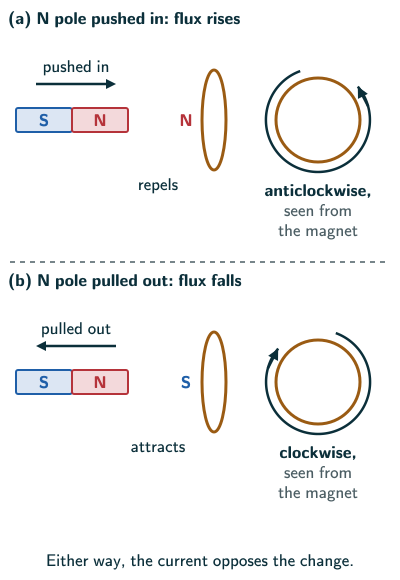
- North pole pushed towards a coil (Experiment 6.1): the flux through the coil increases, so the induced current opposes the increase. Seen from the magnet’s side it flows anticlockwise, which makes the near face of the coil a north pole, facing the approaching north pole (NCERT page 160).
- North pole pulled away: the flux decreases, so the current opposes the decrease. Seen from the magnet’s side it flows clockwise, the near face becomes a south pole, and its attraction opposes the receding magnet (page 160).
- A recipe (reasoned from NCERT page 160):
- Find the direction of B through the loop and whether the flux is rising or falling.
- The induced field inside the loop points against the increasing flux contribution, or in the sense that restores a decreasing contribution. For a fixed field direction, this means against B when its flux magnitude rises and along B when it falls.
- Use the right-hand thumb rule to turn that field direction into a current direction.
- Open circuits: with a gap in the loop, an emf is still induced across the open ends, and Lenz’s law gives its polarity; no current flows (NCERT page 160; Points to Ponder 2, page 174). Strictly, charges shift briefly to set up that emf (reasoned).
- NCERT slip: page 160 refers to “Experiment 6.1 in Section 6.2.1”. There is no Section 6.2.1; Experiment 6.1 is in Section 6.2 (page 155).
Lenz’s law as energy conservation
- Suppose the current went the other way. Then a south pole would face the approaching north pole, the magnet would be attracted towards the coil and speed up, and a gentle push would give it ever more kinetic energy for nothing. That would be a perpetual-motion machine, which violates the conservation of energy, so it cannot happen (NCERT page 160).
- With the correct direction, the coil repels the approaching magnet, so a person has to do work to move it. That energy is dissipated by Joule heating produced by the induced current (page 160). Strictly, in a circuit with inductance some of it can be stored for a while as magnetic energy (reasoned).
- NCERT’s Points to Ponder put it briefly: in a closed circuit, currents are induced so as to oppose the changing flux, as the law of conservation of energy requires (NCERT Points to Ponder 2, page 174).
- Current cannot be induced by changing the electric flux (NCERT Example 6.5(b), page 162). Strictly, a changing electric flux does make a magnetic field, the displacement current of NCERT Chapter 8, but Faraday’s law has only the magnetic flux (reasoned).
Solved examples
Example 1: Loops entering and leaving a field (NCERT Example 6.4)
A uniform magnetic field points into the page, away from the reader. (i) A rectangular loop is moving into the field region, (ii) a triangular loop is moving out of it, and (iii) an irregular loop is moving out of it. Which way does the induced current flow in each, as seen by the reader?
Answer: (i) The flux into the page is increasing, so the induced current makes a field out of the page: it flows anticlockwise. (ii) and (iii) The flux into the page is decreasing, so the induced current makes a field into the page: it flows clockwise. There is no current while a loop is wholly inside or wholly outside the field region (NCERT page 161). These are NCERT’s paths bcdab, bacb and cdabc.
Example 2: Four quick cases (NCERT Example 6.5)
(a) A closed loop is held still between the poles of two strong fixed magnets. Is a current induced? (b) A closed loop moves through the steady electric field between the plates of a large capacitor, wholly inside or partly outside. Is a current induced? (c) A rectangular loop and a circular loop leave a uniform field region at the same constant velocity, the field being normal to both. In which is the emf constant while it leaves? (d) A loop containing a capacitor, plate A above plate B, lies between two bar magnets on a common axis. The magnet on the left approaches with its N pole leading; the one on the right approaches with its S pole leading. Which plate becomes positive?
Answer: (a) No: however strong the magnets, only a changing flux induces a current. (b) No current is induced in either case: current cannot be induced by changing the electric flux (NCERT page 162). Strictly, in this steady electrostatic setting the circulation of E round the loop is zero; surface charges may redistribute for a moment as the loop moves (reasoned). (c) The rectangular loop, with one pair of sides parallel to a straight field boundary and motion normal to it: its area inside the field falls at a steady rate; the circular loop’s does not, so its emf varies. (d) Both magnets make a field from left to right through the loop, and both make it grow. The induced current must make a field from right to left, so it flows anticlockwise as seen from the left-hand magnet. In NCERT’s drawing the capacitor is on the far side of the loop, where this current flows downwards into the upper plate, so plate A becomes positive with respect to B, as NCERT finds (NCERT pages 161–162, Figure 6.9; the current’s path is reasoned).
Example 3: A magnet dropped towards a ring
A copper ring lies flat on a table. A bar magnet, held vertically with its S pole downwards, is dropped towards it. Which way does the induced current flow, seen from above?
Answer: field lines enter a south pole, so below the magnet the field points up through the ring, and this upward flux increases as the magnet falls. The induced current must make a downward field inside the ring, so it flows clockwise seen from above (reasoned from NCERT page 160).
Example 4: Where does the work go?
Pushing a magnet into a coil drives a steady induced current of 0.20 A for 0.50 s through a circuit of total resistance 5.0 Ω. About how much work must be done against the magnetic repulsion?
Answer: neglecting changes in kinetic or stored magnetic energy, the work ends up as Joule heat in the circuit, about I2Rt = 0.202 × 5.0 × 0.50 = 0.10 J (NCERT page 160).
Common mistakes to avoid
Common mistake
Thinking the induced current always opposes the field
It opposes the change in flux, not the field itself. When the flux is falling, the induced field points along the original field to keep the flux up (NCERT page 160).
Common mistake
Saying clockwise without saying from where
A current that is clockwise seen from one side of a loop is anticlockwise from the other. State the viewpoint, as NCERT does: from the side of the magnet (NCERT page 160).
Common mistake
Thinking Lenz’s law needs a closed loop
In an open circuit an emf is still induced across the ends, with the polarity Lenz’s law gives; only the current is missing (NCERT page 160).
Common mistake
Thinking magnetic braking ends as soon as the magnet passes the ring
In the resistive approximation, as the magnet leaves the flux falls, the induced current reverses and the ring attracts the magnet back. The opposing magnetic force makes its downward acceleration less than g while approaching or leaving; it can still speed up if that acceleration is positive (reasoned from NCERT page 160).
Quick revision summary
- Lenz’s law: the induced emf drives a current that opposes the change in flux that produced it; it is the minus sign in ε = −dΦB/dt.
- Rising flux: the induced field points against B. Falling flux: it points along B.
- A north pole pushed into a coil meets a north pole on the coil’s near face (repulsion); pulled out, it meets a south pole (attraction).
- An open circuit still gets an emf of the same polarity, but no current.
- Lenz’s law follows from conservation of energy: the work done against the opposing force appears as heat in the resistive model, with temporary magnetic-energy storage possible when inductance matters.
Formula sheet
- ε = −dΦB/dt (the sign is Lenz’s law)
- resistive loop, fixed field direction: flux magnitude rising → induced field against B
- resistive loop, fixed field direction: flux magnitude falling → induced field along B
Questions students ask
What is the difference between Lenz’s law and Faraday’s law?
Faraday’s law gives the size of an induced emf, the rate of change of magnetic flux, while Lenz’s law gives its direction: the emf drives a current that opposes the change in flux (NCERT pages 158 and 160). Together they make ε = −N dΦB/dt, in which Lenz’s law is the minus sign, so Lenz’s law has no formula of its own (NCERT page 160 and Summary point 3, page 173). Faraday’s law was drawn from experiment, while Lenz’s law also follows from the conservation of energy (NCERT pages 157 and 160); both are different ideas from the Lorentz force.
What is the difference between Lenz’s law and Fleming’s right-hand rule?
Lenz’s law gives the polarity of induced emf, even in a coil at rest beside a changing current, as in NCERT’s Experiment 6.3 (NCERT pages 156 and 160), while Fleming’s right-hand rule, beyond the NCERT text, covers only a conductor moving across a magnetic field. With the thumb, first finger and second finger of the right hand at right angles, along the motion, the field and the motional emf acting on positive charges, the rule gives v × B (reasoned from the Lorentz force, NCERT page 163). The actual current also depends on the rest of the circuit. It is in neither the 2026–27 NCERT Class 12 text nor NCERT Science Class 10, Chapter 12, which explains only the left-hand rule (page 203).
Is the direction of the induced current the same as that of the induced emf?
Yes in a purely resistive closed loop with no other emf; Lenz’s law then fixes both (reasoned from NCERT page 160 and Summary point 2, page 173). With a gap in the loop, the emf’s direction tells which end becomes positive, the end towards which it pushes positive charge, as plate A does in NCERT Example 6.5(d) (page 162). They need not agree if a cell, charged capacitor or inductive back emf also contributes. An inductor can sustain an existing current while the external induced emf acts against it; solve the complete circuit equation (reasoned).
Is work needed to push a magnet into a coil whose circuit is open?
For an ideal non-magnetic coil, neglecting capacitive transients and local eddy currents, almost no work is done against the coil when a magnet is pushed into a coil whose circuit is open: an emf is induced across the open ends, but no current flows, so the coil exerts no opposing magnetic force and there is no Joule heat to supply (reasoned from NCERT page 160 and Points to Ponder 2, page 174). Close the circuit and the work needed rises as the resistance falls, since the induced current takes power ε/R: at the same speed, an emf of 0.18 V costs 0.036 W through 0.90 Ω but 0.36 W through 0.090 Ω (reasoned, ignoring the coil’s self-inductance).
Practice questions
Try each question first, then open the answer to check your working.
-
Q1. State Lenz’s law.
Show answerHide answer
The polarity of the induced emf is such that it tends to produce a current which opposes the change in magnetic flux that produced it (NCERT page 160).
-
Q2. The north pole of a magnet is pulled away from a coil. What pole does the near face of the coil become, and does it attract or repel the magnet?
Show answerHide answer
A south pole, which attracts the receding north pole and so opposes the motion (NCERT page 160).
-
Q3. Why can the induced current not flow so as to attract an approaching magnet?
Show answerHide answer
The magnet would then speed up with no energy supplied, giving a perpetual-motion machine, which violates the conservation of energy (NCERT page 160).