Eddy currents
Beyond NCERT In the JEE Main and NEET syllabus; the Class 12 book has no section for it.
Quick answer
Eddy currents circulate inside a bulk conductor when changing linked magnetic flux induces an emf. In passive magnetic braking they oppose motion and turn mechanical energy into heat; thin insulated laminations reduce unwanted current paths in transformer cores. Eddy currents are also useful for damping, induction heating and crack detection.
What are eddy currents?
Eddy currents
Eddy currents are loops of current induced inside a bulk conductor rather than a separately wound wire circuit, whenever the magnetic flux through parts of it changes: because the metal moves through a field or because the field itself changes (Faraday’s law; MIT 8.02 course notes, Chapter 10, §10.5). They are also called Foucault currents, after Léon Foucault, who demonstrated magnetic drag and heating in a rotating copper disc in 1855 (Smithsonian National Museum of American History, “Ruhmkorff electric machine”).
The 2026–27 NCERT book has no section on eddy currents. It names them once, among the energy losses in a transformer:
The alternating magnetic flux induces eddy currents in the iron core and causes heating.
NCERT Physics Part I (Class 12), Section 7.8, page 196
The JEE Main and NEET syllabuses both list eddy currents in Unit 14.
In plain words: a solid lump of metal is like a huge number of tiny loops of wire, all joined together. Change the flux through it and every one of those loops gets an induced emf, so currents swirl round inside the metal like eddies in a stream. Like all induced currents, they oppose the change that causes them, and they heat the metal.
Eddy currents in a moving metal plate
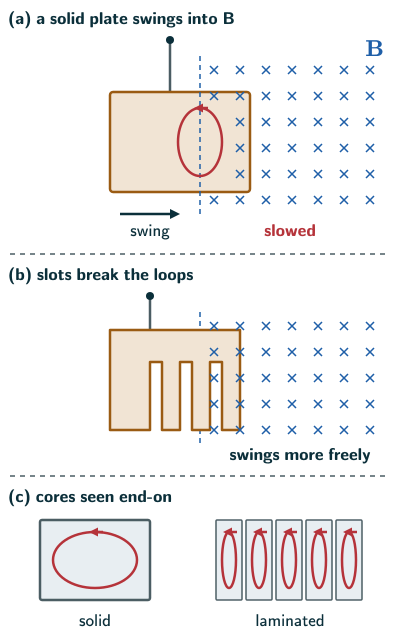
- A swinging plate: hang a flat copper or aluminium plate as a pendulum so that it swings into and out of the field between the poles of a magnet. As part of the plate enters the field, the flux through that region rises, and a loop of current is induced round it; as it leaves, the flux falls and the current reverses (reasoned from Faraday’s law, NCERT Eq. (6.3)).
- They oppose the motion: by Lenz’s law the induced currents oppose the change in flux, and the magnetic force on them opposes the swing. The plate slows quickly and stops, its kinetic energy turned into heat in the metal (reasoned from NCERT Section 6.5).
- Slots make a difference: cut slots across the plate and the large current loops are broken. Only small currents can flow, so the damping is much weaker and the plate swings much more freely (reasoned).
- Eddy currents flow in any conducting body: a solid metal core, a disc, a wheel or a pipe. A magnet dropped down a vertical copper pipe falls slowly for the same reason (reasoned from Lenz’s law).
Reducing them with laminated cores
- The iron cores of transformers, motors and generators carry alternating flux, so eddy currents are induced in the iron and waste energy as heat (NCERT Section 7.8, page 196; MIT 6.061 notes, Chapter 8, §6.3).
- NCERT’s remedy: “The effect is reduced by using a laminated core” (NCERT page 196). The core is built from thin sheets (laminations), insulated from one another and lying along the field, instead of one solid block (MIT 6.061 notes, Chapter 8, §§6.3–6.4).
- Why it works (reasoned): the insulation stops current crossing from one sheet to the next, so each eddy loop must stay inside one thin sheet. A small loop encloses little flux, so its emf is small, and the heating falls sharply. The iron is still there to carry the flux.
- Poorly conducting magnetic core materials also limit eddy-current heating because their high resistivity restricts current (reasoned from Joule heating and Faraday’s law).
Uses: magnetic braking, damping and induction furnaces
- Magnetic braking: in the eddy current brakes of some trains, a magnetic field acts on a moving conducting part and the induced currents produce an opposing force (MIT 8.02 notes, §10.5). Near rest, the braking force tends to zero with speed: ordinary eddy-current brakes cannot hold a stationary train. The speed dependence at high speeds need not remain proportional (reasoned).
- Damping: the opposing force of eddy currents is used to bring moving parts to rest quickly without rubbing, as with the swinging plate above (MIT 8.02 notes, §10.5).
- Induction furnaces and heating: a rapidly alternating field induces large eddy currents in a piece of metal, and these heat it, as in induction heating furnaces (MIT, Electromagnetic Field Theory: A Problem-Solving Approach, §6-1-3).
- Detecting flaws: a crack interrupts current paths, changing the response to an alternating magnetic field; this is the basis of eddy-current crack detection (reasoned from Faraday’s law and current continuity).
- Mechanical coupling: the currents also exert torque, so magnetic coupling can transfer mechanical energy as well as dissipate heat; passive braking is one operating case (reasoned from the force on a current).
Solved examples
Example 1: The swinging plate
A solid copper plate swinging between the poles of a strong magnet stops after a few swings, but the same plate with slots cut in it swings for much longer. Explain.
Answer: in the solid plate, large eddy currents are induced as it enters and leaves the field; by Lenz’s law their force opposes the motion, and the energy goes into heat. The slots break the long current paths, so only small eddy currents flow and the braking is weak (reasoned from NCERT Eq. (6.3) and Section 6.5).
Example 2: Shrinking the eddy loops
Model one eddy current path as a ring of radius 2.0 cm and resistance 1.0 mΩ, in a field normal to it that changes at 0.50 T/s. Find the emf and the heating power. Neglect self-inductance and magnetic back reaction. What happens if the ring’s radius is halved using the same material and strip cross-section, but half the strip length?
Answer: ε = πr2 dB/dt = π × (0.020)2 × 0.50 ≈ 6.3 × 10⁻⁴ V, so P = ε2/R ≈ (6.28 × 10⁻⁴)2/
Example 3: Laminations the right way round
In a transformer core the field runs along the core. Should the laminations lie along the field or across it?
Answer: along the field. The eddy currents circulate round the field lines, in planes at right angles to the field; sheets lying along the field, with insulation between them, cut through those paths (MIT 6.061 notes, Chapter 8, §6.4). Sheets across the field would leave the current paths intact.
Example 4: A magnet in a copper pipe
A small strong magnet dropped down a vertical copper pipe takes much longer to fall than one dropped beside it. Why, and where does its lost energy go?
Answer: as the magnet falls, the flux through each ring of the pipe below it rises and through each ring above it falls, inducing eddy currents that oppose the motion (Lenz’s law). In a sufficiently long pipe, the magnet approaches a steady terminal speed, and its loss of potential energy becomes heat in the pipe (reasoned from NCERT Section 6.5).
Common mistakes to avoid
Common mistake
Thinking eddy currents are always unwanted
They waste energy in transformer and motor cores, but they are used on purpose in magnetic brakes, in damping and in induction furnaces (MIT 8.02 notes, §10.5; MIT field-theory notes, §6-1-3).
Common mistake
Thinking laminating removes the iron
A laminated core is still iron; it is only divided into thin insulated sheets, so the flux is carried as before while the eddy current paths are broken (NCERT page 196 names the laminated core; the explanation is reasoned).
Common mistake
Thinking eddy currents need a coil
They flow in any bulk conductor in a changing flux, such as a plate, a disc or a pipe, along closed paths inside the metal (reasoned).
Quick revision summary
- Eddy currents are induced loops of current inside bulk metal when the flux through it changes, by motion or by a changing field.
- By Lenz’s law they oppose the change: a moving plate is slowed, and the energy appears as heat.
- They waste energy in the iron cores of transformers and motors; laminated cores of thin insulated sheets cut them down.
- Uses: magnetic braking in trains, damping of moving parts, induction furnaces and crack detection.
Formula sheet
- emf round a closed path: ε = −dΦB/dt
- resistive ring, uniform normal field: |ε| = πr2 |dB/dt|
- heating in a path of resistance R: P = ε2/R
Questions students ask
Is eddy current deleted from NCERT Class 12, and is it in the JEE Main and NEET syllabus?
Yes, the eddy currents section of older NCERT editions is gone: the 2026–27 Class 12 book has no section on them and names them only once, as a transformer loss: “The alternating magnetic flux induces eddy currents in the iron core and causes heating” (NCERT Chapter 7, page 196). Both exams still list them in Unit 14: the JEE Main syllabus has “eddy currents” after Lenz’s law, and the NEET (UG) 2026 syllabus “Induced emf and current: Lenz’s Law, Eddy currents.” Braking and laminated cores follow from Faraday’s law and Lenz’s law, NCERT Sections 6.4 and 6.5.
What is the difference between eddy currents and an ordinary induced current?
Eddy currents are induced currents like any other, driven by the emf of a changing flux and opposing that change by Lenz’s law; what sets them apart is where they flow: in closed loops inside a solid piece of metal, with no wire to guide them (reasoned from NCERT Sections 6.4 and 6.5). Their paths and size are set by the metal’s shape and resistivity and by how fast the flux changes, not by a single prescribed wire path. Unlike the output leads of an AC generator, these circulating paths are not designed to supply a lamp. They dissipate Joule heat, but can also exert forces and transfer mechanical energy; during transients, some energy is stored in the magnetic field. In steady passive braking, the lost mechanical power becomes heat.
What is the formula for eddy current loss, and what is its unit?
Eddy current loss is a power, in watts (W m per unit volume), while an eddy current, like any current, is in amperes; for a thin sheet of thickness d and resistivity ρ in a field B0 sin 2πft parallel to its faces, the average loss per unit volume is P/V = πfB02d/(6ρ) (beyond NCERT and both syllabuses; derived from Faraday’s law, consistent with MIT 6.061 notes, Chapter 8, §6.4, after converting its rms field to peak field). This assumes the field fills the sheet evenly, which fails at high frequencies, where the current crowds near the surface. The loss grows as the square of the thickness, the frequency and the peak field and falls as the resistivity rises, hence cores of thin insulated sheets or of ferrites.
Why do ordinary induction cooktops need a magnetic pan base?
Ordinary induction cooktops are designed for effective coupling and heating with a magnetic base, such as iron or magnetic steel; a magnet sticking to the flat base is a useful compatibility check (US Department of Energy, “Making the Switch to Induction Stoves or Cooktops”, 2023). Copper and aluminium still support eddy currents, but their electrical properties require a different drive design; they are not generally compatible with a standard cooktop unless the pan has a suitable magnetic base. Special all-metal induction cooktops can heat copper and aluminium directly using a higher-frequency design (Panasonic, 200 V IH Cooking Heater Business anniversary release, 2020). An insulating glass pot has no comparable conducting current paths.
Does a pipe have to be magnetic to slow a falling magnet?
No, the pipe does not have to be magnetic: a copper or aluminium pipe, which a magnet does not stick to, slows a falling magnet strongly because it conducts electricity very well, so large eddy currents are induced in it (reasoned from Lenz’s law, NCERT page 160). Copper is in fact weakly diamagnetic and aluminium weakly paramagnetic, both far too weakly to matter here (NCERT Chapter 5, page 148; see magnetic materials), while a glass or plastic pipe, which does not conduct, lets the magnet fall freely. The braking needs motion: after switching or motion transients have decayed, a stationary magnet in a stationary copper pipe has no continuing eddy-current braking force.
Practice questions
Try each question first, then open the answer to check your working.
-
Q1. Why are the cores of transformers laminated?
Show answerHide answer
The alternating flux induces eddy currents in the iron core, which heat it and waste energy. Thin insulated sheets break the current paths and reduce the loss (NCERT page 196).
-
Q2. Name two useful applications of eddy currents.
Show answerHide answer
Any two of: magnetic braking in trains, damping of moving parts, induction furnaces, and detecting cracks in metal (MIT 8.02 notes, §10.5; MIT field-theory notes, §6-1-3).
-
Q3. A metal plate moves at constant velocity through a region of uniform magnetic field, staying wholly inside it. Are eddy currents induced?
Show answerHide answer
No. The flux through every closed path in the plate stays the same, so the emf round any such path is zero and no current circulates; charges only shift across the plate, as in a moving rod. Eddy currents appear when motion changes the linked flux, for example at the edges of this region; rotation or spatially varying fields can also matter (NCERT Example 6.4, page 161, notes the same for loops).