Motional electromotive force
NCERT Class 12 Physics Chapter 6 Section 6.6
Quick answer
A straight rod of length l has motional emf ε = Blv when its length, velocity and uniform magnetic field are mutually perpendicular. The bulk-motion Lorentz-force term pushes charges along the rod, while mechanical work supplies energy to a connected circuit. A rod rotating about one end around an axis perpendicular to it, in a uniform field along that axis, has ε = Bωl2/2 between its ends.
With your textbook
NCERT Physics Part I (Class 12), Chapter 6 “Electromagnetic Induction”, Section 6.6 “Motional Electromotive Force”, pages 162–165.
Open the official NCERT chapter (PDF, 2.4 MB, ncert.nic.in) (opens in a new tab)
Checked against the 2026-27 reprint on .
What is motional emf?
Motional emf
A conductor moving through a steady magnetic field can develop an emf when v × B has a component along it. For a straight rod of length l moving at speed v, with the rod, its velocity and the field B all at right angles, the emf is Blv (NCERT Section 6.6, pages 162–163):
The induced emf Blv is called motional emf.
NCERT Physics Part I (Class 12), Section 6.6, page 163
It can be found in two ways: from Faraday’s law, because the moving rod changes the flux through the circuit, and from the Lorentz force on the free charges in the rod (NCERT page 163).
In plain words: the free electrons in a metal rod move with the rod. In the perpendicular arrangement, motion through the magnetic field pushes them along the rod, at right angles to its motion, so charge piles up at one end. The rod becomes a source of emf, like a cell, for as long as it keeps moving.
Emf of a rod moving in a magnetic field
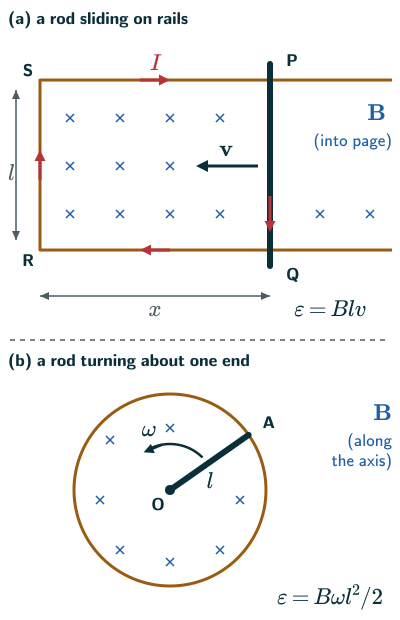
- The set-up (NCERT Figure 6.10, page 162): a rectangular conductor PQRS in which the arm PQ is free to slide. PQ is moved to the left at constant velocity v, with no friction, in a uniform, steady field B perpendicular to the plane of the circuit. With RQ = x and RS = l, the flux through the circuit is ΦB = Blx (page 162).
- As PQ moves, x falls at the rate dx/dt = −v, so (NCERT Eq. (6.5), pages 162–163):
Motional emf (NCERT Eq. 6.5)
- So an emf can be produced by moving a conductor instead of changing the field: what changes is the flux enclosed by the circuit (page 163).
- The emf magnitude is Blv when the rod’s length direction, velocity v and uniform field B are mutually perpendicular (NCERT Summary point 4, page 173). If the rod moves along its own length, or along B, no emf is induced (reasoned: the force qv × B on its charges is then at right angles to the rod, or zero, so it does no work along the rod).
- Direction: the area and the flux into the page fall as PQ moves left, so the induced current flows to keep the flux up: clockwise as seen in NCERT Figure 6.10, from P to Q in the rod (reasoned with Lenz’s law, NCERT page 160, matching the current NCERT draws).
- Current, force and power (beyond NCERT, reasoned): neglecting self-inductance, if the circuit has total resistance R, the current is I = Blv/R. The field then pushes on the current in the rod with a force IlB = B2l2v/R that opposes the motion (force on a current-carrying conductor, NCERT Eq. (4.4)). Keeping v steady needs an equal outside push, whose power Fv = B2l2v2/R equals the Joule heating I2R.
Motional emf from the Lorentz force
- The rod’s bulk velocity v gives a charge q a magnetic force contribution qv × B, of magnitude |q|vB in this perpendicular arrangement and, for a positive q in NCERT Figure 6.10, points towards Q. Equal charges have the same contribution from the rod’s bulk motion throughout the uniform field (NCERT page 163). The free electrons are pushed the other way, towards P, so Q becomes the positive, higher-potential end of the rod (reasoned).
- Integrating the component (v × B)·dl along the moving rod gives its motional emf ε = Blv, as in NCERT Eq. (6.5) (page 163). NCERT’s “work qvBl” argument needs care: the magnetic force is perpendicular to a charge’s total velocity and does no net work on it. The mechanical agent keeping the rod moving supplies the circuit’s energy; the force component along the rod transfers that mechanically supplied energy into electrical motion.
- A stationary conductor in a changing field is different. With v = 0 the force on its charges is F = q(E + v × B) = qE (NCERT Eq. (6.6), page 163), so the emf must come from an electric field: a time-varying magnetic field generates an electric field. Such fields differ in their properties from the fields of static charges (page 163).
- NCERT sums this up: moving charges in a static field and static charges in a changing field both obey Faraday’s law, a hint of the principle of relativity (NCERT Points to Ponder 3, page 174).
- NCERT slip: Points to Ponder 3 (page 174) refers to “the motional emf discussed in Section 6.5”. Motional emf is Section 6.6; Section 6.5 is Lenz’s law.
- A rod turning about one end, about an axis perpendicular to it in a uniform axial field (NCERT Example 6.6, pages 163–164): each short piece dr at distance r from the axis moves at v = ωr, so it contributes dε = Bωr dr. Adding these from 0 to l gives ε = ½Bωl2, where l is the length of the rod. NCERT, which calls this length R, gets the same result from the rate at which the rod sweeps out area, ½l2ω.
Solved examples
Example 1: A rod turning in a ring (NCERT Example 6.6)
A metal rod 1 m long turns at 50 rev/s about one end, at the centre of a metal ring of radius 1 m, its other end sliding on the ring. A uniform field of 1 T is parallel to the axis. Find the emf between the centre and the ring.
Answer: ω = 2π × 50 ≈ 314 rad/s, so ε = ½Bωl2 = ½ × 1 × 314 × 12 ≈ 157 V (NCERT page 164).
Example 2: A wheel with spokes (NCERT Example 6.7)
A wheel with 10 metal spokes, each 0.5 m long, turns at 120 rev/min in a plane normal to the horizontal component of the earth’s field, HE = 0.4 G. Find the emf between the axle and the rim.
Answer: ω = 2π × 2 = 4π rad/s and B = 0.4 × 10⁻⁴ T, so ε = ½ × 4π × 0.4 × 10−4 × 0.52 ≈ 6.28 × 10⁻⁵ V. The number of spokes does not matter: their emfs are in parallel (NCERT page 165).
Example 3: A loop leaving a field (NCERT Exercise 6.4)
A rectangular loop 8 cm × 2 cm, with a small cut, moves out of a uniform field of 0.3 T normal to the loop at 1 cm/s. Find the emf across the cut, and how long it lasts, when the velocity is normal to (a) the longer side, (b) the shorter side.
Answer: only the side still inside the field and moving across it contributes. (a) ε = Blv = 0.3 × 0.08 × 0.01 = 2.4 × 10⁻⁴ V, lasting 2 cm ÷ 1 cm/s = 2 s. (b) ε = 0.3 × 0.02 × 0.01 = 6 × 10⁻⁵ V, lasting 8 s (NCERT Eq. (6.5), page 162; Exercise 6.4, page 176).
Example 4: A falling wire (NCERT Exercise 6.6)
A horizontal wire 10 m long, lying east-west, falls at 5.0 m/s at right angles to the horizontal component of the earth’s field, 0.30 × 10⁻⁴ Wb m−2. Find the emf, its direction and the end at the higher potential.
Answer: ε = Blv = 0.30 × 10−4 × 10 × 5.0 = 1.5 × 10⁻³ V. The field points north and the wire moves down, so v × B points east: the emf drives positive charge from west to east, and the east end is at the higher potential (NCERT page 163; Exercise 6.6, page 176).
Common mistakes to avoid
Common mistake
Using Blv when the motion is not at right angles
ε = Blv holds only when l, v and B are mutually perpendicular (NCERT Summary point 4, page 173). Otherwise use only the perpendicular parts: with the rod normal to both v and B, ε = Blv sin θ, where θ is the angle between v and B. A rod moving along its own length, or along B, has no motional emf, and a bent rod in rigid translation through a uniform field has the same motional emf as the straight line joining its ends (reasoned).
Common mistake
Counting the spokes of a wheel
The spokes of a turning wheel are all connected between the axle and the rim, so their emfs are in parallel: the emf is that of one spoke (NCERT Example 6.7, page 165).
Common mistake
Thinking motional emf needs a closed circuit
The emf Blv appears across the moving rod whether or not the circuit is closed; a current flows only if it is (NCERT pages 160 and 163).
Quick revision summary
- A rod of length l has emf ε = Blv when its length, velocity and uniform field B are mutually perpendicular: motional emf.
- From Faraday’s law: the rod changes the area, and so the flux, of the circuit; from the Lorentz force: the bulk-motion contribution q(v × B) pushes charges along the rod, while an external mechanical agent supplies energy; magnetic force does no net work on each charge.
- With circuit resistance R the current is Blv/R; the opposing magnetic force means work must be done, which appears as Joule heat.
- A rod of length l turning at ω about one end in a field along the axis has an emf Bωl2/2.
- A changing magnetic field acting on charges at rest implies an induced electric field.
Formula sheet
- ε = Blv
- with resistance R: I = Blv/R, F = IlB
- rod of length l turning at ω about one end: ε = Bωl2/2
Questions students ask
What is the vector form of the motional emf formula?
The vector form of the motional emf of a straight rod moving with velocity v through a uniform magnetic field B is ε = (v × B) · l, where l is the rod’s length vector from one end, P, to the other, Q; for a curved wire the parts (v × B) · dl of its short pieces are added (beyond the NCERT text, reasoned from the Lorentz force, NCERT page 163). Its size is Blv when l, v and B are mutually perpendicular, and a positive ε makes Q the positive end. For v = (4.0 î + 2.0 ĵ) m s, B = 0.75 k̂ T and l = 0.32 î m, v × B = (1.5 î − 3.0 ĵ) V m, so ε = 1.5 × 0.32 = 0.48 V: only the velocity across the rod counts.
Is the motional emf across a moving rod the same as the potential difference between its ends?
The potential difference between the ends of a moving rod equals its motional emf Blv when no current flows: the magnetic force drives free electrons to one end until the field of the separated charges, E = vB, balances it, so the ends differ by El = Blv (reasoned from NCERT pages 163–164). Once the rod, of resistance r, carries a current I, it acts like a cell and the potential difference falls to ε − Ir (see terminal potential difference). A rod with ε = 1.82 V and r = 0.45 Ω, on ideal rails joined by 0.85 Ω, carries 1.4 A and has 1.19 V across it.
Is motional emf in the JEE Main and NEET syllabus, and which chapter covers it?
Yes, motional emf is in both syllabuses, though neither uses the name: it is part of “induced emf and current”, listed in Unit 14 of the JEE Main syllabus, and of “Induced emf and current: Lenz’s Law, Eddy currents.” in Unit 14 of the NEET (UG) 2026 syllabus. In NCERT it is Section 6.6, Motional Electromotive Force, of Class 12 Physics Part I, Chapter 6, Electromagnetic Induction (pages 162–165), which also works the rotating rod and the spoked wheel of Examples 6.6 and 6.7.
Can the emf between an aeroplane’s wing tips light a lamp on board?
In the ideal model of rigid translation through a uniform steady field, the wing-tip motional emf cannot drive a current through a lamp on board, because the wires from the tips to the lamp move through the same field with the plane, so an equal emf is induced in them and cancels the wings’ emf round the circuit (beyond the NCERT text, reasoned from NCERT Eq. (6.5), pages 162–163). In Faraday’s terms, the whole circuit moves through a nearly uniform field without any change in the flux through it, so its net emf is zero, and a voltmeter carried on board reads nothing. There is a lab-frame charge-separation potential difference, but the moving measurement leads contribute their own motional emf. In this uniform-field model a usable closed circuit needs a part with different motion; field gradients or changing orientation require a separate calculation.
Practice questions
Try each question first, then open the answer to check your working.
-
Q1. A rod 0.20 m long moves at 5.0 m/s at right angles to a field of 0.50 T, the rod also being at right angles to both its velocity and the field. Find the emf across it.
Show answerHide answer
ε = Blv = 0.50 × 0.20 × 5.0 = 0.50 V (NCERT Eq. (6.5), page 162).
-
Q2. A rod moves parallel to a uniform magnetic field. What emf is induced across it?
Show answerHide answer
None: the velocity is along B, so v × B = 0 and no force pushes charges along the rod (reasoned from NCERT page 163).
-
Q3. A rod 0.50 m long turns at 100 rad/s about one end in a field of 0.20 T along the axis of rotation. Find the emf between its ends.
Show answerHide answer
ε = ½Bωl2 = ½ × 0.20 × 100 × 0.502 = 2.5 V (NCERT Example 6.6, page 164).