The experiments of Faraday and Henry
NCERT Class 12 Physics Chapter 6 Sections 6.1–6.2
Quick answer
Faraday and Henry showed that changing the magnetic flux through a coil induces an emf, whether by moving a magnet or coil or changing a nearby current. In a closed resistive circuit with negligible self-inductance, the current follows the flux change and reverses when that change reverses. Faraday’s law for one turn is ε = −dΦB/dt, and a faster flux change gives a larger emf.
With your textbook
NCERT Physics Part I (Class 12), Chapter 6 “Electromagnetic Induction”, Sections 6.1–6.2 “Introduction” and “The Experiments of Faraday and Henry”, pages 154–156.
Open the official NCERT chapter (PDF, 2.4 MB, ncert.nic.in) (opens in a new tab)
Checked against the 2026-27 reprint on .
What did Faraday and Henry discover?
Electromagnetic induction
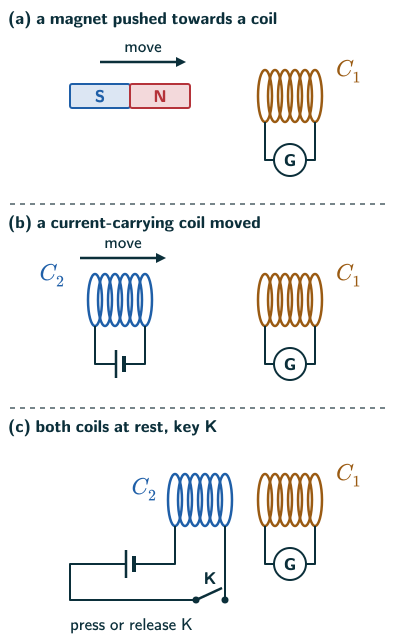
In a long series of experiments (NCERT Section 6.2, page 155), Faraday and Henry showed that a current is induced in a closed coil, with no battery in it, when the magnetic field through it changes (NCERT Section 6.1, page 154). When a magnet is pushed towards a coil joined to a galvanometer, the pointer deflects. NCERT concludes:
It shows that it is the relative motion between the magnet and the coil that is responsible for generation (induction) of electric current in the coil.
NCERT Physics Part I (Class 12), Section 6.2, page 155
A third experiment showed that even motion is not needed: switching on or off the current in a nearby coil also induces a current (NCERT page 156). What the three experiments share is a change in the magnetic flux through the coil (NCERT Section 6.4, page 157).
In plain words: a magnet sitting still next to a coil does nothing, and neither does a steady current in a coil next to it. Move the magnet, move the coil, or switch the current on or off, and a current flows in the coil for as long as the change goes on.
Model used below: the circuit is closed, resistive and initially at rest electrically; self-inductance and the pointer’s mechanical settling time are neglected. Real currents and pointers take a finite time to settle, and motion induces an emf only when it changes the linked flux.
A magnet moved near a coil
Experiment 6.1 (NCERT page 155, Figure 6.1):
- A coil C1 is joined to a galvanometer G. When the north pole of a bar magnet is pushed towards the coil, the pointer deflects, showing a current in the coil.
- The deflection lasts only as long as the magnet moves. With the magnet held still, there is no deflection.
- When the magnet is pulled away, the pointer deflects the opposite way: the current reverses.
- With the south pole, every deflection is opposite to the one the north pole gives for the same movement.
- The deflection, and so the current, is larger when the magnet is moved faster.
- If the magnet is held fixed and the coil is moved towards or away from it, the same effects are seen. So what matters is the relative motion of magnet and coil (page 155).
A changing current in a nearby coil
- Experiment 6.2 (NCERT page 156, Figure 6.2): the magnet is replaced by a second coil C2 joined to a battery. Its steady current makes a steady magnetic field. Moving C2 towards C1 deflects the galvanometer; moving it away deflects it the other way; the deflection lasts only while C2 moves. Moving C1 instead gives the same effects: again, relative motion induces the current.
- Experiment 6.3 (NCERT page 156, Figure 6.3): both coils are held still. C2 is joined to a battery through a tapping key K.
- Pressing K gives a momentary deflection, and the pointer returns to zero after the switching transient.
- While K is held pressed, there is no deflection.
- Releasing K gives a momentary deflection in the opposite direction.
- Putting an iron rod into the coils along their axis makes the deflection much larger.
- So relative motion is not an absolute requirement (page 156).
- NCERT slip: NCERT’s box on Henry (page 155) spells his first name “Josheph”; it is Joseph, as the box’s own side title has it.
What the experiments have in common
- Magnetic flux ΦB measures the field passing through the coil’s area: for a flat area A in a uniform field B, ΦB = BA cos θ, with θ the angle between B and the normal to the area (NCERT Eq. (6.1), page 157).
- NCERT explains all three with one idea: an emf is induced in a coil when the magnetic flux through the coil changes with time (NCERT Section 6.4, page 157).
- In Experiments 6.1 and 6.2, moving the magnet or coil C2 changes the flux through C1. The induced emf drives the current through the galvanometer (page 157).
- In Experiment 6.3, pressing K makes the current in C2, and its field, rise from zero to its full value in a short time, so the flux through C1 rises. While K is held, the current is steady, the flux does not change and the current in C1 drops to zero. Releasing K makes the flux fall, inducing a current again (page 157).
- The iron rod makes the field of C2, and so the change of flux through C1, much larger (reasoned; iron is strongly magnetised in a field, NCERT Chapter 5, page 149).
- The rule for the emf is Faraday’s law, ε = −dΦB/dt: its size is the rate of change of flux, and the minus sign gives its direction (NCERT Eq. (6.3), page 158). For a closely wound coil of N turns, ε = −N dΦB/dt (NCERT Eq. (6.4), page 158).
- A practical warning from NCERT: sensitive instruments near an electromagnet can be damaged by the emfs induced when it is switched on or off (NCERT footnote, page 157).
Solved examples
Example 1: A bigger deflection (NCERT Example 6.1)
In Experiment 6.2, (a) how would you get a large deflection of the galvanometer, and (b) how could you show the induced current without a galvanometer?
Answer: (a) One or more of these: put a soft iron rod inside coil C2, connect C2 to a higher-voltage battery to increase the steady current, or move it quickly towards C1. (b) Replace the galvanometer with a small torch bulb: sufficient induced current from the relative motion makes it glow (NCERT page 158).
Example 2: Which way does the pointer turn?
In Experiment 6.1 the pointer deflects to the right when the N pole is pushed towards the coil. Which way does it deflect when (a) the N pole is pulled away, (b) the S pole is pushed towards the coil, (c) the S pole is pulled away, (d) the magnet rests inside the coil?
Answer: (a) Left: pulling away reverses the current. (b) Left: the S pole gives the opposite deflection to the N pole. (c) Right: both reversals together. (d) No deflection: nothing is changing (NCERT page 155).
Example 3: Key pressed, held, released
In Experiment 6.3 the key is pressed at t = 0, held for 5 s and then released. Describe the galvanometer reading.
Answer: a momentary deflection at t = 0, then zero after the transient while the key remains held, then a momentary deflection the other way at t = 5 s. A current flows in C1 only while the current in C2 is changing (NCERT pages 156–157).
Example 4: How big is the induced emf?
When the key K is pressed, the flux through each turn of a 200-turn coil C1 rises from 0 to 3.0 × 10⁻⁵ Wb in 0.015 s. Find the magnitudes of the average emf and average current if C1 and the galvanometer have a total resistance of 40 Ω.
Answer: ε = NΔΦB/Δt = 200 × 3.0 × 10−5/0.015 = 0.40 V, so I = ε/R = 0.40/40 = 0.010 A, that is 10 mA (NCERT Eq. (6.4), page 158).
Common mistakes to avoid
Common mistake
Thinking a strong magnet at rest induces a current
A magnet held still next to a coil induces nothing, however strong it is; the deflection lasts only while the magnet or the coil moves (NCERT page 155).
Common mistake
Thinking the magnet must be the thing that moves
Moving the coil instead gives the same effects, and in Experiment 6.3 nothing moves at all: a changing current is enough (NCERT pages 155–156).
Common mistake
Expecting the pointer to stay deflected while the key is held
The deflection is momentary. With the key held down the current in C2 is steady, so the flux through C1 does not change (NCERT pages 156–157).
Common mistake
Thinking a faster push sends more charge round the circuit
A faster change gives a larger emf and current, but for a shorter time. The net transferred charge is Q = ∫I dt = −NΔΦB/R, with signs fixed by the chosen loop direction; its magnitude depends on the endpoints, not the speed of the change. Use Q = IΔt only for constant current. If self-inductance matters, integrate over the complete event with the same initial and final current to obtain the same net-charge result (reasoned from NCERT Eq. (6.4) and I = ε/R). In Example 4, |Q| = 200 × 3.0 × 10−5/40 = 1.5 × 10⁻⁴ C.
Quick revision summary
- A magnet moved towards or away from a coil induces a current in it; in the resistive approximation the current lasts while the linked flux changes.
- Reversing the motion, or using the other pole, reverses the current; faster motion gives a larger current.
- Moving the coil instead of the magnet, or moving a current-carrying coil, has the same effect: relative motion counts.
- With both coils at rest, switching the current in one on or off gives a momentary current in the other; an iron rod makes it much larger.
- The common cause is a change of magnetic flux through the coil; the emf is given by Faraday’s law, ε = −dΦB/dt.
Formula sheet
- flux through a plane area: ΦB = BA cos θ
- Faraday’s law: ε = −dΦB/dt
- N-turn coil: ε = −N dΦB/dt
Questions students ask
Who discovered electromagnetic induction first, Faraday or Henry?
Michael Faraday in England and Joseph Henry in the USA discovered electromagnetic induction independently, in experiments around 1830 (NCERT pages 154 and 165). The Smithsonian Institution Archives dates Faraday’s first report to November 1831 and Henry’s publication to July 1832; its account says Henry began related work in August 1831 but delayed the main experiments until June 1832 (Smithsonian, “Electromagnetism” and “Joseph Henry Discovers Electromagnetic Induction”). So Faraday is usually credited, while Henry is remembered in the henry, the SI unit of inductance, and NCERT credits him with discovering self-induction (NCERT pages 155 and 165).
What is the difference between electromagnetism and electromagnetic induction?
Electromagnetism is the broad study of electric and magnetic phenomena; one part, studied by Oersted and Ampere, is the magnetic effect of a current, moving charges producing a magnetic field, while electromagnetic induction, studied by Faraday and Henry, concerns emf produced by changing linked magnetic flux, including changes caused by circuit motion (NCERT page 154 and Points to Ponder 1, page 174). A steady current always has its field, but a field, however strong, induces nothing unless the flux through the circuit changes. The motor effect, the force on a current in a field, belongs to the first, and ‘magnetic induction’ is another name for B (NCERT Chapter 5, page 151).
What is the SI unit of electromagnetic induction?
Electromagnetic induction has no SI unit, because it is a phenomenon, the production of an emf and a current by changing linked magnetic flux, not a physical quantity (NCERT page 154). The quantities it involves do have units: the induced emf is measured in volts, the magnetic flux in webers and inductance in henrys, a unit named after Joseph Henry (NCERT pages 165 and 174). If ‘magnetic induction’ is meant, that is another name for the magnetic field B, whose SI unit is the tesla (NCERT Chapter 5, page 151).
What are the applications of electromagnetic induction in daily life?
Electromagnetic induction is behind the AC generators and transformers that supply mains electricity, which NCERT says grew from the experiments of Faraday and Henry (NCERT page 155). A generator turns mechanical energy into electrical energy; a transformer, using mutual induction, steps the voltage up for transmission and down for homes (NCERT pages 170–171 and 194–196). Beyond the NCERT text, an induction cooktop heats a pan by inducing currents in its metal (US Department of Energy, 2023); see eddy currents.
Is electromagnetic induction in the JEE Main and NEET syllabus, and which chapter covers it?
Yes, electromagnetic induction is in Unit 14, Electromagnetic Induction and Alternating Currents, of both syllabuses: the JEE Main syllabus lists “Electromagnetic induction: Faraday’s law, induced emf and current, Lenz’s law, eddy currents, self and mutual inductance.”, and the NEET (UG) 2026 syllabus lists “Electromagnetic induction: Faraday’s law. Induced emf and current: Lenz’s Law, Eddy currents. Self and mutual inductance.” In NCERT it is Chapter 6 of Class 12 Physics Part I (pages 154–176), and Section 6.2 describes the experiments of Faraday and Henry (pages 155–156). Neither syllabus names these experiments, but they are the evidence for Faraday’s law, which both list first.
Practice questions
Try each question first, then open the answer to check your working.
-
Q1. In Experiment 6.1, what happens to the deflection if the magnet is pushed towards the coil faster?
Show answerHide answer
It is larger: the faster the magnet moves, the larger the induced current (NCERT page 155).
-
Q2. Why does the galvanometer show no deflection while the key K is held pressed in Experiment 6.3?
Show answerHide answer
The current in C2 is then steady, so the flux through C1 does not change and no emf is induced (NCERT page 157).
-
Q3. What did Experiment 6.3 show that Experiments 6.1 and 6.2 did not?
Show answerHide answer
That relative motion is not an absolute requirement: a changing current in a coil at rest induces a current in a nearby coil at rest (NCERT page 156).