Magnetic field on the axis of a circular current loop
NCERT Class 12 Physics Chapter 4 Section 4.5
Quick answer
A circular loop of radius R carrying a current I produces, at a point on its axis a distance x from the centre, a field along the axis of size B = μ0 I R2/[2(x2 + R2)3/2]. At the centre this becomes B0 = μ0 I/(2R), the largest value on the axis, and N tightly wound turns give N times as much. The direction follows the right-hand thumb rule: curl the fingers along the current and the thumb gives the field.
With your textbook
NCERT Physics Part I (Class 12), Chapter 4 “Moving Charges and Magnetism”, Section 4.5 “Magnetic Field on the Axis of a Circular Current Loop”, pages 115–117.
Open the official NCERT chapter (PDF, 3.7 MB, ncert.nic.in) (opens in a new tab)
Checked against the 2026-27 reprint on .
What is the field on the axis of a current loop?
Field on the axis of a circular loop
A circular loop of radius R carries a steady current I. Adding up the fields of all its elements with the Biot–Savart law, NCERT finds the field at a point on the axis a distance x from the centre: it points along the axis, with size B = μ0IR2/[2(x2 + R2)3/2] (NCERT Eq. (4.11), page 116). At the centre this becomes μ0I/(2R). Its direction follows a right-hand thumb rule:
Curl the palm of your right hand around the circular wire with the fingers pointing in the direction of the current. The right-hand thumb gives the direction of the magnetic field.
NCERT Physics Part I (Class 12), Section 4.5, page 116
In plain words: each bit of the ring makes a field at a point on the axis that is tilted away from the axis, more and more so the farther the point is. The sideways tilts from opposite sides of the ring cancel, and the parts along the axis all add up. Along the axis, the field is strongest at the centre and fades away on both sides.
Field on the axis
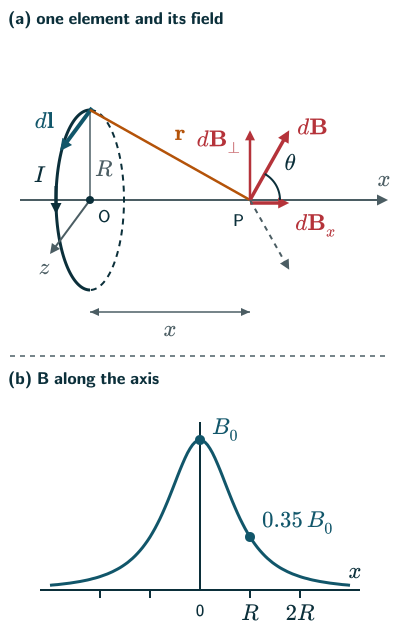
NCERT puts the loop in the y–z plane with its centre at the origin O, and finds the field at a point P on the x-axis, a distance x from O, for a steady current in vacuum (NCERT pages 115–116, Figure 4.9):
- One element: every element dl of the loop is at right angles to the line r from it to P, so |dl × r| = r dl, and r2 = x2 + R2. The Biot–Savart law gives dB = (μ0/4π)I dl/(x2 + R2) (NCERT Eqs. (4.8)–(4.9), page 115).
- Cancelling parts: dB is at right angles to the plane of dl and r. It has a part dBx along the axis and a part dB⊥ across it. The across parts from diametrically opposite elements cancel, so only the x-parts survive (NCERT page 116). The same pairing gives the electric field on the axis of a charged ring.
- Adding parts: let θ be the angle between dB and the axis (NCERT Figure 4.9). dB is at right angles to r, and the axis is at right angles to the radius to the element, so θ is also the angle between r and that radius: cos θ = R/r = R/(x2 + R2)1/2 (NCERT Eq. (4.10), page 116). So dBx = dB cos θ = (μ0/4π)IR dl/r3. The elements dl add up to the circumference 2πR, so (NCERT Eq. (4.11), page 116):
Field on the axis (NCERT Eq. 4.11)
- The field points along the axis (NCERT writes B = Bxî).
- Far from the loop, x ≫ R, the field falls off as 1/x3: B ≈ μ0IR2/(2x3) (reasoned from NCERT Eq. (4.11)). NCERT uses this form when it treats the loop as a magnetic dipole (NCERT Section 4.9.2, page 128).
- A coil of N turns, thin and flat enough that every turn has nearly the same radius and axial position, gives N times the field of one turn (NCERT Example 4.6, page 117).
Field at the centre of the loop
For an arc, this formula gives the arc’s contribution; supply leads must be radial or their fields included separately. In far-axis magnitude formulas, x denotes a positive distance; the axial field points along the loop’s magnetic moment on both sides.
- At the centre, x = 0, and NCERT Eq. (4.11) becomes (NCERT Eq. (4.12), page 116):
Field at the centre (NCERT Eq. 4.12)
- The centre is where the axial field is largest. At x = R it has fallen to 1/(2√2) ≈ 0.35 of B0 (reasoned from NCERT Eqs. (4.11)–(4.12)).
- For N turns, B0 = μ0NI/(2R) (NCERT Example 4.6, page 117).
- Part of a loop: every element of an arc centred on a point contributes a field at that point in the same direction, so an arc of angle φ (in radians) gives the fraction φ/2π of the full-loop field, B = μ0Iφ/(4πR). A semicircle gives half, μ0I/(4R) (reasoned from NCERT Example 4.5, page 117).
- Straight wires pointing at the centre add nothing there: for each of their elements dl and r are parallel, so dl × r = 0 (NCERT Example 4.5, page 117).
Right-hand thumb rule for the field
- Curl the fingers of your right hand round the loop in the direction of the current; the thumb points along the field at the centre and on the axis (NCERT page 116).
- Seen from one side, a current going anticlockwise gives a field pointing towards you; a clockwise current gives a field pointing away from you (reasoned from the rule).
- The field lines of a current loop form closed loops, passing through the loop and returning outside it (NCERT page 116, Figure 4.10). NCERT’s caption calls the upper face, which the lines leave, the north pole and the lower face the south pole. So a face where the current looks anticlockwise acts as a north pole, and one where it looks clockwise as a south pole (reasoned from the rule).
Solved examples
Example 1: A semicircular arc (NCERT Example 4.5)
A wire carrying 12 A runs straight, is bent into a semicircle of radius 2.0 cm and runs straight on, the straight parts lying along the line through the centre. Find the field at the centre.
Answer: the straight parts give nothing, since dl × r = 0 for them. Every element of the arc gives a field in the same direction, so the arc gives half the field of a full loop: B = μ0I/(4R) = 4π × 10−7 × 12/(4 × 0.020) ≈ 1.9 × 10⁻⁴ T. For the arc of NCERT’s Figure 4.11(a), traversed clockwise, it points into the page; bending the arc the other way reverses it (NCERT page 117).
Example 2: A flat coil (NCERT Example 4.6)
A tightly wound coil of 100 turns and radius 10 cm carries 1 A. Find the field at its centre.
Answer: B = μ0NI/(2R) = 4π × 10−7 × 100 × 1/(2 × 0.1) = 2π × 10−4 ≈ 6.28 × 10⁻⁴ T (NCERT page 117).
Example 3: On the axis
For the coil of Example 2, find the field on the axis 10 cm from the centre.
Answer: with x = R, B = B0R3/(x2 + R2)3/2 = B0/(2√2) ≈ 6.28 × 10⁻⁴/2.83 ≈ 2.2 × 10⁻⁴ T (reasoned from NCERT Eqs. (4.11)–(4.12)).
Example 4: A coil from the Exercises (NCERT Exercise 4.1)
A circular coil of 100 turns, each of radius 8.0 cm, carries 0.40 A. Find the field at its centre.
Answer: B = μ0NI/(2R) = 4π × 10−7 × 100 × 0.40/(2 × 0.080) ≈ 3.1 × 10⁻⁴ T (NCERT Eq. (4.12), page 116).
Common mistakes to avoid
Common mistake
Using the centre formula on the axis
μ0I/(2R) holds only at the centre. On the axis the field is smaller, μ0IR2/[2(x2 + R2)3/2] (NCERT Eqs. (4.11)–(4.12)).
Common mistake
Adding the field of a straight lead to the centre of an arc
A straight wire lying along a line through the point gives no field there, since dl × r = 0 (NCERT Example 4.5, page 117).
Common mistake
Rewinding the same wire into more turns
A wire of fixed length L wound into N turns has R = L/(2πN), so B = πμNI/L. At the same current, with negligible lead length and a thin flat winding, doubling the turns makes the field four times as large, not twice (reasoned from NCERT Example 4.6, page 117).
Common mistake
Forgetting the number of turns
A tightly wound coil of N turns gives N times the field of one turn (NCERT Example 4.6, page 117).
Quick revision summary
- On the axis of a loop: B = μ0IR2/[2(x2 + R2)3/2], along the axis; the across parts cancel in pairs.
- At the centre: B = μI/(2R), the largest value on the axis; with N turns, μNI/(2R).
- Far along the axis the field falls as 1/x; at x = R it is about 0.35 B.
- An arc of angle φ gives μIφ/(4πR) at its centre; a semicircle gives μI/(4R); straight leads aimed at the centre give nothing.
- Right-hand thumb rule: fingers along the current, thumb along the field; the face the field leaves acts as a north pole.
Formula sheet
- B = μ0 I R2/[2(x2 + R2)3/2]
- B0 = μ0 I/(2R)
- N turns: B = μNI/(2R)
- arc of angle φ: B = μIφ/(4πR)
- far on the axis: B ≈ μIR/(2x)
Questions students ask
Is the magnetic field strongest at the centre of a circular loop?
The field at the centre of a circular current loop, μ0I/(2R), is the strongest on the axis (NCERT Eqs. (4.11)–(4.12), page 116), but within the disk bounded by an ideal thin loop, the centre has the weakest field in that plane, which grows towards the wire (beyond the NCERT text, reasoned from the Biot–Savart law). Moving off-centre in the plane brings one side of the wire closer, and its stronger field more than makes up for the far side: halfway to the wire the field is about 1.25 times the centre value. Next to the wire the field is like that of a long straight wire, μ0I/(2πd), growing without limit as d shrinks only in the ideal zero-thickness filament model; the model fails inside a real wire (reasoned from NCERT page 119).
What do the magnetic field lines of a circular loop look like near its centre?
Near the centre of a circular current loop the magnetic field lines are almost straight and parallel, running at right angles to the plane of the loop, while close to the wire they are small circles round it, like those of a straight wire (NCERT Class 10 Science, Chapter 12, page 200; NCERT Class 12 Figure 4.10, page 116). Every line is closed: it passes through the loop, spreads out and comes back round the outside (NCERT page 116). The field is nearly uniform near the centre because it changes very slowly there: on the axis, a tenth of a radius from the centre, it is still about 98.5% of its centre value (reasoned from NCERT Eq. (4.11)).
What is the difference between the magnetic field of a circular loop and that of a solenoid?
A single circular loop gives a field that is strongest on its axis at its centre, μ0I/(2R), and fades along the axis, as 1/x far away, while a long solenoid, many loops wound closely along a length, gives an approximately uniform field μ0nI well inside an air-core winding, away from its ends, and almost none outside (NCERT Eqs. (4.12) and (4.16), pages 116 and 122). The solenoid’s field is the sum of the loop fields of its turns, which add up inside and nearly cancel outside (NCERT page 121). So a loop or flat coil gives a strong field at one point, and a solenoid a uniform field over a region (NCERT page 122).
Why is the field at the centre of a loop stronger than at the same distance from a long straight wire?
The field at the centre of a circular loop, μ0I/(2R), is π times the field μ0I/(2πR) at the same distance from a long straight wire with the same current, because every element of the loop is the full distance R from the centre, side-on, with all their fields pointing the same way (reasoned from NCERT Eqs. (4.12) and (4.14), pages 116 and 118). In a straight wire only the nearest part is that close and side-on; elements farther along are farther away and at a slant, so their sin θ shrinks. So even an infinitely long straight wire gives less field than a loop of length 2πR.
Practice questions
Try each question first, then open the answer to check your working.
-
Q1. A single loop of radius 5.0 cm carries 2.0 A. Find the field at its centre.
Show answerHide answer
B = μI/(2R) = 4π × 10−7 × 2.0/(2 × 0.050) ≈ 2.5 × 10⁻⁵ T (NCERT Eq. (4.12), page 116).
-
Q2. Seen from your side, the current in a loop flows clockwise. Which way does the field at its centre point?
Show answerHide answer
Away from you, by the right-hand thumb rule (NCERT page 116).
-
Q3. By what factor does the field at the centre of a loop change if the current is doubled and the radius is halved?
Show answerHide answer
B = μI/(2R), so it becomes 2 × 2 = 4 times as large (NCERT Eq. (4.12), page 116).