Force between two parallel currents and the ampere
NCERT Class 12 Physics Chapter 4 Section 4.8
Quick answer
Two long parallel wires a distance d apart, carrying currents Ia and Ib, each feel a force per unit length f = μ0 Ia Ib/(2πd). Currents in the same direction attract and currents in opposite directions repel, and the two forces are equal and opposite. NCERT uses this force to define the ampere: 1 A in each of two wires 1 m apart gives 2 × 10⁻⁷ N per metre, though under the 2018 SI revision the ampere is defined through the elementary charge.
With your textbook
NCERT Physics Part I (Class 12), Chapter 4 “Moving Charges and Magnetism”, Section 4.8 “Force between Two Parallel Currents, the Ampere”, pages 122–124.
Open the official NCERT chapter (PDF, 3.7 MB, ncert.nic.in) (opens in a new tab)
Checked against the 2026-27 reprint on .
What force do two parallel currents exert on each other?
Force between two parallel currents
Each of two long parallel wires sits in the magnetic field of the other, so each feels a magnetic force. For currents Ia and Ib a distance d apart, the force on a length L of either wire is μ0IaIbL/(2πd) (NCERT Eq. (4.17), page 123). Its direction follows a simple rule:
Parallel currents attract, and antiparallel currents repel.
NCERT Physics Part I (Class 12), Section 4.8, page 123
In plain words: one wire makes circular field lines round itself, and the other wire, carrying its own current, is pushed sideways by them. Currents going the same way pull the wires together; currents going opposite ways push them apart. This is the reverse of charges, where like charges repel.
Parallel currents attract, antiparallel currents repel
The force formulas below use current magnitudes for thin, long, straight wires in vacuum, neglecting end effects; the relative current directions determine attraction or repulsion.
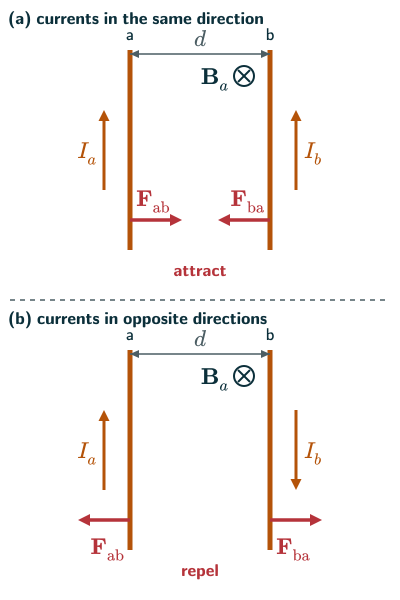
NCERT takes two long parallel conductors a and b, a distance d apart, carrying currents Ia and Ib (NCERT pages 122–123, Figure 4.17):
- Conductor a produces the same field Ba at every point of conductor b. Its size, from Ampere’s circuital law or NCERT Eq. [4.15(a)], is Ba = μ0Ia/(2πd). By the right-hand rule it is at right angles to b (page 123).
- Conductor b feels a sideways force from this field. The force on a current-carrying conductor at right angles to a field is F = IlB (NCERT Eq. (4.4), page 110), so the force on a length L of b is (NCERT Eq. (4.17), page 123):
Force between parallel currents (NCERT Eq. 4.17)
- For parallel currents this force on b points towards a. The force Fab on a length L of a, due to b, has the same size and points towards b, so Fba = −Fab (NCERT Eq. (4.18)). This agrees with Newton’s third law, at least for steady currents in parallel conductors (page 123).
- Same direction: the wires attract. Opposite directions: they repel (page 123). This is the opposite of electrostatics, where like charges repel (page 123).
- The force per unit length is (NCERT Eq. (4.19), page 123):
Force per unit length (NCERT Eq. 4.19)
- For currents that change with time, or charges in motion, Newton’s third law may not hold for the forces between charges and/or conductors. Momentum is still conserved once the momentum carried by the electromagnetic field is counted (NCERT footnote, page 123).
Definition of the ampere
NCERT uses Eq. (4.19) to define the ampere, one of the seven SI base units (page 123). NCERT defines the ampere as the steady current which, in each of two very long, straight, parallel conductors of negligible cross-section placed one metre apart in vacuum, would produce on each a force of 2 × 10⁻⁷ newton per metre of length (NCERT page 124). NCERT adds:
This definition of the ampere was adopted in 1946. It is a theoretical definition.
NCERT Physics Part I (Class 12), Section 4.8, page 124
- Check with NCERT Eq. (4.19): Ia = Ib = 1 A and d = 1 m give f = (4π × 10−7 × 1 × 1)/
(2π × 1) = 2 × 10⁻⁷ N/m (reasoned from NCERT Eq. (4.19)). - In practice the earth’s field must be removed, long wires are replaced by coils, and the force is measured with a current balance (page 124).
- The coulomb then follows: 1 C is the charge that crosses a cross-section in 1 s when a steady current of 1 A flows (page 124).
- NCERT slip, now out of date: the SI was revised in November 2018 (NCERT Physics Part I (Class 11), page 1). The ampere is now defined by fixing the value of the elementary charge e (Class 11 Table 1.1, page 2), not by the force between wires. The force of 2 × 10⁻⁷ N per metre is now a measured result that agrees with the old definition to about 1 part in 1010, the precision to which μ0 equals 4π × 10−7 T m/A (CODATA 2022, NIST); see how the ampere is defined.
Solved examples
Example 1: Two wires (NCERT Exercise 4.7)
Two long parallel wires A and B carry 8.0 A and 5.0 A in the same direction, 4.0 cm apart. Estimate the force on a 10 cm section of A.
Answer: F = μ0IaIbL/(2πd) = 2 × 10−7 × 8.0 × 5.0 × 0.10/0.040 = 2.0 × 10⁻⁵ N, attractive, towards B (NCERT Eq. (4.17), page 123).
Example 2: The earth’s field and the ampere (NCERT Example 4.9)
Considering only the horizontal component of the earth’s field at a place, it is 3.0 × 10⁻⁵ T, pointing from geographic south to north. A long wire on a horizontal table carries 1 A. Find the force per unit length when the current flows (a) east to west, (b) south to north.
Answer: f = IB sin θ. (a) θ = 90°, so f = 1 × 3 × 10−5 = 3 × 10⁻⁵ N m−1, downwards. This is far more than the 2 × 10⁻⁷ N m−1 in the definition, which is why stray fields must be removed when standardising the ampere. (b) θ = 0, so no force (NCERT page 124).
Example 3: Opposite currents
Two long wires 5.0 cm apart carry 10 A and 20 A in opposite directions. Find the force per metre on each.
Answer: f = 2 × 10−7 × 10 × 20/0.050 = 8.0 × 10⁻⁴ N m−1, the same on each wire, pushing them apart (NCERT Eq. (4.19), page 123).
Example 4: Holding a wire up
A long horizontal wire carries 50 A. A second wire, parallel to it and 1.0 cm below it, has a mass of 5.0 g per metre. What current in the lower wire, and in which direction, lets it hang without support?
Answer: the upper wire must pull it up, so the currents must be parallel (attraction). Then μ0IaIb/(2πd) = mg per metre: Ib = 0.0050 × 9.8 × 0.010/(2 × 10−7 × 50) ≈ 49 A (reasoned from NCERT Eq. (4.19)). This balance is unstable: if the lower wire dips a little, the pull weakens and it falls. A wire held up by repulsion above a fixed wire (opposite currents) is stable only for constrained vertical displacements, with the currents held fixed. It is unstable to sideways displacement, so this is not unrestricted levitation. For small vertical displacements it oscillates with period 2π√(d/g) (reasoned from NCERT Eq. (4.19)).
Common mistakes to avoid
Common mistake
Carrying over “like repels like” from charges
For currents it is the other way round: parallel currents attract and antiparallel currents repel (NCERT page 123).
Common mistake
Thinking the larger current feels the larger force
Each wire feels a force of the same size, μIaIbL/(2πd), in opposite directions, Fba = −Fab (NCERT Eq. (4.18)).
Common mistake
Quoting the 1946 ampere as the current definition
Under the SI revised in November 2018 (in force since 20 May 2019, BIPM) the ampere is defined through the fixed value of e; the force between wires is now a measured consequence (NCERT Class 11 Table 1.1, page 2).
Quick revision summary
- Wire a makes Ba = μIa/(2πd) at wire b, perpendicular to it, which then feels F = IbLBa = μIaIbL/(2πd).
- Parallel currents attract, antiparallel currents repel; Fba = −Fab, as Newton’s third law requires for steady currents.
- Force per unit length f = μIaIb/(2πd); for 1 A, 1 m apart, 2 × 10 N/m.
- NCERT gives the 1946 definition of the ampere from this force; under the 2018 SI revision the ampere is fixed through e and the force is a measured result.
- Stray fields such as the earth’s give forces far larger than 2 × 10 N/m and must be removed (current balance).
Formula sheet
- F = μ0 Ia Ib L/(2πd)
- f = μ0 Ia Ib/(2πd)
- Fba = −Fab
- 1 A, 1 m apart: f = 2 × 10 N/m
- same direction attract, opposite repel
Questions students ask
Why do two wires carrying currents in the same direction attract each other?
Two wires carrying currents in the same direction attract because the magnetic field of either wire, crossed with the other wire’s current direction in F = Il × B, points towards the source wire (NCERT page 123). The fields partly cancel between the wires and add outside, but “move towards weaker total field” is not a general force rule for a current. For equal currents the fields cancel at the midpoint; the force on either wire uses the other wire’s external field at that wire.
Is there a force between two long current-carrying wires that cross at right angles?
For perpendicular long wire segments centred symmetrically about their closest approach, without touching, the forces on opposite halves cancel in the long-source approximation, but their moments tend to rotate the segments towards parallel currents (reasoned from F = Il × B, NCERT page 110). This is a statement about a symmetric finite setup with negligible return-lead contributions. An ideal infinite wire has no finite total torque, so it cannot be treated as a freely rotating finite body. End geometry and the complete circuits matter in a real arrangement.
Which definition of the ampere do NCERT and the JEE Main and NEET syllabuses use?
NCERT Class 12 uses the force definition of the ampere: 1 A is the steady current that, in each of two very long, thin, parallel wires 1 m apart in vacuum, produces on each a force of 2 × 10 N per metre of length (NCERT page 124). Unit 13 of JEE Main lists “the force between two parallel currents carrying conductors-definition of ampere”, and NEET (UG) 2026 has the same words, so this is the definition to learn for both exams. The SI revised in November 2018 now defines the ampere through the fixed value of the elementary charge instead (NCERT Class 11 Physics, Chapter 1, page 1 and Table 1.1; see how the ampere is defined).
Do the two wires of an electric cable attract or repel each other?
The two wires of an electric cable carry the current to an appliance and back, in opposite directions, so they repel each other, but only weakly: for 6.0 A in wires 3.0 mm apart the force is 2 × 10 × 6.0 × 6.0/0.0030 ≈ 2.4 × 10 N per metre (reasoned from NCERT Eq. (4.19), page 123). For DC or instantaneous current these are instantaneous forces; with sinusoidal AC, using rms current gives the cycle-average force. With alternating current both currents reverse together, so they stay opposite and the force stays repulsive, rising and falling twice in each cycle. The force grows as the square of the current, so a fault current a hundred times larger, 600 A, would push the wires apart ten thousand times harder, with about 24 N per metre.
Practice questions
Try each question first, then open the answer to check your working.
-
Q1. Two long parallel wires 2.0 m apart each carry 1.0 A in the same direction. Find the force per metre between them.
Show answerHide answer
f = μIaIb/(2πd) = 2 × 10−7 × 1.0 × 1.0/2.0 = 1.0 × 10⁻⁷ N/m, attractive (NCERT Eq. (4.19), page 123).
-
Q2. If the distance between two parallel current-carrying wires is halved and both currents are doubled, by what factor does the force per unit length change?
Show answerHide answer
f ∝ IaIb/d, so it becomes 2 × 2 × 2 = 8 times as large (NCERT Eq. (4.19), page 123).
-
Q3. Do two parallel beams of electrons moving the same way behave like two parallel currents?
Show answerHide answer
Their currents are parallel, so the magnetic forces attract; but the electric repulsion between the like charges is larger by about c2/v2, so at ordinary speeds the beams spread apart (reasoned from NCERT page 123 and Coulomb’s law).