Displacement current
NCERT Class 12 Physics Chapter 8 Sections 8.1–8.2
Quick answer
In vacuum, displacement current is id = ε0 dΦE/dt, the changing-electric-flux term Maxwell added to Ampere’s law. In an ideal charging capacitor it equals the wire current when integrated across the full plate area, although no free charge crosses the gap. The Ampere–Maxwell law is ∮ B · dl = μ0 ic + μ0 ε0 dΦE/dt, with total current i = ic + id through a surface bounded by the loop.
With your textbook
NCERT Physics Part I (Class 12), Chapter 8 “Electromagnetic Waves”, Sections 8.1–8.2 “Introduction” and “Displacement Current”, pages 201–205.
Open the official NCERT chapter (PDF, 1.4 MB, ncert.nic.in) (opens in a new tab)
Checked against the 2026-27 reprint on .
What is displacement current?
Displacement current
Maxwell showed that a changing electric field produces a magnetic field, just as a current does. Applying Ampere’s circuital law to a capacitor being charged, he found an inconsistency, and removed it by adding a new term, ε0 dΦE/dt, to the current (NCERT Sections 8.1–8.2, pages 201–203). NCERT notes that this new term is due to a changing electric field, once called the electric displacement (NCERT page 203):
It is, therefore, called displacement current or Maxwell’s displacement current.
NCERT Physics Part I (Class 12), Section 8.2, page 203
With it, Ampere’s law becomes the Ampere–Maxwell law: the line integral of B round a closed loop equals μ0 times the conduction current plus the displacement current through any surface bounded by the loop (NCERT Eq. (8.6), page 204).
In plain words: no charge flows between the plates of a charging capacitor, yet there is a magnetic field there, and just inside the edge of the plates it matches the field just outside. Something must play the part of the current in the gap: the changing electric field. Maxwell called this the displacement current.
Model and scope: the capacitor has a vacuum (or approximately air) gap, negligible leakage and fringing, uniform plate field and slow enough changes for the quasistatic approximation. The enclosed displacement current equals the full wire current only when the surface captures the full changing plate flux. For a smaller concentric loop it is a fraction. The circular-field formulas also assume axial symmetry; real lead geometry can break it. With a dielectric, distinguish the macroscopic displacement field D from εE: the D-based displacement current includes polarisation, whereas the microscopic ε∂E/∂t law includes bound-charge motion in the material current.
Ampere’s law for a charging capacitor
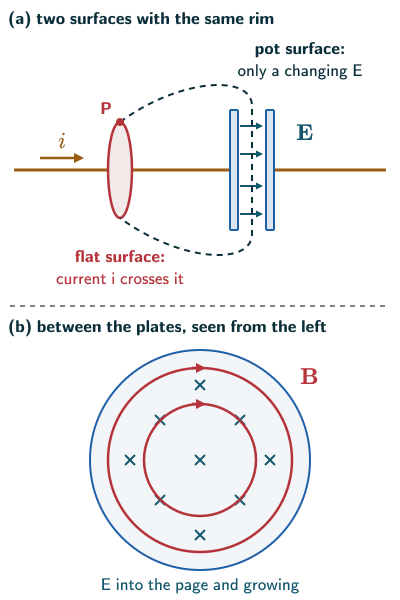
- A parallel plate capacitor is part of a circuit carrying a time-dependent current i(t). Take a circular loop of radius r round the wire, outside the capacitor. By symmetry B is the same all round it, so Ampere’s circuital law gives B(2πr) = μ0i(t) (NCERT Eqs. (8.1)–(8.2), page 202).
- The law allows any surface with the loop as its rim. A flat disc is crossed by the wire. But a pot-shaped surface whose bottom lies between the plates is crossed by no current, so the same law would give B = 0 at the same point. Calculated two ways, the field is both non-zero and zero: a contradiction (NCERT page 203, Figure 8.1).
- What does pass between the plates is the electric field. With plate area A and charge Q, the field in the gap is E = (Q/A)/ε0 (NCERT page 203, citing Eq. (2.41); see the parallel plate capacitor), and the electric flux through the flat bottom S of a tiffin-box-shaped surface (NCERT Figure 8.1(c)) is ΦE = Q/ε0 (NCERT Eq. (8.3), page 203).
- As the charge changes, i = dQ/dt, so (NCERT Eq. (8.4), page 203):
Displacement current (NCERT Eqs. 8.4–8.5)
- Between the plates this equals the current i in the wire. Adding it to the conduction current makes the total the same for every surface, and the contradiction disappears (NCERT page 203).
Ampere–Maxwell law
- The total current is the conduction current ic, from flowing charges, plus the displacement current id = ε0 dΦE/dt: i = ic + id (NCERT Eq. (8.5), page 204). In the ideal good-conductor approximation, displacement current in the wires is negligible, so ic = i; in the gap only displacement current, id = i (NCERT page 204).
- The generalised law uses the total current through any surface bounded by the loop (NCERT Eqs. (8.5)–(8.6), page 204):
Ampere–Maxwell law (NCERT Eqs. 8.5–8.6)
-
Written out with id = ε0 dΦE/dt, this is NCERT’s Eq. (8.6): ∮B·dl = μ0ic + μ0ε0 dΦE/dt.
-
Displacement current contributes to the same magnetic-field law as conduction current. This does not mean it transports free charge or produces the same Joule heating. The field measured just inside the edge of the plates (at M) is the same as just outside (at P), which confirms it (NCERT page 204).
-
For fixed linear capacitance C, since Q = CV, id = C dV/dt. Between circular plates of radius R, a loop of radius r < R encloses the fraction r2/R2 of id, so B = μ0idr/(2πR2); for r ≥ R, B = μ0id/(2πr) (reasoned from NCERT Eq. (8.6); see Example 2).
-
With steady electric fields, as in a wire carrying a steady current, the displacement current is zero. In a charging capacitor the two currents are in different places. In most materials both are present together. In large regions of space there can be displacement current alone, with a magnetic field but no conduction current nearby (NCERT page 204).
-
Symmetry: Faraday’s law says a changing magnetic field gives an electric field; the Ampere–Maxwell law says a changing electric field gives a magnetic field. So time-dependent electric and magnetic fields give rise to each other, and this leads to electromagnetic waves (NCERT pages 204–205). The symmetry is not perfect: no magnetic monopoles, sources of magnetic field like electric charges, are known (NCERT footnote, page 204).
-
NCERT lists Maxwell’s equations in vacuum (page 205): ∮E·dA = Q/ε0 (Gauss’s law); ∮B·dA = 0 (Gauss’s law for magnetism); ∮E·dl = −dΦB/dt (Faraday’s law); ∮B·dl = μ0ic + μ0ε0 dΦE/dt (Ampere–Maxwell law).
Solved examples
Example 1: A charging capacitor (NCERT Exercise 8.1)
A capacitor has circular plates of radius 12 cm, 5.0 cm apart, and is charged by a constant current of 0.15 A. Find (a) its capacitance and the rate of change of the potential difference, (b) the displacement current between the plates. (c) Does Kirchhoff’s junction rule hold at each plate?
Answer: (a) C = ε0A/d = 8.85 × 10⁻¹² × π(0.12)2/0.050 ≈ 8.0 × 10⁻¹² F, and dV/dt = i/C ≈ 0.15/(8.0 × 10−12) ≈ 1.9 × 10¹⁰ V/s. (b) The displacement current equals the conduction current, 0.15 A. (c) Yes, if the current is taken as the sum of conduction and displacement currents: the current into each plate continues across the gap as displacement current (NCERT Eqs. (8.4)–(8.5), pages 203–204; Exercise 8.1, page 213).
Example 2: The field inside, with ac (NCERT Exercise 8.2)
A capacitor of 100 pF has circular plates of radius 6.0 cm and is joined to a 230 V supply of angular frequency 300 rad/s. Find the rms conduction current, say whether it equals the displacement current, and find the amplitude of B 3.0 cm from the axis between the plates.
Answer: I = V/XC = VωC = 230 × 300 × 100 × 10−12 ≈ 6.9 µA. Yes, the displacement current between the plates equals it. The peak current is √2 × 6.9 ≈ 9.8 µA. A loop of radius r = 3.0 cm encloses the fraction r2/R2 of it, so B(2πr) = μ0i0r2/R2, giving B0 = μ0i0r/(2πR2) ≈ 1.6 × 10⁻¹¹ T (reasoned from NCERT Eq. (8.6); Exercise 8.2, pages 213–214).
Example 3: Rate of change of flux
A displacement current of 2.0 A flows between the plates of a capacitor. At what rate is the electric flux through the gap changing?
Answer: dΦE/dt = id/ε0 = 2.0/(8.85 × 10−12) ≈ 2.3 × 10¹¹ V m/s (NCERT Eq. (8.4), page 203).
Example 4: Steady currents
A long straight wire carries steady current in an otherwise time-independent electromagnetic environment. Is there displacement current around it?
Answer: No. With a steady current the electric field does not change with time, so ε0 dΦE/dt is zero everywhere, and Ampere’s original law is enough (NCERT page 204).
Common mistakes to avoid
Common mistake
Thinking charge crosses the gap of a capacitor
No charge flows between the plates. The current there is the displacement current, ε0 times the rate of change of electric flux (NCERT page 203).
Common mistake
Thinking the displacement current is weaker than a conduction current
It has the same magnetic effect as a conduction current: the field just inside the edge of the plates (at M) equals the field just outside (at P) (NCERT page 204).
Common mistake
Using Ampere’s original law with changing fields
Where electric fields change, the displacement current term must be included, or different surfaces give different answers (NCERT page 203).
Quick revision summary
- Ampere’s law applied to a charging capacitor gives a contradiction: a surface between the plates has no current through it.
- The fix is the displacement current, id = ε0 dΦE/dt, which equals the conduction current in the wire.
- Total current i = ic + id; the Ampere–Maxwell law is ∮B·dl = μ0ic + μ0ε0 dΦE/dt.
- A changing electric field makes a magnetic field, as a changing magnetic field makes an electric field: together they give electromagnetic waves.
Formula sheet
- id = ε0 dΦE/dt
- id = C dV/dt
- i = ic + id
- ∮ B · dl = μ0 ic + μ0 ε0 dΦE/dt
Questions students ask
What is the difference between displacement current and conduction current?
Conduction current is a flow of charge, such as electrons drifting in a wire, while displacement current, id = ε0 dΦE/dt, is not a flow of charge but comes from an electric field changing with time (NCERT pages 203–204). Both are in amperes and produce magnetic fields, and the Ampere–Maxwell law adds them (NCERT Eq. (8.5), page 204). Displacement current exists wherever E changes, even in vacuum, but is tiny in a metal carrying ac: from j = σE, the ratio of displacement to conduction current is about ωε0ρ (beyond the NCERT text), some 3 × 10 at 50 Hz for ρ = 10 Ω m, the low end of NCERT’s metals range (Chapter 3, page 90).
Is displacement current a real current, and can it be measured?
Displacement current in vacuum is not transported charge. A normal ammeter placed in a lead measures the conduction current, from which the gap displacement current can be inferred for an ideal capacitor; the gap current can also be measured through its magnetic effect: it produces a magnetic field just as a conduction current does, and NCERT notes that the field just inside the edge of the plates of a charging capacitor can be measured and matches the field just outside (NCERT page 204). Beyond the NCERT text, Bartlett and Corle reported such a measurement in 1985 (Physical Review Letters, vol. 55, page 59): the field between the plates rose in step with r, the distance from the axis, as B = μ0idr/(2πR2) requires for a displacement current spread evenly over them, and matched the predicted size to within 5%.
Why is it called displacement current?
Displacement current is so named because Maxwell tied it to electrical displacement: he pictured an electric field in a body as a slight separation of opposite charges to the two sides of each particle, and added the rate of change of that displacement to the ordinary current (beyond the NCERT text: James Clerk Maxwell, A Dynamical Theory of the Electromagnetic Field, 1865, paragraph 55). NCERT keeps the name, noting that electric displacement is an old term for the electric field (page 203). In a dielectric bound charges do shift a little as the field changes, but in vacuum nothing is displaced.
What are the SI unit and dimensional formula of displacement current and its density?
The SI unit of displacement current is the ampere, as for any current, and its dimensional formula is [A]: ε0, in C N m, times dΦE/dt, in N m C s, gives C s, which is A (reasoned from NCERT Eq. (8.4), page 203; see electric flux). The displacement current per unit area, the displacement current density Jd = ε0 dE/dt, is in A m, with dimensional formula [L A] (beyond the NCERT text, which works only with the whole current). So where the field grows at 6.0 × 10 V m s, Jd ≈ 5.3 A m.
How is displacement current related to electromagnetic waves?
Displacement current makes electromagnetic waves possible: it lets a changing electric field produce a magnetic field even in empty space, and with Faraday’s law, by which a changing magnetic field produces an electric field, the two keep regenerating each other and travel outward as a wave (NCERT pages 204–205). Without the displacement term, the vacuum field equations would not support these freely propagating waves. A static magnetic field can still exist in a vacuum without a local conduction current. Maxwell’s equations give the waves a speed of 1/√(μ0ε0) ≈ 3 × 10 m s, the measured speed of light, which showed that light is an electromagnetic wave (NCERT pages 201–202).
Which chapter covers displacement current, and is it in the JEE Main and NEET syllabus?
Displacement current is NCERT Sections 8.1–8.2 of Chapter 8, Electromagnetic Waves, in Class 12 Physics Part I (2026–27, pages 201–205), where Section 8.2 gives Ampere’s law for a charging capacitor, the Ampere–Maxwell law and, on page 205, Maxwell’s equations in vacuum, with Exercises 8.1–8.2 (pages 213–214). It is in both syllabuses as the first topic of Unit 15, Electromagnetic Waves: the JEE Main syllabus begins “Displacement current, electromagnetic waves and their characteristics” and the NEET (UG) 2026 syllabus “Displacement current.” Neither syllabus names Maxwell’s equations, and the displacement current density is beyond the NCERT text.
Practice questions
Try each question first, then open the answer to check your working.
-
Q1. Write the expression for displacement current.
Show answerHide answer
id = ε0 dΦE/dt (NCERT Eq. (8.4), page 203).
-
Q2. In a charging capacitor, where is the current only a displacement current?
Show answerHide answer
In the gap between the plates, where no charge flows (NCERT page 204).
-
Q3. Who introduced the displacement current, and why?
Show answerHide answer
Maxwell, to remove the inconsistency in Ampere’s circuital law for a charging capacitor (NCERT pages 201 and 203).