Limitations of Ohm’s law
NCERT Class 12 Physics Chapter 3 Section 3.6
Quick answer
Ohm’s law holds for a large class of materials, but some materials and devices do not obey it. NCERT lists three departures: V stops being proportional to I; the current depends on the sign of V, as in a diode; or one current occurs at more than one voltage, as in GaAs over an appropriate range. For such non-ohmic devices the V–I graph is not a straight line through the origin, and V/I changes from point to point.
With your textbook
NCERT Physics Part I (Class 12), Chapter 3 “Current Electricity”, Section 3.6 “Limitations of Ohm’s Law”, page 89.
Open the official NCERT chapter (PDF, 2.2 MB, ncert.nic.in) (opens in a new tab)
Checked against the 2026-27 reprint on .
When does Ohm’s law fail?
Limitations of Ohm’s law
Ohm’s law, V = RI with R constant, is not a universal law of nature. NCERT puts it carefully:
Although Ohm’s law has been found valid over a large class of materials, there do exist materials and devices used in electric circuits where the proportionality of V and I does not hold.
NCERT Physics Part I (Class 12), Section 3.6, page 89
Materials and devices that do not obey it are called non-ohmic. They are widely used in electronic circuits (page 89).
In plain words: Ohm’s law is a property of some materials, not a rule every circuit element must follow. For a metal wire at steady temperature the V–I graph is a straight line through the origin. For many useful devices it is curved, lopsided, or even folds back on itself.
Non-ohmic conductors and devices
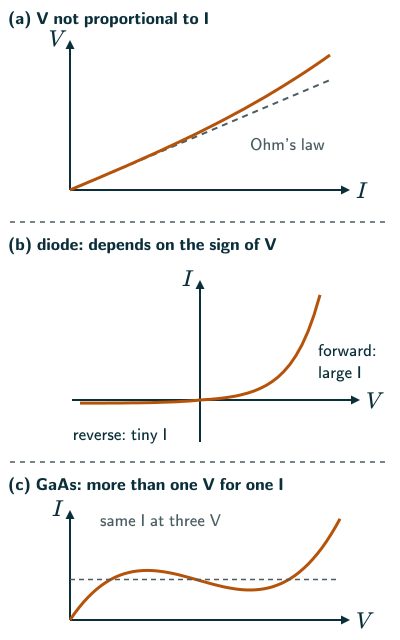
NCERT lists three broad kinds of departure (NCERT Section 3.6, page 89):
- (a) V stops being proportional to I. The V–I graph is not a straight line (NCERT Figure 3.5, which shows a good conductor).
- (b) The relation depends on the sign of V. If a potential difference V gives a current I, reversing V while keeping its size does not give a current of the same size the other way. A diode behaves like this (NCERT Figure 3.6); NCERT studies it in Chapter 14.
- (c) The relation is not unique. There is more than one value of V for the same current I. GaAs (gallium arsenide) behaves like this (NCERT Figure 3.7).
- In this chapter and a few after it, NCERT studies only materials that obey Ohm’s law (page 89).
V–I graphs that are not straight lines
- For an ohmic conductor the V–I graph is a straight line through the origin, and its slope is the constant R (from NCERT Eq. (3.3), page 83).
- In NCERT Figure 3.5 the curve for the good conductor rises above the dashed straight line of Ohm’s law at larger currents: V/I grows as the current grows (page 89).
- In NCERT Figure 3.6 both axes change scale at the origin: the current is in milliamperes for positive V but microamperes for negative V, and the voltage marks are 0.2 V on the positive side but −2 V on the negative side (page 89).
- In NCERT Figure 3.7 the current of GaAs rises, falls and rises again as V increases, so a horizontal line can cut the curve at more than one V (page 89). NCERT labels the falling part the negative resistance region: there the current falls as V rises.
- V = RI can be used for any conducting device: it defines R = V/I. Ohm’s law is the further statement that this R does not depend on V (NCERT Points to Ponder 2, page 105). For a non-ohmic device V/I changes from point to point.
- Even silver or germanium obeys Ohm’s law only within some range of field; if the field becomes too strong, every material departs from it (NCERT Points to Ponder 3, page 105).
Solved examples
Example 1: Which kind of departure?
Match each with NCERT’s types (a), (b) or (c): a diode; a sample of GaAs; a conductor whose V–I graph curves away from a straight line.
Answer: GaAs is type (c), with more than one V for one I; the curving conductor is type (a); the diode is type (b), since its current depends on the sign of V (NCERT page 89). Its curve is not straight either, so NCERT’s summary says a rectifier such as a diode combines (a) and (b) (NCERT Summary point 10, page 103).
Example 2: Is it ohmic?
A component gives these readings: 1.0 V, 0.10 A; 2.0 V, 0.16 A; 3.0 V, 0.20 A. Does it obey Ohm’s law?
Answer: V/I is 10 Ω, 12.5 Ω and 15 Ω: it grows with the current, so V is not proportional to I and the component is non-ohmic, type (a) (NCERT Eq. (3.3), page 83, and page 89).
Example 3: Reversing the voltage
A device carries 20 mA when 0.7 V is applied one way, and about 1 µA when 0.7 V is applied the other way. What kind of device could it be, and is it ohmic?
Answer: reversing V without changing its size changes the size of the current enormously, so the relation depends on the sign of V. This is type (b), like a diode, and it is not ohmic (NCERT page 89). For an ohmic conductor the two currents would be equal in size.
Example 4: Why one I can mean several V
Why can’t you find the voltage across a GaAs sample from the current alone?
Answer: its current first rises, then falls, then rises again as V increases (NCERT Figure 3.7, page 89). So the same current occurs at more than one voltage, and the current does not fix the voltage.
Common mistakes to avoid
Common mistake
Treating Ohm’s law as a law that holds for everything
It holds for a large class of materials, but many materials and devices used in circuits do not obey it (NCERT page 89).
Common mistake
Reading a diode’s graph as if both halves had the same scale
NCERT’s diode graph uses mA for one direction and µA for the other; each voltage mark on the negative side stands for ten times as many volts (−2 V against 0.2 V); the reverse current is far smaller than it looks (NCERT Figure 3.6, page 89).
Common mistake
Reading the slope of an I–V graph as the resistance
On a V–I graph the slope of a straight line is R; on an I–V graph it is 1/R, so there the steeper line has the smaller resistance. For one metal wire at two temperatures, the steeper V–I line is the hotter one (reasoned from NCERT Eq. (3.3) and Section 3.8).
Common mistake
Calling a device ohmic because its graph passes through the origin
The graph must also be a straight line, with the same slope for positive and negative V (NCERT page 89).
Quick revision summary
A falling part of a V–I curve has negative differential resistance dV/dI; this does not require the static ratio V/I to be negative. The ratio V/I is defined only for nonzero current. The gallium-arsenide example concerns the appropriate high-field operating range, not every current or every sample.
- Ohm’s law holds for a large class of materials but not for all; materials and devices that do not obey it are non-ohmic.
- Type (a): V ceases to be proportional to I (NCERT Figure 3.5).
- Type (b): the relation depends on the sign of V, as in a diode (NCERT Figure 3.6).
- Type (c): more than one V for the same I, as in GaAs (NCERT Figure 3.7).
- For a non-ohmic device V/I changes from point to point; such devices are widely used in electronics.
Formula sheet
- ohmic: V–I graph a straight line through the origin
- (a) V not proportional to I
- (b) I depends on the sign of V (diode)
- (c) more than one V for one I (GaAs)
- non-ohmic: V/I changes from point to point
Questions students ask
What are everyday examples of non-ohmic conductors?
Everyday non-ohmic devices include semiconductor diodes, light-emitting diodes among them, whose current depends on the sign of V, NCERT’s type (b) (NCERT page 89). A filament lamp is non-ohmic too: its V/I rises as the current heats the filament (beyond the NCERT text, reasoned from the rise of a metal’s resistivity with temperature, NCERT page 90). The lamp departs from Ohm’s law only because it heats up: its tungsten would give a straight V–I line if held at one temperature, whereas NCERT’s example of type (a) is a material whose ρ grows with I even at a fixed temperature (NCERT Summary point 10, page 103).
If Ohm’s law is not universal, why is it called a law?
Ohm’s law is called a law because it describes accurately how a large class of materials behaves, metals above all, though NCERT stresses that it is not a fundamental law of nature (NCERT Summary point 10, page 103): for such a material at a steady temperature one number, the resistance, gives the current throughout the material’s ohmic operating range. In this it is like Hooke’s law, an empirical law that holds for most materials only up to a limit (see where Hooke’s law fails). Even silver and germanium obey Ohm’s law only within some range of field (NCERT Points to Ponder 3, page 105), and the resistor calculations of this chapter assume that it holds.
How is the resistance of a non-ohmic device such as a diode defined?
For a non-ohmic device two kinds of resistance are used, because V/I changes from point to point: the ratio V/I at a given point, which NCERT says may be applied to any conducting device (NCERT Points to Ponder 2, page 105), and the dynamic resistance ΔV/ΔI for a small change along the curve, which NCERT defines for a diode (NCERT Class 12 Physics Part II, Chapter 14, Eq. (14.6)). If a diode passes 8.0 mA at 0.63 V and 32 mA at 0.69 V, its average dynamic resistance over that range is 0.06 V/24 mA = 2.5 Ω, while V/I at 32 mA is about 22 Ω. For an ohmic conductor the two are equal at every point.
Are the I–V characteristics of ohmic and non-ohmic conductors in the JEE Main and NEET syllabus?
Yes, the I–V characteristics of ohmic and non-ohmic conductors are in both syllabuses, in Unit 12, Current Electricity: the JEE Main syllabus lists “I-V characteristics of Ohmic and non-ohmic conductors” after Ohm’s law and electrical resistance, and the NEET (UG) 2026 syllabus lists the same characteristics at the same point. In NCERT Class 12 Physics Part I they are Section 3.6, Limitations of Ohm’s Law (page 89). The diode’s characteristic returns in Unit 19, Electronic Devices, of both syllabuses and as an experiment in Unit 20: “Characteristic curves of a p-n junction diode in forward and reverse bias.”
Practice questions
Try each question first, then open the answer to check your working.
-
Q1. Name the material NCERT gives as an example of more than one V for the same current.
Show answerHide answer
GaAs (NCERT page 89).
-
Q2. What is special about the V–I graph of an ohmic conductor?
Show answerHide answer
It is a straight line through the origin; its slope is the constant resistance (from NCERT Eq. (3.3), page 83).
-
Q3. In which chapter does NCERT study the diode?
Show answerHide answer
Chapter 14 (NCERT page 89).