Slope of a line
NCERT Class 11 Mathematics Chapter 9 Section 9.2
Quick answer
The slope of a non-vertical line is m = tan θ, where θ is its inclination, the angle from the positive x-axis measured anticlockwise; through (x, y) and (x, y) it is m = (y − y)/(x − x). Two distinct non-vertical lines are parallel exactly when their slopes are equal and perpendicular exactly when mm = −1. The acute angle θ between lines with slopes m and m (when 1 + mm ≠ 0) satisfies tan θ = |(m − m)/(1 + mm)|.
With your textbook
NCERT Mathematics (Class 11), Chapter 9 “Straight Lines”, Section 9.2 “Slope of a Line”, pages 152–159.
Open the official NCERT chapter (PDF, 2.5 MB, ncert.nic.in) (opens in a new tab)
Checked against the 2026-27 reprint on .
What is the slope of a line?
A line in a coordinate plane forms two angles with the x-axis, which are supplementary.
NCERT Mathematics (Class 11), Section 9.2, page 152
Inclination and slope
The angle (say) θ made by the line l with positive direction of x-axis and measured anti clockwise is called the inclination of the line.
NCERT Mathematics (Class 11), Section 9.2, page 153
If θ is the inclination of a line l, then tan θ is called the slope or gradient of the line l.
NCERT Mathematics (Class 11), Section 9.2, page 153
- The slope is written m: m = tan θ, for θ ≠ 90°. A vertical line (θ = 90°) has no slope, because tan 90° is not defined.
In plain words: the slope measures how steeply a line climbs as you move to the right. A line parallel to the x-axis has inclination 0° and slope 0. A vertical line has inclination 90° and no slope at all, which is not the same as slope 0.
It may be observed that the slope of x-axis is zero and slope of y-axis is not defined.
NCERT Mathematics (Class 11), Section 9.2, page 153
NCERT writes “0° ≤ θ ≤ 180°” for the inclination (page 153). A line at 180° is the same as a line at 0°, and NCERT gives such lines the inclination 0°, so the inclination really takes values with 0° ≤ θ < 180°.
| Inclination θ | Slope m = tan θ | The line |
|---|---|---|
| 0° | 0 | horizontal |
| between 0° and 90° | positive | rises to the right |
| 90° | not defined | vertical |
| between 90° and 180° | negative | falls to the right |
Slope from two points
We know that a line is completely determined when we are given two points on it.
NCERT Mathematics (Class 11), Section 9.2.1, page 153
Let P(x1, y1) and Q(x2, y2) be two points on a non-vertical line with inclination θ, so x1 ≠ x2. NCERT draws QR perpendicular to the x-axis and PM perpendicular to RQ, so PM is parallel to the x-axis (Fig 9.3, pages 153–154).
- θ acute. ∠MPQ = θ, because PM is parallel to the x-axis. In the right triangle PMQ, tan θ = MQ/MP = (y2 − y1)/(x2 − x1).
- θ obtuse. In NCERT’s figure Q is to the left of P and higher, and ∠MPQ = 180° − θ. Then tan θ = −tan ∠MPQ = −MQ/MP = −(y2 − y1)/(x1 − x2) = (y2 − y1)/(x2 − x1).
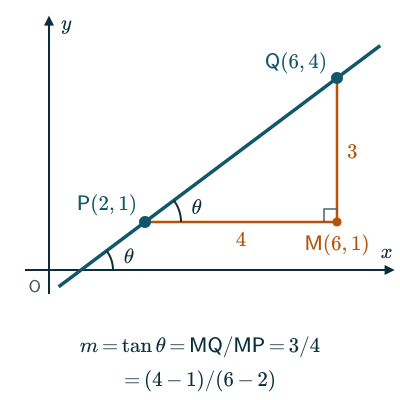
Slope through two points
m = (y − y)/(x − x), x ≠ x
Both cases give the same formula. It does not matter which point is called the first, because (y1 − y2)/(x1 − x2) is the same number. What matters is to subtract in the same order above and below.
NCERT Example 1 (pages 155–156) finds four slopes:
- (a) through (3, −2) and (−1, 4): the rise is 4 − (−2) = 6 and the run is −1 − 3 = −4, so m = −3/2;
- (b) through (3, −2) and (7, −2): the rise is −2 − (−2) = 0, so m = 0/4 = 0, a horizontal line;
- (c) through (3, −2) and (3, 4): the formula gives 6/0, which is not defined, so the line is vertical;
- (d) with inclination 60°, the slope is tan 60°, which is √3.
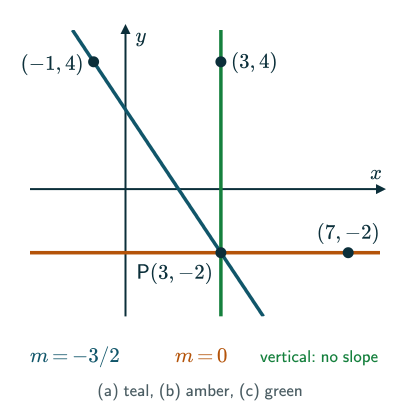
Parallel and perpendicular lines
Let non-vertical lines l1 and l2 have slopes m1 and m2 and inclinations α and β (NCERT Section 9.2.2, pages 154–155).
Parallel. Parallel lines make equal angles with the x-axis, so α = β and m1 = m2. Conversely, equal slopes give the same inclination, so distinct lines are parallel; they can also coincide. Throughout the parallel-line tests below, assume the lines are distinct.
Perpendicular. If l2 is perpendicular to l1, then their inclinations differ by 90°; label them so that β > α, giving β = α + 90°. So tan β = tan(α + 90°) = −cot α = −1/tan α, that is, m2 = −1/m1. Conversely, m1m2 = −1 makes α and β differ by 90°.
two non-vertical lines are perpendicular to each other if and only if their slopes are negative reciprocals of each other
NCERT Mathematics (Class 11), Section 9.2.2, page 155
Parallel and perpendicular lines
parallel: m = m
perpendicular: mm = −1
Vertical lines have no slope, so they are checked separately: two vertical lines are parallel, and a vertical line is perpendicular to every horizontal line (slope 0).
NCERT Example 3 (page 158): the line through (−2, 6) and (4, 8) has slope 2/6 = 1/3. The line through (8, 12) and (x, 24) has slope 12/(x − 8). For the two lines to be perpendicular, (1/3) × 12/(x − 8) = −1, so x − 8 = −4 and x = 4.
Collinear points. The NCERT Summary (page 174) states the slope test for collinearity:
Three points A, B and C are collinear, if and only if slope of AB = slope of BC.
NCERT Mathematics (Class 11), Chapter 9, Summary, page 174
Equal slopes make the lines AB and BC parallel, and they share the point B, so they are the same line. If AB is vertical, use the x-coordinates instead: the points are collinear when all three are equal. The area test, area of triangle ABC = 0, gives the same answer.
Angle between two lines
When we think about more than one line in a plane, then we find that these lines are either intersecting or parallel.
NCERT Mathematics (Class 11), Section 9.2.3, page 156
Let non-vertical lines L1 and L2 have inclinations α1 and α2, with α2 > α1, and slopes m1 = tan α1 and m2 = tan α2. Where they cross they make two adjacent angles, θ and φ = 180° − θ, with θ = α2 − α1 (NCERT Fig 9.6). By the tangent of a difference, with tan α1 = m1 and tan α2 = m2,
tan θ = tan(α2 − α1)
= (m2 − m1)/(1 + m1m2),
and tan φ = −tan θ. If this fraction is positive, θ is the acute angle; if it is negative, φ is. Either way, the acute angle is found by taking the absolute value:
Acute angle between two lines
tan θ = |(m − m)/(1 + mm)|
where 1 + mm ≠ 0
The obtuse angle is 180° − θ. If 1 + m1m2 = 0 the lines are perpendicular. If m1 = m2, tan θ = 0 and the lines are parallel. If one line is vertical, the formula cannot be used: the smaller angle is the absolute difference between 90° and the other line’s inclination.
NCERT Example 2 (pages 157–158): the angle between two lines is π/4 and one slope is 1/2. With m1 = 1/2 and m2 = m, |(m − 1/2)/(1 + m/2)| = 1. The fraction is either 1 or −1:
m − 1/2 = 1 + m/2 gives m = 3;
m − 1/2 = −1 − m/2 gives m = −1/3.
So the other slope is 3 or −1/3. There are two answers because, through any point of the given line, one line on each side of it makes 45° with it. NCERT Fig 9.7 draws the two answer lines crossing L at different points; the figure below draws both through one point C.
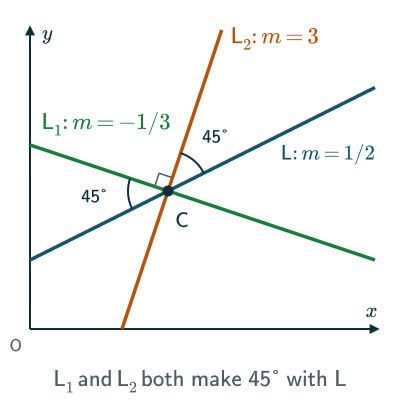
Solved examples
Example 1: A right angle without Pythagoras (NCERT Exercise 9.1, Q6, page 159)
Without using the Pythagoras theorem, show that the points (4, 4), (3, 5) and (−1, −1) are the vertices of a right angled triangle.
Call them A(4, 4), B(3, 5) and C(−1, −1).
Slope of AB = (5 − 4)/(3 − 4) = −1.
Slope of AC = (−1 − 4)/(−1 − 4) = 1.
Answer: (−1) × 1 = −1, so AB is perpendicular to AC, and the triangle has a right angle at A(4, 4).
Example 2: A parallelogram without the distance formula (NCERT Exercise 9.1, Q8, page 159)
Show that the points (−2, −1), (4, 0), (3, 3) and (−3, 2) are the vertices of a parallelogram.
Call them A, B, C, D in that order. The slopes of the sides are:
AB: (0 + 1)/(4 + 2) = 1/6
CD: (2 − 3)/(−3 − 3) = 1/6
BC: (3 − 0)/(3 − 4) = −3
DA: (−1 − 2)/(−2 + 3) = −3
Answer: both pairs of opposite sides are parallel, so ABCD is a parallelogram. The slopes 1/6 and −3 are different, so no three of the points are collinear.
Example 3: An angle measured from the y-axis (NCERT Exercise 9.1, Q7, page 159)
Find the slope of the line which makes an angle of 30° with the positive direction of the y-axis, measured anticlockwise.
The positive y-axis is at 90° from the positive x-axis. Turning a further 30° anticlockwise gives the inclination 90° + 30° = 120°.
Answer: m = tan 120° = −√3.
Example 4: One slope double the other (NCERT Exercise 9.1, Q10, page 159)
The slope of a line is double the slope of another line. If the tangent of the angle between them is 1/3, find the slopes.
Let the slopes be m and 2m. Then
|(2m − m)/(1 + 2m2)| = 1/3,
so 3|m| = 1 + 2m2, that is
2|m|2 − 3|m| + 1 = 0
(2|m| − 1)(|m| − 1) = 0,
so |m| = 1/2 or 1.
Answer: the slopes are 1/2 and 1, or 1 and 2, or −1/2 and −1, or −1 and −2.
Example 5: Collinear by slopes
Find x if the points (x, −1), (2, 1) and (4, 5) are collinear.
Slope of the line through (2, 1) and (4, 5) = (5 − 1)/(4 − 2) = 2. The slope from (x, −1) to (2, 1) must also be 2: (1 + 1)/(2 − x) = 2, so 2 − x = 1.
Answer: x = 1.
Example 6: Two lines at 45° (JEE)
Find the slopes of the lines that make an angle of 45° with a line of slope 2.
|(m − 2)/(1 + 2m)| = 1. Either m − 2 = 1 + 2m, which gives m = −3, or m − 2 = −1 − 2m, which gives m = 1/3.
Answer: −3 and 1/3. Check: (−3) × (1/3) = −1, so the two answers are perpendicular to each other, as in NCERT Example 2.
Common mistakes to avoid
Common mistake
Subtracting in different orders
(y2 − y1)/(x1 − x2) has the wrong sign. For (3, −2) and (−1, 4) it gives 6/4 = 3/2 instead of −3/2.
Common mistake
Calling a vertical line’s slope 0
A horizontal line has slope 0; a vertical line has no slope. For (3, −2) and (3, 4) the formula gives 6/0, which is not 0.
Common mistake
Using mm = −1 with a vertical line
The lines x = 2 and y = 5 are perpendicular, but the first has no slope, so the product test cannot be used. Check vertical lines by their direction.
Common mistake
Keeping only one answer
The modulus in tan θ = |(m2 − m1)/(1 + m1m2)| gives two equations. In NCERT Example 2 both answers, 3 and −1/3, are correct.
Keep only one answer when the direction is fixed. If L2 is L1 turned 45° anticlockwise, drop the modulus: tan 45° = (m2 − m1)/(1 + m1m2). With m1 = 1/2, only m2 = 3 fits; −1/3 is the clockwise turn.
Common mistake
Measuring from the wrong axis
The inclination is measured from the positive x-axis. A line at 30° to the positive y-axis, measured anticlockwise, has inclination 90° + 30° = 120° and slope −√3: not tan 30° = 1/√3, and not tan 60° = √3. If a question says only “30° with the y-axis”, the inclination can be 60° or 120°, so m = ±√3, that is ±cot 30°.
Quick revision summary
- The inclination θ is the angle from the positive x-axis to the line, measured anticlockwise; the slope is m = tan θ, for θ ≠ 90°.
- Through (x1, y1) and (x2, y2), m = (y2 − y1)/(x2 − x1). A horizontal line has slope 0; a vertical line has none.
- Non-vertical lines are parallel exactly when m1 = m2, and perpendicular exactly when m1m2 = −1.
- The acute angle between two lines satisfies tan θ = |(m2 − m1)/(1 + m1m2)|. A, B and C are collinear exactly when the slopes of AB and BC are equal (or, if AB is vertical, all three x-coordinates are equal).
Formula sheet
- m = tan θ, θ ≠ 90°
- m = (y − y)/(x − x), x ≠ x
- distinct non-vertical lines parallel: m = m
- perpendicular: mm = −1
- tan θ = |(m − m)/(1 + mm)|, 1 + mm ≠ 0
- A, B, C collinear ⇔ slope of AB = slope of BC (AB vertical: equal x-coordinates)
Questions students ask
How do you find the inclination of a line from its slope?
The inclination of a line with slope m is the angle θ, with 0° ≤ θ < 180°, whose tangent is m: an acute angle when m > 0 and an obtuse one when m < 0. For a negative slope, find the acute angle whose tangent is |m| and subtract it from 180°. For slope 2 the inclination is about 63.4°, since tan 63.4° ≈ 2, and for slope −2 it is about 180° − 63.4° = 116.6°.
Does the slope of a line have units?
In coordinate geometry the slope of a line has no units: it is a rise divided by a run, two lengths measured on the same scale, so m = tan θ is a pure number. On a graph whose axes carry different quantities, the slope takes the units of the vertical quantity per unit of the horizontal one; the slope of a straight position–time graph is a velocity in metres per second, read in axis units and not from the angle on paper, as reading velocity from an x-t graph explains. For the same reason, m1m2 = −1 shows a right angle on paper only when both axes use the same scale.
Why is the product of the slopes of perpendicular lines −1?
The product of the slopes of two perpendicular lines is −1 because a quarter turn changes a slope m into −1/m: along a line of slope m, a step of 1 to the right and m up turns, through 90° anticlockwise, into a step of m to the left and 1 up, whose slope is 1/(−m). So the two slopes multiply to −1, and conversely slopes with product −1 belong to perpendicular lines; for example, slopes 2/5 and −5/2. The rule needs both lines non-vertical, which also rules out a horizontal line, since the perpendicular to a horizontal line is vertical.
How do you find the angle between two lines from their equations?
For lines A1x + B1y + C1 = 0 and A2x + B2y + C2 = 0, the acute angle θ between them satisfies tan θ = |(A1B2 − A2B1)/(A1A2 + B1B2)|, which is the slope formula with each slope −A/B put in. Unlike the slope form, it also works when one line is vertical, and A1A2 + B1B2 = 0 means the lines are perpendicular. For 4x − y + 1 = 0 and 5x + 3y − 2 = 0 it gives |(12 + 5)/(20 − 3)| = 1, so the acute angle is 45°.
Is the slope of a line the same as its derivative?
For a non-vertical straight line the slope and the derivative are the same number: the derivative of y = mx + c is m at every point. For a curve the slope changes from point to point, and the derivative at a point is the slope of the tangent there, the limit of the slopes of chords, as NCERT’s Limits and Derivatives chapter shows. Physics uses the same idea: the velocity at an instant is the slope of the tangent to the position–time graph.
Practice questions
Try each question first, then open the answer to check your working.
-
Q1. Find the slope of the line which passes through the origin and the mid-point of the segment joining P(0, −4) and B(8, 0) (NCERT Exercise 9.1, Q5).
Show answerHide answer
The mid-point is ((0 + 8)/2, (−4 + 0)/2) = (4, −2). The slope from (0, 0) to (4, −2) is −2/4 = −1/2.
-
Q2. Find the angle between the x-axis and the line joining (3, −1) and (4, −2) (NCERT Exercise 9.1, Q9).
Show answerHide answer
m = (−2 + 1)/(4 − 3) = −1 = tan θ, so the inclination is 135°: the line makes 135° with the positive x-axis, measured anticlockwise. The acute angle between the line and the x-axis is 180° − 135° = 45°.
-
Q3. A line passes through (x1, y1) and (h, k). If its slope is m, show that k − y1 = m(h − x1) (NCERT Exercise 9.1, Q11).
Show answerHide answer
If the given points coincide, both sides of the required identity are 0. Otherwise the finite slope makes h ≠ x1, so by the two-point formula, m = (k − y1)/(h − x1). Multiplying both sides by h − x1 gives k − y1 = m(h − x1).
-
Q4. Find the acute angle between the lines with slopes √3 and −√3.
Show answerHide answer
tan θ = |(−√3 − √3)/(1 − 3)|
= √3, so θ = 60°.