Intersection of lines and centres of a triangle
Beyond NCERT In the JEE Main syllabus; the Class 11 book has no section for it.
Quick answer
Two lines meet at the point whose coordinates satisfy both equations, found by solving them together; if ab − ab = 0, where a, b and a, b are the coefficients of x and y in the two equations, they are parallel or the same line. Three lines are concurrent when the point where two of them meet lies on the third. For a triangle with vertices (x, y), (x, y) and (x, y), the centroid is G = ((x + x + x)/3, (y + y + y)/3), the circumcentre is the point equidistant from the three vertices, and the orthocentre is where the altitudes meet.
Point of intersection of two lines
Point of intersection
- The point of intersection of two lines is the point whose coordinates satisfy both equations. It is found by solving the two equations together.
- Two lines that are not parallel meet in exactly one point: two lines with different slopes, or a vertical line and a non-vertical one. Parallel lines never meet, and two equations of the same line share every point.
In plain words: a point is on a line when it makes the line’s equation true, so the point on both lines makes both equations true. JEE Main 2027 lists the intersection of lines, the concurrence of three lines and the centroid, orthocentre and circumcentre of a triangle in Unit 10, Co-ordinate Geometry. The 2026–27 NCERT book has no section on them. Its Miscellaneous Examples and Exercise on Chapter 9 use intersecting and concurrent lines (Miscellaneous Example 11, Exercise Q8 and Q9), but the chapter never names the centroid, orthocentre or circumcentre.
For a1x + b1y + c1 = 0 and a2x + b2y + c2 = 0, eliminating y and then x gives the cross-multiplication rule, which NCERT uses in Miscellaneous Example 11:
Point of intersection (cross-multiplication)
D = ab − ab ≠ 0
x = (bc − bc)/D
y = (ca − ca)/D
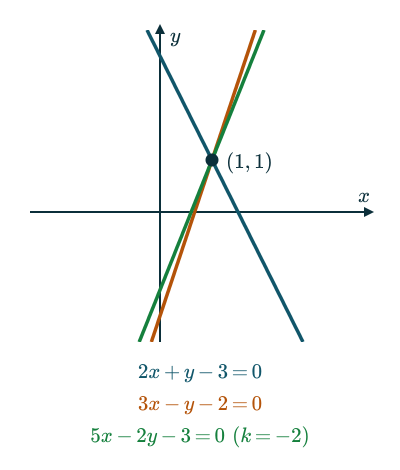
This needs a1b2 − a2b1 ≠ 0. This quotient form also handles x = 0 or y = 0; a chain such as x/(bc − bc) would divide by zero in those cases. If D is 0, the lines have the same direction: they are parallel, or they are the same line. For 2x + y − 3 = 0 and 3x − y − 2 = 0:
x/(−2 − 3) = y/(−9 + 4) = 1/(−2 − 3),
so x = 1 and y = 1: the lines meet at (1, 1). Ordinary elimination gives the same answer: adding the equations gives 5x − 5 = 0.
Concurrent lines
Three lines are said to be concurrent, if they pass through a common point, i.e., point of intersection of any two lines lies on the third line.
NCERT Mathematics (Class 11), Chapter 9, Miscellaneous Examples, page 168
So to test three lines, intersect two of them and put the point into the third.
NCERT Miscellaneous Example 11 (page 168): 2x + y − 3 = 0, 5x + ky − 3 = 0 and 3x − y − 2 = 0 are concurrent. The first and third meet at (1, 1), so 5 + k − 3 = 0 and k = −2.
A one-step test (JEE). Lines aix + biy + ci = 0 (i = 1, 2, 3), no two of them parallel, are concurrent exactly when the expression below is 0. It is the determinant of their coefficients, which Class 12 studies:
Concurrency of three lines
a(bc − bc)
+ b(ca − ca)
+ c(ab − ab) = 0
For Example 11 it gives 5k + 10 = 0, so again k = −2.
Lines through an intersection (JEE). If L1 = 0 and L2 = 0 are two intersecting lines, then L1 + λL2 = 0 is a line through their point of intersection for every number λ. It gives every line through that point except L2 = 0 itself, so test L2 = 0 separately. Choose λ to meet one more condition. This avoids finding the point at all.
Centroid, circumcentre and orthocentre
For a triangle with vertices A(x1, y1), B(x2, y2) and C(x3, y3):
- The centroid G is where the three medians meet. A median joins a vertex to the mid-point of the opposite side, and G divides each median in the ratio 2 : 1 from the vertex. By the section formula, its coordinates are the averages of the vertices’ coordinates.
- The circumcentre O is where the perpendicular bisectors of the sides meet. It is equally far from A, B and C, so it is the centre of the circle through them. In a right triangle, it is the mid-point of the hypotenuse.
- The orthocentre H is where the altitudes meet. An altitude is the line from a vertex perpendicular to the opposite side. In a right triangle, it is the vertex with the right angle.
Centroid G(x, y)
x = (x + x + x)/3
y = (y + y + y)/3
To find O, solve OA2 = OB2 and OA2 = OC2. Each is a linear equation, the perpendicular bisector of one side. To find H, write two altitudes, each through a vertex and perpendicular to the opposite side, and intersect them. Use the negative reciprocal for finite non-zero side slopes; a horizontal side needs a vertical altitude and a vertical side a horizontal altitude.
Worked triangle. A(0, 0), B(6, 0), C(2, 4).
- G = ((0 + 6 + 2)/3, (0 + 0 + 4)/3) = (8/3, 4/3).
- The perpendicular bisector of AB is x = 3. That of AC passes through (1, 2) with slope −1/2. At x = 3 it gives y = 1, so O = (3, 1). Check: OA2 = OB2 = OC2 = 10.
- The altitude from C is x = 2, because AB is horizontal. BC has slope 4/(2 − 6) = −1, so the altitude from A is y = x. So H = (2, 2).
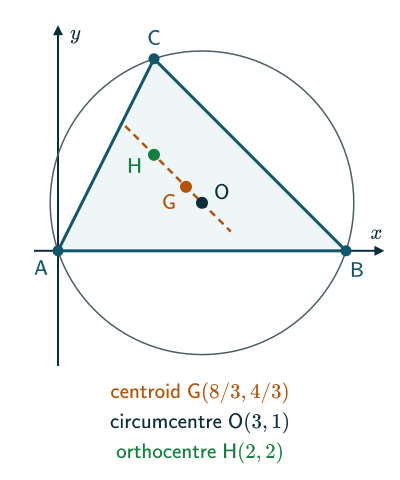
A check (JEE). In every non-equilateral triangle, O, G and H lie on the Euler line, with G between them and HG = 2GO. So H = 3G − 2O. Here 3G − 2O = (8 − 6, 4 − 2) = (2, 2) = H. Once two of the three centres are known, this relation gives the third. (In an equilateral triangle all three are the same point.)
Solved examples
Example 1: A value that makes three lines concurrent (NCERT Miscellaneous Exercise, Q8, page 173)
Find p so that 3x + y − 2 = 0, px + 2y − 3 = 0 and 2x − y − 3 = 0 meet at one point.
Adding the first and third gives 5x − 5 = 0, so x = 1 and y = −1. Putting (1, −1) into the second: p − 2 − 3 = 0.
Answer: p = 5.
Example 2: Equal intercepts through an intersection (NCERT Miscellaneous Exercise, Q11, page 173)
Find the equation of the line through the intersection of 4x + 7y − 3 = 0 and 2x − 3y + 1 = 0 that has equal intercepts on the axes.
Doubling the second equation and subtracting it from the first gives 13y − 5 = 0, so y = 5/13 and then x = 1/13. A line with equal intercepts is x + y = a, so a = 6/13.
Answer: 13x + 13y = 6. The line y = 5x through the origin also passes through (1/13, 5/13), and its two intercepts are both 0, so it is a second answer unless the intercepts must be non-zero.
With L1 + λL2 = 0 instead: (4 + 2λ)x + (7 − 3λ)y + (λ − 3) = 0 has equal intercepts when 4 + 2λ = 7 − 3λ, so λ = 3/5, which gives 13x + 13y = 6. λ = 3 gives 10x − 2y = 0, the line y = 5x.
Example 3: The quickest path to a road (NCERT Miscellaneous Exercise, Q23, page 174)
A person standing at the junction of the paths 2x − 3y + 4 = 0 and 3x + 4y − 5 = 0 wants to reach the path 6x − 7y + 8 = 0 in the least time. Find the equation of the path he should follow.
The junction: 8x − 12y = −16 and 9x + 12y = 15 add to 17x = −1. So x = −1/17 and y = 22/17. The shortest way to a line is along the perpendicular, so the path has slope −7/6 (the road’s slope is 6/7):
y − 22/17 = (−7/6)(x + 1/17)
Multiplying by 102: 102y − 132 = −119x − 7.
Answer: 119x + 102y = 125.
Example 4: The ratio in which a line cuts a segment (NCERT Miscellaneous Exercise, Q13, page 173)
In what ratio does the line x + y = 4 divide the segment joining (−1, 1) and (5, 7)?
Take the ratio k : 1. The dividing point is ((5k − 1)/(k + 1), (7k + 1)/(k + 1)), and it lies on the line:
(5k − 1) + (7k + 1) = 4(k + 1)
12k = 4k + 4, so k = 1/2.
Answer: 1 : 2, at the point (1, 3).
Example 5: Distance measured along a line (NCERT Miscellaneous Example 12, page 169)
Find the distance of the line 4x − y = 0 from P(4, 1), measured along the line that makes 135° with the positive x-axis.
The line through P with slope tan 135° = −1 (tan is negative in the second quadrant) is x + y − 5 = 0. Solving it with 4x − y = 0 gives Q(1, 4).
Answer: PQ = √(9 + 9) = 3√2. This is not the perpendicular distance |16 − 1|/√17, because the path is not perpendicular to the line.
Example 6: An orthocentre, checked by the Euler line
Find the orthocentre of the triangle A(1, 2), B(5, 2), C(3, 6).
AB is horizontal, so the altitude from C is x = 3. BC has slope (6 − 2)/(3 − 5) = −2, so the altitude from A has slope 1/2:
y − 2 = (x − 1)/2
At x = 3, y = 3, so H = (3, 3).
Answer: H(3, 3). Check: G = (3, 10/3) and O = (3, 7/2), with OA2 = OC2 = 25/4. Then 3G − 2O = (9 − 6, 10 − 7) = (3, 3).
Common mistakes to avoid
Common mistake
Mixing up the centres
The circumcentre uses perpendicular bisectors: through mid-points, perpendicular to the sides. The orthocentre uses altitudes: through the vertices, perpendicular to the opposite sides. The centroid uses medians.
Common mistake
Taking the centroid as a mid-point
The centroid averages all three vertices. It is not the mid-point of any side, and it is two-thirds of the way along each median from the vertex, not half-way.
Common mistake
Calling three lines concurrent too soon
Two lines with different slopes always meet; three lines meet in one point only if the third passes through that point. The concurrency expression is also 0 for three parallel lines or repeated equations. Three distinct parallel lines have no common point; two coincident lines can share exactly one point with a third crossing line, while three coincident lines share infinitely many points. Thus a zero determinant alone does not establish concurrence of three distinct lines. After solving for k, check that two of the lines really meet (a1b2 − a2b1 ≠ 0), and reject any value that makes two lines parallel.
Common mistake
Using the perpendicular distance for a distance along a line
In Example 5 the distance along the 135° line is 3√2, but the perpendicular distance is 15/√17. Read which distance the question asks for.
Quick revision summary
- The point of intersection solves both equations; with a1b2 − a2b1 = 0 the lines are parallel or the same.
- Three lines are concurrent when the intersection of two of them lies on the third. L1 + λL2 = 0 is a line through the intersection of L1 = 0 and L2 = 0.
- Centroid G = average of the vertices; circumcentre O = meet of the perpendicular bisectors, equidistant from the vertices; orthocentre H = meet of the altitudes. H = 3G − 2O.
Formula sheet
- D = ab − ab ≠ 0: x = (bc − bc)/D, y = (ca − ca)/D
- parallel or the same line: ab − ab = 0
- concurrent (no two parallel): a(bc − bc) + b(ca − ca) + c(ab − ab) = 0
- through the intersection of L = 0 and L = 0: L + λL = 0
- G = ((x + x + x)/3, (y + y + y)/3)
- circumcentre O: OA = OB = OC
- orthocentre H: meet of the altitudes; H = 3G − 2O
Questions students ask
How can you tell whether two lines intersect, are parallel or coincide?
Two lines meet in exactly one point when a1b2 − a2b1 ≠ 0, where a1, b1 and a2, b2 are the coefficients of x and y in their equations; this is the Class 10 test a1/a2 ≠ b1/b2 without fractions, so it works even when a coefficient is 0. If the expression is 0, the lines coincide when one equation is a non-zero multiple of the other and are parallel otherwise. For example, 2x − 5y + 1 = 0 and 4x − 10y + 2 = 0 are the same line, and 4x − 10y + 3 = 0 is parallel to it.
What is the difference between concurrent lines and intersecting lines?
Intersecting lines are lines that cross at a point, and any two non-parallel lines in a plane intersect, while concurrent lines are three or more lines that all pass through one common point. So every set of concurrent lines intersects, but three lines can cross in pairs at three different points, forming a triangle, without being concurrent. The matching word for points is collinear: three or more points on one line, just as concurrent lines are three or more lines through one point.
Can the circumcentre or orthocentre lie outside the triangle?
The circumcentre and the orthocentre of a triangle lie outside it when the triangle is obtuse; they are inside an acute triangle, and in a right triangle the circumcentre is the mid-point of the hypotenuse and the orthocentre is the right-angle vertex. The centroid, the average of the three vertices, is always inside. For example, the triangle with vertices (0, 0), (4, 0) and (6, 2), obtuse at (4, 0), has its circumcentre at (2, 4) and its orthocentre at (6, −6), both outside it.
Is the circumcentre of a triangle the same as its centroid?
The circumcentre and the centroid of a triangle are the same point only when the triangle is equilateral, and then the orthocentre is there too; in every other triangle the three centres are different points. By the Euler-line relation H = 3G − 2O (H the orthocentre, G the centroid, O the circumcentre), if any two of the centres coincide the third joins them, and a triangle whose medians are also the perpendicular bisectors of its sides has all three sides equal. For example, the right triangle with vertices (0, 0), (10, 0) and (0, 4) has its centroid at (10/3, 4/3) but its circumcentre at (5, 2), the mid-point of the hypotenuse.
Is there a direct formula for the orthocentre and circumcentre of a triangle?
The orthocentre and the circumcentre of a triangle do have direct formulas, though they go beyond NCERT: like the centroid, each is a weighted average of the vertices, with weights tan A, tan B and tan C for the orthocentre and sin 2A, sin 2B and sin 2C for the circumcentre, provided no angle is 90°; A, B and C being the angles at the vertices. So the orthocentre’s x-coordinate is the sum of x1 tan A, x2 tan B and x3 tan C, divided by tan A + tan B + tan C, x1 being that of vertex A, and likewise for y; an obtuse angle gives a negative weight. For a right triangle, use the right-angle vertex as H and the hypotenuse mid-point as O: the tangent weights are undefined, and all three sin 2A weights are 0, so the circumcentre quotient is 0/0. With coordinates it is usually quicker to intersect two altitudes or two perpendicular bisectors.
Is the incentre in the JEE Main syllabus, and what is its formula?
The incentre is not named in the JEE Main syllabus (Unit 10), which lists the centroid, orthocentre and circumcentre, and neither NCERT nor this page covers it. Its x-coordinate is (ax1 + bx2 + cx3)/(a + b + c), and likewise for y, where a, b and c are the sides opposite the vertices with x-coordinates x1, x2 and x3. The incentre is where the angle bisectors meet, the centre of the circle touching all three sides, so it always lies inside the triangle. For example, (0, 0), (4, 0) and (0, 3) give a = 5, b = 3 and c = 4, and the incentre (1, 1).
Practice questions
Try each question first, then open the answer to check your working.
-
Q1. Find the equation of the line parallel to the y-axis through the intersection of x − 7y + 5 = 0 and 3x + y = 0 (NCERT Miscellaneous Exercise, Q5).
Show answerHide answer
From the second equation y = −3x; then x + 21x + 5 = 0, so x = −5/22. The line is x = −5/22.
-
Q2. Find the area of the triangle formed by the lines y − x = 0, x + y = 0 and x − k = 0 (NCERT Miscellaneous Exercise, Q7).
Show answerHide answer
The vertices are (0, 0), (k, k) and (k, −k). The base from (k, k) to (k, −k) is 2|k|, and the height from the origin is |k|, so the area is ½ × 2|k| × |k| = k2.
-
Q3. Find the centroid of the triangle with vertices (1, 2), (3, −4) and (−1, 5).
Show answerHide answer
x = (1 + 3 − 1)/3 = 1,
y = (2 − 4 + 5)/3 = 1,
so the centroid is (1, 1).
-
Q4. Find the circumcentre and the orthocentre of the triangle with vertices (0, 0), (4, 0) and (0, 6).
Show answerHide answer
The right angle is at (0, 0), so the circumcentre is the mid-point of the hypotenuse, (2, 3), and the orthocentre is the right-angle vertex, (0, 0). Check: (2, 3) is √13 from each vertex.