Sections of a cone
NCERT Class 11 Mathematics Chapter 10 Sections 10.1–10.2
Quick answer
A conic section is the curve where a plane cuts a double-napped right circular cone. If α is the cone’s half-angle and β the angle between the plane and the axis, a plane not through the vertex gives a circle when β = 90°, an ellipse when α < β < 90°, a parabola when β = α and a hyperbola when 0° ≤ β < α. Through the vertex the section degenerates to a point, a straight line or a pair of intersecting lines.
With your textbook
NCERT Mathematics (Class 11), Chapter 10 “Conic Sections”, Sections 10.1–10.2 “Introduction” and “Sections of a Cone”, pages 176–179.
Open the official NCERT chapter (PDF, 3.0 MB, ncert.nic.in) (opens in a new tab)
Checked against the 2026-27 reprint on .
What is a conic section?
Conic section
If we take the intersection of a plane with a cone, the section so obtained is called a conic section.
NCERT Mathematics (Class 11), Section 10.2, page 177
In plain words: slice a cone with a flat plane, and the edge of the cut is a conic. Which conic you get depends only on how steeply the plane is tilted, and on whether it passes through the tip of the cone.
The names parabola and hyperbola are given by Apollonius.
NCERT Mathematics (Class 11), Section 10.1, page 176
NCERT lists uses of these curves in planetary motion, in the design of telescopes and antennas, and in the reflectors of torches and car headlights (page 176). NCERT Section 10.1 opens with “In the preceding Chapter 10, we have studied various forms of the equations of a line”. The forms of the equation of a line are in Chapter 9, so it should say Chapter 9.
The double cone
Take a fixed vertical line l and a second line m that crosses it at a fixed point V at an angle α. Turning m round l while keeping α fixed sweeps out a surface. That surface is a double-napped right circular hollow cone, extending without end in both directions (NCERT Section 10.2, pages 176–177, Figs 10.1 and 10.2).
The point V is called the vertex; the line l is the axis of the cone.
NCERT Mathematics (Class 11), Section 10.2, page 177
The rotating line m is called a generator of the cone.
NCERT Mathematics (Class 11), Section 10.2, page 177
The vertex separates the cone into two parts called nappes.
NCERT Mathematics (Class 11), Section 10.2, page 177
Here 0° < α < 90°, so the surface is a genuine cone. Thus α is its half-angle, between the axis and every generator. The cutting plane is described by β, the angle the plane makes with the axis (NCERT Fig 10.3). A plane perpendicular to the axis has β = 90°, and a plane containing the axis has β = 0°.
Circle, ellipse, parabola and hyperbola
When the plane does not pass through the vertex, NCERT Section 10.2.1 (pages 177–178) lists four cases:
| Angle of the plane | Section | What the plane does |
|---|---|---|
| β = 90° | circle | cuts right across one nappe, perpendicular to the axis |
| α < β < 90° | ellipse | cuts right across one nappe, tilted |
| β = α | parabola | is parallel to one generator, so it never closes the curve |
| 0° ≤ β < α | hyperbola | cuts both nappes, giving a curve in two branches |
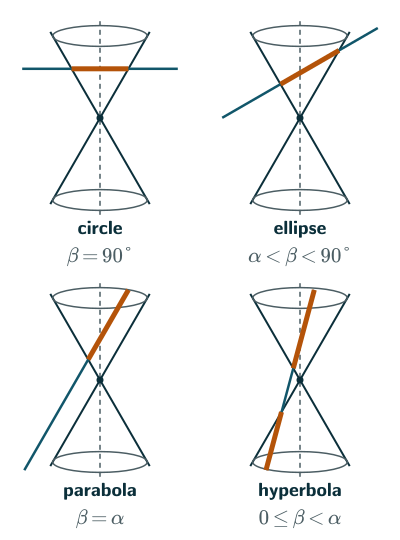
As the plane tilts from β = 90° towards the axis, the circle stretches into longer and longer ellipses. At β = α, the plane runs parallel to a generator and the curve opens out into a parabola. Tilt it further and the plane catches the other nappe too: the curve becomes a hyperbola with two separate branches.
Degenerate conic sections
The intersection of the plane with the cone can take place either at the vertex of the cone or at any other part of the nappe either below or above the vertex.
NCERT Mathematics (Class 11), Section 10.2, page 177
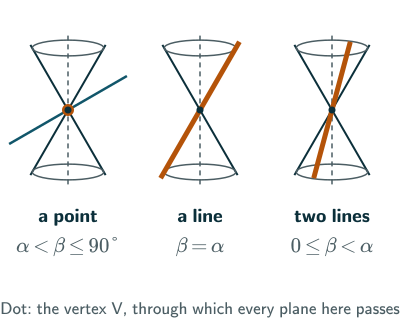
When the plane passes through the vertex, the section is degenerate (NCERT Section 10.2.2, page 178, which says “degenerated”):
- α < β ≤ 90°: only the vertex is on both, so the section is a point.
- β = α: the plane contains a generator, so the section is a straight line, the degenerate case of a parabola.
- 0° ≤ β < α: the section is a pair of intersecting straight lines through the vertex, the degenerate case of a hyperbola.
One number for all four: eccentricity (JEE)
In this section the cutting plane misses the vertex, so the conic is non-degenerate. Each such conic has a number e, its eccentricity. NCERT defines it later only for the ellipse and the hyperbola, as e = c/a (NCERT Sections 10.5.2 and 10.6.1). Beyond the NCERT text, e = 0 for a circle, 0 < e < 1 for an ellipse, e = 1 for a parabola and e > 1 for a hyperbola, and the angles on the cone give it directly. This can be proved by intersecting the plane with the cone’s equation in coordinates.
Eccentricity from the cone
e = cos β / cos α
Some books measure the plane from the base instead. If θ = 90° − β is the plane’s angle with the base, the same result reads e = sin θ / cos α.
It reproduces all four cases. β = 90° gives cos β = 0, so e = 0. For α < β < 90°, cos β < cos α, so e < 1. β = α gives e = 1. For β < α, cos β > cos α, so e > 1. With α = 30° and β = 60°, as in the figure, e = cos 60°/cos 30° = (1/2)/(√3/2) = 1/√3, using the values at the standard angles.
Solved examples
Example 1: Name the section
A double cone has half-angle α = 30°. Name the section made by a plane, not through the vertex, with (i) β = 75°; (ii) β = 30°; (iii) β = 0°.
Compare β with α and with 90°.
Answer: (i) 30° < 75° < 90°: an ellipse. (ii) β = α: a parabola. (iii) 0° ≤ β < α: a hyperbola. A plane containing the axis but missing the vertex cannot exist, so (iii) is a plane parallel to the axis.
Example 2: Planes through the vertex
For a cone with α = 40°, what is the section made by a plane through the vertex with (i) β = 90°; (ii) β = 40°; (iii) β = 20°?
Answer: (i) a point; (ii) a straight line, a generator; (iii) a pair of intersecting straight lines.
Example 3: The eccentricity of a section (JEE)
A cone has α = 45°. A plane misses its vertex. Find the eccentricity of the section made by a plane with β = 60°, and name it.
e = cos 60°/cos 45° = (1/2)/(1/√2) = 1/√2 ≈ 0.707.
Answer: e = 1/√2. It is less than 1, and β lies between α and 90°, so the section is an ellipse.
Example 4: Which tilts give a hyperbola?
For a cone with α = 35°, find all angles β for which a plane not through the vertex cuts both nappes.
Answer: 0° ≤ β < 35°. The plane must be closer to the direction of the axis than the generators are.
Common mistakes to avoid
Common mistake
Measuring β from the base
NCERT’s β is the angle between the plane and the axis of the cone. A horizontal plane has β = 90° and gives a circle; it does not have β = 0°.
Common mistake
Calling any steep cut a parabola
Only β = α exactly gives a parabola. A little steeper (β < α) gives a hyperbola, and a little flatter (β > α) gives an ellipse.
Common mistake
Forgetting the second branch of a hyperbola
When β < α the plane meets both nappes, so the hyperbola has two separate branches. Both belong to the one curve.
Common mistake
Calling a section degenerate without the vertex
A point, a line or a pair of intersecting lines appears only when the plane passes through the vertex. A plane that misses the vertex always gives one of the four curves. A pair of parallel lines is never a section of a double cone: every line in a section through V passes through V.
Quick revision summary
- A conic section is the curve where a plane meets a double-napped right circular cone; α is the cone’s half-angle and β the angle between the plane and the axis.
- Not through the vertex: β = 90° circle; α < β < 90° ellipse; β = α parabola; 0° ≤ β < α hyperbola (both nappes).
- Through the vertex: α < β ≤ 90° a point; β = α a straight line; 0° ≤ β < α a pair of intersecting lines.
- Beyond NCERT: the eccentricity is e = cos β/cos α, which is 0, below 1, 1 or above 1 in the four cases.
Formula sheet
- β = 90°: circle
- α < β < 90°: ellipse
- β = α: parabola
- 0° ≤ β < α: hyperbola
- through the vertex: point, line or pair of intersecting lines
- e = cos β / cos α (plane not through vertex, 0° < α < 90°)
Questions students ask
How do you identify a conic section from its equation?
To identify a conic section from an equation with no xy term, compare the coefficients of x2 and y2: equal ones give a circle, unequal ones of the same sign an ellipse, opposite signs a hyperbola, and one variable squared with the other only to the first power a parabola. For example, 2x2 + 5y2 = 10 is an ellipse and 2x2 − 5y2 = 10 a hyperbola. This test, not stated in NCERT, assumes a genuine curve: x2 − y2 = 0 is the pair of lines y = ±x, a degenerate hyperbola, and some equations give only a point or no real point. An xy term means a turned conic, which NCERT does not treat.
How is the eccentricity of a conic section defined?
The eccentricity e of a conic section is the fixed ratio PF/PM, where PF is the distance of any point P of the curve from a fixed point F, the focus, and PM its distance from a fixed line, the directrix; as a ratio of two lengths it has no unit. A parabola has e = 1, which is exactly NCERT’s definition of the parabola (equal distances), an ellipse has 0 < e < 1 and a hyperbola e > 1, and for these two the ratio equals NCERT’s c/a. A circle has e = 0 but no directrix: it is the limit of ellipses whose two foci merge at the centre. This focus–directrix definition is JEE-level and goes beyond the NCERT text.
What are the applications of conic sections in real life?
Conic sections are used in real life wherever a path or a reflector follows one of these curves: planets move on ellipses with the Sun at one focus, the reflectors of torches, car headlights and dish antennas are parabolic, and hyperbolic radio navigation once located ships by the difference of their distances from two stations. A ball thrown at an angle also follows a parabola if air resistance is neglected (path of a projectile). The ellipse page explains its use.
Are conic sections in the JEE Main syllabus, and what is their weightage?
Conic sections are in the JEE Main syllabus, under Unit 10 (Co-ordinate Geometry), which lists the circle in standard and general form with its centre and radius, the circle on given ends of a diameter, the points where a line meets a circle centred at the origin, “sections of conics” and the parabola, ellipse and hyperbola in standard forms. The NTA syllabus lists topics only and gives no chapter-wise weightage, so any weightage quoted for conic sections is an estimate from past papers, not an official figure.
Who discovered conic sections?
The discovery of conic sections is credited to the Greek mathematician Menaechmus (about 380–320 BC), who came upon them while trying to solve the problem of doubling the cube. He and the geometers who followed cut each curve from a different kind of right circular cone, with the plane at right angles to a generator, and the curves were named after those cones, the parabola being the “section of a right-angled cone”. Apollonius of Perga (about 262–190 BC) obtained all three from a single double cone by changing the tilt of the cutting plane, the approach this page follows, and his Conics (NCERT calls it ‘The Conic’) made the names ellipse, parabola and hyperbola standard.
Practice questions
Try each question first, then open the answer to check your working.
-
Q1. What are the vertex, the axis, a generator and the nappes of a double cone?
Show answerHide answer
The vertex V is the fixed point where the rotating line m crosses the fixed line l; l is the axis; m, in each of its positions, is a generator; the vertex separates the cone into two parts, the nappes.
-
Q2. A cone has half-angle 20°. Name the section made by a plane not through the vertex at β = 50°, β = 20° and β = 5°.
Show answerHide answer
β = 50° lies between 20° and 90°: an ellipse. β = 20° = α: a parabola. β = 5° < α: a hyperbola.
-
Q3. Which degenerate section is the degenerate case of a parabola, and which of a hyperbola?
Show answerHide answer
A plane through the vertex with β = α contains a generator, so the section is a straight line: the degenerate parabola. With β < α it is a pair of intersecting lines: the degenerate hyperbola.
-
Q4. For a cone with α = 60° and a plane not through the vertex, find the eccentricity of the section made by a plane with β = 90°, and with β = 75°.
Show answerHide answer
β = 90°: e = 0/cos 60° = 0, a circle. β = 75°: e = cos 75°/cos 60° ≈ 0.2588/0.5 ≈ 0.518, an ellipse.