Circle on a diameter and a line meeting a circle
Beyond NCERT In the JEE Main syllabus; the Class 11 book has no section for it.
Quick answer
The circle with A(x, y) and B(x, y) as the ends of a diameter is (x − x)(x − x) + (y − y)(y − y) = 0, because the angle in a semicircle is a right angle. A line y = mx + c meets x + y = r in two points, one point or none as c is less than, equal to or greater than r(1 + m), so the tangents of slope m are y = mx ± r√(1 + m).
The circle on a given diameter
Diameter form of a circle
- The circle that has A(x1, y1) and B(x2, y2) as the ends of a diameter is (x − x1)(x − x2) + (y − y1)(y − y2) = 0.
- Its centre is the mid-point of AB and its radius is half of AB.
JEE Main 2027 lists “equation of a circle when the endpoints of a diameter are given” and the “points of intersection of a line and a circle with the centre at the origin” in Unit 10, Co-ordinate Geometry. The 2026–27 NCERT chapter has neither, so this page covers both.
Why the equation works. The angle in a semicircle is a right angle. So for any point P(x, y) of the circle other than A and B, PA is perpendicular to PB, and the product of their slopes is −1:
(y − y1)/(x − x1)
× (y − y2)/(x − x2) = −1.
Clearing the denominators gives (x − x1)(x − x2) + (y − y1)(y − y2) = 0. A and B themselves also satisfy it, since each makes both products zero. If PA is vertical (x = x1), then PB is horizontal (y = y2), and both products are again zero; likewise with A and B swapped. So the equation holds at every point of the circle.
Circle on diameter AB
(x − x)(x − x)
+ (y − y)(y − y) = 0
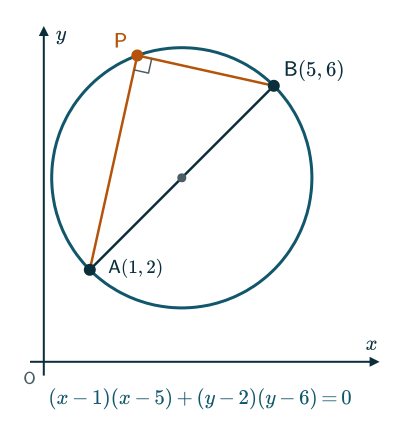
For A(1, 2) and B(5, 6): (x − 1)(x − 5) + (y − 2)(y − 6) = 0, that is x2 + y2 − 6x − 8y + 17 = 0. Its centre is (3, 4), the mid-point of AB, and by the general form, r2 = 9 + 16 − 17 = 8, so r = 2√2. Check: AB = √(16 + 16) = 4√2, twice the radius.
Where a line meets a circle
To find where a line meets a circle, solve their equations together. For the circle x2 + y2 = r2 and the line y = mx + c, substituting for y gives a quadratic in x:
(1 + m2)x2 + 2mcx + (c2 − r2) = 0.
Its discriminant decides how many points there are. A quarter of it is
m2c2 − (1 + m2)(c2 − r2)
= r2(1 + m2) − c2.
Line y = mx + c and circle x + y = r
c < r(1 + m): two points
c = r(1 + m): one point
c > r(1 + m): no point
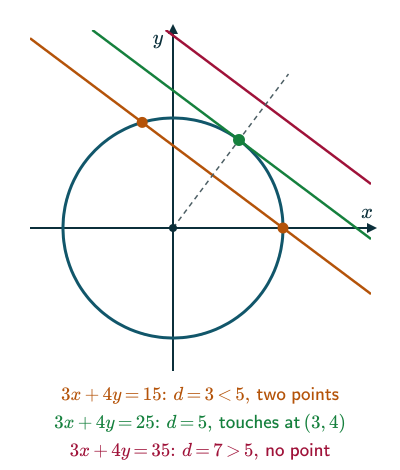
The same test reads more simply with the distance d = |c|/√(1 + m2) of the centre from the line: two points when d < r, a tangent when d = r, and none when d > r. When the line cuts the circle, the chord between the two points has half-length √(r2 − d2), by Pythagoras’ theorem. The JEE Main syllabus names only the points of intersection; tangents and chords follow from the same test and are standard practice.
Tangent and chord
tangent with slope m: y = mx ± r√(1 + m)
touching at (−mr/c, r/c)
chord length = 2√(r − d)
Solved examples
Example 1: Circle on a diameter
Find the circle with A(−2, 3) and B(4, −5) as the ends of a diameter, and its centre and radius.
(x + 2)(x − 4)
+ (y − 3)(y + 5) = 0
x2 − 2x − 8 + y2 + 2y − 15 = 0
Answer: x2 + y2 − 2x + 2y − 23 = 0, with centre (1, −1) and radius √(1 + 1 + 23) = 5. Check: AB = √(36 + 64) = 10, twice the radius.
Example 2: The other end of a diameter
One end of a diameter is (−1, 1) and the centre is (2, −3). Find the circle.
The centre is the mid-point, so the other end is (2 × 2 + 1, 2 × (−3) − 1) = (5, −7). Then
(x + 1)(x − 5)
+ (y − 1)(y + 7) = 0.
Answer: x2 + y2 − 4x + 6y − 12 = 0, of radius √(4 + 9 + 12) = 5.
Example 3: Points where a line meets a circle
Find where y = x + 1 meets x2 + y2 = 25, and the length of the chord.
x2 + (x + 1)2 = 25 gives 2x2 + 2x − 24 = 0, that is x2 + x − 12 = 0, so x = 3 or −4.
Answer: (3, 4) and (−4, −3). The chord is √(72 + 72) = 7√2 long. Check with the formula: d = 1/√2, so 2√(25 − 1/2) = 2√(49/2) = 7√2.
Example 4: A tangent of given slope
Find the lines of slope 2 that touch x2 + y2 = 5, and the points where they touch.
c2 = r2(1 + m2) = 5 × 5 = 25, so c = ±5. For y = 2x + 5:
x2 + (2x + 5)2 = 5
5x2 + 20x + 20 = 0, that is 5(x + 2)2 = 0,
a double root x = −2, so the line touches at (−2, 1).
Answer: y = 2x + 5, touching at (−2, 1), and y = 2x − 5, touching at (2, −1).
Example 5: A chord cut off by a line
Find the length of the chord that x + y = 1 cuts off on x2 + y2 = 9.
The centre is d = |0 + 0 − 1|/√2 = 1/√2 from the line, less than 3.
Answer: 2√(9 − 1/2) = 2√(17/2) = √34.
Common mistakes to avoid
Common mistake
Using the diameter form for any chord
(x − x1)(x − x2) + (y − y1)(y − y2) = 0 needs A and B to be the ends of a diameter. If AB is only a chord, the centre lies elsewhere on the perpendicular bisector of AB, so the circle is a different one. Of all circles through A and B, the diameter form gives the smallest.
Common mistake
Using c = r(1 + m) when the centre is not the origin
That test, and y = mx ± r√(1 + m2), are for x2 + y2 = r2 only. For centre (h, k), the line ax + by + c = 0 touches when |ah + bk + c|/√(a2 + b2) = r. So y = x + c touches x2 + y2 − 4x + 6y − 12 = 0 (centre (2, −3), radius 5) when |c + 5|/√2 = 5, that is c = −5 ± 5√2, not ±5√2.
Common mistake
Missing vertical tangents
The condition c2 = r2(1 + m2) covers lines y = mx + c only. The circle x2 + y2 = 25 also has the vertical tangents x = 5 and x = −5, which have no slope.
Common mistake
Taking a double root as two points
In Example 4 the quadratic is 5(x + 2)2 = 0: one repeated root, so one point of contact, not two.
Common mistake
Forgetting to double the half-chord
The half-chord is √(r2 − d2), where d is the perpendicular distance of the centre from the line. Double it for the whole chord.
Quick revision summary
- The circle on AB as diameter is (x − x1)(x − x2) + (y − y1)(y − y2) = 0, because the angle in a semicircle is a right angle.
- To meet a line with x2 + y2 = r2, substitute and solve the quadratic: two, one or no points as c2 is less than, equal to or greater than r2(1 + m2); equivalently, as d < r, d = r or d > r.
- Tangents of slope m: y = mx ± r√(1 + m2); a chord at distance d from the centre has length 2√(r2 − d2).
Formula sheet
- (x − x)(x − x) + (y − y)(y − y) = 0
- y = mx + c meets x + y = r twice, once or never as c <, =, > r(1 + m)
- tangent: y = mx ± r√(1 + m)
- chord length = 2√(r − d)
Questions students ask
What is the condition of tangency for a circle?
The condition of tangency for a circle is that the perpendicular distance of the centre from the line equals the radius; a smaller distance gives two meeting points and a larger one none. For the circle x2 + y2 = r2 and the line y = mx + c, the condition becomes c2 = r2(1 + m2). It is the one-point case of the line–circle intersection that the JEE Main syllabus (Unit 10) lists, and is not in NCERT. For example, 5x + 12y = 26 touches x2 + y2 = 4 at (10/13, 24/13), as the centre is 26/13 = 2 from the line.
What is the equation of the tangent to a circle at a given point?
The tangent to the circle x2 + y2 = r2 at a point (x1, y1) of the circle is xx1 + yy1 = r2 (the point form, beyond NCERT and not named in the JEE Main syllabus), because the tangent is perpendicular to the radius to that point. For a circle with any centre C the rule is the same: the tangent at P is the line through P perpendicular to CP, and the normal at P is the line CP itself. For example, the tangent to x2 + y2 = 13 at (2, −3) is 2x − 3y = 13, and the normal there is 3x + 2y = 0.
How many tangents can be drawn to a circle from a point?
Two tangents can be drawn to a circle from a point outside it, one from a point on it and none from a point inside, since every line through an inside point cuts the circle twice. The two tangents from an outside point are equally long: from P(x1, y1) to x2 + y2 = r2, each is √(x12 + y12 − r2) long (beyond NCERT), by Pythagoras’ theorem, as the radius to the point of contact is perpendicular to the tangent. For example, the tangents from (6, 2) to x2 + y2 = 15 are each √(36 + 4 − 15) = 5 long.
What is the formula for the length of a chord of a circle?
The length of a chord of a circle of radius r is 2√(r2 − d2), where d is the perpendicular distance of the centre from the line of the chord. The perpendicular from the centre bisects the chord, so the half-chord, d and the radius make a right triangle, and Pythagoras’ theorem gives the half-chord as √(r2 − d2). For example, 3x + 4y = 10 is 10/5 = 2 units from the centre of x2 + y2 = 13, so its chord is 2√(13 − 4) = 6 units long, from (18/5, −1/5) to (−6/5, 17/5).
Practice questions
Try each question first, then open the answer to check your working.
-
Q1. Find the circle with (0, 0) and (6, 8) as the ends of a diameter.
Show answerHide answer
x(x − 6) + y(y − 8) = 0, that is x2 + y2 − 6x − 8y = 0: centre (3, 4), radius 5.
-
Q2. Find where the line y = 7 − x meets the circle x2 + y2 = 25.
Show answerHide answer
x2 + (7 − x)2 = 25 gives x2 − 7x + 12 = 0, so x = 3 or 4. The points are (3, 4) and (4, 3).
-
Q3. Does the line y = x + 6 meet the circle x2 + y2 = 16?
Show answerHide answer
c2 = 36 and r2(1 + m2) = 16 × 2 = 32. Since 36 > 32, it does not: the centre is 6/√2 ≈ 4.24 from the line, more than the radius 4.
-
Q4. Find the lines of slope 1 that touch x2 + y2 = 8.
Show answerHide answer
c = ±r√(1 + m2) = ±√8 × √2 = ±4, so y = x + 4 and y = x − 4. They touch at (−2, 2) and (2, −2).