Hyperbola
NCERT Class 11 Mathematics Chapter 10 Section 10.6
Quick answer
A hyperbola is the set of all points in a plane whose distances from two fixed points, the foci, have an absolute difference 2a, positive and smaller than the distance between the foci. With its centre at the origin and foci (±c, 0), its equation is x/a − y/b = 1, where c = a + b. Its eccentricity e = c/a is greater than 1, and its latus rectum has length 2b/a.
With your textbook
NCERT Mathematics (Class 11), Chapter 10 “Conic Sections”, Section 10.6 “Hyperbola”, pages 195–202.
Open the official NCERT chapter (PDF, 3.0 MB, ncert.nic.in) (opens in a new tab)
Checked against the 2026-27 reprint on .
What is a hyperbola?
Hyperbola
A hyperbola is the set of all points in a plane, the difference of whose distances from two fixed points in the plane is a constant.
NCERT Mathematics (Class 11), Section 10.6, page 195
- The two distinct fixed points F1 and F2 are the foci. For a non-degenerate hyperbola, the constant absolute difference 2a satisfies 0 < 2a < F1F2; throughout, a, b > 0.
The term “difference” that is used in the definition means the distance to the farther point minus the distance to the closer point.
NCERT Mathematics (Class 11), Section 10.6, page 196
In plain words: an ellipse keeps the sum of the distances to two points fixed; a hyperbola keeps their difference fixed. Points nearer F2 form one branch and points nearer F1 the other, so a hyperbola has two separate branches. Like every conic, it is a locus.
The mid-point of the line segment joining the foci is called the centre of the hyperbola.
NCERT Mathematics (Class 11), Section 10.6, page 196
The line through the foci is called the transverse axis and the line through the centre and perpendicular to the transverse axis is called the conjugate axis.
NCERT Mathematics (Class 11), Section 10.6, page 196
The points at which the hyperbola intersects the transverse axis are called the vertices of the hyperbola
NCERT Mathematics (Class 11), Section 10.6, page 196
NCERT writes 2c for the distance between the foci and 2a for the distance between the vertices (the length of the transverse axis), and defines b = √(c2 − a2); 2b is the length of the conjugate axis (page 196). Taking P at a vertex shows that the constant difference is 2a.
a, b and c for a hyperbola
c = a + b
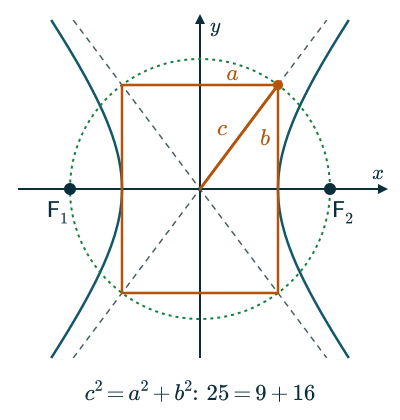
Compare the ellipse: there a is the largest of the three and a2 = b2 + c2. For a hyperbola, c is the largest and c2 = a2 + b2; b may be larger or smaller than a.
Eccentricity
Just as for the ellipse, the eccentricity is e = c/a (NCERT Definition 8, page 197), and each focus is ae from the centre.
Eccentricity of a hyperbola
e = c/a, e > 1
NCERT says “Since c ≥ a, the eccentricity is never less than one” (page 197). For a hyperbola c > a strictly, as NCERT itself uses on page 198, so e > 1; e = 1 would need b = 0. Since b2 = a2(e2 − 1), a larger e means a wider-opening hyperbola.
The standard equation
Put the centre at the origin and the foci at F1(−c, 0) and F2(c, 0) (NCERT Section 10.6.2, pages 197–199). For a point P(x, y) of the right-hand branch, PF1 − PF2 = 2a, and by the distance formula:
√((x + c)2 + y2) = 2a + √((x − c)2 + y2).
Squaring and cancelling gives (c/a)x − a = √((x − c)2 + y2). Squaring again gives x2(c2 − a2)/a2 − y2 = c2 − a2. Put c2 − a2 = b2 and divide by b2:
Hyperbola with foci on the x-axis
x/a − y/b = 1
Conversely, a point of this curve with x ≥ a has PF1 = ex + a and PF2 = ex − a, which differ by 2a. For x ≤ −a, PF2 − PF1 = 2a (NCERT pages 198–199). So the equation describes exactly the hyperbola.
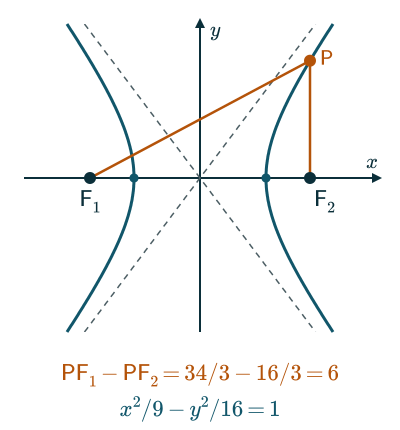
Therefore, no portion of the curve lies between the lines x = + a and x = – a
NCERT Mathematics (Class 11), Section 10.6.2, page 199
Since x2/a2 = 1 + y2/b2 ≥ 1, every point has x ≤ −a or x ≥ a. The hyperbola never meets the conjugate axis. With the foci on the y-axis, the equation is y2/a2 − x2/b2 = 1. NCERT refers to its figure as “Fig 11.31 (b)” (page 199); it is Fig 10.29 (b) on page 197.
The foci are always on the transverse axis.
NCERT Mathematics (Class 11), Section 10.6.2, page 200
The positive term shows the transverse axis: x2/9 − y2/16 = 1 has its transverse axis along the x-axis, of length 6, while y2/25 − x2/16 = 1 has it along the y-axis, of length 10 (NCERT page 200). Unlike the ellipse, the larger denominator does not decide it.
A hyperbola in which a = b is called an equilateral hyperbola.
NCERT Mathematics (Class 11), Section 10.6.2, page 199
Asymptotes (JEE, beyond NCERT). The dashed lines y = ±(b/a)x in both figures are the extended diagonals of the rectangle with sides 2a and 2b. The branches get closer and closer to them without meeting them; they are called the asymptotes. NCERT draws them in Fig 10.28 (page 196) but does not name them. For y2/a2 − x2/b2 = 1 they are y = ±(a/b)x: in either form, replace 1 by 0 and factor. An equilateral hyperbola (also called a rectangular hyperbola) has a = b.
Latus rectum
Latus rectum of hyperbola is a line segment perpendicular to the transverse axis through any of the foci and whose end points lie on the hyperbola.
NCERT Mathematics (Class 11), Section 10.6.3, page 200
Put x = c in x2/a2 − y2/b2 = 1: y2 = b2(c2/a2 − 1) = b4/a2, so the ends are (c, ±b2/a), as for the ellipse.
Latus rectum of a hyperbola
length = 2b/a
Solved examples
Example 1: Reading a hyperbola (NCERT Example 14 (i), page 200)
Find the foci, vertices, eccentricity and latus rectum of x2/9 − y2/16 = 1.
a = 3, b = 4 and c = √(9 + 16) = 5.
Answer: foci (±5, 0), vertices (±3, 0), e = 5/3, latus rectum 2 × 16/3 = 32/3.
Example 2: Transverse axis along y (NCERT Example 14 (ii), pages 200–201)
Find the foci, vertices, eccentricity and latus rectum of y2 − 16x2 = 16.
Divide by 16: y2/16 − x2/1 = 1. The positive term is in y, so a = 4, b = 1 and c = √17.
Answer: foci (0, ±√17), vertices (0, ±4), e = √17/4, latus rectum 2 × 1/4 = 1/2.
Example 3: From foci and vertices (NCERT Example 15, page 201)
Find the hyperbola with foci (0, ±3) and vertices (0, ±√11/2).
c = 3 and a2 = 11/4, so b2 = 9 − 11/4 = 25/4. The foci are on the y-axis:
y2/(11/4) − x2/(25/4) = 1.
Answer: multiplying by 275, 100y2 − 44x2 = 275.
Example 4: From the foci and the latus rectum (NCERT Example 16, page 201)
Find the hyperbola with foci (0, ±12) and latus rectum 36.
c = 12 and 2b2/a = 36, so b2 = 18a. Then 144 = a2 + 18a, that is (a + 24)(a − 6) = 0, and a = 6 (a is positive), b2 = 108.
Answer: y2/36 − x2/108 = 1, that is 3y2 − x2 = 108.
Example 5: Through a point (NCERT Exercise 10.4, Q15, page 202)
Find the hyperbola with foci (0, ±√10) passing through (2, 3).
y2/a2 − x2/b2 = 1 with b2 = 10 − a2. Putting in (2, 3):
9/a2 − 4/(10 − a2) = 1
9(10 − a2) − 4a2 = a2(10 − a2)
a4 − 23a2 + 90 = 0,
so a2 = 5 or 18. a2 = 18 would make b2 negative, so a2 = b2 = 5.
Answer: y2/5 − x2/5 = 1, that is y2 − x2 = 5, an equilateral hyperbola.
Example 6: From the vertices and e (NCERT Exercise 10.4, Q14, page 202)
Find the hyperbola with vertices (±7, 0) and e = 4/3.
a = 7, c = ae = 28/3, so b2 = 784/9 − 49 = 343/9.
Answer: x2/49 − 9y2/343 = 1.
Common mistakes to avoid
Common mistake
Using c = a − b
For a hyperbola c2 = a2 + b2, because the foci lie outside the vertices. For x2/9 − y2/16 = 1, c = 5, not √(9 − 16).
Common mistake
Choosing the transverse axis by the larger denominator
For a hyperbola, the transverse axis goes with the positive term. y2/9 − x2/27 = 1 has its transverse axis along y, although 27 > 9.
Common mistake
Taking a from the wrong term
a always goes with the positive term. In y2 − 16x2 = 16, that is y2/16 − x2/1 = 1, a = 4 and b = 1.
Common mistake
Keeping a root that makes b negative
When a2 comes from a quadratic, as in Example 5, check that b2 = c2 − a2 is positive; a < c always.
Common mistake
Forgetting that the difference must be less than the distance between the foci
A hyperbola needs 0 < 2a < 2c. A zero difference gives the perpendicular bisector of the two distinct foci. If the difference of the distances equals F1F2, the points form the two rays of the line F1F2 that start at the foci and point outwards; if it is larger, no point qualifies.
Quick revision summary
- A hyperbola is the set of points whose distances from two fixed points (the foci) differ by a constant 2a; it has two branches.
- c2 = a2 + b2; the eccentricity e = c/a is greater than 1.
- Centre at the origin: x2/a2 − y2/b2 = 1 (foci (±c, 0)) or y2/a2 − x2/b2 = 1 (foci (0, ±c)); the positive term gives the transverse axis.
- The latus rectum has length 2b2/a; a = b gives an equilateral hyperbola.
Formula sheet
- x/a − y/b = 1: foci (±c, 0), vertices (±a, 0)
- y/a − x/b = 1: foci (0, ±c), vertices (0, ±a)
- c = a + b
- e = c/a > 1
- latus rectum = 2b/a
- asymptotes (JEE) of x/a − y/b = 1: y = ±(b/a)x
Questions students ask
What is the difference between an ellipse and a hyperbola?
An ellipse is the set of points whose distances from two foci have a constant sum 2a, and a hyperbola the set whose distances from them have a constant difference 2a, so an ellipse is one closed curve and a hyperbola has two open branches. An ellipse has c2 = a2 − b2 and 0 < e < 1; a hyperbola has c2 = a2 + b2 and e > 1. Their standard equations differ only in the sign between the two terms, + for the ellipse and − for the hyperbola, and the foci of an ellipse lie between its vertices, those of a hyperbola beyond them.
Are the asymptotes and the rectangular hyperbola in the JEE Main syllabus?
Neither the asymptotes of a hyperbola nor the rectangular hyperbola is named in the JEE Main syllabus, whose Unit 10 (Co-ordinate Geometry) lists “equations of conic sections (parabola, ellipse and hyperbola) in standard forms”. The NCERT Class 11 text never uses the word asymptote, and it mentions the equilateral hyperbola, a = b, also called rectangular, only in a one-line note. So the asymptotes y = ±(b/a)x of x2/a2 − y2/b2 = 1 are a JEE extra, beyond NCERT, though not being named in the syllabus does not rule out a question on them.
Is xy = c a hyperbola?
The curve xy = c2 is a hyperbola: it is the rectangular hyperbola x2 − y2 = 2c2 turned through 45° about the origin, so its asymptotes are the coordinate axes and its transverse axis lies along y = x (both beyond NCERT; here c is any non-zero real constant, not the focal distance). If c = 0, xy = 0 is instead the pair of coordinate axes. A rectangular hyperbola (NCERT’s equilateral hyperbola) has a = b, and one branch of xy = c2 is the graph of Boyle’s law, PV = constant. For xy = 8, the vertices are (2√2, 2√2) and (−2√2, −2√2), so a = 4, and the foci are (4, 4) and (−4, −4).
What is the conjugate hyperbola?
The conjugate hyperbola of x2/a2 − y2/b2 = 1 is y2/b2 − x2/a2 = 1 (beyond NCERT): the transverse and conjugate axes swap roles and the foci move to (0, ±c), while the centre, the asymptotes and c2 = a2 + b2 stay the same. Its eccentricity is c/b instead of c/a, and the two eccentricities e1 and e2 always satisfy 1/e12 + 1/e22 = 1. For x2/64 − y2/225 = 1, c = 17, so the eccentricities are 17/8 and 17/15.
Where are hyperbolas used in real life?
Hyperbolas appear wherever a difference of two distances is fixed: a ship that receives radio pulses sent at the same instant by two stations, t seconds apart, lies on one branch of a hyperbola with the stations as foci, and a second pair of stations fixes its position, the principle of LORAN navigation. In the ideal two-body model, a comet or spacecraft moving non-radially faster than the escape speed at its distance from the Sun passes it along one branch of a hyperbola with the Sun at a focus, if the Sun’s pull alone acts. Power-station cooling towers are hyperboloids, surfaces made by spinning a hyperbola about its conjugate axis, which can be built from straight beams.
Practice questions
Try each question first, then open the answer to check your working.
-
Q1. Find the foci, vertices, eccentricity and latus rectum of x2/16 − y2/9 = 1 (NCERT Exercise 10.4, Q1).
Show answerHide answer
a = 4, b = 3, c = 5: foci (±5, 0), vertices (±4, 0), e = 5/4, latus rectum 9/2.
-
Q2. Find the foci, vertices, eccentricity and latus rectum of y2/9 − x2/27 = 1 (NCERT Exercise 10.4, Q2).
Show answerHide answer
a = 3, b = 3√3, c = 6: foci (0, ±6), vertices (0, ±3), e = 2, latus rectum 2 × 27/3 = 18.
-
Q3. Find the hyperbola with vertices (±2, 0) and foci (±3, 0) (NCERT Exercise 10.4, Q7).
Show answerHide answer
b2 = 9 − 4 = 5: x2/4 − y2/5 = 1.
-
Q4. Find the hyperbola with foci (±5, 0) and transverse axis of length 8 (NCERT Exercise 10.4, Q10).
Show answerHide answer
a = 4, b2 = 25 − 16 = 9: x2/16 − y2/9 = 1.