Coordinate axes and planes in space
NCERT Class 11 Mathematics Chapter 11 Sections 11.1–11.2
Quick answer
In space, three mutually perpendicular lines through a point O, the x-, y- and z-axes, are the coordinate axes, and O is the origin. Taken two at a time they give the three coordinate planes: the XY-plane (z = 0), the YZ-plane (x = 0) and the ZX-plane (y = 0). These planes cut space into eight octants, I to VIII, and the signs of a point’s coordinates tell you its octant.
With your textbook
NCERT Mathematics (Class 11), Chapter 11 “Introduction to Three Dimensional Geometry”, Sections 11.1–11.2 “Introduction” and “Coordinate Axes and Coordinate Planes in Three Dimensional Space”, pages 208–209.
Open the official NCERT chapter (PDF, 1.3 MB, ncert.nic.in) (opens in a new tab)
Checked against the 2026-27 reprint on .
Three axes in space
Coordinate axes in space
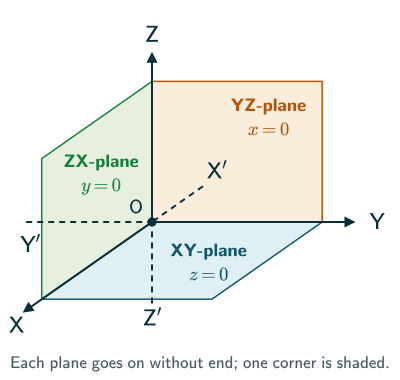
Consider three planes intersecting at a point O such that these three planes are mutually perpendicular to each other (Fig 11.1). These three planes intersect along the lines X′OX, Y′OY and Z′OZ, called the x, y and z-axes, respectively.
NCERT Mathematics (Class 11), Section 11.2, page 209
The point O is called the origin of the coordinate system.
NCERT Mathematics (Class 11), Section 11.2, page 209
In plain words: a point on a sheet of paper needs two numbers, its distances from two perpendicular lines. A point in a room needs one more, its height. NCERT’s example is the tip of a bulb hanging from the ceiling (Section 11.1, page 208):
we need not only two but three numbers representing the perpendicular distances of the point from three mutually perpendicular planes, namely the floor of the room and two adjacent walls of the room.
NCERT Mathematics (Class 11), Section 11.1, page 208
The three axes are the three edges that meet at one corner of the room: two along the floor and one going up. A point of space is then named by an ordered triplet (x, y, z) of real numbers, an element of R × R × R, just as a point of the plane is an ordered pair in the coordinate plane. Here x, y and z are the point’s signed perpendicular distances from the YZ-, ZX- and XY-planes, respectively (NCERT Section 11.3, page 210); which side counts as positive is set out below.
The three coordinate planes
The planes XOY, YOZ and ZOX, called, respectively the XY-plane, YZ-plane and the ZX-plane, are known as the three coordinate planes.
NCERT Mathematics (Class 11), Section 11.2, page 209
Each coordinate plane contains two axes and is perpendicular to the third. Every point of the XY-plane is at height 0, so its z-coordinate is 0; and every point with z = 0 is in the XY-plane. So z = 0 is the equation of the XY-plane. In the same way:
Equations of the coordinate planes
XY-plane: z = 0
YZ-plane: x = 0
ZX-plane: y = 0
NCERT also calls the ZX-plane the “XZ-plane” (Exercise 11.1, Q2); it is the same plane. Two coordinate planes meet in an axis: the XY- and ZX-planes meet in the x-axis, so a point of the x-axis has y = 0 and z = 0.
Planes parallel to the coordinate planes (JEE). The plane 3 units above the XY-plane and parallel to it is z = 3: its points all have height 3, with any x and y. In general z = c, x = a and y = b are planes parallel to the XY-, YZ- and ZX-planes.
Which way is positive.
The distances measured from XY-plane upwards in the direction of OZ are taken as positive and those measured downwards in the direction of OZ′ are taken as negative.
NCERT Mathematics (Class 11), Section 11.2, page 209
In the same way, NCERT takes distances to the right of the ZX-plane (along OY) and in front of the YZ-plane (along OX) as positive (page 209). So OX, OY and OZ are the positive halves of the axes, and OX′, OY′ and OZ′ the negative halves. NCERT’s figures use the standard right-handed arrangement: if the fingers of your right hand curl from OX towards OY, your thumb points along OZ.
Octants
The three coordinate planes divide the space into eight parts known as octants.
NCERT Mathematics (Class 11), Section 11.2, page 209
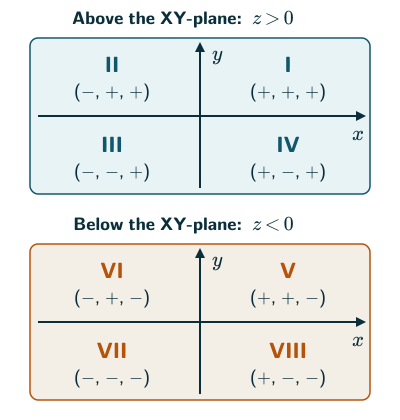
NCERT names the octants XOYZ, X′OYZ, X′OY′Z, XOY′Z, XOYZ′, X′OYZ′, X′OY′Z′ and XOY′Z′, and numbers them I to VIII in that order (page 209). Each name lists the three half-axes that bound the octant, and a primed letter is a negative half-axis, so the name gives the signs of the coordinates:
The sign of the coordinates of a point determine the octant in which the point lies.
NCERT Mathematics (Class 11), Section 11.3, page 210
| Octant | Bounded by | Signs of (x, y, z) |
|---|---|---|
| I | OX, OY, OZ | (+, +, +) |
| II | OX′, OY, OZ | (−, +, +) |
| III | OX′, OY′, OZ | (−, −, +) |
| IV | OX, OY′, OZ | (+, −, +) |
| V | OX, OY, OZ′ | (+, +, −) |
| VI | OX′, OY, OZ′ | (−, +, −) |
| VII | OX′, OY′, OZ′ | (−, −, −) |
| VIII | OX, OY′, OZ′ | (+, −, −) |
The signs are those of NCERT Table 11.1 (page 210). There is an easy way to remember them. Octants I to IV lie above the XY-plane (z > 0), in the same order as quadrants I to IV of the xy-plane. Octants V to VIII lie directly below them (z < 0): V under I, VI under II, VII under III and VIII under IV.
A point with a coordinate equal to 0 is in none of the octants: it lies on one or more coordinate planes, on the boundaries of octants. Exactly one zero coordinate puts it between two octants; two zero coordinates put it on an axis, and the origin borders all eight. For example, (3, 0, −2) lies on the ZX-plane, between octants V and VIII.
Solved examples
Example 1: Two points, two octants (NCERT Example 2, page 211)
Find the octants in which (−3, 1, 2) and (−3, 1, −2) lie.
(−3, 1, 2) has signs (−, +, +): octant II. (−3, 1, −2) has signs (−, +, −): octant VI, directly below it.
Answer: II and VI.
Example 2: Reading the signs (NCERT Exercise 11.1, Q3, page 211)
Name the octants of (1, 2, 3), (4, −2, 3), (4, −2, −5) and (4, 2, −5).
The signs are (+, +, +), (+, −, +), (+, −, −) and (+, +, −).
Answer: I, IV, VIII and V.
Example 3: Fill in the blanks (NCERT Exercise 11.1, Q4 (i) and (iii), page 211)
(i) The x-axis and y-axis taken together determine a plane known as ____. (iii) Coordinate planes divide the space into ____ octants.
Answer: (i) the XY-plane; (iii) eight.
Example 4: Signs given in letters
If a < 0, b > 0 and c < 0, in which octant does (a, −b, c) lie?
a is negative, −b is negative and c is negative: the signs are (−, −, −).
Answer: octant VII.
Example 5: Directions in words
A point is 3 units behind the YZ-plane, 2 units to the right of the ZX-plane and 4 units below the XY-plane. Find its coordinates and its octant.
Behind the YZ-plane means x is negative, to the right of the ZX-plane means y is positive, and below the XY-plane means z is negative.
Answer: (−3, 2, −4), in octant VI.
Example 6: A mirror image
Find the image of P(2, −3, 5) in the XY-plane, used as a mirror, and the octants of P and its image.
The mirror keeps x and y and changes the sign of the height z: the image is (2, −3, −5).
Answer: P is in octant IV and its image in octant VIII, directly below.
Common mistakes to avoid
Common mistake
Writing the XY-plane as x = 0, y = 0
The XY-plane is z = 0. The two equations x = 0 and y = 0 together describe the z-axis, where the YZ- and ZX-planes meet.
Common mistake
Numbering the octants round in a circle
Octant V is not next to IV. Octants I to IV go round above the XY-plane, and V to VIII repeat the same order below it: V is under I.
Common mistake
Giving an octant to a point on a coordinate plane
(0, 4, −1) and (3, 0, −2) are in no octant: each has a zero coordinate, so it lies on a coordinate plane.
Common mistake
Treating the XZ-plane and the ZX-plane as two planes
They are the same plane, y = 0. NCERT uses both names.
Quick revision summary
- Three mutually perpendicular lines X′OX, Y′OY and Z′OZ, the x-, y- and z-axes, meet at the origin O.
- The coordinate planes are the XY-plane (z = 0), the YZ-plane (x = 0) and the ZX-plane (y = 0); z = c is a plane parallel to the XY-plane.
- The three planes cut space into eight octants. I to IV lie above the XY-plane in quadrant order, and V to VIII lie below them in the same order.
- The signs of (x, y, z) give the octant; a point with a zero coordinate lies on a coordinate plane, in no octant.
Formula sheet
- XY-plane: z = 0; YZ-plane: x = 0; ZX-plane: y = 0
- x-axis: y = 0 and z = 0
- octants I to IV: (+, +, +), (−, +, +), (−, −, +), (+, −, +)
- octants V to VIII: (+, +, −), (−, +, −), (−, −, −), (+, −, −)
Questions students ask
Why are there eight octants in 3D geometry?
There are eight octants in 3D geometry because each of the three coordinate planes cuts space into two halves, so a point on none of the planes has an x-, a y- and a z-coordinate that are each either positive or negative, and 2 × 2 × 2 = 8 sign patterns are possible. Each pattern is one octant: (+, −, +), for example, is octant IV in NCERT Table 11.1. The same count gives 2 × 2 = 4 quadrants in a plane and 2 half-lines on a number line.
What is the difference between a quadrant and an octant?
A quadrant is one of the four regions into which the x- and y-axes divide a plane, while an octant is one of the eight regions into which the XY-, YZ- and ZX-planes divide space. A quadrant is fixed by the signs of two coordinates and an octant by the signs of three, so octants need three dimensions. The two fit together: the part of the XY-plane where x > 0 and y > 0, its first quadrant, is the floor of octant I (+, +, +) above it and the ceiling of octant V (+, +, −) below it.
What is the equation of the x-axis in 3D geometry?
The x-axis in 3D geometry is given by two equations taken together, y = 0 and z = 0: it is the line where the ZX-plane (y = 0) meets the XY-plane (z = 0). One linear equation alone describes a plane, because in space y = 0 by itself is the whole ZX-plane, not a line. In the same way, the line through (5, −2, 3) parallel to the x-axis is y = −2 and z = 3, where the planes y = −2 and z = 3 meet.
What is the z-axis in 3D geometry?
The z-axis in 3D geometry is the line Z′OZ through the origin perpendicular to both the x- and y-axes, and so perpendicular to the XY-plane; with the XY-plane drawn horizontal, as in NCERT, it is vertical, and the z-coordinate of a point is its height above the XY-plane, negative below it. Its positive half OZ is chosen to make the axes a right-handed system: with x pointing towards you and y to the right, as in NCERT Fig 11.1, OZ points up. Reversing any one of the three axes would make the system left-handed.
Is three dimensional geometry in Class 11 or Class 12?
Three dimensional geometry is taught in both classes: NCERT Class 11 Chapter 11, Introduction to Three Dimensional Geometry, covers the coordinate axes and planes, the octants, the coordinates of a point and the distance formula. NCERT Class 12 Chapter 11, Three Dimensional Geometry, covers direction cosines and direction ratios, the equation of a line, the angle between two lines and the shortest distance between two lines. The JEE Main syllabus puts both parts in one unit, Unit 11, together with the section formula.
Practice questions
Try each question first, then open the answer to check your working.
-
Q1. Name the octants of (−4, 2, −5), (−4, 2, 5), (−3, −1, 6) and (−2, −4, −7) (NCERT Exercise 11.1, Q3).
Show answerHide answer
VI, II, III and VII: the signs are (−, +, −), (−, +, +), (−, −, +) and (−, −, −).
-
Q2. Which coordinate plane is perpendicular to the z-axis, and what is its equation?
Show answerHide answer
The XY-plane, z = 0.
-
Q3. In which octants is x positive?
Show answerHide answer
I, IV, V and VIII: the octants bounded by OX.
-
Q4. Write the equation of the plane parallel to the ZX-plane and 5 units to the left of it.
Show answerHide answer
y = −5: to the left of the ZX-plane is the direction of OY′, where y is negative.