Coordinates of a point in space
NCERT Class 11 Mathematics Chapter 11 Section 11.3
Quick answer
To find the coordinates of a point P, drop a perpendicular PM to the XY-plane and then ML to the x-axis: with O the origin, OL = x, LM = y and MP = z, taken with signs, and P is the ordered triplet (x, y, z). A point on the x-axis has the form (x, 0, 0) and a point of the YZ-plane (0, y, z). The distances of P from the YZ-, ZX- and XY-planes are |x|, |y| and |z|.
With your textbook
NCERT Mathematics (Class 11), Chapter 11 “Introduction to Three Dimensional Geometry”, Section 11.3 “Coordinates of a Point in Space”, pages 209–211.
Open the official NCERT chapter (PDF, 1.3 MB, ncert.nic.in) (opens in a new tab)
Checked against the 2026-27 reprint on .
The coordinates of a point
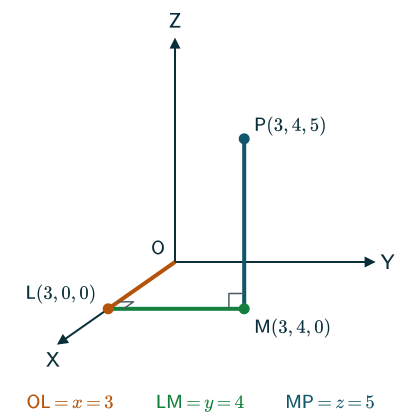
Take any point P in space. NCERT first drops a perpendicular PM from P to the XY-plane, with foot M (Section 11.3, page 209, Fig 11.2), and then:
Coordinates of a point in space
Then, from the point M, we draw a perpendicular ML to the x-axis, meeting it at L. Let OL be x, LM be y and MP be z. Then x,y and z are called the x, y and z coordinates, respectively, of the point P in the space.
NCERT Mathematics (Class 11), Section 11.3, page 209
In plain words: walk x along the x-axis to L, turn and walk y parallel to the y-axis to M, then climb z straight up to P. Each step is taken with a sign: a step along OX′, OY′ or OZ′ counts as negative, so a point in another octant gets negative coordinates. The three numbers, in this order, form the ordered triplet (x, y, z), an element of R × R × R. (2, 4, 5) and (4, 2, 5) are different points.
From a triplet back to a point
The steps also run backwards. Given (x, y, z), mark L on the x-axis at x, go to the point M of the XY-plane with coordinates (x, y), and move z along the perpendicular to the XY-plane at M (NCERT page 210). Every point gets exactly one triplet and every triplet gives exactly one point:
Thus, there is a one to one correspondence between the points in space and ordered triplet (x, y, z) of real numbers.
NCERT Mathematics (Class 11), Section 11.3, page 210
This is the same idea as in the coordinate plane, with one more number for the height.
The box through P
NCERT gives a second way to read the coordinates:
Alternatively, through the point P in the space, we draw three planes parallel to the coordinate planes, meeting the x-axis, y-axis and z-axis in the points A, B and C, respectively (Fig 11.3). Let OA = x, OB = y and OC = z.
NCERT Mathematics (Class 11), Section 11.3, page 210
When all three coordinates are non-zero, the three planes and the coordinate planes make a rectangular box with O and P at opposite corners. Its eight corners have only the coordinates 0, x, y and z: a corner on an axis (A, B, C) keeps one coordinate of P, D, E and F keep two, and P keeps all three. If a coordinate is zero, that dimension collapses and some corners coincide; the coordinate and projection rules still apply.
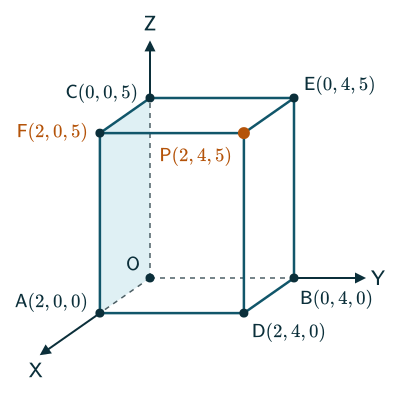
Distances from the coordinate planes. The edges of the box show how far P is from each coordinate plane: PE = OA from the YZ-plane, PF = OB from the ZX-plane and PD = OC from the XY-plane. NCERT puts it this way:
We observe that if P (x, y, z) is any point in the space, then x, y and z are perpendicular distances from YZ, ZX and XY planes, respectively.
NCERT Mathematics (Class 11), Section 11.3, page 210
Read literally, this holds only when x, y and z are not negative: a distance is never negative, but a coordinate can be, as in (−3, 1, 2) of NCERT Example 2 (page 211). NCERT’s statement fits its own convention in Section 11.2 (page 209), where distances measured along OX′, OY′ or OZ′ count as negative, so the coordinates are signed distances. The perpendicular distances of P(x, y, z) from the YZ-, ZX- and XY-planes are |x|, |y| and |z|; (−3, 1, 2) is 3 units behind the YZ-plane. The summary (page 215) uses the same loose wording.
Points on the axes and planes
The coordinates of the origin O are (0,0,0). The coordinates of any point on the x-axis will be as (x,0,0) and the coordinates of any point in the YZ-plane will be as (0, y, z).
NCERT Mathematics (Class 11), Section 11.3, page 210
A point of a coordinate plane has 0 for the coordinate missing from the plane’s name (z for the XY-plane), and a point on an axis has the other two coordinates equal to 0:
| Where the point is | Its form |
|---|---|
| origin | (0, 0, 0) |
| x-axis | (x, 0, 0) |
| y-axis | (0, y, 0) |
| z-axis | (0, 0, z) |
| XY-plane | (x, y, 0) |
| YZ-plane | (0, y, z) |
| ZX-plane | (x, 0, z) |
Feet of perpendiculars (JEE). The foot of the perpendicular from P(x, y, z) to a coordinate plane keeps the two coordinates of that plane and puts 0 for the third: on the XY-plane it is M(x, y, 0). The foot on an axis keeps one coordinate: on the x-axis it is L(x, 0, 0). PM and ML are both perpendicular to the x-axis, so the plane PML, and the line PL in it, is perpendicular to it too. The mirror image of P in a coordinate plane lies on the same perpendicular, as far beyond the plane as P is in front of it, so the coordinate missing from the plane’s name changes sign: in the XY-plane it is (x, y, −z), with the foot (x, y, 0) halfway between.
Solved examples
Example 1: A corner of the box (NCERT Example 1, page 211)
In NCERT Fig 11.3, if P is (2, 4, 5), find the coordinates of F.
F is the corner of the box in the ZX-plane, directly above A and level with C. Its distance along OY is 0, and it keeps x = 2 and z = 5.
Answer: F(2, 0, 5).
Example 2: A point on the x-axis (NCERT Exercise 11.1, Q1, page 211)
A point is on the x-axis. What are its y-coordinate and z-coordinate?
The x-axis is where the XY- and ZX-planes meet, so the point has z = 0 and y = 0.
Answer: both are 0; the point is (x, 0, 0).
Example 3: A point in the XZ-plane (NCERT Exercise 11.1, Q2, page 211)
A point is in the XZ-plane. What can you say about its y-coordinate?
The XZ-plane is the ZX-plane, on which every point has y = 0.
Answer: its y-coordinate is 0; the point is (x, 0, z).
Example 4: Points of the XY-plane (NCERT Exercise 11.1, Q4 (ii), page 211)
The coordinates of points in the XY-plane are of the form ____.
Answer: (x, y, 0).
Example 5: Feet and distances
For P(−3, 4, −5), find the feet of the perpendiculars from P to the three coordinate planes, and the distances of P from them.
Keep two coordinates and put 0 for the third. On the XY-plane: (−3, 4, 0); on the YZ-plane: (0, 4, −5); on the ZX-plane: (−3, 0, −5).
Answer: feet (−3, 4, 0), (0, 4, −5) and (−3, 0, −5) on the XY-, YZ- and ZX-planes, at distances 5, 3 and 4.
Example 6: The whole box
P is (−2, 3, 4). Find the six corners of the box with O and P at opposite corners, other than O and P.
On the axes: A(−2, 0, 0), B(0, 3, 0) and C(0, 0, 4). On the coordinate planes: (−2, 3, 0) in the XY-plane, (0, 3, 4) in the YZ-plane and (−2, 0, 4) in the ZX-plane.
Answer: (−2, 0, 0), (0, 3, 0), (0, 0, 4), (−2, 3, 0), (0, 3, 4) and (−2, 0, 4). The box lies behind the YZ-plane, because x = −2.
Common mistakes to avoid
Common mistake
Taking a coordinate as a distance
(−3, 1, 2) is 3 units from the YZ-plane, not −3. The distance is |x|; the sign only says on which side of the plane the point is.
Common mistake
Getting the foot of the perpendicular backwards
The foot of P(x, y, z) on the XY-plane is (x, y, 0), not (0, 0, z). The plane keeps its own two coordinates.
Common mistake
Setting two coordinates to 0 for a plane
A point of the YZ-plane has only x = 0, as in (0, 4, −5). Two zero coordinates put the point on an axis.
Common mistake
Distance from a plane or from an axis
P(3, 4, 5) is 3 units from the YZ-plane, but its distance from the x-axis is not 3. That distance is PL, from P to L(3, 0, 0), which depends on y and z; it needs the distance formula of the next section (here √41).
Common mistake
Changing the order of the triplet
(2, 4, 5) and (4, 2, 5) are different points: the first number is always x, the second y and the third z.
Quick revision summary
- P(x, y, z): drop PM to the XY-plane and ML to the x-axis; then OL = x, LM = y and MP = z, each with a sign.
- Points of space and ordered triplets of real numbers match one to one.
- Planes through P parallel to the coordinate planes make a box with O and P at opposite corners; its corners use only 0, x, y and z.
- On the axes: (x, 0, 0), (0, y, 0), (0, 0, z). On the planes: (x, y, 0), (0, y, z), (x, 0, z).
- The distances of P from the YZ-, ZX- and XY-planes are |x|, |y| and |z|.
Formula sheet
- origin (0, 0, 0); x-axis (x, 0, 0); y-axis (0, y, 0); z-axis (0, 0, z)
- XY-plane (x, y, 0); YZ-plane (0, y, z); ZX-plane (x, 0, z)
- foot of P(x, y, z) on the XY-plane: (x, y, 0); on the x-axis: (x, 0, 0)
- distances from the YZ-, ZX- and XY-planes: |x|, |y|, |z|
Questions students ask
What is the distance of a point from the x-axis in 3D?
The distance of a point P(x, y, z) from the x-axis in 3D is √(y2 + z2), the length of the perpendicular from P to its foot (x, 0, 0) on the axis; likewise it is √(z2 + x2) from the y-axis and √(x2 + y2) from the z-axis. The coordinate along the axis plays no part, and in the plane, with no z, the distance from the x-axis is just |y|. For P(6, −3, 4), the distance from the x-axis is √(9 + 16) = 5 and from the z-axis √(36 + 9) = 3√5.
What is the image of a point in the XY-plane and in the x-axis?
The image (mirror reflection) of P(x, y, z) in the XY-plane is (x, y, −z): the coordinate that is 0 on the plane changes sign, and the foot (x, y, 0) is the mid-point of P and its image. The image in the x-axis changes the other two signs, giving (x, −y, −z), because there the foot is (x, 0, 0), and the image in the origin O changes all three, giving (−x, −y, −z). For P(4, −1, 6), the images are (4, −1, −6) in the XY-plane, (4, 1, −6) in the x-axis and (−4, 1, −6) in the origin.
How do you plot a point such as (4, −3, 2) in 3D?
To plot the point (4, −3, 2) in 3D, move 4 units from O along OX to L(4, 0, 0), then 3 units parallel to the y-axis in the direction of OY′ to M(4, −3, 0) in the XY-plane, and finally 2 units up, parallel to OZ, to P(4, −3, 2). The order of the three moves does not matter, since each one changes only its own coordinate. Its signs (+, −, +) put the point in octant IV, and drawing the box with O and P at opposite corners, hidden edges dashed, makes its position easy to read.
Are spherical and cylindrical coordinates in the JEE Main syllabus?
No, spherical and cylindrical coordinates are not in the JEE Main syllabus: its Unit 11 and the NCERT three dimensional geometry chapters use only rectangular (Cartesian) coordinates (x, y, z), measured along three mutually perpendicular axes. Cylindrical coordinates (r, θ, z) keep the height z and give the foot (x, y, 0) by its polar coordinates, x = r cos θ and y = r sin θ, while spherical coordinates give a point by its distance OP from the origin and two angles. Both are used in university calculus and physics, for problems with cylindrical or spherical symmetry.
Practice questions
Try each question first, then open the answer to check your working.
-
Q1. In NCERT Fig 11.3, if P is (2, 4, 5), find the coordinates of D and E.
Show answerHide answer
D is the corner in the XY-plane, (2, 4, 0); E is the corner in the YZ-plane, (0, 4, 5).
-
Q2. Write the form of a point on the z-axis, and of a point in the ZX-plane.
Show answerHide answer
(0, 0, z) and (x, 0, z).
-
Q3. How far is (4, −7, −2) from each coordinate plane?
Show answerHide answer
4 from the YZ-plane, 7 from the ZX-plane and 2 from the XY-plane.
-
Q4. Find the foot of the perpendicular from (5, −1, 3) to the YZ-plane, and to the y-axis.
Show answerHide answer
(0, −1, 3) on the YZ-plane and (0, −1, 0) on the y-axis.