Section formula in three dimensions
Beyond NCERT In the JEE Main syllabus; the Class 11 book has no section for it.
Quick answer
The point dividing the segment from P(x, y, z) to Q(x, y, z) internally in the ratio m : n is ((mx + nx)/(m + n), (my + ny)/(m + n), (mz + nz)/(m + n)): the plane section formula used for each coordinate. With m = n it gives the mid-point, and the centroid of a triangle is the average of its three vertices.
Dividing a segment in a given ratio
For distinct endpoints P and Q, take m, n > 0 as the parts of an ordinary length ratio.
Section formula in space
- The point R that divides the segment from P(x1, y1, z1) to Q(x2, y2, z2) internally in the ratio m : n (so PR : RQ = m : n) is R((mx2 + nx1)/(m + n), (my2 + ny1)/(m + n), (mz2 + nz1)/(m + n)).
- For external division in the ratio m : n (m ≠ n), replace n by −n: each coordinate is (mx2 − nx1)/(m − n), and so on.
JEE Main 2027 lists the “section formula” in Unit 11, Three Dimensional Geometry, right after the distance between two points. The 2026–27 NCERT Class 11 chapter has no section on it, though its Example 9 and Miscellaneous Exercise use the centroid and mid-points. The Class 12 NCERT book derives it with vectors (NCERT Vector Algebra, Section 10.5.3, page 352), proving internal division and leaving external division as an exercise.
In plain words: work out each coordinate on its own with the section formula of the plane. Each end is multiplied by the part of the ratio next to the other end: m, the part next to P, multiplies Q’s coordinates, and n multiplies P’s.
Internal division in the ratio m : n
x = (mx + nx)/(m + n)
y = (my + ny)/(m + n)
z = (mz + nz)/(m + n)
Why it works
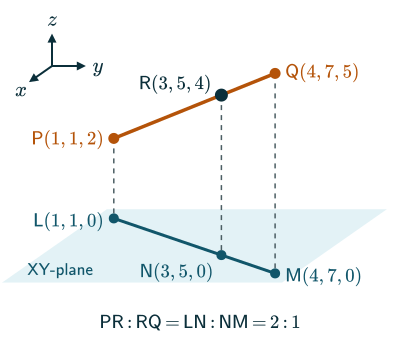
Let R(x, y, z) divide PQ in the ratio m : n. Drop perpendiculars PL, RN and QM to the XY-plane. PL and QM are both perpendicular to the XY-plane, so they are parallel and lie in one plane. That plane contains P and Q, so it contains the line PQ, the point R and RN (the line through R parallel to PL). So the feet L(x1, y1, 0), N(x, y, 0) and M(x2, y2, 0) lie on the line where that plane meets the XY-plane. Parallel lines cut two transversals in the same ratio, so
LN : NM = PR : RQ = m : n.
So N divides LM in the ratio m : n inside the XY-plane, and the plane section formula gives x = (mx2 + nx1)/(m + n) and y = (my2 + ny1)/(m + n). Dropping the perpendiculars to the ZX-plane instead gives z = (mz2 + nz1)/(m + n) in the same way. (If PQ is perpendicular to the XY-plane, the three feet coincide and x and y are constant, as the formula gives.)
External division. R divides PQ externally in the ratio m : n when R is on the line PQ but outside the segment, with PR : RQ = m : n. Outside the segment, PR and RQ point in opposite directions, so with signed lengths PR : RQ = m : (−n), and the same argument replaces n by −n. R lies beyond Q when m > n and beyond P when m < n. The formula fails for m = n: no point of the line PQ outside the segment is equally far from P and Q.
The ratio form. Writing k = m/n, the point dividing PQ in the ratio k : 1 is ((kx2 + x1)/(k + 1), (ky2 + y1)/(k + 1), (kz2 + z1)/(k + 1)). The same expression extends to a signed ratio parameter k: positive k means internal division, negative k other than −1 means external division with length ratio |k| : 1, and k = −1 gives no point. This form is the quickest way to find an unknown ratio.
Mid-point and centroid
With m = n = 1 the formula gives the mid-point; the centroid, worked out below, is the average of three vertices:
Mid-point and centroid, coordinate by coordinate
mid-point: x = (x + x)/2
centroid: x = (x + x + x)/3
the same for y and for z
The centroid G of a triangle ABC is where its medians meet, as in the plane (see the centres of a triangle). It divides the median from A in the ratio 2 : 1. With A(x1, y1, z1) and D((x2 + x3)/2, …), the mid-point of BC:
x = (2 × (x2 + x3)/2 + 1 × x1)/3 = (x1 + x2 + x3)/3,
and the same for y and z. The centroid is the average of the three vertices.
Two more uses.
- The diagonals of a parallelogram ABCD bisect each other, so A + C = B + D coordinate by coordinate, and the fourth vertex is D = A + C − B.
- The centroid of a tetrahedron with vertices A, B, C and D is the average of the four: ((x1 + x2 + x3 + x4)/4, …).
Where a coordinate plane cuts a segment
The XY-plane is z = 0. If it meets the line PQ at a unique point and z2 ≠ 0, the signed ratio parameter k : 1 satisfies (kz2 + z1)/(k + 1) = 0, so
k = −z1/z2.
The plane cuts the segment itself (k > 0) exactly when P and Q are on opposite sides of it, that is when z1 and z2 have opposite signs. If exactly one endpoint has z = 0, that endpoint is the intersection. If both have z = 0, the whole line lies in the plane, so there is no unique dividing point. Equal non-zero heights give a parallel line with no intersection. In the same way, the YZ-plane divides PQ in the ratio −x1 : x2 and the ZX-plane in the ratio −y1 : y2.
Solved examples
Example 1: Internal and external division
Find the points that divide the segment from P(1, −2, 3) to Q(3, 4, −5) in the ratio 2 : 3 (i) internally, (ii) externally.
(i) Internally:
x = (2 × 3 + 3 × 1)/5 = 9/5
y = (2 × 4 + 3 × (−2))/5 = 2/5
z = (2 × (−5) + 3 × 3)/5 = −1/5
(ii) Externally, the denominator is 2 − 3 = −1:
x = (2 × 3 − 3 × 1)/(−1) = −3
y = (2 × 4 − 3 × (−2))/(−1) = −14
z = (2 × (−5) − 3 × 3)/(−1) = 19
Answer: (9/5, 2/5, −1/5) and (−3, −14, 19); the second lies beyond P, since 2 < 3.
Example 2: The third vertex from the centroid (NCERT Example 9, pages 214–215)
The centroid of triangle ABC is (1, 1, 1), with A(3, −5, 7) and B(−1, 7, −6). Find C(x, y, z).
(3 − 1 + x)/3 = 1
(−5 + 7 + y)/3 = 1
(7 − 6 + z)/3 = 1
Answer: x = 1, y = 1, z = 2: C is (1, 1, 2).
Example 3: The fourth vertex of a parallelogram (NCERT Miscellaneous Exercise on Chapter 11, Q1, page 215)
Three vertices of a parallelogram ABCD are A(3, −1, 2), B(1, 2, −4) and C(−1, 1, 2). Find D.
The diagonals AC and BD have the same mid-point, so D = A + C − B.
Coordinate by coordinate, x = 3 − 1 − 1 = 1, y = −1 + 1 − 2 = −2 and z = 2 + 2 + 4 = 8.
Answer: D = (1, −2, 8).
Example 4: Lengths of the medians (NCERT Miscellaneous Exercise on Chapter 11, Q2, page 215)
Find the lengths of the medians of the triangle with vertices A(0, 0, 6), B(0, 4, 0) and C(6, 0, 0). NCERT prints the third vertex as just “(6, 0, 0)”, without its letter.
The mid-points of BC, CA and AB are (3, 2, 0), (3, 0, 3) and (0, 2, 3). Each median runs from a vertex to the mid-point of the opposite side, and the distance formula gives its length:
from A: √(9 + 4 + 36) = 7
from B: √(9 + 16 + 9) = √34
from C: √(36 + 4 + 9) = 7
Answer: 7, √34 and 7.
Example 5: Origin as the centroid (NCERT Miscellaneous Exercise on Chapter 11, Q3, page 215)
The origin is the centroid of triangle PQR with P(2a, 2, 6), Q(−4, 3b, −10) and R(8, 14, 2c). Find a, b and c.
Each coordinate sum is 0: 2a − 4 + 8 = 0, 2 + 3b + 14 = 0 and 6 − 10 + 2c = 0.
Answer: a = −2, b = −16/3, c = 2.
Example 6: Where the XY-plane cuts a segment
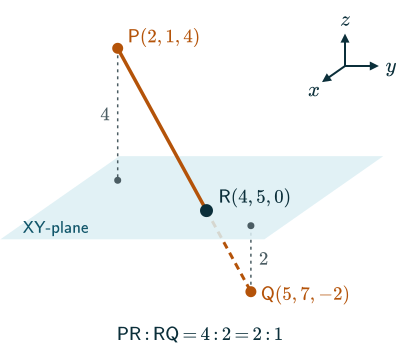
Find the ratio in which the XY-plane divides the segment from P(2, 1, 4) to Q(5, 7, −2), and the point where it cuts it.
k = −z1/z2 = −4/(−2) = 2, so the ratio is 2 : 1, internally.
Then x = (2 × 5 + 2)/3 = 4, y = (2 × 7 + 1)/3 = 5 and z = 0.
Answer: 2 : 1, internally, at R(4, 5, 0).
Common mistakes to avoid
Common mistake
Putting the weights on the wrong ends
For PR : RQ = m : n, the numerator is mx2 + nx1: m, the part next to P, multiplies the coordinate of Q. Swapping them gives the point that divides PQ in the ratio n : m.
Common mistake
Forgetting the minus signs in external division
External division in the ratio m : n needs (mx2 − nx1)/(m − n). In Example 1 (ii) the denominator is 2 − 3 = −1, and dropping it gives (3, 14, −19), the wrong point.
Common mistake
Reading a negative k as an answer
If k = −z1/z2 is negative, the XY-plane does not cut the segment. If k ≠ −1, it meets the line PQ outside the segment, dividing PQ externally in the ratio |k| : 1. If k = −1 (z1 = z2), PQ is parallel to the plane and never meets it.
Common mistake
Using A + B − C for the fourth vertex
In the parallelogram ABCD, A and C are opposite, so D = A + C − B. A + B − C gives the fourth vertex of a different parallelogram, one in which AB is a diagonal. If the order ABCD is not given, A + C − B, A + B − C and B + C − A are all possible.
Quick revision summary
- The point dividing PQ internally in the ratio m : n is ((mx2 + nx1)/(m + n), (my2 + ny1)/(m + n), (mz2 + nz1)/(m + n)); externally, replace n by −n.
- It is the plane section formula applied to each coordinate; the perpendiculars to a coordinate plane carry the ratio to the feet.
- The mid-point (m = n) is the average of two points, the centroid of a triangle the average of three, and of a tetrahedron the average of four.
- The XY-plane divides PQ in the ratio −z1 : z2; it crosses the segment between P and Q only when z1 and z2 have opposite signs.
Formula sheet
- internal m : n: ((mx + nx)/(m + n), (my + ny)/(m + n), (mz + nz)/(m + n))
- external m : n: ((mx − nx)/(m − n), (my − ny)/(m − n), (mz − nz)/(m − n))
- mid-point: ((x + x)/2, (y + y)/2, (z + z)/2)
- centroid: ((x + x + x)/3, (y + y + y)/3, (z + z + z)/3)
- XY-plane unique intersection: signed ratio −z : z, z ≠ z
Questions students ask
Is the section formula in 3D in Class 11, or only in JEE?
The section formula in 3D is in the JEE Main syllabus (Unit 11, Three Dimensional Geometry), but the current NCERT Class 11 book has no section on it: its chapter ends with the distance formula, though NCERT Example 9 and the Miscellaneous Exercise use the centroid and mid-points. NCERT Class 12 proves the section formula in vector form, and its coordinate form is the one on this page. For JEE Main it is worth learning in full, with external division and the ratio in which a coordinate plane cuts a segment.
What is the section formula in vector form?
In vector form, the point R that divides PQ internally in the ratio m : n has position vector r = (mb + na)/(m + n), where a and b are the position vectors of P and Q; NCERT Class 12 proves it in Vector Algebra (Section 10.5.3). Writing a = x1î + y1ĵ + z1k̂, b in the same way, and comparing components gives the three coordinate formulas on this page, so the two forms are one result. The mid-point has position vector (a + b)/2; position vectors in space are introduced on the physics page on vectors in three dimensions.
When do you use the section formula in 3D?
Use the section formula in 3D whenever a problem ties a ratio to the line through two given points: to find the point dividing a segment in a known ratio or, writing the ratio as k : 1, the ratio in which a known point or plane divides it. Typical uses are mid-points and centroids, the fourth vertex of a parallelogram, a collinearity test (one k must fit all three coordinates), the point where a segment crosses a coordinate plane, and the foot of an angle bisector: in triangle ABC the internal bisector from A meets BC at the point dividing it in the ratio AB : AC. Lengths need the distance formula instead.
In what ratio does a plane parallel to a coordinate plane divide a segment?
The plane x = c, parallel to the YZ-plane, divides the segment from P to Q in the ratio (c − x1) : (x2 − c), provided x1 ≠ x2, where these are the x-coordinates of P and Q: it comes from setting the x-coordinate (kx2 + x1)/(k + 1) of the dividing point equal to c. When c lies between x1 and x2, the ratio is positive and the plane cuts the segment itself; the absolute values of the two parts give the ordinary length ratio. If x1 = x2, the entire segment is in the plane when that value equals c, and there is no intersection otherwise. The planes y = c and z = c work the same way, and c = 0 gives the coordinate planes. For P(2, −1, 5) and Q(8, 5, −1), the plane x = 4 gives the ratio 2 : 4 = 1 : 2 and the crossing point (4, 1, 3).
Practice questions
Try each question first, then open the answer to check your working.
-
Q1. Find the mid-point of (−1, 4, 6) and (3, −2, 0).
Show answerHide answer
Halve the sums of the coordinates, 2, 2 and 6: the mid-point is (1, 1, 3).
-
Q2. Find the point that divides the segment from A(2, 1, −3) to B(5, −8, 3) internally in the ratio 1 : 2.
Show answerHide answer
((1 × 5 + 2 × 2)/3, (1 × (−8) + 2 × 1)/3, (1 × 3 + 2 × (−3))/3) = (3, −2, −1).
-
Q3. Find the centroid of the triangle with vertices (1, 2, 3), (−2, 0, 5) and (4, 1, −2).
Show answerHide answer
The sums of the coordinates are 3, 3 and 6; divide by 3: the centroid is (1, 1, 2).
-
Q4. In what ratio does the YZ-plane divide the segment from (−2, 4, 7) to (3, −5, 8)? Find the point where it cuts it.
Show answerHide answer
k = −x1/x2 = 2/3, so the ratio is 2 : 3, internally. The point is (0, (2 × (−5) + 3 × 4)/5, (2 × 8 + 3 × 7)/5) = (0, 2/5, 37/5).