Intuitive idea of derivatives
NCERT Class 11 Mathematics Chapter 12 Sections 12.1–12.2
Quick answer
The instantaneous rate of change of a function at a point is the value its average rate of change approaches as the interval shrinks to that point from either side; this value is the derivative at that point and, on the graph, the slope of the tangent. For a body falling s = 4.9t metres in t seconds, the average velocity between 2 and 2 + h is 19.6 + 4.9h, so its velocity at t = 2, the instantaneous rate of change of downward displacement, is exactly 19.6 m/s.
With your textbook
NCERT Mathematics (Class 11), Chapter 12 “Limits and Derivatives”, Sections 12.1–12.2 “Introduction” and “Intuitive Idea of Derivatives”, pages 217–220.
Open the official NCERT chapter (PDF, 3.4 MB, ncert.nic.in) (opens in a new tab)
Checked against the 2026-27 reprint on .
Velocity at an instant
Calculus is that branch of mathematics which mainly deals with the study of change in the value of a function as the points in the domain change.
NCERT Mathematics (Class 11), Section 12.1, page 217
NCERT starts with a falling body. Ignoring air resistance and taking downward as positive, a body dropped from rest from a tall cliff falls s = 4.9t2 metres in t seconds (Section 12.2, page 217). Assume the body has not reached the ground during the times considered. How fast is it moving at exactly t = 2 seconds?
Average and instantaneous velocity
- The average velocity between t1 and t2 is the change in position (displacement) divided by the time taken: (s(t2) − s(t1))/(t2 − t1).
- The instantaneous velocity at t = a is the value that the average velocities over shorter and shorter intervals starting or ending at a approach; both sides must give the same value.
Here the motion is always downward, so displacement equals distance travelled. In general, average speed uses total distance while average velocity uses displacement. A speedometer shows instantaneous speed, the magnitude of instantaneous velocity. Physics uses the same idea for velocity from average to instantaneous. This settling-down value is the first example of a derivative.
Average velocities closing in on t = 2
From s = 4.9t2, s(2) = 19.6 m. Over the first two seconds the average velocity is 19.6/2 = 9.8 m/s, and between t = 1 and t = 2 it is (19.6 − 4.9)/1 = 14.7 m/s (NCERT page 218). NCERT Tables 12.2 and 12.3 shrink the interval from both sides:
| Interval (seconds) | Average velocity (m/s) |
|---|---|
| [1.9, 2] | 19.11 |
| [1.95, 2] | 19.355 |
| [1.99, 2] | 19.551 |
| [2, 2.01] | 19.649 |
| [2, 2.05] | 19.845 |
| [2, 2.1] | 20.09 |
The values below 2 rise towards some number and the values above 2 fall towards it. NCERT concludes:
Technically, we say that the instantaneous velocity at t = 2 is between 19.551 m/s and 19.649 m/s.
NCERT Mathematics (Class 11), Section 12.2, page 219
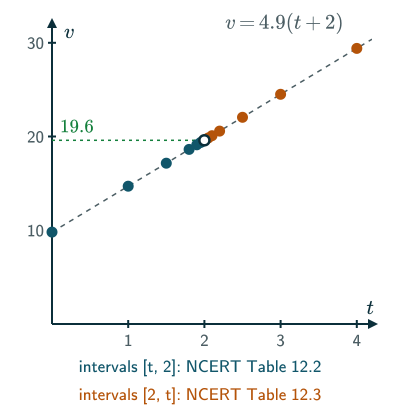
The exact value. Algebra pins the number down. Over the interval from 2 to 2 + h (with h positive or negative, but not 0):
(s(2 + h) − s(2))/h = 4.9((2 + h)2 − 4)/h
= 4.9(4h + h2)/h
= 19.6 + 4.9h.
Writing t = 2 + h, this is 4.9(t + 2), the dashed line in the figure above.
As h gets closer to 0, this gets closer to 19.6. The velocity at t = 2 is exactly 19.6 m/s, inside NCERT’s bounds. Since 4.9t2 is ½gt2 with g = 9.8 m/s2, this is the speed gt = 9.8 × 2 of a body falling from rest, measured downwards. The cancelling of h is allowed because h ≠ 0; at h = 0 there is no interval and the ratio is 0/0.
Three slips in NCERT’s text here.
- NCERT’s text twice uses old numbers, “Table 13.1” (page 217) and “Table 13.2” (page 218), for Tables 12.1 and 12.2.
- After NCERT Table 12.2, the text speaks of “the average velocity at t = 2 seconds” (page 218). An average needs an interval; what is meant is the velocity at t = 2.
- On page 219 it describes the second set of averages as “decreasing in time intervals ending at t = 2”. That set uses intervals starting at t = 2.
Secants and the tangent
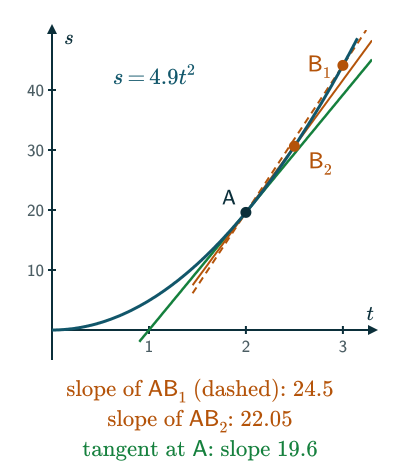
On the graph of s against t, the average velocity between 2 and 2 + h is the slope of the chord (secant) joining A(2, 19.6) to the point of the curve at 2 + h. As h shrinks, the chord turns towards the tangent at A:
From the Fig 12.1 it is safe to conclude that this latter sequence approaches the slope of the tangent to the curve at point A.
NCERT Mathematics (Class 11), Section 12.2, page 220
So the velocity at t = 2 is the slope of the tangent to s = 4.9t2 at t = 2, that is 19.6. NCERT’s Fig 12.1 labels the time axis 2 + t1 and 2 + t2, while its text calls the interval lengths h1 and h2; the points are 2 + h1 and 2 + h2.
Rate of change: the derivative
As is well-known, velocity is the rate of change of displacement.
NCERT Mathematics (Class 11), Section 12.2, page 219
For a function f defined around an interior point a, try this recipe: form the average rate of change (f(a + h) − f(a))/h, simplify while h ≠ 0, and see what it approaches as h gets close to 0. If the two-sided limit exists as a finite number, that value is the derivative of f at a, the instantaneous rate of change, and the slope of the tangent to y = f(x) at x = a. NCERT studies “approaches” through limits (Section 12.3) and then defines the derivative (Section 12.5).
Solved examples
Example 1: Two average velocities (NCERT page 218)
For s = 4.9t2, find the average velocity over the first 2 seconds and between t = 1 and t = 2.
s(0) = 0, s(1) = 4.9 and s(2) = 19.6.
Answer: (19.6 − 0)/2 = 9.8 m/s and (19.6 − 4.9)/1 = 14.7 m/s.
Example 2: Over [2, 2.5] (NCERT Table 12.3)
Find the average velocity between t = 2 and t = 2.5.
s(2.5) = 4.9 × 6.25 = 30.625.
Answer: (30.625 − 19.6)/0.5 = 22.05 m/s, the slope of AB2 in the second figure.
Example 3: The exact velocity at t = 3
Find the velocity of the falling body at t = 3 seconds.
(s(3 + h) − s(3))/h = 4.9((3 + h)2 − 9)/h
= 4.9(6h + h2)/h = 29.4 + 4.9h.
Answer: as h approaches 0 this approaches 29.4, so the velocity is 29.4 m/s (= 9.8 × 3).
Example 4: A ball thrown upwards
A ball’s height after t seconds is y = 20t − 5t2 metres. Find its velocity at t = 1.
y(1) = 15, and y(1 + h) = 20 + 20h − 5 − 10h − 5h2 = 15 + 10h − 5h2.
(y(1 + h) − y(1))/h = 10 − 5h.
Answer: 10 m/s, upwards.
Example 5: Slope of a tangent
Find the slope of the tangent to y = x2 at (1, 1), and the tangent itself.
((1 + h)2 − 1)/h = (2h + h2)/h = 2 + h, which approaches 2.
Answer: slope 2; the tangent is y − 1 = 2(x − 1), that is y = 2x − 1.
Example 6: The rate of change of an area
A square has side x cm. How fast does its area change with x when x = 5?
((5 + h)2 − 25)/h = 10 + h, which approaches 10.
Answer: 10 cm2 per cm of side. A thin strip of width h along two sides adds about 2 × 5 × h.
Common mistakes to avoid
Common mistake
Dividing the distance by the time
s(2)/2 = 9.8 m/s is the average velocity over [0, 2], not the velocity at t = 2, which is 19.6 m/s.
Common mistake
Putting h = 0 too early
(s(2 + h) − s(2))/h at h = 0 is 0/0, which means nothing. Simplify first, while h ≠ 0, and only then let h approach 0.
Common mistake
Trusting a table for the exact value
Tables only trap the answer between two numbers (19.551 and 19.649 here). The algebra 19.6 + 4.9h gives the exact value, 19.6.
Common mistake
Checking only one side
The chords must settle to the same slope from both sides. For y = |x| at 0, chords from the right have slope 1 and chords from the left −1, so there is no single tangent slope and no derivative there.
Common mistake
Using a chord for the tangent
The slope of AB1, 24.5, is an average rate over [2, 3]. The tangent’s slope at A is a single number, the derivative, 19.6.
Quick revision summary
- Average velocity over [t1, t2] is (s(t2) − s(t1))/(t2 − t1), the slope of a chord of the s–t graph.
- The velocity at an instant is what the average velocity approaches as the interval shrinks to that instant, from either side.
- For s = 4.9t2, (s(2 + h) − s(2))/h = 19.6 + 4.9h, so the velocity at t = 2 is 19.6 m/s.
- The same limit of (f(a + h) − f(a))/h is the derivative of f at a: the instantaneous rate of change and the slope of the tangent.
Formula sheet
- average velocity = (s(t) − s(t))/(t − t)
- s = 4.9t: (s(2 + h) − s(2))/h = 19.6 + 4.9h → 19.6
- derivative at a: (f(a + h) − f(a))/h as h → 0
- slope of tangent = limit of slopes of chords
Questions students ask
What is the difference between average and instantaneous rate of change?
The average rate of change of f over [a, a + h] is (f(a + h) − f(a))/h, the slope of a chord, while the instantaneous rate of change at a is the single value this approaches as h approaches 0, which is the derivative of f at a and the slope of the tangent. For f(x) = x2, the average rate over [2, 3] is (9 − 4)/1 = 5, but the instantaneous rate at x = 2 is 4, because the average between 2 and 2 + h is 4 + h. An average rate belongs to an interval and an instantaneous rate to a single point, which is why only the second is the derivative NCERT defines in Section 12.5.
How is instantaneous velocity related to the instantaneous rate of change?
Instantaneous velocity is one case of an instantaneous rate of change: it is the rate of change of displacement with respect to time, while a rate of change in general can be of any quantity with respect to any variable it depends on. The units of a rate of change are the units of the quantity per unit of the variable: metres per second for velocity, cm3 per cm for the volume of a cube against its side, rupees per kilogram for a cost against a mass. Velocity itself, with its sign and direction, is treated in instantaneous velocity.
What is the difference between a secant and a tangent to a curve?
A secant of a curve is the line through two of its points, and its slope is the average rate of change between them; the tangent at a point P is the line the secants through P approach as the second point slides along the curve to P from either side, and its slope is the instantaneous rate of change at P. A tangent can meet the curve again away from P: the tangent to y = x3 at the point where x = a, with a ≠ 0, cuts the curve again where x = −2a. So “touches the curve at only one point” describes a tangent to a circle, not to every curve.
How can you estimate an instantaneous rate of change from a table of values?
A table of values only lets you estimate an instantaneous rate of change: work out the average rates over two equal short intervals, just before and just after the point, and when the slope is steadily rising or falling there, the true value lies between the two. Their mean, the average over an interval centred on the point, is usually a much closer estimate. For f(x) = x3 with f(1.9) = 6.859, f(2) = 8 and f(2.1) = 9.261, the two averages are 11.41 and 12.61, their mean is 12.01, and the exact rate at x = 2, found as a limit, is 12.
Is rate of change in the JEE Main syllabus?
Yes, rate of change is in the JEE Main syllabus: Unit 7 (Limit, Continuity and Differentiability) lists “Rate of change of quantities” among the applications of derivatives, with increasing and decreasing functions and maxima and minima. The Class 11 idea, the instantaneous rate as the limit of average rates, is where it starts; NCERT takes it up again in Class 12, Chapter 6 (Application of Derivatives), Section 6.2, where dy/dx is read as the rate of change of y with respect to x.
Practice questions
Try each question first, then open the answer to check your working.
-
Q1. For s = 4.9t2, find the average velocity between t = 1.5 and t = 2 (NCERT Table 12.2).
Show answerHide answer
s(1.5) = 11.025, so (19.6 − 11.025)/0.5 = 17.15 m/s.
-
Q2. For s = 4.9t2, find the average velocity between t = 2 and t = 2.2 (NCERT Table 12.3).
Show answerHide answer
s(2.2) = 23.716, so (23.716 − 19.6)/0.2 = 20.58 m/s.
-
Q3. Find the velocity of the falling body at t = 1 second.
Show answerHide answer
(4.9(1 + h)2 − 4.9)/h = 9.8 + 4.9h, which approaches 9.8. The velocity is 9.8 m/s.
-
Q4. Find the slope of the tangent to y = x2 at x = 3.
Show answerHide answer
((3 + h)2 − 9)/h = 6 + h, which approaches 6.