Derivatives
NCERT Class 11 Mathematics Chapter 12 Section 12.5
Quick answer
The derivative of f at x is f′(x) = lim (h→0) (f(x + h) − f(x))/h, the first principle; at a point it is the slope of the tangent to the graph. Derivatives obey (uv)′ = u′v + uv′ and (u/v)′ = (u′v − uv′)/v, and the standard results are (x)′ = nx, (sin x)′ = cos x and (cos x)′ = −sin x.
With your textbook
NCERT Mathematics (Class 11), Chapter 12 “Limits and Derivatives”, Section 12.5 “Derivatives”, pages 239–249.
Open the official NCERT chapter (PDF, 3.4 MB, ncert.nic.in) (opens in a new tab)
Checked against the 2026-27 reprint on .
The derivative at a point
The heart of the matter is derivative of a function at a given point in its domain of definition.
NCERT Mathematics (Class 11), Section 12.5, page 239
Derivative at a point
Suppose f is a real valued function and a is a point in its domain of definition. The derivative of f at a is defined by
NCERT Mathematics (Class 11), Section 12.5, page 240
- f′(a) = limh→0 (f(a + h) − f(a))/h, provided this limit exists.
We require a finite two-sided limit at an interior point of the domain; endpoint derivatives, when used, need an explicit one-sided convention.
In plain words: f′(a) is the velocity-at-an-instant idea for any function. The fraction is the average rate of change of f over the step from a to a + h, and the derivative is what it settles to as the step shrinks. NCERT opens the section with “We have seen in the Section 13.2” (page 239); the section meant is 12.2, on the falling body.
Derivative of f at a
f′(a) = lim (h→0) (f(a + h) − f(a))/h
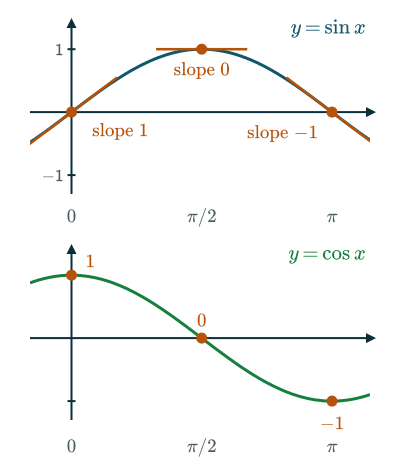
NCERT Example 5 (page 240): for f(x) = 3x, (3(2 + h) − 6)/h = 3, so f′(2) = 3. NCERT Example 7 (page 241): for sin x at 0, (sin h − sin 0)/h = (sin h)/h → 1, so the derivative is 1. NCERT Example 8: a constant function has derivative 0 everywhere, since (3 − 3)/h = 0.
The slope of the tangent
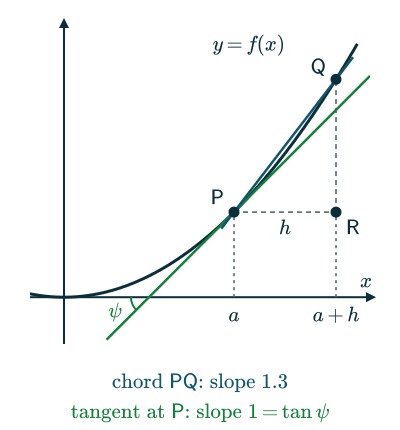
Take P(a, f(a)) and Q(a + h, f(a + h)) on the graph, and R below Q at the height of P (NCERT Fig 12.11, page 241). Then (f(a + h) − f(a))/h = QR/PR is the slope of the chord PQ. As h → 0, Q slides to P and the chord turns into the tangent:
Thus the limit turns out to be equal to the slope of the tangent.
NCERT Mathematics (Class 11), Section 12.5, page 242
So f′(a) = tan ψ, where ψ is the angle the tangent at P makes with the positive x-axis.
The derivative function: first principle
Doing this at every point x gives a new function, f′:
Derivative from first principle
f′(x) = lim (h→0) (f(x + h) − f(x))/h
This definition of derivative is also called the first principle of derivative.
NCERT Mathematics (Class 11), Section 12.5, page 242
Clearly the domain of definition of f′ (x) is wherever the above limit exists.
NCERT Mathematics (Class 11), Section 12.5, page 242
Other notations: f′(x) is also written df/dx, (d/dx)f(x), dy/dx for y = f(x), or D(f(x)). NCERT Examples 9–12 (pages 242–243) give (10x)′ = 10, (x2)′ = 2x, (constant)′ = 0 and (1/x)′ = −1/x2.
When the limit fails (JEE). For f(x) = |x| at 0, (|h| − 0)/h is 1 for h > 0 and −1 for h < 0. The left-hand derivative is −1 and the right-hand derivative is 1 (see one-sided limits); they differ, so f′(0) does not exist: the graph has a corner there. Yet |x| is continuous at 0. A function with a derivative at a point is continuous there, but a continuous function need not have a derivative.
Rules for derivatives
Derivative of sum of two functions is sum of the derivatives of the functions.
NCERT Mathematics (Class 11), Section 12.5.1, page 244
The proofs follow from the algebra of limits, as NCERT notes. With u = f(x) and v = g(x) both differentiable at the point:
Algebra of derivatives
(u ± v)′ = u′ ± v′
(uv)′ = u′v + uv′
(u/v)′ = (u′v − uv′)/v, v ≠ 0
(ku)′ = ku′, k constant
NCERT calls this result “Theorem 5”, the same number as its theorem on the limits of (sin x)/x and (1 − cos x)/x in Section 12.4 (page 235). The product rule is also called Leibnitz’s rule.
Powers. For every positive integer n, d/dx (xn) = nxn−1 (NCERT Theorem 6, page 245). Proof: by the binomial theorem, (x + h)n − xn = h(nxn−1 + terms containing h), so the quotient tends to nxn−1. NCERT also proves it by induction with the product rule, and adds:
The above theorem is true for all powers of x, i.e., n can be any real number (but we will not prove it here).
NCERT Mathematics (Class 11), Section 12.5.1, page 246
For arbitrary real n, the power rule is valid for x > 0. Integer powers also allow negative x; negative powers exclude 0. At 0, check the domain and derivative separately: √x has no finite right derivative there. The constant power x = 1 has derivative 0; do not interpret its derivative as an undefined 0 × x at 0.
Polynomials and trigonometric functions
A polynomial is differentiated term by term: (anxn + … + a1x + a0)′ = nanxn−1 + (n − 1)an−1xn−2 + … + a1 (NCERT Theorem 7, page 246). NCERT prints the power in its second term as xx−2; it is xn−2.
sin x (NCERT Example 16, page 247). Using sin A − sin B = 2 cos C sin D, where C = (A + B)/2 and D = (A − B)/2:
(sin(x + h) − sin x)/h = cos(x + h/2) × [sin(h/2)/(h/2)],
which tends to cos x × 1 = cos x, by the standard limit (sin u)/u → 1. The same method gives (cos x)′ = −sin x (NCERT Exercise 12.2, Q10), and NCERT Example 17 gives (tan x)′ = sec2 x. The quotient rule then gives the other three, wherever the original trigonometric function is defined.
Standard derivatives (x in radians)
(x)′ = nx
(sin x)′ = cos x
(cos x)′ = −sin x
(tan x)′ = sec x
(cot x)′ = −cosec x
(sec x)′ = sec x tan x
(cosec x)′ = −cosec x cot x
Solved examples
Example 1: Two derivatives at points (NCERT Example 6, pages 240–241)
For f(x) = 2x2 + 3x − 5, find f′(−1) and f′(0), and show that f′(0) + 3f′(−1) = 0.
f(−1 + h) − f(−1) = 2h2 − h, so the quotient is 2h − 1 → −1.
f(h) − f(0) = 2h2 + 3h, so the quotient is 2h + 3 → 3.
Answer: f′(−1) = −1 and f′(0) = 3, so f′(0) + 3f′(−1) = 3 − 3 = 0.
Example 2: 1/x from first principle (NCERT Example 12, page 243)
Find the derivative of f(x) = 1/x.
(1/(x + h) − 1/x)/h = (x − (x + h))/(hx(x + h))
= −1/(x(x + h)).
Answer: −1/x2, for x ≠ 0.
Example 3: A sum of fifty powers (NCERT Example 14, page 247)
Find the derivative of f(x) = 1 + x + x2 + … + x50 at x = 1.
f′(x) = 1 + 2x + 3x2 + … + 50x49, so f′(1) = 1 + 2 + … + 50.
Answer: 50 × 51/2 = 1275.
Example 4: The quotient rule (NCERT Example 15, page 247)
Find the derivative of f(x) = (x + 1)/x.
u = x + 1 and v = x, so u′ = v′ = 1:
(1 × x − (x + 1) × 1)/x2 = −1/x2.
Answer: −1/x2, for x ≠ 0. (Check: f(x) = 1 + 1/x.)
Example 5: cos x from first principle (NCERT Exercise 12.2, Q10, page 249)
Find the derivative of cos x from first principle.
With cos A − cos B = −2 sin((A + B)/2) sin((A − B)/2):
(cos(x + h) − cos x)/h = −sin(x + h/2) × [sin(h/2)/(h/2)].
Answer: −sin x × 1 = −sin x.
Example 6: A rational function from first principle (NCERT Example 19 (i), pages 249–250)
Find the derivative of f(x) = (2x + 3)/(x − 2) from first principle.
Over the common denominator, the numerator of f(x + h) − f(x) is
(2x + 2h + 3)(x − 2) − (2x + 3)(x + h − 2)
= 2h(x − 2) − h(2x + 3) = −7h.
So the quotient is −7/((x − 2)(x + h − 2)).
Answer: −7/(x − 2)2, for x ≠ 2.
Example 7: cot x by the quotient rule (NCERT Example 21 (ii), pages 251–252)
Find the derivative of cot x = cos x/sin x.
By the quotient rule the numerator is (−sin x) sin x − cos x cos x = −(sin2 x + cos2 x) = −1, and the denominator is sin2 x.
Answer: −1/sin2 x = −cosec2 x.
Example 8: Product and quotient together (NCERT Example 22 (i), pages 252–253)
Find the derivative of (x5 − cos x)/sin x.
By the quotient rule, the numerator is (5x4 + sin x) sin x − (x5 − cos x) cos x and the denominator sin2 x. In the numerator, sin2 x + cos2 x = 1.
Answer: the derivative has numerator −x5 cos x + 5x4 sin x + 1 and denominator sin2 x.
Common mistakes to avoid
Common mistake
Differentiating a product factor by factor
(uv)′ is not u′v′. For x · x, that would give 1, but (x2)′ = 2x = 1 · x + x · 1.
Common mistake
Reversing the quotient rule
(u/v)′ = (u′v − uv′)/v2, in that order. The other order gives the negative of the answer.
Common mistake
Putting h = 0 too early
In a first-principle calculation, simplify the difference quotient or use a known limit, then let h → 0; cancellation is not possible in every problem. Putting h = 0 at the start gives 0/0.
Common mistake
Using degrees
(sin x)′ = cos x needs x in radians, because it rests on (sin h)/h → 1.
Quick revision summary
- f′(a) = limh→0 (f(a + h) − f(a))/h, when the limit exists; it is the slope tan ψ of the tangent at (a, f(a)).
- f′(x) from the same limit at every x is the derivative function (first principle); it is written dy/dx, df/dx or D(f(x)).
- (u ± v)′ = u′ ± v′, (uv)′ = u′v + uv′, (u/v)′ = (u′v − uv′)/v2.
- (xn)′ = nxn−1; (sin x)′ = cos x, (cos x)′ = −sin x, (tan x)′ = sec2 x.
Formula sheet
- f′(x) = lim (h→0) (f(x + h) − f(x))/h
- (uv)′ = u′v + uv′; (u/v)′ = (u′v − uv′)/v, v ≠ 0
- (x)′ = nx (real n: x > 0; integer powers on their domains)
- (sin x)′ = cos x; (cos x)′ = −sin x; (tan x)′ = sec x
- (cot x)′ = −cosec x; (sec x)′ = sec x tan x; (cosec x)′ = −cosec x cot x
Questions students ask
What is the difference between derivatives and differentiation?
A derivative is a result and differentiation is the process of finding it: differentiating f(x) gives its derivative f′(x), the rate at which f changes with x. At a point the derivative is a number, the slope of the tangent there, and taken at every x it is a new function. In notation, d/dx is the instruction to differentiate and dy/dx or f′(x) is its result, both defined by the first principle.
Why is the derivative of sin x equal to cos x?
The derivative of sin x is cos x (with x in radians) because, from first principle, the sin A − sin B identity turns the difference quotient of sin x into cos(x + h/2) times sin(h/2)/(h/2), and that last factor tends to 1 as h → 0, leaving cos x; the working is in Polynomials and trigonometric functions. A quick numerical check at x = π/3 with h = 0.001 gives a quotient of about 0.4996, already close to cos(π/3) = 0.5.
What is the derivative of sin 3x from first principle?
The derivative of sin 3x is 3 cos 3x. From first principle, the sin A − sin B identity turns the difference quotient into 3 cos(3x + 3h/2) times sin(3h/2)/(3h/2), and the second factor tends to 1 as h → 0, leaving 3 cos 3x. In the same way the derivative of sin ax is a cos ax for any constant a; in Class 12 the chain rule gives this in one step.
What is the difference between the product rule and the quotient rule?
The product rule differentiates a product of two functions and the quotient rule a quotient: (uv)′ = u′v + uv′, while (u/v)′ = (u′v − uv′)/v2, wherever v ≠ 0. The product rule adds two terms and treats u and v alike, but the quotient rule subtracts and divides by the square of the denominator. To keep its order, a common memory aid is “low d-high minus high d-low, over low squared”, with v as low and u as high.
What are the basic derivative formulas in Class 11?
The basic derivative formulas in Class 11 are the power rule, (xn)′ = nxn−1, the derivatives of the six trigonometric functions and the sum, product and quotient rules; this page’s formula sheet lists them all. To remember the trigonometric ones (with x in radians), learn those of sin x, tan x and sec x, then get each “co” partner by changing every function to its co-function and adding a minus sign: sec x has derivative sec x tan x, so cosec x has −cosec x cot x.
Are derivatives in the JEE Main syllabus, and which parts are taught in Class 11?
Yes, derivatives are in the JEE Main syllabus, Unit 7 (Limit, Continuity and Differentiability), which lists differentiation of sums, differences, products and quotients; of trigonometric, inverse trigonometric, logarithmic, exponential, composite and implicit functions; derivatives up to order two; and applications: rate of change, increasing and decreasing functions, and maxima and minima. NCERT Class 11 Chapter 12 covers the first principle, the sum, product and quotient rules and the derivatives of polynomials and trigonometric functions. The rest is in NCERT Class 12, Chapter 5 (Continuity and Differentiability) and Chapter 6 (Application of Derivatives).
Practice questions
Try each question first, then open the answer to check your working.
-
Q1. Find the derivative of x2 − 2 at x = 10, of x at x = 1, and of 99x at x = 100 (NCERT Exercise 12.2, Q1–Q3).
Show answerHide answer
2x at 10 is 20; the derivative of x is 1 everywhere; the derivative of 99x is 99 everywhere.
-
Q2. From first principle, find the derivatives of (i) x3 − 27, (ii) (x − 1)(x − 2), (iii) 1/x2, (iv) (x + 1)/(x − 1) (NCERT Exercise 12.2, Q4).
Show answerHide answer
(i) ((x + h)3 − x3)/h = 3x2 + 3xh + h2 → 3x2. (ii) 2x − 3. (iii) −2/x3. (iv) −2/(x − 1)2.
-
Q3. f(x) = x100/100 + x99/99 + … + x2/2 + x + 1. Prove that f′(1) = 100f′(0) (NCERT Exercise 12.2, Q5).
Show answerHide answer
f′(x) = x99 + x98 + … + x + 1, so f′(1) = 100 and f′(0) = 1.
-
Q4. For constants a and b, find the derivatives of (i) (x − a)(x − b), (ii) (ax2 + b)2, (iii) (x − a)/(x − b) (NCERT Exercise 12.2, Q7).
Show answerHide answer
(i) 2x − a − b. (ii) Expand to a2x4 + 2abx2 + b2: 4a2x3 + 4abx. (iii) (a − b)/(x − b)2.