Limits of trigonometric functions
NCERT Class 11 Mathematics Chapter 12 Section 12.4
Quick answer
Limits of trigonometric functions rest on two standard limits: as x tends to 0, with x in radians, (sin x)/x tends to 1 and (1 − cos x)/x tends to 0. The first follows from the sandwich theorem, because cos x < (sin x)/x < 1 for 0 < |x| < π/2. From these, (tan x)/x → 1 and (sin ax)/(bx) → a/b for b ≠ 0.
With your textbook
NCERT Mathematics (Class 11), Chapter 12 “Limits and Derivatives”, Section 12.4 “Limits of Trigonometric Functions”, pages 234–239.
Open the official NCERT chapter (PDF, 3.4 MB, ncert.nic.in) (opens in a new tab)
Checked against the 2026-27 reprint on .
Two facts about inequalities
The following facts (stated as theorems) about functions in general come in handy in calculating limits of some trigonometric functions.
NCERT Mathematics (Class 11), Section 12.4, page 234
Comparison and sandwich theorems
- Theorem 3. If f(x) ≤ g(x) for all x in their common domain, and both limits at a exist, then limx→a f(x) ≤ limx→a g(x). A strict < between functions gives only ≤ between limits: cos x < 1 for 0 < |x| < π/2, yet both tend to 1.
- Theorem 4 (sandwich theorem). If f(x) ≤ g(x) ≤ h(x) for all x ≠ a in some open interval around a, and limx→a f(x) = l = limx→a h(x), then limx→a g(x) = l.
NCERT’s Theorem 3 (Section 12.4, page 234) assumes f(x) ≤ g(x) for all x in the domain of definition, and Theorem 4 assumes f(x) ≤ g(x) ≤ h(x) for all x in the common domain of definition. In fact only values near a matter, which is why the sandwich theorem applies to (sin x)/x: its bounds fail at x = 2π, where cos x = 1 and (sin x)/x = 0, but hold for 0 < |x| < π/2.
In plain words: if g is trapped between two functions that head for the same number, g has no room to go anywhere else. The sandwich theorem is the tool for limits that cannot be found by cancelling, like (sin x)/x at 0. All angles here are in radians, as in radian measure.
The key inequality
Given below is a beautiful geometric proof of the following important inequality relating trigonometric functions.
NCERT Mathematics (Class 11), Section 12.4, page 234
For 0 < |x| < π/2:
The inequality (NCERT page 234)
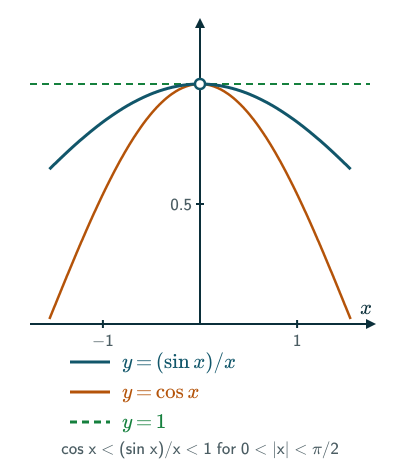
cos x < (sin x)/x < 1
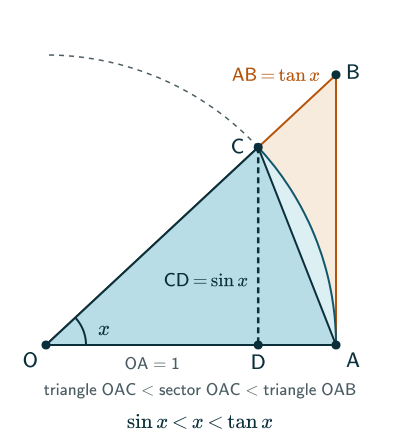
The proof (NCERT page 235). Both cos x and (sin x)/x are even functions, since sin(−x)/(−x) = (−sin x)/(−x) = (sin x)/x, so it is enough to take 0 < x < π/2. In the unit circle with centre O, let angle AOC = x, with CD and AB perpendicular to OA and B on OC extended. Then CD = sin x and AB = tan x, and the triangle OAC lies inside the sector OAC, which lies inside the triangle OAB:
area of △OAC < area of sector OAC < area of △OAB
½ sin x < ½ x < ½ tan x.
The sector is the fraction x/(2π) of the circle, whose area is π, so its area is ½x. This holds only for x in radians (in degrees it would be πx/360).
So sin x < x < tan x. Dividing by sin x, which is positive, gives 1 < x/sin x < 1/cos x, and taking reciprocals reverses both inequality signs: cos x < (sin x)/x < 1.
The two standard limits
The following are two important limits.
NCERT Mathematics (Class 11), Section 12.4, page 235
Theorem 5 (x in radians)
lim (x→0) (sin x)/x = 1
lim (x→0) (1 − cos x)/x = 0
Proof of the first. (sin x)/x is sandwiched between cos x and the constant 1, and cos x → 1 as x → 0. By the sandwich theorem, (sin x)/x → 1.
Proof of the second. Use 1 − cos x = 2 sin2(x/2):
(1 − cos x)/x = sin(x/2) × [sin(x/2)/(x/2)].
As x → 0, x/2 → 0 too, so the bracket tends to 1 and sin(x/2) tends to 0. The limit is 0 × 1 = 0. The first of these limits is what gives the derivatives of sin x and cos x.
Useful forms (JEE). The same idea gives, as x → 0:
- (sin u)/u → 1 whenever u → 0 with u ≠ 0, for example sin(x2)/x2 → 1;
- (sin kx)/(kx) → 1 for any constant k ≠ 0, so (sin ax)/(bx) → a/b for b ≠ 0 (if a = 0 the quotient is simply zero);
- (tan x)/x = [(sin x)/x] × [1/cos x] → 1 (NCERT Example 4 (ii));
- (1 − cos x)/x2 = ½[sin(x/2)/(x/2)]2 → 1/2.
A general rule
A general rule that needs to be kept in mind while evaluating limits is the following.
NCERT Mathematics (Class 11), Section 12.4, page 237
For an algebraic 0/0 form, look for a common factor in numerator and denominator. Cancel only the same factor, and only where it is non-zero near the limiting point. If the remaining numerator p and denominator q are continuous at a and q(a) ≠ 0, the limit is p(a)/q(a). Two different factors do not cancel merely because both tend to zero.
With trigonometric expressions, use identities to form a known limit: write sin u = u × (sin u)/u for u ≠ 0, and use (sin u)/u → 1 as u → 0. The 0/0 form alone guarantees neither a cancellable factor nor a finite limit. For polynomials, see rational limits.
Solved examples
Example 1: sin 4x over sin 2x (NCERT Example 4 (i), page 236)
Evaluate limx→0 (sin 4x)/(sin 2x).
(sin 4x)/(sin 2x) = 2 × [(sin 4x)/(4x)] ÷ [(sin 2x)/(2x)].
As x → 0, 4x → 0 and 2x → 0, so both brackets tend to 1.
Answer: 2 × 1 ÷ 1 = 2.
Example 2: tan x over x (NCERT Example 4 (ii), pages 236–237)
Evaluate limx→0 (tan x)/x.
(tan x)/x = [(sin x)/x] × [1/cos x].
Answer: 1 × 1 = 1.
Example 3: sin ax over bx and over sin bx (NCERT Exercise 12.1, Q13 and Q14, page 237)
Evaluate limx→0 (sin ax)/(bx) and limx→0 (sin ax)/(sin bx), with a, b ≠ 0.
(sin ax)/(bx) = (a/b) × (sin ax)/(ax). For the second, divide top and bottom by x as well:
(a/b) × [(sin ax)/(ax)] ÷ [(sin bx)/(bx)].
Answer: both limits are a/b.
Example 4: Double angles (NCERT Exercise 12.1, Q17, page 238)
Evaluate the limit as x → 0 of (cos 2x − 1)/(cos x − 1).
cos 2x − 1 = −2 sin2 x and cos x − 1 = −2 sin2(x/2), so the fraction is sin2 x/sin2(x/2). Squaring sin x = 2 sin(x/2) cos(x/2) gives sin2 x = 4 sin2(x/2) cos2(x/2), so the fraction is 4 cos2(x/2).
Answer: since cos(x/2) → 1, the limit is 4 cos2 0 = 4.
Example 5: A limit at π/2 (NCERT Exercise 12.1, Q22, page 238)
Evaluate limx→π/2 (tan 2x)/(x − π/2).
Put y = x − π/2, so y → 0 and tan 2x = tan(2y + π) = tan 2y:
(tan 2y)/y = 2 × (tan 2y)/(2y).
Answer: 2 × 1 = 2.
Example 6: cosec x − cot x (NCERT Exercise 12.1, Q21, page 238)
Evaluate limx→0 (cosec x − cot x).
cosec x − cot x = (1 − cos x)/sin x
= [(1 − cos x)/x] ÷ [(sin x)/x].
Answer: 0 ÷ 1 = 0.
Common mistakes to avoid
Common mistake
Measuring x in degrees
(sin x)/x → 1 only with x in radians. With x in degrees, sin x° = sin(πx/180) (see converting degrees to radians), and (sin x°)/x → π/180.
Common mistake
Using the standard limit away from 0
(sin x)/x → 1 as x → 0, not as x → π. At π it is 0/π = 0. Shift the variable first, as in Example 5.
Common mistake
Mixing up (1 − cos x)/x and (1 − cos x)/x
The first tends to 0 and the second to 1/2. Count the powers of x: 1 − cos x behaves like x2/2 near 0.
Common mistake
Using a/b away from 0
(sin 4x)/(sin 2x) → 2 as x → 0, but the limit can change at another point. As x → π/2, put x = π/2 + h: sin 4x = sin 4h and sin 2x = −sin 2h, so the limit is −2.
Common mistake
Dropping the modulus
√(1 − cos 2x) = √(2 sin2 x) = √2 |sin x|, not √2 sin x. So √(1 − cos 2x)/x → √2 as x → 0+ and −√2 as x → 0−: the limit does not exist.
Quick revision summary
- Sandwich theorem: if f ≤ g ≤ h near a and f and h both tend to l, then g tends to l.
- For 0 < |x| < π/2, cos x < (sin x)/x < 1, from the areas of a triangle, a sector and a larger triangle in the unit circle.
- With x in radians, (sin x)/x → 1 and (1 − cos x)/x → 0 as x → 0; hence (tan x)/x → 1 and (sin ax)/(bx) → a/b for b ≠ 0.
- For a 0/0 form, cancel a common non-zero factor where possible; with sines, write sin u = u × (sin u)/u.
Formula sheet
- cos x < (sin x)/x < 1 for 0 < |x| < π/2
- lim (x→0) (sin x)/x = 1
- lim (x→0) (1 − cos x)/x = 0
- lim (x→0) (tan x)/x = 1
- lim (x→0) (sin ax)/(bx) = a/b, b ≠ 0
Questions students ask
Why does sin x/x tend to 1 as x tends to 0, and why must x be in radians?
The limit of (sin x)/x as x → 0 is 1 because, in the unit circle, a triangle, a sector and a larger triangle on the same arc show that (sin x)/x lies between cos x and 1 for 0 < |x| < π/2, and as cos x → 1 the sandwich theorem squeezes it to 1; the steps are in the key inequality. The angle must be in radians because the proof uses the sector’s area, ½x, which holds only in radian measure, where an arc of the unit circle equals its angle. Near 0 the two are already close: (sin 0.1)/0.1 ≈ 0.998.
Can L’Hospital’s rule be used to find the limit of sin x/x as x tends to 0?
L’Hospital’s rule gives the right value, 1, for (sin x)/x as x → 0, but it cannot prove it: the rule needs the derivative of sin x, and (sin x)′ = cos x is itself derived from this very limit, so the argument goes round in a circle. The sandwich proof from areas in the unit circle needs no derivative at all. L’Hospital’s rule is not in the NCERT Class 11 book and is not named in the JEE Main syllabus (Unit 7) text, although many students use it to check 0/0 limits.
What is the limit of sin x/x as x tends to infinity?
The limit of (sin x)/x as x → ∞ is 0, not 1, because sin x stays between −1 and 1 while x grows without bound. For x > 0, −1/x ≤ (sin x)/x ≤ 1/x, and both bounds tend to 0, so the sandwich theorem, applied as x → ∞, gives 0; the limit is 0 as x → −∞ too. The standard limit 1 holds only as x → 0; limits as x → ∞ go beyond the NCERT Class 11 chapter, which takes limits only as x tends to a real number, and are useful extensions of the same methods.
What is the difference between the sandwich theorem and the squeeze theorem?
The sandwich theorem and the squeeze theorem are the same result under two names: a function trapped near a point between two functions that tend to the same limit there must tend to that limit too. NCERT and many Indian textbooks call it the sandwich theorem, while American calculus books usually call it the squeeze theorem. The trapping need hold only for x close to the point, not at the point itself, which is why it works for (sin x)/x, squeezed between cos x and 1 only for 0 < |x| < π/2.
Is the sandwich theorem in the JEE Main syllabus?
Yes, the sandwich theorem is part of the limits topic in the JEE Main syllabus (Unit 7, Limit, Continuity and Differentiability), although the syllabus text names no theorems: for limits it says only “Limits, continuity and differentiability”. It is taught in NCERT Class 11, Section 12.4 (Theorem 4), where it proves (sin x)/x → 1. The same method also handles suitable expressions involving the greatest integer function by bounding them between simpler functions.
How do you solve limits of trigonometric functions?
To solve limits of trigonometric functions, first check whether the expression is continuous at the limiting point: if so, direct substitution gives the limit. A value assigned at one point alone does not determine a limit. For a 0/0 form, make the variable tend to 0 (if x → a, put y = x − a), then use identities such as 1 − cos x = 2 sin2(x/2) to build fractions like (sin u)/u or (tan u)/u with u → 0, each of which tends to 1 with angles in radians, as in the general rule. For example, (1 − cos 4x)/x2 = 8 × [(sin 2x)/(2x)]2, which tends to 8.
Practice questions
Try each question first, then open the answer to check your working.
-
Q1. Evaluate limx→π sin(π − x)/(π(π − x)) (NCERT Exercise 12.1, Q15).
Show answerHide answer
Put y = π − x → 0: (sin y)/(πy) → 1/π.
-
Q2. Evaluate limx→0 cos x/(π − x) (NCERT Exercise 12.1, Q16).
Show answerHide answer
No 0/0 here: the value at 0 is 1/π.
-
Q3. Evaluate limx→0 (ax + x cos x)/(b sin x) (NCERT Exercise 12.1, Q18).
Show answerHide answer
Divide by x: (a + cos x)/(b × (sin x)/x) → (a + 1)/b.
-
Q4. Evaluate limx→0 x sec x (NCERT Exercise 12.1, Q19).
Show answerHide answer
x/cos x → 0/1 = 0.