Angles: degree and radian measure
NCERT Class 11 Mathematics Chapter 3 Section 3.2
Quick answer
Degree and radian measure are two ways of measuring the same rotation: a full turn is 360° or 2π radian, and one radian is the angle at the centre of a circle subtended by an arc equal in length to the radius, so l = rθ with θ in radians. Since π radian = 180°, multiply by π/180 to convert degrees to radians and by 180/π to convert back. The angle itself measures the rotation of a ray from its initial side to its terminal side, positive anticlockwise and negative clockwise.
With your textbook
NCERT Mathematics (Class 11), Chapter 3 “Trigonometric Functions”, Section 3.2 “Angles”, pages 43–49.
Open the official NCERT chapter (PDF, 3.0 MB, ncert.nic.in) (opens in a new tab)
Checked against the 2026-27 reprint on .
What is an angle?
Angle
Angle is a measure of rotation of a given ray about its initial point.
NCERT Mathematics (Class 11), Section 3.2, page 43
- The ray’s starting position is the initial side, its final position the terminal side, and the point it turns about the vertex (NCERT pages 43–44).
- Anticlockwise rotation gives a positive angle and clockwise rotation a negative one.
- Two common units: the degree (1/360 of a revolution) and the radian, with π radian = 180°.
In plain words: in trigonometry an angle is not a fixed corner but an amount of turning. Because a ray can turn more than once, and in either direction, angles such as 420° or −30° make sense. NCERT Fig 3.3 (page 44) shows 360°, 180°, 270°, 420°, −30° and −420°. An angle of 420° ends in the same place as 60°, after one full turn and 60° more.
The point of rotation is called the vertex. If the direction of rotation is anticlockwise, the angle is said to be positive and if the direction of rotation is clockwise, then the angle is negative (Fig 3.1).
NCERT Mathematics (Class 11), Section 3.2, page 44
Degree measure
One complete revolution is divided into 360 equal parts, and a rotation of 1/360 of a revolution is one degree, written 1° (NCERT Section 3.2.1, page 44).
A degree is divided into 60 minutes, and a minute is divided into 60 seconds .
NCERT Mathematics (Class 11), Section 3.2.1, page 44
A minute is written 1′ and a second 1″, so 1° = 60′ and 1′ = 60″. For example, 40° 20′ = 40 + 20/60 = 40⅓ degrees.
Radian measure
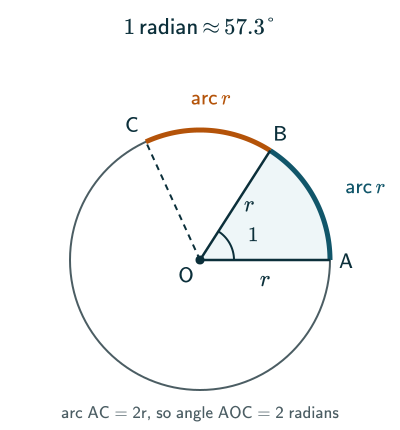
Angle subtended at the centre by an arc of length 1 unit in a unit circle (circle of radius 1 unit) is said to have a measure of 1 radian.
NCERT Mathematics (Class 11), Section 3.2.2, page 45
More generally, in a circle of radius r, an arc of length r will subtend an angle of 1 radian.
NCERT Mathematics (Class 11), Section 3.2.2, page 45
Equal arcs of a circle subtend equal angles at the centre, so the angle grows in proportion to the arc. An arc of length l is l/r arcs of length r, so it subtends l/r radian. This gives the arc-length formula for a non-negative angle. For a signed rotation θ, the distance travelled along the circle is r|θ|; the signed arc displacement is rθ.
Arc length
θ = l/r, or l = rθ (θ in radians)
A whole circle has circumference 2πr, so one revolution is 2πr/r = 2π radian. Physics uses the same formula for a body moving on a circle, Δs = RΔθ, which leads to v = Rω for uniform circular motion. In SI the radian is the unit of plane angle, symbol rad (see plane and solid angle).
Radians and real numbers
NCERT Section 3.2.3 (page 46) wraps the number line round the unit circle. Take the tangent to the unit circle at A, mark A as 0, and wind the positive half anticlockwise and the negative half clockwise round the circle. A real number t is then the signed length of arc wound from A, so it is the radian measure of the angle that arc subtends at O. Each real number gives exactly one radian measure and each radian measure comes from exactly one real number. Points on the circle repeat (t and t + 2π land on the same point), but the angles do not.
Thus, radian measures and real numbers can be considered as one and the same.
NCERT Mathematics (Class 11), Section 3.2.3, page 46
This is why sin x can be a function of a real number x in the next topic, trigonometric functions. Radian measure is also what makes (sin x)/x tend to 1 as x → 0, the standard limit behind the derivative of sin x.
Converting between degrees and radians
Since a circle subtends at the centre an angle whose radian measure is 2π and its degree measure is 360°, it follows that 2π radian = 360° or π radian = 180°
NCERT Mathematics (Class 11), Section 3.2.4, page 46
Degree–radian conversion
radians = (π/180) × degrees
degrees = (180/π) × radians
So 1 radian = 180°/π and 1° = π/180 radian. With the true value of π these are 1 radian ≈ 57.2958° (57° 17′ 45″) and 1° ≈ 0.017453 radian. NCERT (page 46) uses π ≈ 22/7, which gives the slightly different 57° 16′ and 0.01746 radian; say which value of π you use.
| Degrees | Radians |
|---|---|
| 30° | π/6 |
| 45° | π/4 |
| 60° | π/3 |
| 90° | π/2 |
| 180° | π |
| 270° | 3π/2 |
| 360° | 2π |
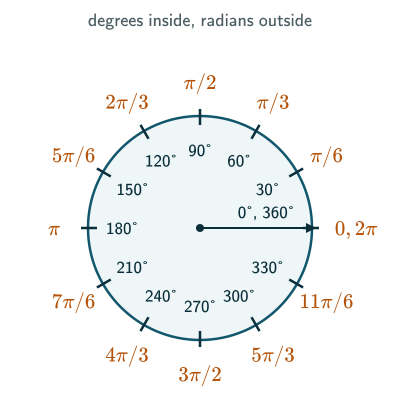
Note that when an angle is expressed in radians, the word ‘radian’ is frequently omitted.
NCERT Mathematics (Class 11), Section 3.2.4, page 47
So π = 180° and π/4 = 45° mean π radian and π/4 radian. NCERT’s convention (page 47): θ° means an angle of θ degrees, and an angle written without the degree sign, such as β, is in radians.
Solved examples
Example 1: Degrees and minutes to radians (NCERT Example 1, page 47)
Convert 40° 20′ into radian measure.
40° 20′ = 40⅓° = 121/3 degrees. Multiply by π/180: (121/3) × (π/180) = 121π/540.
Answer: 40° 20′ = 121π/540 radian (about 0.704 radian).
Example 2: Radians to degrees, minutes and seconds (NCERT Example 2, page 47)
Convert 6 radians into degree measure, using π = 22/7 as NCERT does.
- 6 × 180/π = 6 × 180 × 7/22 = 3780/11 = 343 + 7/11 degrees.
- 7/11 degree = 420/11 minutes = 38 + 2/11 minutes.
- 2/11 minute = 120/11 seconds ≈ 10.9 seconds.
Answer: 6 radians ≈ 343° 38′ 11″. With the true value of π, 6 radians ≈ 343.775° ≈ 343° 46′ 29″, so the 22/7 approximation is about 8′ out here.
Example 3: Radius from arc and angle (NCERT Example 3, page 47)
A central angle of 60° intercepts an arc of length 37.4 cm. Find the radius (use π = 22/7).
θ = 60° = π/3 radian, so r = l/θ = 37.4 × 3/π = 37.4 × 3 × 7/22 = 785.4/22.
Answer: r = 35.7 cm.
Example 4: Tip of the minute hand (NCERT Example 4, page 48)
The minute hand of a watch is 1.5 cm long. How far does its tip move in 40 minutes? (Use π = 3.14.)
In 40 minutes the hand turns 40/60 = 2/3 of a revolution, that is (2/3) × 2π = 4π/3 radian. Then l = rθ = 1.5 × 4π/3 cm = 2π cm = 2 × 3.14 cm.
Answer: 2π cm = 6.28 cm.
Example 5: Ratio of radii (NCERT Example 5, page 48)
Arcs of the same length in two circles subtend 65° and 110° at the centre. Find the ratio of the radii.
Let r1 be the radius of the circle where the arc subtends θ1 = 65°, and r2 the one with θ2 = 110°. Then l = r1θ1 = r2θ2, so r1/r2 = θ2/θ1. The ratio of two angles is the same in degrees or radians: 110/65 = 22/13.
Answer: r1 : r2 = 22 : 13. The smaller angle needs the larger circle.
Common mistakes to avoid
Common mistake
Using l = rθ with θ in degrees
The formula l = rθ holds only in radians. For 60° and r = 10 cm, l = 10 × π/3 ≈ 10.47 cm, not 10 × 60 = 600 cm.
Common mistake
Treating minutes as decimals
40° 20′ is 40⅓° ≈ 40.33°, not 40.20°, because a degree has 60 minutes, not 100.
Common mistake
Writing π = 180
π is the number 3.14159…; only π radian = 180°. So π° (π degrees) is about 3.14°, and sin π° ≈ 0.0548 while sin π = 0.
Common mistake
Forgetting that radians are the default
sin 2 means the sine of 2 radians (about 114.6°), not of 2°. An angle with no degree sign is in radians.
Quick revision summary
- An angle measures rotation from the initial side to the terminal side: anticlockwise positive, clockwise negative.
- 1° = 1/360 of a revolution; 1° = 60′ and 1′ = 60″.
- 1 radian is the angle subtended by an arc equal to the radius; l = rθ with θ in radians.
- π radian = 180°: multiply by π/180 to get radians and by 180/π to get degrees.
Formula sheet
- π radian = 180°; 2π radian = 360°
- radians = (π/180) × degrees
- degrees = (180/π) × radians
- l = rθ, θ in radians
- 1° = 60′, 1′ = 60″
Questions students ask
What is the difference between degree and radian measure?
Degree and radian measure differ in what they are based on: a degree is 1/360 of a full revolution, a size fixed by convention, while a radian is fixed by the circle itself as the angle subtended at the centre by an arc equal to the radius. So a full turn is 360° but only 2π ≈ 6.28 radian, and on the unit circle a radian measure is simply the length of the arc turned through, which is why radian measures can be treated as real numbers. Both measure the same rotation, linked by π radian = 180°. On a calculator, degree mode reads sin 30 as sin 30° = 0.5, while radian mode reads it as the sine of 30 radians, about −0.988.
Why do we use radians instead of degrees?
Radians are used because they keep the formulas for circles and for calculus free of conversion factors: the arc length l = rθ and the sector area ½r2θ hold only with θ in radians, and in degrees each needs an extra factor π/180. In calculus the derivative of sin x is cos x, and sin x/x tends to 1 as x tends to 0, only when x is in radians; NCERT Class 11 Chapter 12, Limits and Derivatives, proves that limit with the angle measured in radians. Degrees stay convenient for everyday angles such as 30° or 45°, but sin x as a function of a real number x needs radians.
How many degrees is 1 radian?
One radian is 180°/π ≈ 57.2958°, which is 57° 17′ 45″ to the nearest second, and the other way round 1° = π/180 ≈ 0.01745 radian. NCERT’s value of 57° 16′ (page 46) comes from taking π ≈ 22/7, so say which value of π you use. One radian is a little less than 60° because in a circle of radius r the chord of a 60° arc equals r (with the two radii it makes an equilateral triangle) and the arc is longer than its chord, so an arc of exactly r needs a smaller angle.
What is the radian measure of 135°, 225° and 315°?
In radian measure, 135° = 3π/4, 225° = 5π/4 and 315° = 7π/4, found by multiplying each angle by π/180 and cancelling: 225 × π/180 = 5π/4, since 225/180 = 5/4. Every multiple of 45° is the same multiple of π/4, because 45° = π/4, so 135°, 225° and 315° are 3, 5 and 7 times π/4. As decimals these are about 2.36, 3.93 and 5.50 radian, using π ≈ 3.1416.
Practice questions
Try each question first, then open the answer to check your working.
-
Q1. Find the radian measures of (i) 25°; (ii) −47° 30′; (iii) 240°; (iv) 520° (NCERT Exercise 3.1, Q1).
Show answerHide answer
(i) 25π/180 = 5π/36; (ii) −47.5 × π/180 = −19π/72; (iii) 240π/180 = 4π/3; (iv) 520π/180 = 26π/9.
-
Q2. Find the degree measures of (i) 5π/3; (ii) 7π/6 radian (NCERT Exercise 3.1, Q2 (iii), (iv)).
Show answerHide answer
(i) (5π/3) × (180/π) = 300°; (ii) (7π/6) × (180/π) = 210°.
-
Q3. A wheel makes 360 revolutions in one minute. Through how many radians does it turn in one second? (NCERT Exercise 3.1, Q3)
Show answerHide answer
360 revolutions a minute is 6 a second, and each revolution is 2π radian: 12π radian in one second (an angular speed of 12π rad/s).
-
Q4. In a circle of diameter 40 cm, a chord is 20 cm long. Find the length of its minor arc (NCERT Exercise 3.1, Q5).
Show answerHide answer
The radius is 20 cm, so the chord and the two radii form an equilateral triangle and the angle at the centre is 60° = π/3. The arc is 20 × π/3 = 20π/3 cm ≈ 20.94 cm.