Sum and difference formulas
NCERT Class 11 Mathematics Chapter 3 Section 3.4
Quick answer
The sum and difference formulas are cos (x ± y) = cos x cos y ∓ sin x sin y and sin (x ± y) = sin x cos y ± cos x sin y. Taking y equal to x gives the double angle formulas sin 2x = 2 sin x cos x and cos 2x = 2 cos x − 1 = 1 − 2 sin x. Adding and subtracting the sum and difference formulas gives the product-to-sum formulas; read backwards, they give sum-to-product formulas such as cos x + cos y = 2 cos A cos B, with A = (x + y)/2 and B = (x − y)/2.
With your textbook
NCERT Mathematics (Class 11), Chapter 3 “Trigonometric Functions”, Section 3.4 “Trigonometric Functions of Sum and Difference of Two Angles”, pages 57–68.
Open the official NCERT chapter (PDF, 3.0 MB, ncert.nic.in) (opens in a new tab)
Checked against the 2026-27 reprint on .
What are the sum and difference formulas?
In this Section, we shall derive expressions for trigonometric functions of the sum and difference of two numbers (angles) and related expressions. The basic results in this connection are called trigonometric identities.
NCERT Mathematics (Class 11), Section 3.4, page 57
The four basic formulas
- cos (x + y) = cos x cos y − sin x sin y
- cos (x − y) = cos x cos y + sin x sin y
- sin (x + y) = sin x cos y + cos x sin y
- sin (x − y) = sin x cos y − cos x sin y
They hold for all real x and y (NCERT identities 3, 4, 7 and 8, pages 58–59).
In plain words: sin (x + y) is not sin x + sin y. For x = y = 30°, sin 60° ≈ 0.866 but sin 30° + sin 30° = 1. The formulas tell you what the sine and cosine of a sum really are, and every other identity on this page follows from them, together with sin (−x) = −sin x and cos (−x) = cos x (NCERT identities 1 and 2, page 57; see signs in the four quadrants).
Proving cos (x + y)
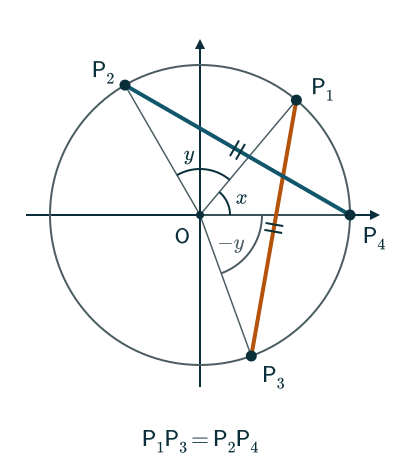
NCERT (page 58) puts four points on the unit circle: P4(1, 0); P1 reached by turning x; P2 reached by turning x + y; and P3 reached by turning −y. So
- P1 = (cos x, sin x) and P2 = (cos (x + y), sin (x + y));
- P3 = (cos y, −sin y) and P4 = (1, 0).
Rotate the circle about O through y: P3, at angle −y, moves to P4, and P1, at angle x, moves to P2, at angle x + y. Rotation preserves distance, so the chords P1P3 and P2P4 are equal. This works for all real x and y, including negative angles and rotations beyond a full turn. By the distance formula:
- P1P32 = (cos x − cos y)2 + (sin x + sin y)2 = 2 − 2(cos x cos y − sin x sin y);
- P2P42 = (1 − cos (x + y))2 + sin2 (x + y) = 2 − 2 cos (x + y).
Both simplifications use sin2 + cos2 = 1. Setting the two equal gives cos (x + y) = cos x cos y − sin x sin y.
The other three. Replace y by −y to get cos (x − y). Put x = π/2 in cos (x − y) to get cos (π/2 − y) = sin y, and then sin (π/2 − x) = cos x (NCERT identities 5 and 6, page 59). Then:
sin (x + y) from cos (x − y)
sin (x + y) = cos (π/2 − (x + y))
= cos ((π/2 − x) − y)
= cos (π/2 − x) cos y
+ sin (π/2 − x) sin y
= sin x cos y + cos x sin y
Replacing y by −y gives sin (x − y).
These formulas are also why, when two complex numbers are multiplied, their arguments add (see polar form).
Beyond the NCERT text: a sin x + b cos x. For real a and b, not both 0, put R = √(a2 + b2) and choose α with cos α = a/R and sin α = b/R. Then a sin x + b cos x = R(sin x cos α + cos x sin α) = R sin (x + α), so a sin x + b cos x always lies between −R and R. For example, 3 sin x + 4 cos x lies between −5 and 5.
Angles such as π − x and π + x
Choosing special values of x and y in the four formulas gives these results (NCERT identities 5, 6 and 9, pages 59–60):
| Angle | sin | cos |
|---|---|---|
| π/2 − x | cos x | sin x |
| π/2 + x | cos x | −sin x |
| π − x | sin x | −cos x |
| π + x | −sin x | −cos x |
| 2π − x | −sin x | cos x |
Similar results for tan x, cot x, sec x and cosec x can be obtained from the results of sin x and cos x.
NCERT Mathematics (Class 11), Section 3.4, page 60
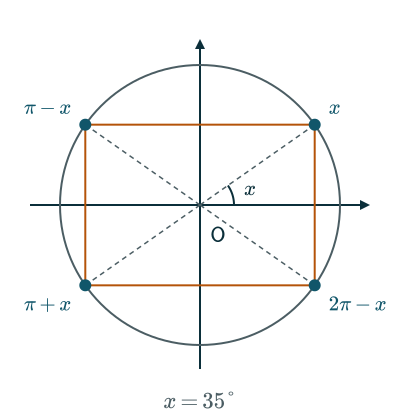
For example, tan (π + x) = (−sin x)/(−cos x) = tan x, which is why tan repeats every π. On the unit circle the points for π − x, π + x and 2π − x are mirror images of the point for x:
tan and cot of a sum or difference
Divide sin (x + y) by cos (x + y), then divide the top and bottom by cos x cos y (NCERT identity 10, page 60). The formulas hold when every tan or cot in them is defined and the denominator is not 0:
Tangent and cotangent of a sum
tan (x + y) =
(tan x + tan y)/
tan (x − y) =
(tan x − tan y)/
cot (x + y) =
(cot x cot y − 1)/
cot (x − y) =
(cot x cot y + 1)/
NCERT (pages 60–61) states the conditions: for tan (x + y), none of x, y and x + y is an odd multiple of π/2; for cot (x + y), none of x, y and x + y is a multiple of π.
The formula for tan (x − y) also gives the tangent of the angle between two lines from their slopes.
Double and triple angle formulas
Put y = x in the sum formulas (NCERT identities 14–16, pages 61–62):
Double angle formulas
sin 2x = 2 sin x cos x
cos 2x = cos x − sin x
= 2 cos x − 1
= 1 − 2 sin x
tan 2x = 2 tan x/(1 − tan x)
Since cos2 x + sin2 x = 1, write sin 2x = (2 sin x cos x)/
- sin 2x = 2 tan x/(1 + tan2 x);
- cos 2x = (1 − tan2 x)/(1 + tan2 x).
NCERT gives the condition for tan 2x as 2x ≠ nπ + π/2 (page 62). The right-hand side also needs tan x to be defined, so x ≠ nπ + π/2 as well: at x = π/2, tan 2x = tan π = 0 but tan x does not exist.
Solving cos 2x = 2 cos2 x − 1 and cos 2x = 1 − 2 sin2 x for the squares gives the forms used for half angles:
Squares in terms of cos 2x
cos x = (1 + cos 2x)/2
sin x = (1 − cos 2x)/2
Replacing x by x/2: sin2 (x/2) = (1 − cos x)/2 and cos2 (x/2) = (1 + cos x)/2. The sign of sin (x/2) or cos (x/2) comes from the quadrant of x/2.
Writing 3x = 2x + x and using the double angle formulas gives the triple angle formulas (NCERT identities 17–19, pages 62–63):
Triple angle formulas
sin 3x = 3 sin x − 4 sin x
cos 3x = 4 cos x − 3 cos x
tan 3x =
(3 tan x − tan x)/
The tan 3x formula needs 3x ≠ nπ + π/2 (NCERT identity 19, page 62); that condition already makes tan x defined and 1 − 3 tan2 x ≠ 0. For example, sin 3x = sin 2x cos x + cos 2x sin x = 2 sin x (1 − sin2 x) + (1 − 2 sin2 x) sin x = 3 sin x − 4 sin3 x.
Sum to product and product to sum
Adding and subtracting the formulas for cos (x ± y) and sin (x ± y) gives the product-to-sum results (NCERT identity 21, page 64):
Product to sum
2 cos x cos y
= cos (x + y) + cos (x − y)
−2 sin x sin y
= cos (x + y) − cos (x − y)
2 sin x cos y
= sin (x + y) + sin (x − y)
2 cos x sin y
= sin (x + y) − sin (x − y)
To turn a sum into a product, put x + y = θ and x − y = φ, so x = (θ + φ)/2 and y = (θ − φ)/2. The first line then says that cos θ + cos φ is 2 cos x cos y: twice the cosine of (θ + φ)/2 times the cosine of (θ − φ)/2. This is NCERT identity 20 (pages 63–64).
Since θ and φ can take any real values, we can replace θ by x and φ by y.
NCERT Mathematics (Class 11), Section 3.4, page 64
Sum to product
cos x + cos y = 2 cos A cos B
cos x − cos y = −2 sin A sin B
sin x + sin y = 2 sin A cos B
sin x − sin y = 2 cos A sin B
A = (x + y)/2, B = (x − y)/2
The first of these is how physics explains beats: two sound waves of nearly equal frequency add to a wave whose loudness rises and falls.
Solved examples
Example 1: sin 15°, sin 75° and tan 15° (NCERT Example 11 and Exercise 3.3, Q5)
Find sin 15°, sin 75° and tan 15°.
sin 15° = sin (45° − 30°) = sin 45° cos 30° − cos 45° sin 30° = (1/√2)(√3/2) − (1/√2)(1/2). Likewise sin 75° = sin (45° + 30°) = (1/√2)(√3/2) + (1/√2)(1/2). For tan 15° = tan (45° − 30°), use the tan formula with tan 45° = 1 and tan 30° = 1/√3, then multiply top and bottom by √3 − 1.
Answer: sin 15° = (√3 − 1)/(2√2); sin 75° = (√3 + 1)/(2√2); tan 15° = (√3 − 1)/(√3 + 1) = 2 − √3.
Example 2: An angle beyond π (NCERT Example 12, page 64)
Find tan (13π/12).
tan repeats every π, so tan (13π/12) = tan (π + π/12) = tan (π/12), and π/12 = π/4 − π/6, which is 15°.
Answer: tan (13π/12) = 2 − √3.
Example 3: A tan identity (NCERT Example 14, page 65)
Show that tan 3x tan 2x tan x = tan 3x − tan 2x − tan x.
tan 3x = tan (2x + x) = (tan 2x + tan x)/
Answer: tan 3x − tan 2x − tan x = tan 3x tan 2x tan x, wherever all three tangents are defined.
Example 4: Sum to product (NCERT Example 16, page 66)
Prove that (cos 7x + cos 5x)/
Top: 2 cos 6x cos x. Bottom: 2 cos 6x sin x. Cancel 2 cos 6x, which must not be 0.
Answer: the ratio is cos x/sin x = cot x, on the original domain cos 6x ≠ 0 and sin x ≠ 0. Cancelling a factor does not restore excluded values.
Example 5: sin (x + y) from two quadrants (NCERT Example 18, page 68)
sin x = 3/5 and cos y = −12/13, with x and y both in the second quadrant. Find sin (x + y).
In the second quadrant cosines are negative and sines positive: cos x = −4/5 and sin y = 5/13. Then sin (x + y) = (3/5)(−12/13) + (−4/5)(5/13) = −36/65 − 20/65.
Answer: sin (x + y) = −56/65.
Example 6: Half angles (NCERT Example 21, page 70)
tan x = 3/4 with π < x < 3π/2. Find sin (x/2), cos (x/2) and tan (x/2).
sec2 x = 1 + 9/16 = 25/16 and cos x < 0, so cos x = −4/5. Since π/2 < x/2 < 3π/4, sin (x/2) > 0 and cos (x/2) < 0. Now 2 sin2 (x/2) = 1 − cos x = 9/5 and 2 cos2 (x/2) = 1 + cos x = 1/5, so sin2 (x/2) = 9/10 and cos2 (x/2) = 1/10.
Answer: sin (x/2) = 3/√10, cos (x/2) = −1/√10, tan (x/2) = −3.
Common mistakes to avoid
Common mistake
Treating sin (x + y) as sin x + sin y
The same slip with double angles: cos 2x ≠ 2 cos x. At x = 60°, cos 120° = −1/2 but 2 cos 60° = 1.
Common mistake
Mixing up the signs in cos (x ± y)
The sign flips: cos (x + y) has a minus, cos (x − y) a plus. sin (x ± y) keeps the same sign as the angle.
Common mistake
Choosing the wrong sign of a half angle
In Example 6, x is in the third quadrant but x/2 is in the second, so sin (x/2) is positive although sin x is negative. Always locate x/2 first.
Quick revision summary
- The signs: cos (x ± y) = cos x cos y ∓ sin x sin y flips the sign, while sin (x ± y) = sin x cos y ± cos x sin y keeps it; sin 2x = 2 sin x cos x and cos 2x = 2 cos2 x − 1 = 1 − 2 sin2 x follow with y = x.
- The conditions: the tan and cot formulas hold only where every tan or cot in them is defined; tan 2x also needs tan x defined.
- The half-angle sign: find the quadrant of x/2 before taking a square root; cos x + cos y = 2 cos A cos B with A = (x + y)/2 and B = (x − y)/2.
Formula sheet
- cos (x ± y) = cos x cos y ∓ sin x sin y
- sin (x ± y) = sin x cos y ± cos x sin y
- sin 2x = 2 sin x cos x
- cos 2x = 2 cos x − 1 = 1 − 2 sin x
- tan 2x = 2 tan x/(1 − tan x)
- sin 3x = 3 sin x − 4 sin x
- cos 3x = 4 cos x − 3 cos x
- cos x + cos y = 2 cos A cos B
- sin x + sin y = 2 sin A cos B
- A = (x + y)/2; B = (x − y)/2
Questions students ask
What are allied angles and compound angles in trigonometry?
Allied angles are pairs whose sum or difference is 0 or a multiple of 90° (π/2), such as x and π − x, while a compound angle is the sum or difference of two angles, such as x + y or 60° + 45°. A compound angle needs the full sum and difference formulas: cos 105° = cos (60° + 45°) works out to (1 − √3)/(2√2). For an allied angle the same formulas collapse to one term, ± sin x or ± cos x: putting y = π in sin (x + y) gives sin (π + x) = −sin x. NCERT uses neither name, but its results for π/2 ± x, π ± x and 2π − x are the allied angle formulas.
How do you remember the allied angle formulas?
The allied angle formulas follow one rule: write the angle as n × 90° ± x; for even n (180° ± x, 360° − x) the function keeps its name, and for odd n (90° ± x, 270° ± x) it changes to its co-function: sin and cos swap, as do tan and cot, and sec and cosec. The sign is that of the original function in the angle’s quadrant, with x taken as acute, read from All Silver Tea Cups. For example, cos 330° = cos (270° + 60°) = sin 60° = √3/2, since n = 3 is odd and cosine is positive in the fourth quadrant. The results are identities, true for every x, not only acute ones.
What is sin (x + y) sin (x − y) equal to?
The product sin (x + y) sin (x − y) equals sin2 x − sin2 y for all real x and y: multiply the sum and difference formulas for sine and simplify with sin2 + cos2 = 1 for each angle. Its partner is cos (x + y) cos (x − y) = cos2 x − sin2 y. For x = 60° and y = 30°, sin 90° sin 30° = 1/2, and sin2 60° − sin2 30° = 3/4 − 1/4 = 1/2.
What is the formula for 2 sin x sin y?
The product-to-sum formula is 2 sin x sin y = cos (x − y) − cos (x + y), with the cosine of the difference first; NCERT writes the same result as −2 sin x sin y = cos (x + y) − cos (x − y). It comes from subtracting the formula for cos (x + y) from that for cos (x − y), which cancels the cos x cos y terms and doubles sin x sin y. For x = y = 45°, 2 sin 45° sin 45° = 1, and cos 0° − cos 90° = 1 − 0 = 1, while the other order would give −1.
What is a trigonometric identity, and how many are there?
A trigonometric identity is an equation in trigonometric functions that holds for every value of the variable for which both sides are defined, such as sin2 x + cos2 x = 1, unlike an equation such as sin x = 1/2, which holds only for some x. There is no fixed number of identities, because new ones can always be derived from old ones. The core set for Class 11 is small: the three Pythagorean identities and the results that NCERT numbers 1 to 21 in its Section 3.4, which start from sin (−x), cos (−x) and the four sum and difference formulas.
How do you prove a trigonometric identity?
To prove a trigonometric identity, transform the more complicated side into the other, or simplify each side separately until they meet; do not start from the identity and square or cross-multiply, because reaching a true statement that way proves nothing unless every step reverses. Useful moves are writing everything in sin and cos, using the sum, difference, double angle or sum-to-product formulas to make the angles match, and factorising, noting where a cancelled factor must not be 0. A numerical check at one value, such as x = π/6, can catch a misprinted question first; the solved examples show the method.
Practice questions
Try each question first, then open the answer to check your working.
-
Q1. Prove that (i) sin2 (π/6) + cos2 (π/3) − tan2 (π/4) = −1/2; (ii) 2 sin2 (3π/4) + 2 cos2 (π/4) + 2 sec2 (π/3) = 10 (NCERT Exercise 3.3, Q1 and Q4).
Show answerHide answer
(i) 1/4 + 1/4 − 1 = −1/2. (ii) sin (3π/4) = 1/√2 and sec (π/3) = 2, so 2(1/2) + 2(1/2) + 2(4) = 1 + 1 + 8 = 10.
-
Q2. Prove that tan (π/4 + x)/tan (π/4 − x) = ((1 + tan x)/(1 − tan x))2 (NCERT Exercise 3.3, Q7).
Show answerHide answer
tan (π/4 + x) = (1 + tan x)/(1 − tan x) and tan (π/4 − x) = (1 − tan x)/(1 + tan x), since tan (π/4) = 1. Dividing the first by the second squares the first. This proof uses the common domain: tan x is defined and tan x ≠ ±1. At an excluded angle, one of the original tangents or denominators is undefined or zero.
-
Q3. Prove that sin2 6x − sin2 4x = sin 2x sin 10x (NCERT Exercise 3.3, Q12).
Show answerHide answer
As a difference of squares, sin2 6x − sin2 4x = (sin 6x + sin 4x) × (sin 6x − sin 4x). The first factor is 2 sin 5x cos x and the second is 2 cos 5x sin x. Regrouped, their product is (2 sin 5x cos 5x) × (2 sin x cos x), which is sin 10x sin 2x.
-
Q4. Find tan (π/8) (NCERT Example 20, page 69).
Show answerHide answer
Let t = tan (π/8). Then tan (π/4) = 2t/(1 − t2) = 1, so t2 + 2t − 1 = 0 and t = −1 ± √2. π/8 is in the first quadrant, so t > 0: tan (π/8) = √2 − 1.