Argument and polar form of a complex number
Beyond NCERT In the JEE Main syllabus; the Class 11 book has no section for it.
Quick answer
Any non-zero complex number z = x + iy can be written in polar form z = r(cos θ + i sin θ), where r = |z| and θ is an argument of z, the angle from the positive real axis to z in the Argand plane. The principal argument arg z is the value with −π < θ ≤ π, found from the quadrant and, off the axes, the acute angle α with tan α = |y|/|x|; on an axis, read its direction directly. When complex numbers are multiplied, their moduli multiply and their arguments add (up to a multiple of 2π).
What is the argument of a complex number?
The JEE Main 2027 mathematics syllabus (Unit 2) lists the “modulus and argument (or amplitude) of a complex number”. The 2026–27 NCERT Class 11 book names polar representation only in the heading of Section 4.5, so this page covers it from the standard definitions.
Argument and polar form
For z = x + iy ≠ 0, let r = |z| = √(x2 + y2).
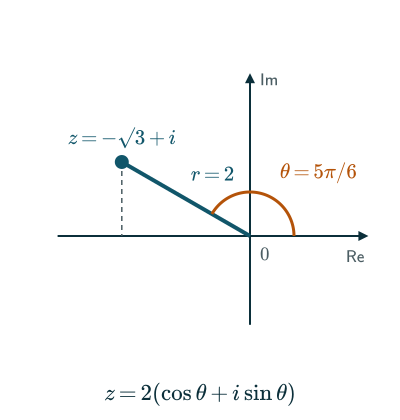
- An argument (or amplitude) of z is an angle θ with cos θ = x/r and sin θ = y/r: the angle from the positive real axis to the line from 0 to z in the Argand plane.
- Then x = r cos θ and y = r sin θ, so z = r(cos θ + i sin θ). This is the polar form of z.
- The principal argument, written arg z, is the one value of θ with −π < θ ≤ π.
In plain words: the polar form describes z by how far it is from 0 (the modulus r) and in which direction (the argument θ). Turning once more round the circle changes θ by 2π and returns to the same point, so if θ is an argument of z, so is θ + 2nπ for every integer n; the principal argument picks one of them. The number 0 has modulus 0 and no argument.
The definition uses the unit-circle sine and cosine: (cos θ, sin θ) is the point on the unit circle in the direction of z, and z is r times it.
Finding the principal argument
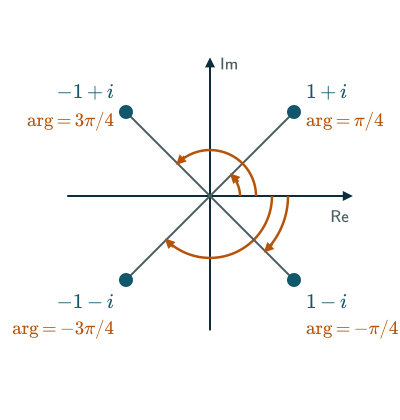
For a point off both axes (x ≠ 0 and y ≠ 0), first find the acute angle α with tan α = |y|/|x|; then the quadrant of z decides arg z:
| Where z is | arg z |
|---|---|
| quadrant I (x > 0, y > 0) | α |
| quadrant II (x < 0, y > 0) | π − α |
| quadrant III (x < 0, y < 0) | −(π − α) |
| quadrant IV (x > 0, y < 0) | −α |
On the axes: arg z = 0 for a positive real number, π for a negative real number, π/2 on the positive imaginary axis and −π/2 on the negative imaginary axis.
Multiplying and dividing in polar form
If z1 = r1(cos θ1 + i sin θ1) and z2 = r2(cos θ2 + i sin θ2), multiplying out and using the sum formulas for cos (θ1 + θ2) and sin (θ1 + θ2) gives the product. Multiplying out with i2 = −1:
Multiplying out
zz = rr ×
[(cos θ cos θ
− sin θ sin θ)
+ i(sin θ cos θ
+ cos θ sin θ)]
The two brackets are cos (θ1 + θ2) and sin (θ1 + θ2). For division, 1/z2 = (1/r2)(cos (−θ2) + i sin (−θ2)), because the product of the two is 1. So:
Product and quotient in polar form
zz
= rr(cos (θ + θ)
+ i sin (θ + θ))
z/z = (r/r) ×
(cos (θ − θ)
+ i sin (θ − θ))
So moduli multiply and arguments add (up to a multiple of 2π); in division, moduli divide and arguments subtract. Multiplying by i = cos (π/2) + i sin (π/2) adds π/2 to the argument: a quarter turn anticlockwise, as in the powers of i.
Solved examples
Example 1: A first-quadrant number
Write z = 1 + i√3 in polar form.
r = √(1 + 3) = 2. cos θ = 1/2 and sin θ = √3/2, so θ = π/3, in the first quadrant.
Answer: z = 2(cos (π/3) + i sin (π/3)); arg z = π/3.
Example 2: A third-quadrant number
Find the modulus and principal argument of z = −1 − i.
r = √2. tan α = |y|/|x| = 1, so α = π/4. The point (−1, −1) is in the third quadrant, so arg z = −(π − π/4).
Answer: |z| = √2 and arg z = −3π/4, so z = √2(cos θ + i sin θ) with θ = −3π/4.
Example 3: The number in the figure
Write z = −√3 + i in polar form.
r = √(3 + 1) = 2. tan α = 1/√3, so α = π/6. The point (−√3, 1) is in the second quadrant, so θ = π − π/6.
Answer: z = 2(cos (5π/6) + i sin (5π/6)).
Example 4: Simplify first, then convert
Write (1 + 7i)/(2 − i)2 in polar form.
(2 − i)2 = 4 − 4i + i2 = 3 − 4i. Then (1 + 7i)/(3 − 4i) = (1 + 7i)(3 + 4i)/25 = (3 + 4i + 21i − 28)/25 = −1 + i. Its modulus is √2 and it is in the second quadrant with α = π/4.
Answer: √2(cos θ + i sin θ) with θ = 3π/4.
Common mistakes to avoid
Common mistake
Taking tan(y/x) without the quadrant
For −1 − i, y/x = 1 and a calculator gives tan−1 1 = π/4, but −1 − i is in the third quadrant: arg = −3π/4. Always draw or locate the point first.
Common mistake
Giving a principal argument outside (−π, π]
5π/4 and −3π/4 point the same way, but only −3π/4 is the principal argument. Add or subtract 2π to land in −π < θ ≤ π.
Common mistake
Assuming arg (zz) = arg z + arg z exactly
For z = −1 + i, arg z = 3π/4, so 3π/4 + 3π/4 = 3π/2. But z2 = −2i, and its principal argument is −π/2. In general arg (z1z2) = arg z1 + arg z2 + 2kπ, with k = −1, 0 or 1 chosen to bring the sum into (−π, π]. The same holds for quotients.
Common mistake
Taking arg of the conjugate as −arg z every time
The conjugate of z has argument −arg z, except when z is a negative real number: then the conjugate is z itself and both arguments are π, because −π is not allowed.
Common mistake
Writing a polar form with a negative modulus
−2(cos (π/3) + i sin (π/3)) is not in polar form, because r must be positive. It equals 2(cos θ + i sin θ) with θ = −2π/3.
Quick revision summary
- For z = x + iy ≠ 0: r = |z|, cos θ = x/r, sin θ = y/r, and z = r(cos θ + i sin θ).
- The principal argument arg z lies in −π < θ ≤ π; find the acute angle α with tan α = |y|/|x| first, then use the quadrant.
- In products, moduli multiply and arguments add; in quotients, moduli divide and arguments subtract (for principal arguments, adjust by 2π if needed).
Formula sheet
- z = r(cos θ + i sin θ), r = |z|
- cos θ = x/r, sin θ = y/r
- −π < arg z ≤ π
- |z1z2| = r1r2, arg adds (up to a multiple of 2π)
Questions students ask
Argument vs principal argument: what is the difference?
A non-zero complex number has infinitely many arguments, since if θ is one, so is θ + 2nπ for every integer n (a full turn about 0 returns to the same point); the principal argument, arg z, is the one of them that lies in −π < θ ≤ π. For example, √3 − i has the principal argument −π/6, and 11π/6 and −13π/6 are also arguments of it; the whole set, −π/6 + 2nπ, is often called the general argument. Some books write the principal value as Arg z, or take it in 0 ≤ θ < 2π (which would give 11π/6 here), so check the convention a question states; this page uses −π < θ ≤ π.
Is the amplitude of a complex number the same as its argument?
Yes, the amplitude of a complex number is another name for its argument, the angle θ from the positive real axis to the point z: amp z and arg z mean the same thing, and the principal amplitude is the principal argument. The JEE Main 2027 syllabus lists “modulus and argument (or amplitude) of a complex number”, so either word can appear in a question. The amplitude is not the modulus |z|, the distance from 0, nor the amplitude of a wave or a sine graph, which is a size like the modulus: for 2 − 2√3 i, the amplitude is −π/3 and the modulus is 4.
What are the properties of arg z?
The main properties of the argument of non-zero numbers, each true only up to a multiple of 2π (so a principal value may need a multiple of 2π added or subtracted), are: the argument of a product is the sum of the arguments, of a quotient the difference, of zn (n an integer) n times arg z, and of the conjugate −arg z. Multiplying z by a positive real number leaves its argument unchanged, and multiplying by a negative one changes it by π or −π. A useful consequence: if arg (z1/z2) = ±π/2, then z1/z2 is purely imaginary and the lines from 0 to z1 and to z2 are perpendicular.
How do you add complex numbers in polar form?
Complex numbers in polar form are added by converting each to x + iy, adding, and converting back, because a sum, unlike a product, has no simple rule in terms of the moduli and arguments: in general its modulus is not r1 + r2 and its argument is not θ1 + θ2. For example, 2 (modulus 2, argument 0) and 2i (modulus 2, argument π/2) add to 2 + 2i = 2√2(cos (π/4) + i sin (π/4)), whose modulus 2√2 is less than 2 + 2. Polar form suits multiplying, dividing and powers, where moduli multiply or divide and arguments add or subtract, while x + iy suits adding and subtracting.
What is the exponential form of a complex number?
The exponential form of a complex number is z = reiθ, a short way of writing the polar form r(cos θ + i sin θ) by Euler’s formula eiθ = cos θ + i sin θ, with θ in radians; some books write r cis θ instead. In this form the product rule of the polar form becomes the law of indices: multiplying two numbers multiplies the moduli and adds the exponents iθ1 and iθ2. The exponential form is not in the NCERT Class 11 book or the JEE Main 2027 syllabus, and the usual proofs of Euler’s formula use material beyond this chapter, so for JEE Main treat reiθ only as shorthand for the polar form.
What is the principal argument of ω and ω, the complex cube roots of unity?
The complex cube roots of unity are ω = (−1 + i√3)/2, with principal argument 2π/3, and ω2 = (−1 − i√3)/2, with principal argument −2π/3. Both have modulus 1 and make the acute angle π/3 with the real axis, ω in the second quadrant and ω2 in the third. The tempting value arg ω2 = 2 × 2π/3 = 4π/3 is an argument of ω2 but not the principal one, because it is greater than π: subtracting 2π gives −2π/3.
Practice questions
Try each question first, then open the answer to check your working.
-
Q1. Find the modulus and principal argument of −√3 − i.
Show answerHide answer
r = 2; α = π/6; third quadrant, so arg = −(π − π/6) = −5π/6.
-
Q2. Write i and −3 in polar form.
Show answerHide answer
i = 1(cos (π/2) + i sin (π/2)); −3 = 3(cos π + i sin π).
-
Q3. Write 1 − i in polar form.
Show answerHide answer
r = √2; α = π/4; fourth quadrant, so θ = −π/4: 1 − i = √2(cos (−π/4) + i sin (−π/4)).
-
Q4. If z1 = 2(cos (π/6) + i sin (π/6)) and z2 = 3(cos (π/3) + i sin (π/3)), find z1z2 in the form a + ib.
Show answerHide answer
Moduli multiply and arguments add: 6(cos (π/2) + i sin (π/2)) = 6i.