Algebra of complex numbers
NCERT Class 11 Mathematics Chapter 4 Section 4.3
Quick answer
The algebra of complex numbers is adding, subtracting, multiplying and dividing numbers a + ib: add or subtract the real parts and the imaginary parts separately, and multiply by expanding the brackets with i = −1, so (a + ib)(c + id) = (ac − bd) + i(ad + bc). To divide, multiply the top and bottom by the conjugate of the bottom (c − id for c + id), which makes the bottom real. Powers of i repeat every four: i, −1, −i, 1.
With your textbook
NCERT Mathematics (Class 11), Chapter 4 “Complex Numbers and Quadratic Equations”, Section 4.3 “Algebra of Complex Numbers”, pages 77–81.
Open the official NCERT chapter (PDF, 1.6 MB, ncert.nic.in) (opens in a new tab)
Checked against the 2026-27 reprint on .
What is the algebra of complex numbers?
In this Section, we shall develop the algebra of complex numbers.
NCERT Mathematics (Class 11), Section 4.3, page 77
The four operations work on a + ib exactly as on an expression in a letter i, with one extra rule, i2 = −1. The results are always again complex numbers (except that we never divide by 0).
Adding and subtracting complex numbers
Sum and difference
For z1 = a + ib and z2 = c + id (NCERT Sections 4.3.1–4.3.2, page 77):
- z1 + z2 = (a + c) + i(b + d);
- z1 − z2 = z1 + (−z2) = (a − c) + i(b − d).
In plain words: add the real parts, and add the imaginary parts. NCERT’s examples (page 77): (2 + i3) + (−6 + i5) = −4 + i8, and (6 + 3i) − (2 − i) = 4 + 4i, while (2 − i) − (6 + 3i) = −4 − 4i. Subtraction is not commutative.
The addition of complex numbers satisfy the following properties:
NCERT Mathematics (Class 11), Section 4.3.1, page 77
These are the same laws as for real numbers:
- closure: the sum of two complex numbers is a complex number;
- commutative: z1 + z2 = z2 + z1;
- associative: (z1 + z2) + z3 = z1 + (z2 + z3);
- additive identity 0 = 0 + i0, with z + 0 = z;
- additive inverse −z = −a + i(−b), with z + (−z) = 0.
Multiplying complex numbers
Multiply out as for ordinary brackets and replace i2 by −1: (a + ib)(c + id) = ac + iad + ibc + i2bd. This is NCERT’s definition (Section 4.3.3, page 78):
Product
(a + ib)(c + id)
= (ac − bd) + i(ad + bc)
For example, (3 + i5)(2 + i6) = (3 × 2 − 5 × 6) + i(3 × 6 + 5 × 2) = −24 + i28 (NCERT page 78).
The multiplication of complex numbers possesses the following properties, which we state without proofs.
NCERT Mathematics (Class 11), Section 4.3.3, page 78
Multiplication is closed, commutative and associative, distributes over addition, and has the identity 1 = 1 + i0. Every non-zero complex number also has a multiplicative inverse:
Multiplicative inverse
1/(a + ib)
= a/(a + b)
+ i(−b)/(a + b)
This works whenever a2 + b2 ≠ 0, that is, whenever a and b are not both 0. NCERT (page 78, and again in the chapter summary on page 87) writes the condition as “a ≠ 0, b ≠ 0”, which is too strong: z = 2, with b = 0, has the inverse 1/2, and z = 3i, with a = 0, has the inverse −i/3. The correct condition is z ≠ 0. NCERT Section 4.4 rewrites this inverse using the conjugate a − ib.
Dividing complex numbers
For z2 ≠ 0, z1/z2 = z1 × (1/z2) (NCERT Section 4.3.4, page 78). In practice, multiply the top and the bottom by the bottom with the sign of its imaginary part changed; the bottom then becomes a real number:
Dividing by 2 − i
(6 + 3i)/(2 − i)
= (6 + 3i)(2 + i)/((2 − i)(2 + i))
= (12 + 6i + 6i + 3i)/(4 + 1)
= (9 + 12i)/5
NCERT works this example (pages 78–79) from the definition, multiplying 6 + 3i by 1/(2 − i) = (2 + i)/5, and gets (1/5)(9 + 12i), that is 9/5 + (12/5)i.
Powers of i
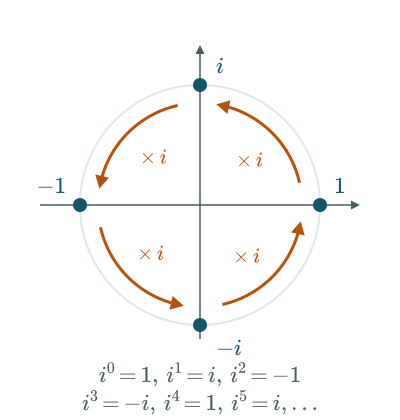
Since i2 = −1 (NCERT Section 4.3.5, page 79), each extra factor of i moves one step round the cycle 1 → i → −1 → −i → 1. If a + ib is drawn as the point (a, b) (the Argand plane of NCERT Section 4.5), then i(a + ib) = −b + ia is the point (−b, a): the same distance from 0, turned a right angle (π/2 radian) anticlockwise about 0 (see the figure below). In symbols:
- i3 = i2 × i = −i and i4 = (i2)2 = 1;
- i5 = i, i6 = −1, and so on: the powers repeat every 4;
- negative powers too: i−1 = 1/i = −i, i−2 = −1, i−3 = i, i−4 = 1.
Powers of i (k any integer)
i = 1, i = i
i = −1, i = −i
To find in, divide n by 4 and keep the remainder: i35 = i32 + 3 = −i, and i−35 = i−36 + 1 = i.
Square roots of negative numbers
Both i and −i square to −1, so −1 has the two square roots ±i; the symbol √−1 means i only (NCERT Section 4.3.6, page 79). In the same way the square roots of −3 are ±√3 i, and √−3 means √3 i. In general, for a positive real number a, √−a = √a i.
The rule √a × √b = √(ab) holds for positive a and b, and also when one of them is negative, but not when both are negative (NCERT pages 79–80). If it did, then i2 = √−1 × √−1 = √((−1)(−1)) = √1 = 1, which contradicts i2 = −1.
Identities
Because addition and multiplication obey the usual laws, the algebraic identities for real numbers hold for complex numbers too (NCERT Section 4.3.7, page 80):
- (z1 + z2)2 = z12 + 2z1z2 + z22 and (z1 − z2)2 = z12 − 2z1z2 + z22;
- (z1 ± z2)3 = z13 ± 3z12z2 + 3z1z22 ± z23;
- z12 − z22 = (z1 + z2)(z1 − z2).
In fact, many other identities which are true for all real numbers, can be proved to be true for all complex numbers.
NCERT Mathematics (Class 11), Section 4.3.7, page 80
NCERT proves the first one step by step: (z1 + z2)(z1 + z2) = z12 + z2z1 + z1z2 + z22 by the distributive law, and z2z1 = z1z2 by the commutative law.
Solved examples
Example 1: Products with i (NCERT Example 2, page 80)
Express in the form a + bi: (i) (−5i)(i/8); (ii) (−i)(2i)(−i/8)3.
(i) (−5/8)i2 = 5/8. (ii) (−i)(2i) = −2i2 = 2, and (−i/8)3 = −i3/512 = i/512, so the product is 2i/512.
Answer: (i) 5/8 + i0; (ii) 0 + i/256.
Example 2: A cube (NCERT Example 3, page 81)
Express (5 − 3i)3 in the form a + ib.
Use (z1 − z2)3: 53 − 3 × 52 × 3i + 3 × 5 × (3i)2 − (3i)3 = 125 − 225i − 135 + 27i.
Answer: −10 − 198i.
Example 3: A root of a negative number (NCERT Example 4, page 81)
Express (−√3 + √−2)(2√3 − i) in the form a + ib.
First write √−2 = √2 i. Then multiply out: −6 + √3 i + 2√6 i − √2 i2 = (−6 + √2) + (√3 + 2√6)i, and √3 + 2√6 = √3(1 + 2√2).
Answer: (−6 + √2) + √3(1 + 2√2)i.
Example 4: Expressions in a + ib (NCERT Exercise 4.1, Q4, Q8 and Q9)
Express (i) 3(7 + i7) + i(7 + i7); (ii) (1 − i)4; (iii) (1/3 + 3i)3 in the form a + ib.
(i) 21 + 21i + 7i + 7i2 = 14 + 28i. (ii) (1 − i)2 = 1 − 2i + i2 = −2i, and (−2i)2 = −4. (iii) 1/27 + 3 × (1/9) × 3i + 3 × (1/3) × (3i)2 + (3i)3 = 1/27 + i − 9 − 27i.
Answer: (i) 14 + 28i; (ii) −4 + 0i; (iii) −242/27 − 26i.
Common mistakes to avoid
Common mistake
Multiplying square roots of two negatives
√−4 × √−9 = (2i)(3i) = 6i2 = −6, not √36 = 6. Change each √−a to √a i before multiplying.
Common mistake
Forgetting that i = −1 when expanding
(2 + 3i)2 = 4 + 12i + 9i2 = −5 + 12i, not 13 + 12i.
Common mistake
Dividing the parts separately
(6 + 3i)/(2 − i) is not 6/2 + (3/(−1))i = 3 − 3i. Multiply the top and the bottom by 2 + i first: the answer is 9/5 + (12/5)i.
Quick revision summary
- (a + ib) ± (c + id) = (a ± c) + i(b ± d); (a + ib)(c + id) = (ac − bd) + i(ad + bc), using i2 = −1.
- 1/(a + ib) = (a − ib)/(a2 + b2) for a + ib ≠ 0; to divide by c + id, multiply the top and the bottom by c − id.
- i4k = 1, i4k + 1 = i, i4k + 2 = −1, i4k + 3 = −i.
- √−a = √a i for a > 0; √a √b = √(ab) fails when a and b are both negative.
Formula sheet
- i = −1
- (a + ib) + (c + id) = (a + c) + i(b + d)
- (a + ib)(c + id) = (ac − bd) + i(ad + bc)
- 1/(a + ib) = (a − ib)/(a + b), a + ib ≠ 0
- i4k = 1, i4k+1 = i, i4k+2 = −1, i4k+3 = −i
Questions students ask
Is there a formula for dividing complex numbers?
Yes, the formula for dividing complex numbers is (a + ib)/(c + id) = [(ac + bd) + i(bc − ad)]/
Is the square root of a negative number undefined?
The square root of a negative number is undefined among the real numbers but defined among the complex numbers: no real number squares to a negative number, while for any real a > 0 the two complex numbers ±√a i square to −a, and √−a means √a i. For example, the square roots of −49 are 7i and −7i, since (7i)2 = 49i2 = −49, and √−49 = 7i. NCERT’s historical note (page 87) records that Mahavira (850), in his Ganitasara Sangraha, already stated that a negative quantity has no square root because it is not a square.
How do you find the square root of a complex number such as 3 + 4i?
To find the square roots of a + ib, write a root as x + iy with x, y real, equate parts in (x + iy)2 = a + ib and add x2 + y2 = |a + ib| from the moduli; solve for x2 and y2, giving x and y the same sign if b > 0 and opposite signs if b < 0. For 3 + 4i, x2 = 4 and y2 = 1 with like signs, so the square roots are 2 + i and −2 − i; indeed (2 + i)2 = 3 + 4i. The method is beyond the 2026–27 NCERT text and is not named in the JEE Main 2027 syllabus.
What is the difference between the additive and multiplicative inverse of a complex number?
The additive inverse of z = a + ib is −z = −a − ib, which adds to z to give 0, while the multiplicative inverse is 1/z = (a − ib)/(a2 + b2), which multiplies z to give 1. Every complex number has an additive inverse, but only a non-zero one has a multiplicative inverse. For z = 1 − 2i, the additive inverse is −1 + 2i and the multiplicative inverse is (1 + 2i)/5, since (1 − 2i)(1 + 2i) = 5.
Practice questions
Try each question first, then open the answer to check your working.
-
Q1. Express in the form a + ib: (i) (5i)(−3i/5); (ii) i9 + i19; (iii) i−39 (NCERT Exercise 4.1, Q1–Q3).
Show answerHide answer
(i) −3i2 = 3 + 0i; (ii) i + i3 = i − i = 0 + 0i; (iii) i−39 = i−40 + 1 = i, that is 0 + 1i.
-
Q2. Express (1 − i) − (−1 + i6) in the form a + ib (NCERT Exercise 4.1, Q5).
Show answerHide answer
(1 + 1) + i(−1 − 6) = 2 − 7i.
-
Q3. Express (1/5 + (2/5)i) − (4 + (5/2)i) in the form a + ib (NCERT Exercise 4.1, Q6).
Show answerHide answer
(1/5 − 4) + i(2/5 − 5/2) = −19/5 − (21/10)i.
-
Q4. Express (−2 − i/3)3 in the form a + ib (NCERT Exercise 4.1, Q10).
Show answerHide answer
(−2 − i/3)3 = −(2 + i/3)3. By the cube of a sum, (2 + i/3)3 = 8 + 3 × 4 × i/3 + 3 × 2 × i2/9 + i3/27 = 8 + 4i − 2/3 − i/27 = 22/3 + (107/27)i. So (−2 − i/3)3 = −22/3 − (107/27)i.