The Argand plane
NCERT Class 11 Mathematics Chapter 4 Section 4.5
Quick answer
In the Argand plane the complex number x + iy is drawn as the point (x, y): the real axis is the x-axis and the imaginary axis is the y-axis. The modulus |z| is the distance of the point from the origin, and |z − z| is the distance between two points. The conjugate x − iy is the mirror image of x + iy in the real axis.
With your textbook
NCERT Mathematics (Class 11), Chapter 4 “Complex Numbers and Quadratic Equations”, Section 4.5 “Argand Plane and Polar Representation”, pages 83–84.
Open the official NCERT chapter (PDF, 1.6 MB, ncert.nic.in) (opens in a new tab)
Checked against the 2026-27 reprint on .
What is the Argand plane?
Every ordered pair of real numbers (x, y) is a point of the coordinate plane, and every complex number x + iy is made of the same two real numbers. So complex numbers can be drawn as points.
The complex number x + iy which corresponds to the ordered pair (x, y) can be represented geometrically as the unique point P(x, y) in the XY-plane and vice-versa.
NCERT Mathematics (Class 11), Section 4.5, page 83
Argand plane
The plane having a complex number assigned to each of its point is called the complex plane or the Argand plane.
NCERT Mathematics (Class 11), Section 4.5, page 83
- x + iy is plotted at the point (x, y): the real part is the x-coordinate and the imaginary part the y-coordinate.
- Real numbers a + i0 lie on the x-axis, the real axis; numbers 0 + ib lie on the y-axis, the imaginary axis (NCERT page 84).
Plotting complex numbers
NCERT Fig 4.1 (page 83) plots six numbers: 2 + 4i, −2 + 3i, 0 + 1i, 2 + 0i, −5 − 2i and 1 − 2i at the points A(2, 4), B(−2, 3), C(0, 1), D(2, 0), E(−5, −2) and F(1, −2).
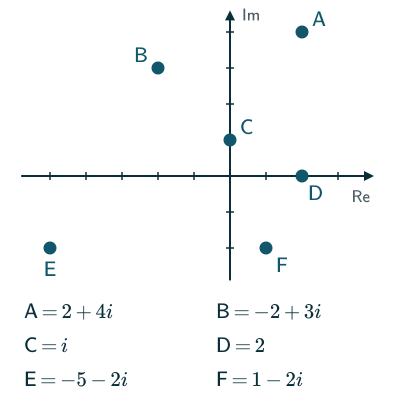
The x-axis and y-axis in the Argand plane are called, respectively, the real axis and the imaginary axis.
NCERT Mathematics (Class 11), Section 4.5, page 84
Modulus as a distance
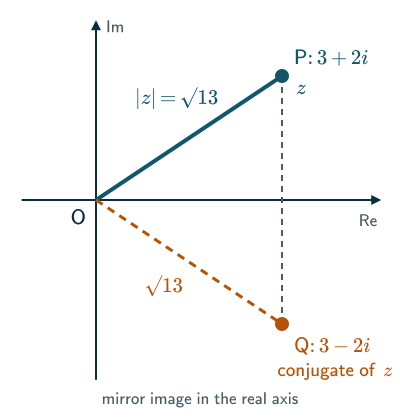
The point P(x, y) is at distance √(x2 + y2) from the origin O(0, 0), by the distance formula. That is exactly the modulus: for z = x + iy, |z| = √(x2 + y2) = OP, the distance of the point z from the origin (NCERT page 84, Fig 4.2).
The same idea gives the distance between two complex numbers: the points z1 = x1 + iy1 and z2 = x2 + iy2 are √((x1 − x2)2 + (y1 − y2)2) apart. Since z1 − z2 = (x1 − x2) + i(y1 − y2), that distance is exactly |z1 − z2|.
Distances in the Argand plane
distance from 0 to z = |z|
distance from z to z = |z − z|
So the points with |z| = 5 form the circle of radius 5 about 0, and the points with |z − (1 + i)| = 2 form the circle of radius 2 about 1 + i. In general, |z − z0| = r (r > 0) is the circle of radius r centred at the point z0.
NCERT’s Section 4.5 heading also says “Polar Representation”, but the 2026–27 book gives no polar form. For JEE Main, the point z is also fixed by its distance |z| from O and the angle that OP makes with the positive real axis, the argument of z. That leads to the polar form, a separate JEE topic on this site.
Conjugate as a mirror image
z = x + iy is the point P(x, y), and its conjugate = x − iy is the point Q(x, −y) (NCERT page 84).
Geometrically, the point (x, – y) is the mirror image of the point (x, y) on the real axis (Fig 4.3).
NCERT Mathematics (Class 11), Section 4.5, page 84
NCERT’s sentence just before this one prints the conjugate as “z = x – iy”: the bar over the second z is missing, so read it as = x − iy. The mirror image is the same distance from O, which is why || = |z|.
Solved examples
Example 1: Reading the plane
In which quadrant or on which axis do these lie: (i) −3 + 4i; (ii) 5; (iii) −2i; (iv) the conjugate of −3 + 4i?
The real part gives left or right, the imaginary part up or down.
Answer: (i) second quadrant, at (−3, 4); (ii) on the real axis, at (5, 0); (iii) on the imaginary axis, at (0, −2); (iv) −3 − 4i, third quadrant.
Example 2: Distance between two points
Find the distance between the points representing 2 + 3i and −1 − i.
The distance is |(2 + 3i) − (−1 − i)| = |3 + 4i| = √(9 + 16).
Answer: 5.
Example 3: Modulus and conjugate in the plane
For z = 3 + 2i, find |z| and , and say where is.
|z| = √(9 + 4) = √13; = 3 − 2i.
Answer: |z| = √13; = 3 − 2i is the point (3, −2), the reflection of (3, 2) in the real axis, also √13 from O.
Common mistakes to avoid
Common mistake
Plotting x + iy at (x, iy)
The point for 3 + 2i is (3, 2), not (3, 2i). Coordinates are real numbers; i only says which axis.
Common mistake
Reading the centre of a circle with the wrong sign
|z + 2 − i| = 3 is |z − (−2 + i)| = 3: the circle of radius 3 centred at −2 + i, not at 2 − i. Write it as z − (centre) before reading the centre.
Common mistake
Reflecting the conjugate in the wrong axis
is the mirror image of z in the real axis (the x-axis). Reflecting in the imaginary axis gives − instead: for 3 + 2i, that is −3 + 2i.
Quick revision summary
- x + iy is the point (x, y) of the Argand plane; the x-axis is the real axis and the y-axis the imaginary axis.
- |z| is the distance of z from 0, and |z1 − z2| is the distance between z1 and z2.
- = x − iy is the mirror image of z in the real axis, at the same distance from 0.
Formula sheet
- x + iy ↔ the point (x, y)
- |z| = distance of z from 0
- |z1 − z2| = distance between z1 and z2
Questions students ask
Are the Argand plane, the complex plane and the Argand diagram the same?
The Argand plane and the complex plane are two names for the same plane, in which the point (x, y) stands for the complex number x + iy; an Argand diagram is a drawing of particular numbers in that plane, though the three names are often used for one another. NCERT defines “the complex plane or the Argand plane”, while the JEE Main 2027 syllabus says “Argand diagram”. The plane is named after Jean-Robert Argand, who described it in 1806, and is also called the Gauss (or Gaussian) plane, after Carl Friedrich Gauss; Caspar Wessel had published the same idea in 1799.
What is the difference between the Argand plane and the Cartesian plane?
The Argand plane and the Cartesian plane have the same points, axes and distances; they differ in what a point stands for. In the Cartesian plane the point (x, y) is an ordered pair of real numbers, while in the Argand plane it is the complex number x + iy, so the x-axis is called the real axis and the y-axis the imaginary axis: the point (0, 3) is the number 3i, not 3. Because the points are numbers, two of them can be multiplied or divided to give another point, which the Cartesian plane has no rule for; in polar form, a product multiplies the distances from 0 and adds the angles.
Is the Argand plane deleted from the Class 11 syllabus?
No, the Argand plane is not deleted from Class 11 Mathematics: the 2026–27 NCERT book keeps it in Section 4.5, “Argand Plane and Polar Representation” (pages 83–84), which covers plotting x + iy, the real and imaginary axes, the modulus as a distance and the conjugate as a mirror image. Despite its heading, that section gives no polar form. The JEE Main 2027 syllabus (Unit 2) lists the “Argand diagram” and the “modulus and argument (or amplitude) of a complex number”, so JEE aspirants also study the argument and polar form.
How is the sum of two complex numbers shown in the Argand plane?
The sum z1 + z2 is the fourth vertex of the parallelogram with vertices 0, z1 and z2 (when these three are not on one line), because adding the real parts and the imaginary parts separately adds the position vectors of the two points by the parallelogram law. For example, 4 + i and 1 + 3i add to 5 + 4i, the corner of that parallelogram opposite 0. The difference z1 − z2 is the arrow from z2 to z1, moved to start at 0.
What does |z − z| = |z − z| represent in the Argand plane?
The equation |z − z1| = |z − z2|, with z1 ≠ z2, says that z is equally far from the points z1 and z2, so its locus is the perpendicular bisector of the segment joining them. For example, |z − 2| = |z − 4i| is the perpendicular bisector of the segment from (2, 0) to (0, 4), which works out to the line x − 2y + 3 = 0 through the midpoint (1, 2). With < in place of =, the locus is the half-plane of points nearer to z1, on one side of that bisector.
Practice questions
Try each question first, then open the answer to check your working.
-
Q1. Write the complex numbers at the points (−4, 1), (0, 6) and (7, 0).
Show answerHide answer
−4 + i, 6i (that is, 0 + 6i) and 7 (that is, 7 + 0i).
-
Q2. Find the distance of −5 − 12i from the origin, and of its conjugate.
Show answerHide answer
|−5 − 12i| = √(25 + 144) = 13. The conjugate −5 + 12i is its mirror image in the real axis, also 13 from 0.
-
Q3. Find the distance between 1 + i and 4 − 3i.
Show answerHide answer
|(1 + i) − (4 − 3i)| = |−3 + 4i| = 5.
-
Q4. Describe the set of points z with |z| = 2.
Show answerHide answer
All points at distance 2 from 0: the circle of radius 2 centred at the origin, for example 2, −2, 2i, −2i and √2 + i√2.