Cartesian product of sets
NCERT Class 11 Mathematics Chapter 2 Section 2.2
Quick answer
The Cartesian product A × B of two sets is the set of all ordered pairs (a, b) with a ∈ A and b ∈ B. Two ordered pairs are equal only when their first entries are equal and their second entries are equal, so order matters and in general A × B ≠ B × A. If n(A) = p and n(B) = q, then n(A × B) = pq, and A × ϕ = ϕ.
With your textbook
NCERT Mathematics (Class 11), Chapter 2 “Relations and Functions”, Section 2.2 “Cartesian Product of Sets”, pages 24–28.
Open the official NCERT chapter (PDF, 2.0 MB, ncert.nic.in) (opens in a new tab)
Checked against the 2026-27 reprint on .
What is the Cartesian product?
Cartesian product of two sets
Given two non-empty sets P and Q. The cartesian product P × Q is the set of all ordered pairs of elements from P and Q
NCERT Mathematics (Class 11), Section 2.2, page 25
In plain words: A × B pairs every element of A with every element of B, always with the element of A first. NCERT’s first illustration (page 24) takes two colours, A = {red, blue}, and three objects, B = {b, c, s} (a bag, a coat and a shirt). Each colour goes with each object, giving 2 × 3 = 6 coloured objects:
A × B = {(red, b), (red, c), (red, s), (blue, b), (blue, c), (blue, s)}.
Any subset of A × B, usually picked out by a rule, is called a relation from A to B, the subject of NCERT Section 2.3.
Ordered pairs
An ordered pair (a, b) is two elements in round brackets in a fixed order: a is the first entry and b the second. The order matters. In NCERT’s licence-plate illustration (page 25), a code is a state from A = {DL, MP, KA} followed by a number from B = {01, 02, 03}, and the code (DL, 01) is not the same as (01, DL).
Two ordered pairs are equal, if and only if the corresponding first elements are equal and the second elements are also equal.
NCERT Mathematics (Class 11), Section 2.2, page 25
Equality of ordered pairs
(a, b) = (x, y) ⇔ a = x and b = y
This is where an ordered pair differs from a set. The sets {1, 2} and {2, 1} are equal, because a set ignores order, but (1, 2) ≠ (2, 1). Also (1, 1) is a perfectly good ordered pair, while {1, 1} is just {1}.
NCERT Example 1 (page 26) uses the rule to solve for unknowns: if (x + 1, y − 2) = (3, 1), then x + 1 = 3 and y − 2 = 1, so x = 2 and y = 3.
Number of elements in a Cartesian product
If there are p elements in A and q elements in B, then there will be pq elements in A × B, i.e., if n(A) = p and n(B) = q, then n(A × B) = pq.
NCERT Mathematics (Class 11), Section 2.2, page 26
These counting formulas use finite sets. The reason: each of the p first entries can be followed by any of the q second entries, so the pairs come in p rows of q. This is the fundamental principle of counting in its simplest form. The licence plates give 3 × 3 = 9 codes, and A = {a1, a2} with B = {b1, b2, b3, b4} gives 2 × 4 = 8 pairs (NCERT page 25).
Number of elements
n(A × B) = n(A) × n(B)
n(A × B × C) = n(A) × n(B) × n(C)
If A and B are non-empty sets and either A or B is an infinite set, then so is A × B.
NCERT Mathematics (Class 11), Section 2.2, page 26
A × B is not B × A
For P = {a, b, c} and Q = {r}, P × Q = {(a, r), (b, r), (c, r)} but Q × P = {(r, a), (r, b), (r, c)}. No pair is in both, so P × Q ≠ Q × P, although both have 3 elements (NCERT Example 2, page 26). In general A × B ≠ B × A; the two are equal only when A = B, or when one of the sets is empty.
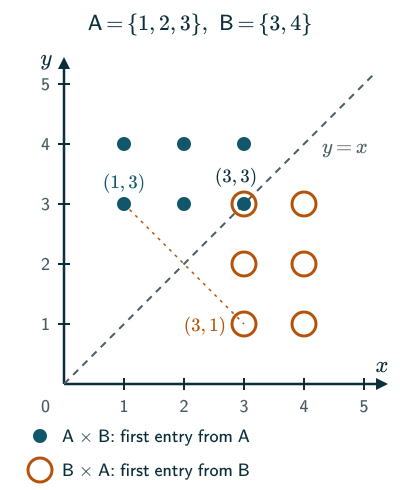
When A and B are sets of real numbers, each pair (x, y) is a point of the plane, and swapping the entries reflects the point in the line y = x:
Ordered triplets and R × R
The same idea works with three sets: A × B × C = {(a, b, c) : a ∈ A, b ∈ B, c ∈ C}, and (a, b, c) is called an ordered triplet. NCERT (page 26) writes the case A × A × A = {(a, b, c) : a, b, c ∈ A}. For P = {1, 2}, P × P × P has 2 × 2 × 2 = 8 triplets (NCERT Example 4, page 27):
P × P × P = {(1, 1, 1), (1, 1, 2), (1, 2, 1), (1, 2, 2), (2, 1, 1), (2, 1, 2), (2, 2, 1), (2, 2, 2)}.
With R the set of real numbers, R × R = {(x, y) : x, y ∈ R} is the set of coordinates of all points in the plane, and R × R × R = {(x, y, z) : x, y, z ∈ R} the coordinates of all points in space (NCERT Example 5, page 27). This is why it is called the Cartesian product: it is the set behind Cartesian coordinates. The graph of a real function is a subset of R × R. The same plane, with x + iy drawn at (x, y), is the Argand plane of complex numbers.
Products with union and intersection
NCERT Example 3 (page 26) takes A = {1, 2, 3}, B = {3, 4} and C = {4, 5, 6}:
- A × B = {(1, 3), (1, 4), (2, 3), (2, 4), (3, 3), (3, 4)} (the dots in the figure above) and A × C = {(1, 4), (1, 5), (1, 6), (2, 4), (2, 5), (2, 6), (3, 4), (3, 5), (3, 6)}.
- B ∩ C = {4}, so A × (B ∩ C) = {(1, 4), (2, 4), (3, 4)}, and (A × B) ∩ (A × C) is the same set.
- B ∪ C = {3, 4, 5, 6}, so A × (B ∪ C) has 3 × 4 = 12 pairs, and (A × B) ∪ (A × C) is the same 12 pairs.
These are true for all sets, and so is the rule for difference. They are proved by checking a pair (x, y) entry by entry: (x, y) ∈ A × (B ∩ C) means x ∈ A and y is in both B and C, which is exactly (x, y) ∈ (A × B) ∩ (A × C).
Distributive laws for ×
A × (B ∩ C) = (A × B) ∩ (A × C)
A × (B ∪ C) = (A × B) ∪ (A × C)
A × (B − C) = (A × B) − (A × C)
Beyond the NCERT text, the same entry-by-entry check gives (A × B) ∩ (C × D) = (A ∩ C) × (B ∩ D). In particular, A × B and B × A have exactly (A ∩ B) × (A ∩ B) in common, so they share n(A ∩ B)2 pairs; in the figure, A ∩ B = {3} and the only common point is (3, 3).
The union does not split the same way: (A × B) ∪ (C × D) is only a subset of (A ∪ C) × (B ∪ D). For A = B = {1} and C = D = {2}, the left side is {(1, 1), (2, 2)} but the right side has 4 pairs.
Finding A and B from A × B
The first entries of the pairs in A × B make up A, and the second entries make up B, provided neither set is empty. If A × B = {(p, q), (p, r), (m, q), (m, r)}, then A = {p, m} and B = {q, r} (NCERT Example 6, page 27).
Solved examples
Example 1: Equal ordered pairs with fractions (NCERT Exercise 2.1, Q1)
If (x/3 + 1, y − 2/3) = (5/3, 1/3), find x and y.
Equate first entries: x/3 + 1 = 5/3, so x/3 = 2/3 and x = 2. Equate second entries: y − 2/3 = 1/3, so y = 1.
Answer: x = 2, y = 1.
Example 2: G × H and H × G (NCERT Exercise 2.1, Q3)
If G = {7, 8} and H = {5, 4, 2}, find G × H and H × G.
Pair each element of the first set with each element of the second, in order.
Answer: G × H = {(7, 5), (7, 4), (7, 2), (8, 5), (8, 4), (8, 2)}; H × G = {(5, 7), (5, 8), (4, 7), (4, 8), (2, 7), (2, 8)}. Both have 2 × 3 = 6 pairs, but no pair is in both.
Example 3: True or false (NCERT Exercise 2.1, Q4)
(i) If P = {m, n} and Q = {n, m}, then P × Q = {(m, n), (n, m)}. (ii) If A and B are non-empty sets, then A × B is a non-empty set of ordered pairs (x, y) such that x ∈ A and y ∈ B. (iii) If A = {1, 2} and B = {3, 4}, then A × (B ∩ ϕ) = ϕ.
(i) P and Q are the same set {m, n}, so P × Q has 2 × 2 = 4 pairs, including (m, m) and (n, n). (ii) This is the definition, and A × B is non-empty because any a ∈ A and b ∈ B give a pair (a, b). (iii) B ∩ ϕ = ϕ, and A × ϕ = ϕ.
Answer: (i) False; correctly, P × Q = {(m, m), (m, n), (n, m), (n, n)}. (ii) True. (iii) True.
Example 4: Verifying the laws (NCERT Exercise 2.1, Q7)
Let A = {1, 2}, B = {1, 2, 3, 4}, C = {5, 6} and D = {5, 6, 7, 8}. Verify that (i) A × (B ∩ C) = (A × B) ∩ (A × C); (ii) A × C is a subset of B × D.
(i) B ∩ C = ϕ, so the left side is A × ϕ = ϕ. On the right, every pair in A × B has second entry 1, 2, 3 or 4, and every pair in A × C has second entry 5 or 6, so no pair is in both: the right side is ϕ as well. (ii) A × C = {(1, 5), (1, 6), (2, 5), (2, 6)}. Each first entry is in B (since A ⊂ B) and each second entry is in D (since C ⊂ D), so every pair is in B × D.
Answer: both sides of (i) are ϕ; and A × C ⊂ B × D, since A ⊂ B and C ⊂ D.
Example 5: Rebuilding a set from its square (NCERT Exercise 2.1, Q10)
A × A has 9 elements, among them (−1, 0) and (0, 1). Find A and the remaining elements of A × A.
n(A)2 = 9, so n(A) = 3. The pairs show that −1, 0 and 1 are all in A, and that is already 3 elements.
Answer: A = {−1, 0, 1}. The other 7 elements are (−1, −1), (−1, 1), (0, −1), (0, 0), (1, −1), (1, 0) and (1, 1).
Common mistakes to avoid
Common mistake
Writing { } for an ordered pair
{3, 4} is a set and equals {4, 3}; (3, 4) is an ordered pair and does not equal (4, 3). Cartesian products are sets of ordered pairs, so their elements are written in round brackets.
Common mistake
Adding instead of multiplying
n(A × B) = n(A) × n(B), not n(A) + n(B). With n(A) = 3 and n(B) = 4 there are 12 pairs, not 7.
Common mistake
Leaving out pairs with equal entries
A × A contains (a, a) for every a ∈ A. For A = {m, n}, A × A has 4 pairs: (m, m) and (n, n) as well as (m, n) and (n, m).
Quick revision summary
- A × B = {(a, b) : a ∈ A, b ∈ B}; R × R is the coordinate plane.
- (a, b) = (x, y) exactly when a = x and b = y.
- n(A × B) = n(A) × n(B): if n(A) = p and n(B) = q, then n(A × B) = pq. Also A × ϕ = ϕ, and in general A × B ≠ B × A.
- × distributes over ∩, ∪ and −; A × B and B × A share n(A ∩ B)2 pairs.
Formula sheet
- A × B = {(a, b) : a ∈ A, b ∈ B}
- (a, b) = (x, y) ⇔ a = x and b = y
- n(A × B) = n(A) × n(B); A × ϕ = ϕ
- A × (B ∩ C) = (A × B) ∩ (A × C)
- A × (B ∪ C) = (A × B) ∪ (A × C)
Questions students ask
What is the difference between the Cartesian product and the power set?
The Cartesian product A × B and the power set P(A) are sets of different things: A × B holds the ordered pairs (a, b) with a ∈ A and b ∈ B, while P(A) holds the subsets of A. Their sizes follow different rules, the product n(A) × n(B) for A × B and 2n for P(A) when A has n elements: for A = {2, 4, 6}, A × A has 3 × 3 = 9 elements, such as (2, 6) and (6, 2), while P(A) has 23 = 8, such as {2, 6} and ϕ. The two meet in relations: every subset of A × B is a relation from A to B, so P(A × B) is the set of all relations from A to B.
Is the Cartesian product of sets associative?
The Cartesian product of sets is not associative in the strict sense: (A × B) × C is made of pairs whose first entry is a pair, while A × (B × C) is made of pairs whose second entry is a pair, so the two differ unless one of the sets is empty (then both are ϕ). For A = {1}, B = {2} and C = {3}, (A × B) × C = {((1, 2), 3)} but A × (B × C) = {(1, (2, 3))}, two different pairs. Both ((a, b), c) and (a, (b, c)) match the ordered triplet (a, b, c), so in practice both sets are identified with A × B × C, which has n(A) × n(B) × n(C) elements.
What is the Cartesian product of a set and the empty set?
The Cartesian product of any set A with the empty set is empty: A × ϕ = ϕ and ϕ × A = ϕ, because a pair needs one entry from each set and ϕ has none to give. For finite A the count agrees: n(A × ϕ) = n(A) × 0 = 0. The argument using pairs also applies when A is infinite. Write the answer as ϕ, not as {ϕ}, which is a set with one element (see ϕ, {0} and {ϕ} are different). So A × B = ϕ exactly when A = ϕ or B = ϕ.
Is the Cartesian product the same as the cross product of vectors?
No, the Cartesian product of sets and the cross product of vectors are different operations that share the sign × and the reading “cross”: A × B turns two sets into a set of ordered pairs, while the vector (cross) product a × b turns two vectors into a vector perpendicular to both (the zero vector when they are parallel or antiparallel). In print, sets are plain capitals such as A and B, while vectors are bold, such as a and b. The two meet in coordinates: R × R × R is the set of points (x, y, z) of space, where vectors and their cross products are drawn.
Can the Cartesian product A × B be shown in a Venn diagram?
The usual Venn diagram for A and B does not represent A × B: membership of the product is determined by two entries, not by whether a single element lies in A or B. When A and B contain ordinary numbers or objects, their product contains ordered pairs instead. It is pictured instead as a grid with a row for each element of A and a column for each element of B, or, for sets of numbers, as points (x, y) of the plane, as in the figure of A × B and B × A above. A Venn diagram can compare such products only as subsets of a larger product, such as U × U for a universal set U.
Practice questions
Try each question first, then open the answer to check your working.
-
Q1. If the set A has 3 elements and B = {3, 4, 5}, find the number of elements in A × B (NCERT Exercise 2.1, Q2).
Show answerHide answer
n(A × B) = 3 × 3 = 9.
-
Q2. If A = {−1, 1}, find A × A × A (NCERT Exercise 2.1, Q5).
Show answerHide answer
2 × 2 × 2 = 8 triplets: (−1, −1, −1), (−1, −1, 1), (−1, 1, −1), (−1, 1, 1), (1, −1, −1), (1, −1, 1), (1, 1, −1), (1, 1, 1).
-
Q3. If A × B = {(a, x), (a, y), (b, x), (b, y)}, find A and B (NCERT Exercise 2.1, Q6).
Show answerHide answer
The first entries give A = {a, b}; the second entries give B = {x, y}.
-
Q4. Let A = {1, 2} and B = {3, 4}. Write A × B. How many subsets does A × B have? List them (NCERT Exercise 2.1, Q8).
Show answerHide answer
A × B = {(1, 3), (1, 4), (2, 3), (2, 4)}. It has 4 elements, so it has 24 = 16 subsets (see power set); they are the 16 relations from A to B of NCERT Example 9 (page 29): ϕ; the four one-pair sets {(1, 3)}, {(1, 4)}, {(2, 3)}, {(2, 4)}; the six two-pair sets {(1, 3), (1, 4)}, {(1, 3), (2, 3)}, {(1, 3), (2, 4)}, {(1, 4), (2, 3)}, {(1, 4), (2, 4)}, {(2, 3), (2, 4)}; the four three-pair sets {(1, 3), (1, 4), (2, 3)}, {(1, 3), (1, 4), (2, 4)}, {(1, 3), (2, 3), (2, 4)}, {(1, 4), (2, 3), (2, 4)}; and A × B itself.