Relations
NCERT Class 11 Mathematics Chapter 2 Section 2.3
Quick answer
A relation R from a set A to a set B is a subset of the Cartesian product A × B, usually described by a rule linking the first and second entries of each pair. Its domain is the set of first entries, its range the set of second entries, and B is its codomain, so the range is a subset of the codomain. If n(A) = p and n(B) = q, there are 2pq relations from A to B.
With your textbook
NCERT Mathematics (Class 11), Chapter 2 “Relations and Functions”, Section 2.3 “Relations”, pages 28–30.
Open the official NCERT chapter (PDF, 2.0 MB, ncert.nic.in) (opens in a new tab)
Checked against the 2026-27 reprint on .
What is a relation?
Relation
A relation R from a non-empty set A to a non-empty set B is a subset of the cartesian product A × B. The subset is derived by describing a relationship between the first element and the second element of the ordered pairs in A × B. The second element is called the image of the first element.
NCERT Mathematics (Class 11), Section 2.3, page 28
- If (x, y) ∈ R, we say x is related to y, and y is an image of x.
- Any subset of A × B is a relation from A to B, including ϕ and A × B itself.
In plain words: A × B lists every possible pairing of an element of A with an element of B, and a relation keeps only the pairs that obey a rule. NCERT’s example (page 28) takes P = {a, b, c} and Q = {Ali, Bhanu, Binoy, Chandra, Divya}. P × Q has 3 × 5 = 15 pairs, and the rule “x is the first letter of the name y” keeps four of them:
R = {(a, Ali), (b, Bhanu), (b, Binoy), (c, Chandra)}.
Here b has two images, and Divya is the image of nothing, because no element of P is the letter d. A relation allows both. A function does not allow the first, since each element of the first set must have exactly one image, but it does allow the second.
Three ways to show a relation
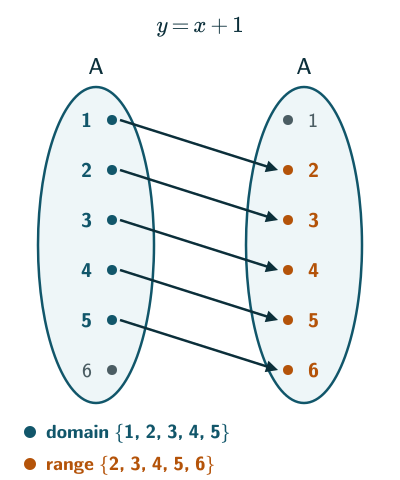
A relation can be written in roster form, in set-builder form, or drawn as an arrow diagram, with an arrow from each element to each of its images (NCERT page 28). For A = {1, 2, 3, 4, 5, 6} and the relation from A to A given by y = x + 1 (NCERT Example 7, page 28):
- set-builder form: R = {(x, y) : y = x + 1}, with x, y ∈ A;
- roster form: R = {(1, 2), (2, 3), (3, 4), (4, 5), (5, 6)};
- arrow diagram: the figure below.
Domain, codomain and range
The set of all first elements of the ordered pairs in a relation R from a set A to a set B is called the domain of the relation R.
NCERT Mathematics (Class 11), Section 2.3, page 28
The set of all second elements in a relation R from a set A to a set B is called the range of the relation R. The whole set B is called the codomain of the relation R. Note that range ⊂ codomain.
NCERT Mathematics (Class 11), Section 2.3, page 28
For y = x + 1 on A = {1, 2, 3, 4, 5, 6}: the domain is {1, 2, 3, 4, 5}, since 6 has no image in A; the range is {2, 3, 4, 5, 6}; and the codomain is all of A, {1, 2, 3, 4, 5, 6} (NCERT Example 7, page 29, which prints a stray comma after the 5 in the domain). The domain need not be all of A, and the range need not be all of B.
NCERT Example 8 (page 29) gives an arrow diagram from P = {9, 4, 25} to Q = {5, 3, 2, 1, −2, −3, −5} in which each number points to both of its square roots. The rule is “x is the square of y”:
- set-builder form: R = {(x, y) : x is the square of y, x ∈ P, y ∈ Q};
- roster form: R = {(9, 3), (9, −3), (4, 2), (4, −2), (25, 5), (25, −5)};
- domain {4, 9, 25}, range {−2, 2, −3, 3, −5, 5}, codomain Q.
The element 1 of Q is not the square root of anything in P, so it is in the codomain but not in the range.
Number of relations between two sets
The total number of relations that can be defined from a set A to a set B is the number of possible subsets of A × B.
NCERT Mathematics (Class 11), Section 2.3, page 29
If n(A) = p and n(B) = q, then A × B has pq elements (see counting a Cartesian product), and a set with pq elements has 2pq subsets (see power set). Each pair is either in the relation or not, two choices for each of the pq pairs.
Number of relations
number of relations from A to B = 2pq, where n(A) = p and n(B) = q
number of relations on A = 2n², where n(A) = n
For A = {1, 2} and B = {3, 4}, A × B = {(1, 3), (1, 4), (2, 3), (2, 4)} has 4 pairs, so there are 24 = 16 relations from A to B (NCERT Example 9, page 29). The count includes the empty relation ϕ and the whole of A × B.
Relations on a set
A relation R from A to A is also stated as a relation on A.
NCERT Mathematics (Class 11), Section 2.3, page 29
A relation on A is a subset of A × A, so a set with n elements has 2n² relations on it: 29 = 512 when n = 3.
NCERT Example 19 (page 39) looks at the relation R = {(a, b) : a, b ∈ Q and a − b ∈ Z} on the rational numbers and shows three facts:
- (a, a) ∈ R for every a, because a − a = 0 ∈ Z;
- if (a, b) ∈ R then (b, a) ∈ R, because b − a = −(a − b) is also an integer;
- if (a, b) ∈ R and (b, c) ∈ R then (a, c) ∈ R, because a − c = (a − b) + (b − c) is a sum of integers.
These three properties are called reflexive, symmetric and transitive, and a relation with all three is an equivalence relation. The names are studied in Class 12, and the JEE Main syllabus lists types of relations and equivalence relations in Unit 1.
Solved examples
Example 1: Domain, codomain and range (NCERT Exercise 2.2, Q1)
Let A = {1, 2, 3, …, 14} and R = {(x, y) : 3x − y = 0, where x, y ∈ A}. Write the domain, codomain and range of R.
3x − y = 0 means y = 3x, and y must be at most 14, so x can only be 1, 2, 3 or 4. R = {(1, 3), (2, 6), (3, 9), (4, 12)}.
Answer: domain {1, 2, 3, 4}; range {3, 6, 9, 12}; codomain A = {1, 2, 3, …, 14}.
Example 2: Odd differences (NCERT Exercise 2.2, Q3)
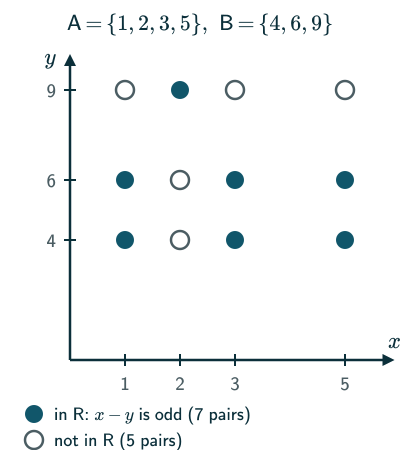
A = {1, 2, 3, 5} and B = {4, 6, 9}. Write R = {(x, y) : the difference between x and y is odd; x ∈ A, y ∈ B} in roster form.
The difference of two whole numbers is odd exactly when one is odd and the other even. So the odd numbers 1, 3, 5 pair with the even numbers 4 and 6, and the even number 2 pairs with the odd number 9.
Answer: R = {(1, 4), (1, 6), (2, 9), (3, 4), (3, 6), (5, 4), (5, 6)}: 7 of the 12 pairs of A × B.
Example 3: Reading an arrow diagram (NCERT Exercise 2.2, Q4)
In NCERT Fig 2.7 (page 30), arrows go from P = {5, 6, 7} to Q = {3, 4, 5}: 5 to 3, 6 to 4 and 7 to 5. Write the relation in set-builder and roster form, and give its domain and range.
Each arrow goes from a number to the number 2 less than it.
Answer: R = {(x, y) : y = x − 2, x ∈ P, y ∈ Q} = {(5, 3), (6, 4), (7, 5)}; domain {5, 6, 7}; range {3, 4, 5}.
Example 4: Divisibility (NCERT Exercise 2.2, Q5)
Let A = {1, 2, 3, 4, 6} and R = {(a, b) : a, b ∈ A, b is exactly divisible by a}. Write R in roster form and find its domain and range.
Go through each a and list the multiples of a in A: 1 divides all five; 2 divides 2, 4, 6; 3 divides 3, 6; 4 divides 4; 6 divides 6.
Answer: R = {(1, 1), (1, 2), (1, 3), (1, 4), (1, 6), (2, 2), (2, 4), (2, 6), (3, 3), (3, 6), (4, 4), (6, 6)}; domain = range = {1, 2, 3, 4, 6}, because every number divides itself.
Example 5: Testing the three properties (NCERT Miscellaneous Exercise, Q9)
R = {(a, b) : a, b ∈ N and a = b2}. Are these true? (i) (a, a) ∈ R for all a ∈ N; (ii) (a, b) ∈ R implies (b, a) ∈ R; (iii) (a, b) ∈ R and (b, c) ∈ R imply (a, c) ∈ R.
One counterexample is enough to show a statement false. (i) 2 ≠ 22, so (2, 2) ∉ R. (ii) (4, 2) ∈ R since 4 = 22, but (2, 4) ∉ R since 2 ≠ 42. (iii) (16, 4) ∈ R and (4, 2) ∈ R, but (16, 2) ∉ R since 16 ≠ 22.
Answer: all three are false. (Only (1, 1) satisfies a = a2 in N.)
Common mistakes to avoid
Common mistake
Calling the codomain the range
The codomain is the whole second set B; the range is only the images that actually occur. In NCERT Example 7 the codomain is {1, 2, 3, 4, 5, 6} but the range is {2, 3, 4, 5, 6}.
Common mistake
Counting pairs instead of relations
There are pq pairs, and a relation is any choice of some of them, so the count is 2pq. For n(A) = 3 and n(B) = 2 that is 26 = 64: not 6 (that is the number of pairs), and not 23 × 22 = 32 (subsets of A times subsets of B).
Common mistake
Reversing the pairs
A relation from A to B has its first entries in A. For “x is the square of y” from P to Q, the pair is (9, 3), not (3, 9).
Quick revision summary
- A relation R from A to B is a subset of A × B; if (x, y) ∈ R, y is an image of x.
- Domain = set of first entries; range = set of second entries; codomain = B; range ⊂ codomain.
- If n(A) = p and n(B) = q, there are 2pq relations from A to B; a relation from A to A is a relation on A.
Formula sheet
- R ⊂ A × B
- domain of R = {x ∈ A : (x, y) ∈ R for some y ∈ B}
- range of R = {y ∈ B : (x, y) ∈ R for some x ∈ A} ⊂ codomain B
- number of relations from A to B = 2pq, where n(A) = p and n(B) = q
Questions students ask
What is the difference between a relation and the Cartesian product A × B?
The Cartesian product A × B is the set of all ordered pairs (a, b) with a ∈ A and b ∈ B, and a relation from A to B is any subset of it, usually the pairs that obey a rule. So every relation R from A to B satisfies ϕ ⊂ R ⊂ A × B: ϕ is the smallest relation from A to B and A × B itself the largest. For A = {1, 4} and B = {2, 3, 5}, A × B has 2 × 3 = 6 pairs, and the relation “x is less than y” keeps four of them: (1, 2), (1, 3), (1, 5) and (4, 5).
What are the types of relations in maths?
The main types of relations are the empty relation ϕ, the universal relation A × A, and reflexive, symmetric and transitive relations; a relation with all three properties is an equivalence relation. A relation R on A is reflexive if (a, a) ∈ R for every a ∈ A, symmetric if (a, b) ∈ R always gives (b, a) ∈ R, and transitive if (a, b) ∈ R and (b, c) ∈ R always give (a, c) ∈ R. For example, “is less than” on N is transitive but neither reflexive nor symmetric, while “was born in the same month as” is an equivalence relation. These names are taught in Class 12 and are in JEE Main Unit 1.
How many symmetric relations are there on a set with n elements?
A set with n elements has 2n(n + 1)/2 symmetric relations on it. Each of the n pairs (a, a) may be in or out, but the other pairs come in n(n − 1)/2 mirror couples, (a, b) with (b, a), that must be taken or left together, giving n(n + 1)/2 free choices. For a set of 4 elements that is 210 = 1024 symmetric relations out of 216 = 65 536 in all; if it must also be reflexive, every (a, a) is in and only the couples are free, giving 2n(n − 1)/2, here 26 = 64. Symmetric and reflexive relations are Class 12 topics, in JEE Main Unit 1.
Is the number of relations from A to B the same as from B to A?
Yes, there are as many relations from B to A as from A to B: if n(A) = p and n(B) = q, both A × B and B × A have pq pairs, so each direction has 2pq relations. The relations themselves need not be the same: a relation from A to B has its first entries in A and one from B to A has them in B. Some can coincide, such as the empty relation; if A = B, the two collections are identical. Reversing every pair of a relation from A to B gives one from B to A (often called its inverse), and this matches the two collections one to one. For n(A) = 2 and n(B) = 4 there are 28 = 256 relations in each direction.
Practice questions
Try each question first, then open the answer to check your working.
-
Q1. Define R on N by R = {(x, y) : y = x + 5, x is a natural number less than 4; x, y ∈ N}. Write R in roster form and give its domain and range (NCERT Exercise 2.2, Q2).
Show answerHide answer
x = 1, 2, 3, so R = {(1, 6), (2, 7), (3, 8)}; domain {1, 2, 3}; range {6, 7, 8}.
-
Q2. Find the domain and range of R = {(x, x + 5) : x ∈ {0, 1, 2, 3, 4, 5}} (NCERT Exercise 2.2, Q6).
Show answerHide answer
R = {(0, 5), (1, 6), (2, 7), (3, 8), (4, 9), (5, 10)}; domain {0, 1, 2, 3, 4, 5}; range {5, 6, 7, 8, 9, 10}.
-
Q3. Write R = {(x, x3) : x is a prime number less than 10} in roster form (NCERT Exercise 2.2, Q7).
Show answerHide answer
The primes below 10 are 2, 3, 5, 7: R = {(2, 8), (3, 27), (5, 125), (7, 343)}.
-
Q4. Let A = {x, y, z} and B = {1, 2}. Find the number of relations from A to B (NCERT Exercise 2.2, Q8).
Show answerHide answer
n(A × B) = 3 × 2 = 6, so there are 26 = 64 relations.