Types of relations
NCERT Class 12 Mathematics Chapter 1 Sections 1.1–1.2
Quick answer
The types of relations in a set A studied in Class 12 are the empty relation R = φ and the universal relation R = A × A, together called trivial relations, and reflexive, symmetric, transitive and equivalence relations. R is reflexive if (a, a) ∈ R for every a in A, symmetric if (a, b) ∈ R always gives (b, a) ∈ R, and transitive if (a, b) and (b, c) in R always give (a, c) in R. An equivalence relation has all three properties, and it splits A into disjoint equivalence classes, the class [a] holding every element related to a.
With your textbook
NCERT Mathematics Part I (Class 12), Chapter 1 “Relations and Functions”, Sections 1.1–1.2 “Introduction” and “Types of Relations”, pages 1–7.
Open the official NCERT chapter (PDF, 1.4 MB, ncert.nic.in) (opens in a new tab)
Checked against the 2026-27 reprint on .
What are reflexive, symmetric and transitive relations?
Reflexive, symmetric and transitive relations
A relation R in a set A is called
(i) reflexive, if (a, a) ∈ R, for every a ∈ A,
(ii) symmetric, if (a, a) ∈ R implies that (a, a) ∈ R, for all a, a ∈ A.
(iii) transitive, if (a, a) ∈ R and (a, a) ∈ R implies that (a, a) ∈ R, for all a, a, a ∈ A.
NCERT Mathematics Part I (Class 12), Section 1.2, page 2
- A relation that is reflexive, symmetric and transitive is an equivalence relation (NCERT Definition 4, page 3).
- If (a, b) ∈ R we also write a R b, read “a is related to b”.
In plain words: a relation in a set A is any subset of A × A, and the three properties ask three yes-or-no questions about it.
- Reflexive: is every element related to itself?
- Symmetric: whenever a is related to b, is b related to a?
- Transitive: whenever a is related to b and b to c, is a related to c?
“Is equal to”, “is congruent to” and “has the same remainder on division by 3 as” pass all three tests. “Is less than” is only transitive, and “is perpendicular to” is only symmetric. NCERT opens the chapter with relations such as “a is brother of b” and “a lives in the same locality as b” (Section 1.1, page 1).
A relation R in a set A is said to be an equivalence relation if R is reflexive, symmetric and transitive.
NCERT Mathematics Part I (Class 12), Section 1.2, page 3
Empty and universal relations
A relation in A is a subset of A × A, so the smallest one has no pairs at all and the largest has every pair.
A relation R in a set A is called empty relation, if no element of A is related to any element of A, i.e., R = φ ⊂ A × A.
NCERT Mathematics Part I (Class 12), Section 1.2, page 2
A relation R in a set A is called universal relation, if each element of A is related to every element of A, i.e., R = A × A.
NCERT Mathematics Part I (Class 12), Section 1.2, page 2
NCERT’s illustration (page 2) takes A = {1, 2, 3, 4}. R = {(a, b) : a − b = 10} is empty, because no two numbers of A differ by 10. R′ = {(a, b) : |a − b| ≥ 0} is all of A × A, all 16 pairs, because every |a − b| is at least 0. In NCERT Example 1, in a boys’ school “a is sister of b” is empty, and “the heights of a and b differ by less than 3 metres” is universal.
Both the empty relation and the universal relation are some times called trivial relations.
NCERT Mathematics Part I (Class 12), Section 1.2, page 2
The universal relation is an equivalence relation: every pair is in it, so every test passes. On a non-empty set the empty relation is not reflexive, because (a, a) is missing, yet it is symmetric and transitive: those two tests begin “if (a, b) ∈ R”, and with no pairs in R there is nothing that could fail.
Testing a relation for the three properties
To prove a property, argue for every element or every pair. To disprove it, one counterexample is enough.
- Reflexive: every (a, a) must be in R. On a finite set, look for the whole diagonal of A × A.
- Symmetric: for each pair (a, b) in R, look for its mirror pair (b, a).
- Transitive: for each chain (a, b), (b, c) in R, look for (a, c). Chains with a = c count too: (1, 2) and (2, 1) together need (1, 1).
NCERT Example 4 (page 3): on {1, 2, 3}, R = {(1, 1), (2, 2), (3, 3), (1, 2), (2, 3)} is reflexive, since all three diagonal pairs are in it. It is not symmetric, since (1, 2) ∈ R but (2, 1) ∉ R. It is not transitive, since (1, 2) and (2, 3) are in R but (1, 3) is not.
NCERT Example 3 (page 3, Fig 1.1) takes lines in a plane with L R L when L is perpendicular to L. No line is perpendicular to itself, so R is not reflexive. Perpendicularity works both ways, so R is symmetric. If L ⊥ L and L ⊥ L, then L is parallel to L, not perpendicular, so R is not transitive.
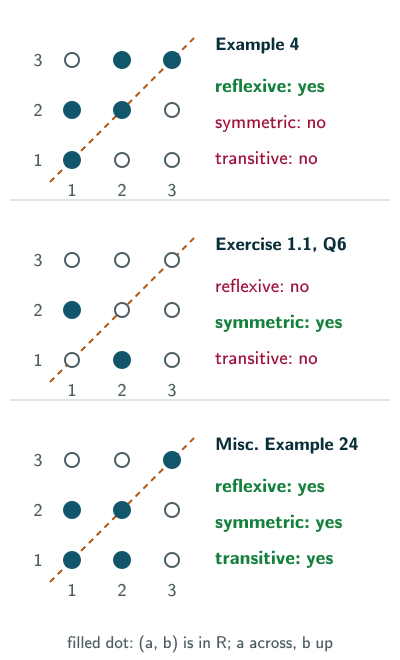
Properties can come in any mix. NCERT Exercise 1.1, Q10 (page 6) asks for one relation of each kind; answers on {1, 2, 3} are in the extra questions below.
Equivalence relations
NCERT Example 2 (page 3): congruence of triangles is an equivalence relation. Every triangle is congruent to itself; if T is congruent to T then T is congruent to T; and congruence passes along a chain T, T, T.
NCERT Example 5 (page 3): R = {(a, b) : 2 divides a − b} in the integers Z.
- Reflexive: a − a = 0, and 2 divides 0.
- Symmetric: if 2 divides a − b, it divides b − a = −(a − b).
- Transitive: if 2 divides a − b and b − c, it divides their sum, (a − b) + (b − c) = a − c.
The same three lines work with any positive integer n in place of 2. NCERT Example 6 (pages 4–5) is the finite version: in A = {1, 2, 3, 4, 5, 6, 7}, “a and b are both odd or both even” is an equivalence relation.
Equivalence classes
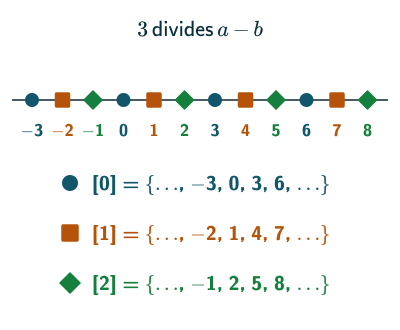
In NCERT Example 5, every even integer is related to 0 and to every other even integer, while no odd integer is related to an even one. So the relation sorts Z into two groups, the even integers E and the odd integers O. E is written [0] and O is written [1], and [0] = [2] = [−4], because any member of a class names it.
The subsets A are called equivalence classes.
NCERT Mathematics Part I (Class 12), Section 1.2, page 4
Equivalence class [a] containing a ∈ X for an equivalence relation R in X is the subset of X containing all elements b related to a.
NCERT Mathematics Part I (Class 12), Chapter 1, Summary, page 16
NCERT page 4 lists what an equivalence relation in a set X always does: it divides X into subsets A such that
- all elements of each A are related to each other;
- no element of A is related to any element of A for i ≠ j;
- the A together make up X and are pairwise disjoint: A ∩ A = φ for i ≠ j.
So two classes are either the same class or have nothing in common. It works in reverse too (NCERT page 4): split Z into A = {…, −3, 0, 3, …}, A = {…, −2, 1, 4, …} and A = {…, −1, 2, 5, …}, and the relation “3 divides a − b” has exactly these three sets as its classes: A = [0], A = [1], A = [2].
A small finite case: in A = {1, 2, 3, 4}, the relation R = {(1, 1), (2, 2), (3, 3), (4, 4), (1, 3), (3, 1)} is an equivalence relation with three classes, [1] = [3] = {1, 3}, [2] = {2} and [4] = {4}.
Counting relations (JEE). The JEE Main 2027 syllabus (Unit 1) lists relations, types of relations and equivalence relations. Beyond the NCERT text, the number of relations of each type follows from NCERT’s definitions and the count of relations from Class 11. A set with n elements has n2 pairs in A × A, so it has 2n² relations.
- Reflexive relations: the n diagonal pairs must be in, and the other n2 − n pairs are free, which gives 2n² − n.
- Symmetric relations: each diagonal pair and each mirror couple {(a, b), (b, a)} is in or out together, so there are n + n(n − 1)/2 = n(n + 1)/2 free choices and 2n(n + 1)/2 symmetric relations.
- Equivalence relations: one for each way of splitting the set into classes. A set of 3 elements can be split in 5 ways: {1, 2, 3}; {1, 2}, {3}; {1, 3}, {2}; {2, 3}, {1}; and {1}, {2}, {3}.
NCERT slip (pages 1 and 16): the chapter’s Introduction (page 1) and its Summary (page 16) still list binary operations among the topics, but the 2026–27 book no longer teaches them. In an exam, expect relations and functions as taught in Sections 1.2–1.4; the JEE Main 2027 syllabus (Unit 1) does not list binary operations either.
Solved examples
Example 1: Three relations tested (NCERT Exercise 1.1, Q1 (i)–(iii))
Is each relation reflexive, symmetric or transitive? (i) R = {(x, y) : 3x − y = 0} in A = {1, 2, …, 14}; (ii) R = {(x, y) : y = x + 5 and x < 4} in N; (iii) R = {(x, y) : y is divisible by x} in A = {1, 2, 3, 4, 5, 6}.
(i) R = {(1, 3), (2, 6), (3, 9), (4, 12)}. (1, 1) ∉ R; (1, 3) ∈ R but (3, 1) ∉ R; (1, 3) and (3, 9) are in R but (1, 9) is not.
(ii) R = {(1, 6), (2, 7), (3, 8)}. (1, 1) ∉ R and (6, 1) ∉ R. No pair starts where another ends (6, 7 and 8 are not first entries), so no chain exists and transitivity cannot fail.
(iii) Every x divides itself. 2 divides 4 but 4 does not divide 2. If x divides y and y divides z, then x divides z.
Answer: (i) none of the three; (ii) transitive only; (iii) reflexive and transitive, not symmetric.
Example 2: Counterexamples on the real line (NCERT Exercise 1.1, Q2)
Show that R = {(a, b) : a ≤ b2} in R is neither reflexive nor symmetric nor transitive.
Not reflexive: 1/2 ≤ (1/2)2 = 1/4 is false, so (1/2, 1/2) ∉ R.
Not symmetric: 1 ≤ 42, so (1, 4) ∈ R, but 4 ≤ 12 is false.
Not transitive: (3, 2) ∈ R since 3 ≤ 4, and (2, 1.5) ∈ R since 2 ≤ 2.25, but (3, 1.5) ∉ R since 3 > 2.25.
Answer: each property fails for the pairs above, so R has none of the three.
Example 3: The elements related to 1 (NCERT Exercise 1.1, Q9)
In A = {x ∈ Z : 0 ≤ x ≤ 12}, show that R = {(a, b) : |a − b| is a multiple of 4} is an equivalence relation, and find the set of elements related to 1. Do the same for R = {(a, b) : a = b}.
|a − a| = 0 = 4 × 0; |b − a| = |a − b|; and if a − b and b − c are multiples of 4, so is their sum a − c. The elements related to 1 are those that leave remainder 1 on division by 4. For a = b, each element is related only to itself.
Answer: both are equivalence relations. For the first, the set related to 1 is {1, 5, 9}; the other classes are {0, 4, 8, 12}, {2, 6, 10} and {3, 7, 11}. For a = b, it is {1}.
Example 4: Equal fractions (NCERT Miscellaneous Example 19, page 13)
In the set A of ordered pairs of positive integers, (x, y) R (u, v) if and only if xv = yu. Show that R is an equivalence relation.
Read (x, y) as the fraction x/y: then xv = yu says x/y = u/v. Reflexive: xy = yx. Symmetric: xv = yu gives uy = vx. Transitive: from xv = yu and ub = va, multiply to get xv · ub = yu · va, then cancel uv (both positive) to get xb = ya.
Answer: R is an equivalence relation. The class of (1, 2) is {(1, 2), (2, 4), (3, 6), …}: all the pairs that name the fraction 1/2.
Example 5: Choose the correct answer (NCERT Exercise 1.1, Q15)
R = {(1, 2), (2, 2), (1, 1), (4, 4), (1, 3), (3, 3), (3, 2)} in {1, 2, 3, 4}. Which is true? (A) reflexive and symmetric but not transitive; (B) reflexive and transitive but not symmetric; (C) symmetric and transitive but not reflexive; (D) an equivalence relation.
All four diagonal pairs are in R, so it is reflexive. (1, 2) ∈ R but (2, 1) ∉ R, so it is not symmetric. The only chain that does not use a diagonal pair is (1, 3), (3, 2), which needs (1, 2), and that is in R; a chain through a diagonal pair, such as (1, 1), (1, 3), gives back a pair already in R.
Answer: (B).
Example 6: Counting equivalence relations (NCERT Miscellaneous Exercise, Q7)
Let A = {1, 2, 3}. How many equivalence relations in A contain (1, 2)? (A) 1 (B) 2 (C) 3 (D) 4
(1, 2) ∈ R puts 1 and 2 in the same class. Then 3 is either in a class of its own or in that class too. The first choice gives R = {(1, 1), (2, 2), (3, 3), (1, 2), (2, 1)}, and the second gives the universal relation A × A. NCERT Miscellaneous Example 24 (page 14) reaches the same two by adding pairs one at a time.
Answer: (B) 2.
Common mistakes to avoid
Common mistake
Thinking symmetric and transitive force reflexive
The “proof” goes: (a, b) ∈ R gives (b, a) ∈ R, and then transitivity gives (a, a) ∈ R. It only works for an a that is related to something. In A = {1, 2, 3}, R = {(2, 2), (2, 3), (3, 2), (3, 3)} is symmetric and transitive but not reflexive: 1 is related to nothing, so (1, 1) ∉ R.
Common mistake
Missing the chains that come back
In A = {1, 2, 3}, R = {(2, 3), (3, 2)} is not transitive: the chain (2, 3), (3, 2) needs (2, 2), and the chain (3, 2), (2, 3) needs (3, 3). Check chains with a = c as well.
Common mistake
Proving a property from one example
(1, 1) ∈ R does not show that R is reflexive. Every element of A needs its pair. One counterexample disproves a universal property; one successful case does not prove it unless that case exhausts what must be checked.
Common mistake
Calling a relation with nothing to check non-transitive
R = {(1, 2)} in {1, 2, 3} is transitive: there is no chain (a, b), (b, c) in R, so the condition is never broken. The empty relation is symmetric and transitive for the same reason.
Quick revision summary
- A relation R in A is a subset of A × A. The trivial relations are the empty relation (no pairs) and the universal relation (all pairs).
- Reflexive: every (a, a) is in R. Symmetric: the mirror of each pair is in R. Transitive: every chain (a, b), (b, c) in R closes with (a, c).
- An equivalence relation has all three properties. Two of its classes are either equal or disjoint, together they make up the whole set, and a R b exactly when [a] = [b].
- To prove a property, argue for every element; to disprove it, give one counterexample.
Formula sheet
- empty relation: R = φ; universal relation: R = A × A
- reflexive: (a, a) ∈ R for every a ∈ A
- symmetric: (a, b) ∈ R ⇒ (b, a) ∈ R
- transitive: (a, b) ∈ R and (b, c) ∈ R ⇒ (a, c) ∈ R
- equivalence relation = reflexive + symmetric + transitive
- equivalence class: [a] = {b ∈ A : b R a}
- n(A) = n gives N = n2 pairs in A × A: 2N relations, 2N−n of them reflexive
Questions students ask
Why are two equivalence classes either equal or disjoint?
Two equivalence classes [a] and [b] of an equivalence relation R are either the same set or have no element in common, because a single shared element forces them to be equal. If c is in both, then c R a and c R b; symmetry turns the first into a R c, and transitivity then gives a R b, so every element related to a is related to b, and the other way round, which makes [a] = [b]. Reflexivity puts each a in its own class [a], so the classes also cover the whole set: together they form a partition of it, as the section on equivalence classes describes.
How many equivalence relations are there on a set with 4 elements?
A set with 4 elements has 15 equivalence relations, because each equivalence relation matches exactly one way of splitting the set into non-empty, disjoint classes. For {1, 2, 3, 4} there is 1 split into one class, 7 into two classes (4 like {1, 2, 3}, {4} and 3 like {1, 2}, {3, 4}), 6 into three classes (a pair and two single elements, with 4C2 = 6 choices of the pair) and 1 into four single elements: 1 + 7 + 6 + 1 = 15. These counts are called Bell numbers and have no simple closed formula; a set with 5 elements already has 52 equivalence relations.
What are the smallest and largest equivalence relations on a set?
On a set A, the smallest equivalence relation is the identity relation {(a, a) : a ∈ A} (a name NCERT’s Chapter 1 does not use), which relates each element only to itself, and the largest is the universal relation A × A; every equivalence relation in A lies between the two. Every reflexive relation contains all the pairs (a, a), and these pairs alone already pass the symmetric and transitive tests. On a non-empty set of n elements the identity relation has n pairs and n one-element classes, while A × A has n2 pairs and a single class, A itself. The relation “a = b” in NCERT Exercise 1.1, Q9 (ii) is the identity relation of its set.
What is an antisymmetric relation, and is it the opposite of a symmetric relation?
An antisymmetric relation, a term beyond the NCERT text, is a relation R in which (a, b) and (b, a) can both be in R only when a = b; despite its name it is not the opposite of symmetric, since a relation can be both, just one, or neither. The identity relation {(a, a) : a ∈ A} is both, while R = {(1, 3), (3, 1), (2, 3)} in {1, 2, 3} is neither: (1, 3) and (3, 1) break antisymmetry, and (2, 3) has no mirror (3, 2). “a divides b” is antisymmetric in N, since natural numbers that divide each other are equal, but not in Z, where 2 and −2 divide each other. A reflexive, antisymmetric and transitive relation is called a partial order, as “divides” is in N.
Are equivalence relations in the JEE Main 2027 syllabus?
Yes, equivalence relations are in the JEE Main 2027 syllabus: Unit 1, Sets, Relations and Functions, lists “Relations, type of relations, equivalence relations, functions; one-one, into and onto functions, the composition of functions.” Equivalence classes are not named on their own, but they come with every equivalence relation, which splits its set into classes (NCERT Mathematics Part I (Class 12), Section 1.2, page 4). The empty, universal, reflexive, symmetric and transitive relations of NCERT Section 1.2 fall under the unit’s “type of relations”.
What is the difference between an equivalence relation and an equivalence class?
An equivalence relation is a set of ordered pairs, a subset of A × A, while an equivalence class is a set of elements of A: the class [a] holds every element related to a. The relation fixes the classes, and the classes give back the relation, since a R b exactly when a and b lie in the same class. For example, “a − b is a multiple of 5” in A = {1, 2, …, 10} has the 5 classes {1, 6}, {2, 7}, {3, 8}, {4, 9} and {5, 10}, while the relation itself has 20 pairs, the 2 × 2 = 4 pairs inside each class, such as (1, 1), (1, 6), (6, 1) and (6, 6).
Practice questions
Try each question first, then open the answer to check your working.
-
Q1. Check whether R = {(a, b) : b = a + 1} in {1, 2, 3, 4, 5, 6} is reflexive, symmetric or transitive (NCERT Exercise 1.1, Q3).
Show answerHide answer
R = {(1, 2), (2, 3), (3, 4), (4, 5), (5, 6)}. Not reflexive: (1, 1) ∉ R. Not symmetric: (1, 2) ∈ R but (2, 1) ∉ R. Not transitive: (1, 2) and (2, 3) are in R but (1, 3) is not. It has none of the three properties.
-
Q2. Show that R = {(1, 2), (2, 1)} in {1, 2, 3} is symmetric but neither reflexive nor transitive (NCERT Exercise 1.1, Q6).
Show answerHide answer
The pair (1, 2) has its mirror (2, 1) in R, and the mirror of (2, 1) is (1, 2): symmetric. (1, 1) ∉ R: not reflexive. (1, 2) and (2, 1) are in R but (1, 1) is not: not transitive.
-
Q3. L is the set of all lines in the xy-plane and L R L when L is parallel to L. Show that R is an equivalence relation and find the set of lines related to y = 2x + 4 (NCERT Exercise 1.1, Q14).
Show answerHide answer
For R to be reflexive, a line must count as parallel to itself, as the exercise intends. Lines are parallel when they have the same slope (or are both vertical), and “has the same slope as” is reflexive, symmetric and transitive. The lines related to y = 2x + 4 are all the lines y = 2x + c, for every real c: the lines of slope 2.
-
Q4. R is the relation “is similar to” on the set of all triangles. Show that R is an equivalence relation. Of the right triangles T with sides 3, 4, 5, T with sides 5, 12, 13 and T with sides 6, 8, 10, which are related? (NCERT Exercise 1.1, Q12)
Show answerHide answer
Every triangle is similar to itself; similarity works both ways; and two triangles similar to a third are similar to each other. So R is an equivalence relation. 6 : 8 : 10 = 3 : 4 : 5, so T and T are related (scale factor 2). 5 : 12 : 13 is not in the ratio 3 : 4 : 5, so T is related to neither of them.