Operations on sets
NCERT Class 11 Mathematics Chapter 1 Section 1.9
Quick answer
The union A ∪ B holds the elements in A or B or both, the intersection A ∩ B holds the elements in both, and the difference A − B holds the elements in A but not in B. Sets with no common element are disjoint. Union and intersection are commutative and associative, intersection distributes over union, and for finite sets n(A ∪ B) = n(A) + n(B) − n(A ∩ B).
With your textbook
NCERT Mathematics (Class 11), Chapter 1 “Sets”, Section 1.9 “Operations on Sets”, pages 13–18.
Open the official NCERT chapter (PDF, 2.2 MB, ncert.nic.in) (opens in a new tab)
Checked against the 2026-27 reprint on .
What are the operations on sets?
Operations on sets
Just as two numbers combine to give a number, two sets combine to give a set (NCERT Section 1.9, pages 13–14). All sets here are subsets of a universal set U.
- Union A ∪ B = {x : x ∈ A or x ∈ B}: everything in A, in B or in both.
- Intersection A ∩ B = {x : x ∈ A and x ∈ B}: everything common to A and B.
- Difference A − B = {x : x ∈ A and x ∉ B}: what is in A but not in B.
In plain words: union means “or”, intersection means “and”, and difference means “but not”. If A is the hockey team and B the football team, A ∪ B is everyone who plays at least one of the games, A ∩ B is everyone who plays both, and A − B is everyone who plays hockey but not football.
Union of sets
The union of two sets A and B is the set C which consists of all those elements which are either in A or in B (including those which are in both).
NCERT Mathematics (Class 11), Section 1.9.1, page 14
For A = {2, 4, 6, 8} and B = {6, 8, 10, 12}, A ∪ B = {2, 4, 6, 8, 10, 12}: the common elements 6 and 8 are written only once (NCERT Example 12, page 14). If B ⊂ A, then A ∪ B = A: for A = {a, e, i, o, u} and B = {a, i, u}, A ∪ B = A (NCERT Example 13).
For the class XI students X = {Ram, Geeta, Akbar} in the hockey team and Y = {Geeta, David, Ashok} in the football team, X ∪ Y = {Ram, Geeta, Akbar, David, Ashok}: the students in the hockey team or the football team or both (NCERT Example 14).
Properties of union (NCERT pages 14–15):
| Law | Statement |
|---|---|
| Commutative | A ∪ B = B ∪ A |
| Associative | (A ∪ B) ∪ C = A ∪ (B ∪ C) |
| Identity | A ∪ ϕ = A (ϕ is the identity of ∪) |
| Idempotent | A ∪ A = A |
| Law of U | U ∪ A = U |
Intersection of sets
The intersection of two sets A and B is the set of all those elements which belong to both A and B.
NCERT Mathematics (Class 11), Section 1.9.2, page 15
For the same A and B as before, A ∩ B = {6, 8} (NCERT Example 15); for the teams, X ∩ Y = {Geeta} (Example 16). If B ⊂ A, then A ∩ B = B: for A = {1, 2, …, 10} and B = {2, 3, 5, 7}, A ∩ B = B (Example 17).
If A ∩ B = ϕ, A and B are called disjoint sets: for example {2, 4, 6, 8} and {1, 3, 5, 7} (NCERT page 15).
Properties of intersection (NCERT pages 15–16):
| Law | Statement |
|---|---|
| Commutative | A ∩ B = B ∩ A |
| Associative | (A ∩ B) ∩ C = A ∩ (B ∩ C) |
| Law of ϕ and U | ϕ ∩ A = ϕ, U ∩ A = A |
| Idempotent | A ∩ A = A |
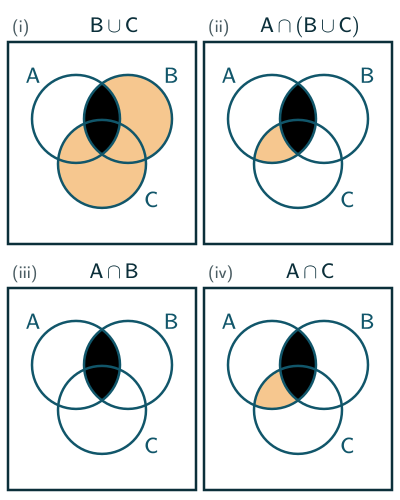
| Distributive | A ∩ (B ∪ C) = (A ∩ B) ∪ (A ∩ C) |
The distributive law says that ∩ distributes over ∪; NCERT checks it with Venn diagrams (Figs 1.7, page 16). The other distributive law, A ∪ (B ∩ C) = (A ∪ B) ∩ (A ∪ C), is not stated in the NCERT text but is just as true; both laws are among the “algebraic properties” of union and intersection that JEE Main 2027 lists in Unit 1. The Cartesian product distributes in the same way: A × (B ∪ C) = (A × B) ∪ (A × C) and A × (B ∩ C) = (A × B) ∩ (A × C) (see products with union and intersection).
Difference of sets
The difference of the sets A and B in this order is the set of elements which belong to A but not to B.
NCERT Mathematics (Class 11), Section 1.9.3, page 16
It is written A − B and read “A minus B”. For A = {1, 2, 3, 4, 5, 6} and B = {2, 4, 6, 8}: A − B = {1, 3, 5} and B − A = {8}, so A − B ≠ B − A (NCERT Example 18). For V = {a, e, i, o, u} and B = {a, i, k, u}: V − B = {e, o} and B − V = {k} (Example 19). For any set A, the difference U − A has a name of its own: it is the complement of A, written A′ (NCERT Section 1.10, page 18). Beyond the NCERT text, the symmetric difference A Δ B holds the elements in exactly one of the sets: A Δ B = (A − B) ∪ (B − A) = (A ∪ B) − (A ∩ B). For Example 18 it is {1, 3, 5, 8}.
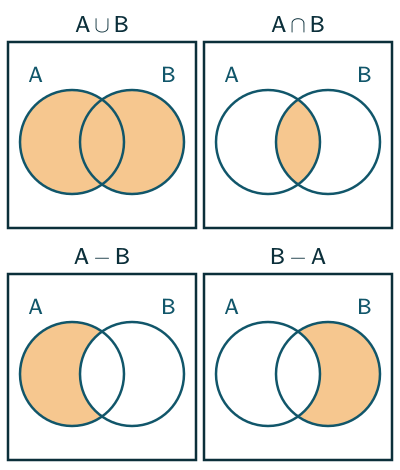
The sets A – B, A ∩ B and B – A are mutually disjoint sets, i.e., the intersection of any of these two sets is the null set as shown in Fig 1.9.
NCERT Mathematics (Class 11), Section 1.9.3, page 17
Counting elements
The counting rules in this section go beyond the NCERT text. For a finite set A, n(A) is the number of its distinct elements (NCERT Section 1.4, page 6). A − B, A ∩ B and B − A are disjoint and make up A ∪ B, so n(A ∪ B) = n(A − B) + n(A ∩ B) + n(B − A). Since n(A) = n(A − B) + n(A ∩ B) and n(B) = n(B − A) + n(A ∩ B), for finite sets
Number of elements in a union
n(A ∪ B) = n(A) + n(B) − n(A ∩ B)
Adding n(A) and n(B) counts the common elements twice, so they are subtracted once. If A and B are disjoint, n(A ∪ B) = n(A) + n(B). For the sets of Example 12, n(A ∪ B) = 4 + 4 − 2 = 6. For three sets the same reasoning gives:
Number of elements in a union of three sets
n(A ∪ B ∪ C) = n(A) + n(B) + n(C)
− n(A ∩ B) − n(B ∩ C)
− n(C ∩ A)
+ n(A ∩ B ∩ C)
Both formulas stay true with P in place of n: they are the addition rule for probabilities, for two events and for three.
The operations work on any sets, not only numbers. Among the period 3 elements Na, Mg, Al, Si, P, S, Cl and Ar, let A be the metals, {Na, Mg, Al}, and B the s-block elements, {Na, Mg}. Here B ⊂ A, so A ∩ B = B = {Na, Mg} and A ∪ B = A = {Na, Mg, Al}, as in NCERT Examples 13 and 17; A − B = {Al}, and n(A ∪ B) = 3 + 2 − 2 = 3.
Solved examples
Example 1: Unions and intersections (NCERT Exercise 1.4, Q4 and Q6)
For A = {1, 2, 3, 4}, B = {3, 4, 5, 6}, C = {5, 6, 7, 8} and D = {7, 8, 9, 10}, find A ∪ B, A ∪ C and B ∪ C ∪ D. For E = {3, 5, 7, 9, 11}, F = {7, 9, 11, 13}, G = {11, 13, 15} and H = {15, 17} (NCERT calls these A, B, C and D in Q6), find E ∩ (F ∪ G) and E ∩ G ∩ H.
Combine element by element, writing each element once.
Answer: A ∪ B = {1, 2, 3, 4, 5, 6}; A ∪ C = {1, 2, 3, 4, 5, 6, 7, 8}; B ∪ C ∪ D = {3, 4, …, 10}; F ∪ G = {7, 9, 11, 13, 15}, so E ∩ (F ∪ G) = {7, 9, 11}; E ∩ G ∩ H = ϕ, since E and H have no common element.
Example 2: Differences (NCERT Exercise 1.4, Q9)
For A = {3, 6, 9, 12, 15, 18, 21}, B = {4, 8, 12, 16, 20}, C = {2, 4, 6, 8, 10, 12, 14, 16} and D = {5, 10, 15, 20}, find A − B, B − A, C − D and D − C.
Remove from the first set every element of the second.
Answer: A − B = {3, 6, 9, 15, 18, 21}; B − A = {4, 8, 16, 20}; C − D = {2, 4, 6, 8, 12, 14, 16}; D − C = {5, 15, 20}.
Example 3: Sets of numbers (NCERT Exercise 1.4, Q7 and Q11)
With A = N, B the even natural numbers, C the odd natural numbers and D the primes, find A ∩ B, B ∩ C, B ∩ D and C ∩ D. What is R − Q?
Every natural number is even or odd, never both; 2 is the only even prime.
Answer: A ∩ B = B; B ∩ C = ϕ; B ∩ D = {2}; C ∩ D = the odd primes {3, 5, 7, 11, …}; R − Q is the set of irrational numbers.
Example 4: Disjoint or not? (NCERT Exercise 1.4, Q8)
Which pairs are disjoint: (i) {1, 2, 3, 4} and {x : x ∈ N and 4 ≤ x ≤ 6}; (ii) {a, e, i, o, u} and {c, d, e, f}; (iii) the even integers and the odd integers?
(i) Both contain 4. (ii) Both contain e. (iii) No integer is both.
Answer: only (iii) is disjoint; (i) and (ii) are not.
Example 5: Using the counting formula
In a class of 40, 25 students like cricket, 18 like football and 8 like both. How many like at least one of the two? How many like neither?
n(C ∪ F) = 25 + 18 − 8 = 35. The rest of the class, 40 − 35 = 5, like neither.
Answer: 35 like at least one; 5 like neither.
Common mistakes to avoid
Common mistake
Writing common elements twice in a union
{1, 2} ∪ {2, 3} = {1, 2, 3}, not {1, 2, 2, 3}. A set lists each element once.
Common mistake
Treating A − B and B − A as the same
A − B keeps what is in A only; B − A keeps what is in B only. For A = {1, 2, 3} and B = {2, 3, 4}, A − B = {1} but B − A = {4}.
Common mistake
Cancelling a set
A ∪ B = A ∪ C does not give B = C: {1} ∪ {1} = {1} ∪ ϕ. Nor does A ∩ B = A ∩ C: {1} ∩ {2} = {1} ∩ {3}. Both together do give B = C (NCERT Miscellaneous Exercise, Q3 and Q8, page 21).
Common mistake
Adding n(A) and n(B) for overlapping sets
n(A ∪ B) = n(A) + n(B) only when A and B are disjoint; otherwise subtract n(A ∩ B), or the common elements are counted twice.
Quick revision summary
- A ∪ B: in A or B (or both); A ∩ B: in both; A − B: in A but not B.
- A ∩ B = ϕ: disjoint sets. A − B, A ∩ B and B − A are mutually disjoint.
- Union and intersection are commutative, associative and idempotent; A ∪ ϕ = A, U ∪ A = U, ϕ ∩ A = ϕ, U ∩ A = A.
- Distributive laws: A ∩ (B ∪ C) = (A ∩ B) ∪ (A ∩ C) and A ∪ (B ∩ C) = (A ∪ B) ∩ (A ∪ C).
- If B ⊂ A: A ∪ B = A and A ∩ B = B.
- n(A ∪ B) = n(A) + n(B) − n(A ∩ B); for three sets, add n(A), n(B), n(C), subtract the three pairwise intersections and add back n(A ∩ B ∩ C).
Formula sheet
- A ∪ B = {x : x ∈ A or x ∈ B}; A ∩ B = {x : x ∈ A and x ∈ B}
- A − B = {x : x ∈ A and x ∉ B}
- A ∩ (B ∪ C) = (A ∩ B) ∪ (A ∩ C); A ∪ (B ∩ C) = (A ∪ B) ∩ (A ∪ C)
- n(A ∪ B) = n(A) + n(B) − n(A ∩ B)
Questions students ask
What is the difference between union and intersection of sets?
Union and intersection differ in what they keep: the union A ∪ B holds every element that is in A or in B or in both, while the intersection A ∩ B holds only the elements common to A and B. For {10, 20, 30} and {20, 40}, the union is {10, 20, 30, 40} and the intersection is {20}. The intersection lies inside each set and each set lies inside the union, A ∩ B ⊂ A ⊂ A ∪ B, and for finite sets their sizes are linked by n(A ∪ B) = n(A) + n(B) − n(A ∩ B).
What are the laws of algebra of sets?
The laws of the algebra of sets, the “algebraic properties” named in the JEE Main syllabus, are the commutative, associative, idempotent and identity laws of union and intersection, the laws of U and ϕ, and the two distributive laws, in which each operation distributes over the other, such as A ∩ (B ∪ C) = (A ∩ B) ∪ (A ∩ C). The absorption laws A ∪ (A ∩ B) = A and A ∩ (A ∪ B) = A are often added, and the complement brings the complement laws and De Morgan’s laws. Each law is proved by showing that each side is a subset of the other, and can be illustrated on a Venn diagram.
What is the symmetric difference of two sets, and how is it different from A − B?
The symmetric difference A Δ B is the set of elements in exactly one of A and B, A Δ B = (A − B) ∪ (B − A) = (A ∪ B) − (A ∩ B), while the difference A − B keeps only the part of A outside B. So A − B and B − A usually differ but A Δ B = B Δ A: for A = {2, 3, 5, 7} and B = {1, 3, 5, 9}, A − B = {2, 7}, B − A = {1, 9} and A Δ B = {1, 2, 7, 9}. For finite sets n(A Δ B) = n(A) + n(B) − 2n(A ∩ B), here 4 + 4 − 2 × 2 = 4. The symmetric difference is not in the NCERT text.
Is the formula n(A ∪ B) = n(A) + n(B) − n(A ∩ B) in the NCERT Class 11 book?
No, the counting formula n(A ∪ B) = n(A) + n(B) − n(A ∩ B) is not in the current NCERT Class 11 book (the 2026–27 reprint): NCERT dropped its section on practical problems on union and intersection of two sets in the rationalised syllabus of 2022, and the book now only defines n(A) for a finite set. The formula follows because A − B, A ∩ B and B − A are disjoint and together make up A ∪ B. For example, if n(A) = 30, n(B) = 22 and n(A ∪ B) = 45, then n(A ∩ B) = 30 + 22 − 45 = 7.
How do you find n(A ∩ B ∩ C) when the other counts are known?
To find n(A ∩ B ∩ C), use the three-set formula n(A ∪ B ∪ C) = n(A) + n(B) + n(C) − n(A ∩ B) − n(B ∩ C) − n(C ∩ A) + n(A ∩ B ∩ C), which links eight counts, so any one of them follows from the other seven. For n(A) = 20, n(B) = 25, n(C) = 30, n(A ∩ B) = 8, n(B ∩ C) = 10, n(C ∩ A) = 9 and n(A ∪ B ∪ C) = 52, it gives 52 = 75 − 27 + n(A ∩ B ∩ C), so n(A ∩ B ∩ C) = 4. Filling a three-set Venn diagram from the centre outwards checks the answer: no region may come out negative.
Practice questions
Try each question first, then open the answer to check your working.
-
Q1. Find the union and the intersection of X = {1, 3, 5} and Y = {1, 2, 3} (NCERT Exercise 1.4, Q1 (i) and Q5).
Show answerHide answer
X ∪ Y = {1, 2, 3, 5}; X ∩ Y = {1, 3}.
-
Q2. If A = {a, b} and B = {a, b, c}, is A ⊂ B? What is A ∪ B (NCERT Exercise 1.4, Q2)?
Show answerHide answer
Yes, A ⊂ B, so A ∪ B = B = {a, b, c}.
-
Q3. For X = {a, b, c, d} and Y = {f, b, d, g}, find X − Y, Y − X and X ∩ Y (NCERT Exercise 1.4, Q10).
Show answerHide answer
X − Y = {a, c}; Y − X = {f, g}; X ∩ Y = {b, d}.
-
Q4. If A ⊂ B, what is A ∪ B (NCERT Exercise 1.4, Q3)?
Show answerHide answer
A ∪ B = B: every element of A is already in B.
-
Q5. n(A) = 12, n(B) = 9 and n(A ∪ B) = 17. Find n(A ∩ B).
Show answerHide answer
17 = 12 + 9 − n(A ∩ B), so n(A ∩ B) = 4.
-
Q6. Are {2, 3, 4, 5} and {3, 6} disjoint? Are {a, e, i, o, u} and {a, b, c, d} disjoint (NCERT Exercise 1.4, Q12 (i), (ii))?
Show answerHide answer
Neither pair is disjoint: the first two share 3, and the second two share a.