Sets and their representations
NCERT Class 11 Mathematics Chapter 1 Section 1.2
Quick answer
Roster form and set-builder form are the two ways to write a set, a well-defined collection of objects for which you can decide whether any object belongs. In roster form the elements are listed in braces, such as {2, 4, 6}, with order ignored and no element repeated. In set-builder form the set is described by a property that its elements have and no other object has, such as {x : x is a natural number and 3 < x < 10}, read “the set of all x such that …”.
With your textbook
NCERT Mathematics (Class 11), Chapter 1 “Sets”, Section 1.2 “Sets and their Representations”, pages 1–5.
Open the official NCERT chapter (PDF, 2.2 MB, ncert.nic.in) (opens in a new tab)
Checked against the 2026-27 reprint on .
What is a set?
Set
We shall say that a set is a well-defined collection of objects.
NCERT Mathematics (Class 11), Section 1.2, page 2
- The objects in a set are its elements or members; the three words mean the same thing.
- Sets are usually named by capital letters A, B, C, X, Y, …; elements by small letters a, b, x, y, …
- a ∈ A means “a belongs to A”; b ∉ A means “b does not belong to A”.
In plain words: a set is a collection where, for any object you pick, there is a clear yes-or-no answer to “is it in?”. The vowels of the English alphabet form a set: a is in, b is not. “The five most renowned mathematicians of the world” is not a set, because people would disagree about who belongs (NCERT page 2). Once a collection is well defined, the order of its elements and any repetitions do not matter; only which objects are in it.
Well-defined collections
NCERT’s examples of sets include the odd natural numbers less than 10, the rivers of India, the vowels of the English alphabet, the prime factors of 210 (2, 3, 5 and 7) and the solutions of x2 − 5x + 6 = 0, namely 2 and 3 (NCERT Section 1.2, page 1). In each case we can decide whether a given object belongs: the river Ganga belongs to the set of rivers of India and the Nile does not. Sets appear across subjects too: the SI base units form the set {m, kg, s, A, K, mol, cd}, with exactly seven elements.
Some sets are used so often that they have their own symbols (NCERT page 2):
| Symbol | Set |
|---|---|
| N | natural numbers |
| Z | integers |
| Q | rational numbers |
| R | real numbers |
| Z+ | positive integers |
| Q+ | positive rational numbers |
| R+ | positive real numbers |
Here N = {1, 2, 3, …}: 0 is not a natural number (NCERT Section 1.4, page 7).
In the set V of vowels, a ∈ V but b ∉ V; in the set P of prime factors of 30, 3 ∈ P but 15 ∉ P (NCERT page 2). The symbol ∈ is the Greek letter epsilon.
Roster form
There are two ways to write a set: the roster (or tabular) form and the set-builder form (NCERT page 2).
In roster form, all the elements of a set are listed, the elements are being separated by commas and are enclosed within braces { }.
NCERT Mathematics (Class 11), Section 1.2, page 2
For example, the even positive integers less than 7 are {2, 4, 6}, and the natural numbers that divide 42 are {1, 2, 3, 6, 7, 14, 21, 42}. Two rules go with the roster form (NCERT page 3):
- order does not matter: {1, 2, 3, 6, 7, 14, 21, 42} and {1, 3, 7, 21, 2, 6, 14, 42} are the same set (see equal sets);
- an element is not repeated: the letters of the word SCHOOL form the set {S, C, H, O, L}, with O written once.
A set with infinitely many elements can sometimes be written in roster form by listing enough elements to show the pattern, followed by three dots: the odd natural numbers are {1, 3, 5, …}. Dots between two listed elements mean the pattern continues up to the last one: {1, 4, 9, …, 100} is finite, with ten elements. Dots at both ends, as in {…, −2, −1, 0, 1, 2, …}, run on both ways (NCERT page 7).
Set-builder form
In set-builder form, all the elements of a set possess a single common property which is not possessed by any element outside the set.
NCERT Mathematics (Class 11), Section 1.2, page 3
The set of vowels is written V = {x : x is a vowel in the English alphabet}, read “the set of all x such that x is a vowel in the English alphabet”. The braces stand for “the set of all” and the colon for “such that” (NCERT page 3). Any letter can stand for the element: x, y, z or n. Beyond the NCERT text, the set x comes from can also be written before the colon, {x ∈ Z : −3 ≤ x < 7}, and some books use a bar for the colon, {x | x is a vowel}; both mean the same.
For example, A = {x : x is a natural number and 3 < x < 10} has the elements 4, 5, 6, 7, 8 and 9.
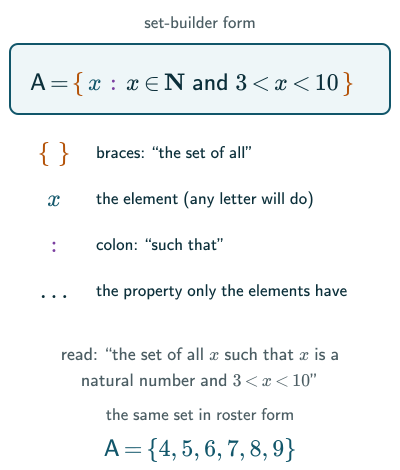
Which form to use. The roster form is best for small sets and for showing exactly what is in a set. The set-builder form is best for large or infinite sets, and for sets such as the real numbers between 1 and 2, whose elements cannot be listed in any pattern.
Changing from one form to the other
- Set-builder to roster: find every element that has the property. {x : x is a positive integer and x2 < 40} = {1, 2, 3, 4, 5, 6}, since 62 = 36 < 40 but 72 = 49 > 40 (NCERT Example 2, page 3).
- Roster to set-builder: find a property shared by every element and by nothing else. {1, 4, 9, 16, 25, …} = {x : x is the square of a natural number}, or {x : x = n2, n ∈ N} (NCERT Example 3, page 4).
The solution set of an equation is a common case: x2 + x − 2 = 0 factorises as (x − 1)(x + 2) = 0, so its solution set is {1, −2} (NCERT Example 1, page 3).
Solved examples
Example 1: Which collections are sets? (NCERT Exercise 1.1, Q1 (i), (ii), (v), (ix))
Which of these are sets: (a) the months of a year beginning with J; (b) the ten most talented writers of India; (c) the natural numbers less than 100; (d) a collection of the most dangerous animals of the world?
Ask whether membership can be decided without opinion. (a) January, June, July: decided. (b) “Most talented” is a matter of opinion. (c) 1, 2, …, 99: decided. (d) “Most dangerous” is a matter of opinion.
Answer: (a) and (c) are sets; (b) and (d) are not.
Example 2: Set-builder to roster (NCERT Exercise 1.1, Q3 (i), (iii), (iv), (v))
Write in roster form: (a) A = {x : x is an integer and −3 ≤ x < 7}; (b) C = {x : x is a two-digit natural number whose digits add up to 8}; (c) D = {x : x is a prime number that divides 60}; (d) the set of letters in TRIGONOMETRY.
(a) −3 is included and 7 is not. (b) The tens digit runs from 1 to 8 and the units digit is 8 minus it. (c) 60 = 22 × 3 × 5. (d) Write each letter once.
Answer: (a) {−3, −2, −1, 0, 1, 2, 3, 4, 5, 6}; (b) {17, 26, 35, 44, 53, 62, 71, 80}; (c) {2, 3, 5}; (d) {T, R, I, G, O, N, M, E, Y}.
Example 3: Roster to set-builder (NCERT Exercise 1.1, Q4 (i), (ii), (iii), (v))
Write in set-builder form: (a) {3, 6, 9, 12}; (b) {2, 4, 8, 16, 32}; (c) {5, 25, 125, 625}; (d) {1, 4, 9, …, 100}.
NCERT prints the first set as “(3, 6, 9, 12}”, opening with a round bracket by mistake; it is the set {3, 6, 9, 12}. Look for the rule that makes each element. (a) multiples of 3 up to 12; (b) powers of 2 from 21 to 25; (c) powers of 5 from 51 to 54; (d) squares from 12 to 102. In the answers n is only a counter: the elements are the values x takes as n runs through 1, 2, 3, ….
Answer: (a) {x : x = 3n, n ∈ N and 1 ≤ n ≤ 4}; (b) {x : x = 2n, n ∈ N and 1 ≤ n ≤ 5}; (c) {x : x = 5n, n ∈ N and 1 ≤ n ≤ 4}; (d) {x : x = n2, n ∈ N and 1 ≤ n ≤ 10}.
Example 4: A pattern in fractions (NCERT Example 4, page 4)
Write {1/2, 2/3, 3/4, 4/5, 5/6, 6/7} in set-builder form.
Each numerator is one less than its denominator, and the numerators run from 1 to 6.
Answer: {x : x = n/(n + 1), where n is a natural number and 1 ≤ n ≤ 6}.
Example 5: Matching the two forms (NCERT Example 5, page 4)
Match (i) {P, R, I, N, C, A, L}, (ii) {0}, (iii) {1, 2, 3, 6, 9, 18}, (iv) {3, −3} with (a) {x : x is a positive integer that divides 18}, (b) {x : x is an integer and x2 − 9 = 0}, (c) {x : x is an integer and x + 1 = 1}, (d) {x : x is a letter of the word PRINCIPAL}.
PRINCIPAL has 9 letters, but P and I repeat, leaving 7 distinct letters. x + 1 = 1 gives x = 0; x2 = 9 gives x = ±3; the positive divisors of 18 are 1, 2, 3, 6, 9 and 18.
Answer: (i)–(d), (ii)–(c), (iii)–(a), (iv)–(b).
Common mistakes to avoid
Common mistake
Repeating elements in roster form
The letters of COMMITTEE form {C, O, M, I, T, E}, not {C, O, M, M, I, T, T, E, E}. Repeating an element does not change the set, so it is simply not written.
Common mistake
Thinking the order of elements matters
{1, 2, 3} and {3, 1, 2} are the same set. Order matters for ordered pairs (a, b), met in the next chapter, but not inside braces.
Common mistake
Getting the endpoints of an inequality wrong
{x : x is an integer and −3 ≤ x < 7} includes −3 but not 7. Read each sign separately: ≤ includes the endpoint, < leaves it out.
Common mistake
Ignoring what kind of number *x* is
{x : x ∈ N and x2 = 4} = {2}, but {x : x ∈ Z and x2 = 4} = {−2, 2} (NCERT Example 6, page 7). Read what x is before solving.
Common mistake
Taking an opinion for a property
“Tall students” or “difficult questions” do not make a set, because membership depends on who decides. A set needs a property everyone can check.
Quick revision summary
- A set is a well-defined collection of objects; a ∈ A means a belongs to A, b ∉ A means it does not.
- Standard sets: N, Z, Q, R, Z+, Q+, R+; 0 is not in N.
- Roster form: list the elements in braces, separated by commas; order does not matter and no element is repeated.
- Set-builder form: {x : property of x}, read “the set of all x such that …”.
- Infinite sets with a pattern can be written {1, 3, 5, …}; sets without a pattern need set-builder form.
Formula sheet
- a ∈ A: a belongs to A; b ∉ A: b does not belong to A
- Roster form: {1, 2, 3, 6} (order irrelevant, no repetition)
- Set-builder form: {x : x has property P}, read “the set of all x such that x has property P”
Questions students ask
What is the difference between roster form and set-builder form?
Roster form lists every element of a set inside braces, while set-builder form describes the elements by a property that they have and no other object has. The multiples of 5 from 5 to 20 are {5, 10, 15, 20} in roster form and {x : x = 5n, n ∈ N and 1 ≤ n ≤ 4} in set-builder form. Roster form shows at a glance what a small set holds; set-builder form is shorter for large sets and is needed for sets such as the real numbers between 0 and 1, which cannot be listed at all.
What are the other names for roster form and set-builder form?
Roster form is also called the tabular form or the listing method, and set-builder form is also called the rule method or the property method; NCERT names them the roster (or tabular) form and the set-builder form. Whatever the names, a set is the same in either form: {2, 3, 5, 7} in tabular form and {x : x is a prime number less than 10} in rule form are the same set. A Venn diagram is a third way to show a set, as a picture rather than in symbols.
What do N, Z, Q, R and T stand for in sets?
In NCERT’s notation N is the set of natural numbers {1, 2, 3, …}, Z the integers, Q the rational numbers, R the real numbers and T the irrational numbers, that is the real numbers that are not rational. The letter Z comes from the German word Zahlen, “numbers”, and Q from “quotient”, because every rational number is a quotient p/q of integers with q ≠ 0. They fit together as N ⊂ Z ⊂ Q ⊂ R, with T the part of R outside Q, as shown in subsets of the real numbers.
Is 0 a natural number in Class 11 sets?
No, 0 is not a natural number in NCERT Class 11 Mathematics, where N = {1, 2, 3, …}; adding 0 gives the whole numbers {0, 1, 2, 3, …}. Some university books and the ISO standard for mathematical notation do include 0 in N, so check how a source defines N before answering. The difference changes answers: {x : x ∈ N and x < 3} = {1, 2}, but the whole numbers less than 3 form {0, 1, 2}.
Is the chapter Sets in the JEE Main 2027 syllabus?
Yes, sets are in the JEE Main 2027 Mathematics syllabus published by the NTA: Unit 1, Sets, Relations and Functions, begins with “Sets and their representation”, followed by union, intersection and complement of sets and their algebraic properties, and the power set. The same Unit 1 appears in the Mathematics part of Paper 2A (B.Arch.) and Paper 2B (B.Planning). The syllabus does not list the empty, finite, equal or universal sets by name; they are the basic language of the unit, as in NCERT Chapter 1.
What is the difference between set-builder notation and interval notation?
Set-builder notation can describe any set by a property, while interval notation is a shorthand only for an unbroken stretch of the real line, such as all the real numbers between two endpoints. So {x : x ∈ R and 2 < x ≤ 6} can be written as the interval (2, 6], but {x : x ∈ Z and 2 < x ≤ 6} = {3, 4, 5, 6} cannot, because it holds only the integers in that range. The bracket rules for open, closed and half-open intervals are on the subsets page, under intervals as subsets of R.
Practice questions
Try each question first, then open the answer to check your working.
-
Q1. Let A = {1, 2, 3, 4, 5, 6}. Insert ∈ or ∉: (i) 5 … A; (ii) 8 … A; (iii) 0 … A; (iv) 4 … A; (v) 2 … A; (vi) 10 … A (NCERT Exercise 1.1, Q2).
Show answerHide answer
(i) 5 ∈ A; (ii) 8 ∉ A; (iii) 0 ∉ A; (iv) 4 ∈ A; (v) 2 ∈ A; (vi) 10 ∉ A.
-
Q2. Write in roster form: (i) B = {x : x is a natural number less than 6}; (ii) the set of letters in BETTER (NCERT Exercise 1.1, Q3 (ii), (vi)).
Show answerHide answer
(i) {1, 2, 3, 4, 5}; (ii) {B, E, T, R}.
-
Q3. Write the solution set of x2 − x − 6 = 0 in roster form.
Show answerHide answer
(x − 3)(x + 2) = 0, so x = 3 or x = −2: the solution set is {3, −2}.
-
Q4. List all the elements of: (i) C = {x : x is an integer and x2 ≤ 4}; (ii) D = {x : x is a letter in the word LOYAL}; (iii) E = {x : x is a month of a year not having 31 days} (NCERT Exercise 1.1, Q5 (iii)–(v)).
Show answerHide answer
(i) {−2, −1, 0, 1, 2}; (ii) {L, O, Y, A}; (iii) {February, April, June, September, November}.
-
Q5. Write {2, 4, 6, …} in set-builder form (NCERT Exercise 1.1, Q4 (iv)).
Show answerHide answer
{x : x is an even natural number}, or {x : x = 2n, n ∈ N}.
-
Q6. Match (i) {1, 2, 3, 6}, (ii) {2, 3}, (iii) {M, A, T, H, E, I, C, S}, (iv) {1, 3, 5, 7, 9} with (a) {x : x is a prime number and a divisor of 6}, (b) {x : x is an odd natural number less than 10}, (c) {x : x is a natural number and a divisor of 6}, (d) {x : x is a letter of the word MATHEMATICS} (NCERT Exercise 1.1, Q6).
Show answerHide answer
(i)–(c), (ii)–(a), (iii)–(d), (iv)–(b).