Subsets
NCERT Class 11 Mathematics Chapter 1 Section 1.6
Quick answer
A is a subset of B, written A ⊂ B, when every element of A is also in B; every set is a subset of itself, and the empty set is a subset of every set. A ⊂ B with A ≠ B makes A a proper subset of B. For a < b, intervals are subsets of R: (a, b) leaves out both endpoints, [a, b] includes both, and the half-open intervals include one; each has length b − a.
With your textbook
NCERT Mathematics (Class 11), Chapter 1 “Sets”, Section 1.6 “Subsets”, pages 9–12.
Open the official NCERT chapter (PDF, 2.2 MB, ncert.nic.in) (opens in a new tab)
Checked against the 2026-27 reprint on .
What is a subset?
Subset
A set A is said to be a subset of a set B if every element of A is also an element of B.
NCERT Mathematics (Class 11), Section 1.6, page 9
- In symbols, A ⊂ B if a ∈ A ⇒ a ∈ B, read “A is a subset of B” or “A is contained in B”; if not, A ⊄ B.
- A ⊂ B and B ⊂ A together mean A = B (NCERT page 9).
- Every set is a subset of itself, A ⊂ A, and the empty set ϕ is a subset of every set.
In plain words: A is a subset of B when A lies wholly inside B, with nothing of A left outside. The students of your class form a subset of the students of your school (NCERT page 9). A subset can be all of B (B ⊂ B) or none of it (ϕ ⊂ B); anything in between counts too.
Proper subsets, supersets and singletons
Let A and B be two sets. If A ⊂ B and A ≠ B , then A is called a proper subset of B and B is called superset of A.
NCERT Mathematics (Class 11), Section 1.6, page 10
For example, A = {1, 2, 3} is a proper subset of B = {1, 2, 3, 4}. A set with only one element, such as {a}, is a singleton set (NCERT page 10).
NCERT’s other examples (page 10):
- the rational numbers form a subset of the real numbers, Q ⊂ R;
- if A is the set of divisors of 56 and B the set of its prime divisors, then B ⊂ A: B = {2, 7}, A = {1, 2, 4, 7, 8, 14, 28, 56};
- {1, 3, 5} and {x : x is an odd natural number less than 6} are each a subset of the other, so they are equal;
- {a, e, i, o, u} and {a, b, c, d}: neither is a subset of the other, since e is not in the second and b is not in the first (NCERT Example 10).
Outside mathematics too: the seven SI base units form a subset of the set of all SI units, which also contains the derived units such as the newton. In biology, the organisms of a species form a subset of the organisms of its genus, and those of a genus a subset of those of its family, up the taxonomic hierarchy.
A note on symbols. NCERT writes ⊂ for every subset, including A ⊂ A. Many books and exam papers write ⊆ for “subset, possibly equal” and keep ⊂ for a proper subset. Read which convention a question uses; in NCERT, ⊂ allows equality.
∈ and ⊂ are different
∈ joins an element to a set; ⊂ joins a set to a set. For A = {1, 2, {3, 4}, 5}: 1 ∈ A and {1, 2, 5} ⊂ A, but writing 1 ⊂ A is wrong, because 1 is not a set. {3, 4} ∈ A, since {3, 4} is one of the elements listed; {3, 4} ⊄ A, since 3 and 4 themselves are not elements of A; and {{3, 4}} ⊂ A.
NCERT Example 11 (page 10) shows that A ∈ B and B ⊂ C do not give A ⊂ C: with A = {1}, B = {{1}, 2} and C = {{1}, 2, 3}, A ∈ B and B ⊂ C, but 1 ∈ A while 1 ∉ C, so A ⊄ C. By contrast, ⊂ is transitive: if A ⊂ B and B ⊂ C, then A ⊂ C, since every element of A is in B and so in C.
Subsets of the real numbers
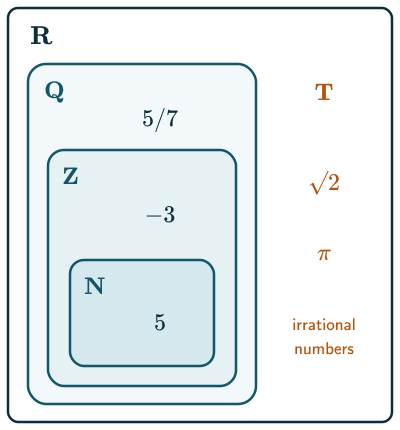
Some important subsets of R (NCERT Section 1.6.1, pages 10–11):
- natural numbers N = {1, 2, 3, 4, 5, …};
- integers Z = {…, −3, −2, −1, 0, 1, 2, 3, …};
- rational numbers Q = {x : x = p/q, p, q ∈ Z and q ≠ 0}, such as −5 = −5/1, 5/7, 3½ = 7/2 and −11/3;
- irrational numbers, which NCERT writes T = {x : x ∈ R and x ∉ Q}, such as √2, √5 and π.
They are related by N ⊂ Z ⊂ Q, Q ⊂ R, T ⊂ R and N ⊄ T (NCERT page 11). In fact Q and T share no element, and together they make up R.
Intervals as subsets of R
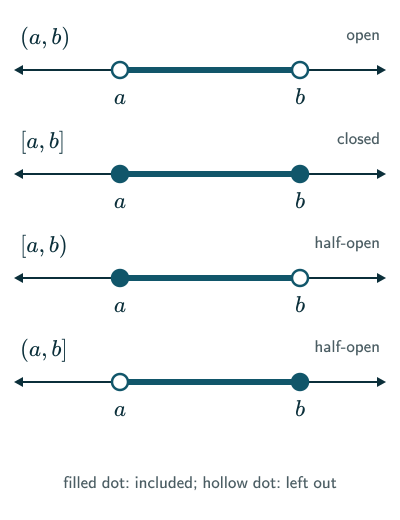
Let a, b ∈ R with a < b (NCERT Section 1.6.2, page 11):
| Interval | Set-builder form | Endpoints |
|---|---|---|
| (a, b) | {x : a < x < b} | neither included (open) |
| [a, b] | {x : a ≤ x ≤ b} | both included (closed) |
| [a, b) | {x : a ≤ x < b} | a only |
| (a, b] | {x : a < x ≤ b} | b only |
A round bracket leaves the endpoint out; a square bracket puts it in. NCERT page 11 introduces the last two as “closed at one end and open at the other” but then calls each an “open interval” from a to b; they are usually called half-open (or semi-open) intervals, since one end is included and the other is not.
Intervals can also run to infinity: [0, ∞) is the non-negative real numbers, (−∞, 0) the negative real numbers and (−∞, ∞) the whole of R. Infinity is not a number, so ∞ always takes a round bracket. Domains and ranges of real functions are often intervals like these: f(x) = x2 has range [0, ∞), and sin x has domain (−∞, ∞) and range [−1, 1].
Here, we note that an interval contains infinitely many points.
NCERT Mathematics (Class 11), Section 1.6.2, page 11
The number b − a is called the length of each of these four intervals (NCERT page 12).
For example, (−3, 5) ⊂ [−7, 9] (NCERT page 11); {x : x ∈ R, −5 < x ≤ 7} = (−5, 7]; and [−3, 5) = {x : −3 ≤ x < 5}. Solution sets of inequalities are written the same way: 5x − 3 < 3x + 1 gives x < 2, the interval (−∞, 2).
Solved examples
Example 1: ⊂ or ⊄? (NCERT Example 9, page 10)
For ϕ, A = {1, 3}, B = {1, 5, 9} and C = {1, 3, 5, 7, 9}, fill in ⊂ or ⊄: (i) ϕ … B; (ii) A … B; (iii) A … C; (iv) B … C.
(i) The empty set is a subset of every set. (ii) 3 ∈ A but 3 ∉ B. (iii) 1 and 3 are both in C. (iv) 1, 5 and 9 are all in C.
Answer: (i) ϕ ⊂ B; (ii) A ⊄ B; (iii) A ⊂ C; (iv) B ⊂ C.
Example 2: Element or subset? (NCERT Exercise 1.3, Q3)
For A = {1, 2, {3, 4}, 5}, which are incorrect: (i) {3, 4} ⊂ A; (ii) {3, 4} ∈ A; (iii) {{3, 4}} ⊂ A; (iv) 1 ∈ A; (v) 1 ⊂ A; (vi) {1, 2, 5} ⊂ A; (vii) {1, 2, 5} ∈ A; (viii) {1, 2, 3} ⊂ A; (ix) ϕ ∈ A; (x) ϕ ⊂ A; (xi) {ϕ} ⊂ A?
The elements of A are 1, 2, {3, 4} and 5. (i) 3 ∉ A. (v) 1 is not a set. (vii) {1, 2, 5} is not one of the four elements. (viii) 3 ∉ A. (ix) ϕ is not listed as an element. (xi) {ϕ} ⊂ A would need ϕ ∈ A.
Answer: incorrect: (i), (v), (vii), (viii), (ix) and (xi). Correct: (ii), (iii), (iv), (vi) and (x).
Example 3: All subsets (NCERT Exercise 1.3, Q4)
Write all the subsets of (i) {a}; (ii) {a, b}; (iii) {1, 2, 3}; (iv) ϕ.
List by size: none, one element, two elements, and so on.
Answer: (i) ϕ, {a}; (ii) ϕ, {a}, {b}, {a, b}; (iii) ϕ, {1}, {2}, {3}, {1, 2}, {1, 3}, {2, 3}, {1, 2, 3}; (iv) ϕ only. The counts are 2, 4, 8 and 1, that is 21, 22, 23 and 20: a set with n elements has 2n subsets (together they form its power set; see why there are 2n).
Example 4: Intervals (NCERT Exercise 1.3, Q5 and Q6)
(a) Write as intervals: {x : x ∈ R, −4 < x ≤ 6} and {x : x ∈ R, 0 ≤ x < 7}. (b) Write in set-builder form: (6, 12] and [−23, 5).
A strict inequality gives a round bracket; ≤ gives a square one.
Answer: (a) (−4, 6] and [0, 7); (b) {x : x ∈ R, 6 < x ≤ 12} and {x : x ∈ R, −23 ≤ x < 5}.
Common mistakes to avoid
Common mistake
Mixing up ∈ and ⊂
∈ is used between an element and a set, ⊂ between two sets: 2 ∈ {1, 2} but {2} ⊂ {1, 2}. Writing 2 ⊂ {1, 2} is wrong. Watch the empty set too: ϕ ∈ {ϕ} and ϕ ⊂ {ϕ} are both true, but ϕ ∈ {1, 2} is false.
Common mistake
Forgetting ϕ and the set itself
Every set has ϕ and itself among its subsets. {1, 2, 3} has 8 subsets, not 6.
Common mistake
Getting brackets wrong at infinity
(−∞, 0) and [0, ∞) are right; [0, ∞] is wrong, because ∞ is not a real number and cannot be included.
Common mistake
Calling [a, b) an open interval
Only (a, b) is open and only [a, b] is closed; [a, b) includes a, so it is half-open, not open.
Quick revision summary
- A ⊂ B: every element of A is in B. A ⊂ B and B ⊂ A ⇔ A = B. ϕ ⊂ A and A ⊂ A for every A.
- Proper subset: A ⊂ B and A ≠ B; then B is a superset of A. A singleton has one element.
- ∈ links an element to a set; ⊂ links two sets.
- N ⊂ Z ⊂ Q ⊂ R; irrationals T = {x : x ∈ R and x ∉ Q}.
- Intervals: (a, b) open; [a, b] closed; half-open [a, b) with a ≤ x < b, and (a, b] with a < x ≤ b; length b − a; ∞ always gets a round bracket.
Formula sheet
- A ⊂ B ⇔ (a ∈ A ⇒ a ∈ B); A ⊂ B and B ⊂ A ⇔ A = B
- (a, b) = {x : a < x < b}; [a, b] = {x : a ≤ x ≤ b}
- [a, b) = {x : a ≤ x < b}; (a, b] = {x : a < x ≤ b}; length b − a
- A set with n elements has 2n subsets
Questions students ask
What is the difference between a subset and a proper subset?
A subset of B may be the whole of B, while a proper subset of B must leave out at least one element of B: A ⊂ B means that every element of A is in B, and A is a proper subset of B when, in addition, A ≠ B. So {2, 4} and {2, 4, 8} are both subsets of {2, 4, 8}, but only {2, 4} is a proper subset of it. Every set is a subset of itself but never a proper subset of itself, and a set with n elements has 2n − 1 proper subsets.
What is an improper subset of a set?
The improper subset of a set A is A itself, the one subset of A that is not a proper subset, since A ⊂ A holds but A ≠ A does not. Some books also call the empty set ϕ an improper subset and keep the word proper for the subsets that are neither ϕ nor A; under that convention a non-empty set with n elements has 2n − 2 proper subsets, while NCERT’s definition (A ⊂ B and A ≠ B) makes ϕ a proper subset of every non-empty set and gives 2n − 1. Check which convention a question follows before counting.
What are the symbols for subset, proper subset and superset?
The subset symbol in NCERT is ⊂: A ⊂ B means “A is a subset of B” and allows A = B, A ⊄ B means that A is not a subset of B, and a proper subset is written A ⊂ B together with A ≠ B. Many other books and exam papers write A ⊆ B for a subset that may equal B and keep A ⊂ B for a proper subset. The superset symbol faces the other way: B ⊃ A, read “B contains A”, says the same as A ⊂ B, and books that write ⊆ write ⊇ in the same way; NCERT calls B a superset of A when A is a proper subset of B.
Why is the empty set a subset of every set?
The empty set ϕ is a subset of every set A because the test for ϕ ⊂ A, that every element of ϕ is also an element of A, cannot fail: ϕ has no elements, so none of them can be missing from A. To show ϕ ⊄ A you would need an element of ϕ that is not in A, and there is none. So ϕ ⊂ A for every set A, ϕ ⊂ ϕ included, and ϕ is a proper subset of every set except ϕ itself.
Can a set be both an element and a subset of another set?
Yes, a set can be both an element and a subset of another set: in B = {a, {a}}, the set {a} is an element because it is listed, and a subset because its only element a is listed too, so {a} ∈ B and {a} ⊂ B. Being an element does not make it a subset: for distinct ordinary objects a and b, in C = {b, {a}}, {a} ∈ C but {a} ⊄ C, since a itself is not an element of C. Test ∈ by finding the object in the list, and ⊂ by finding each of its elements there.
Practice questions
Try each question first, then open the answer to check your working.
-
Q1. Fill in ⊂ or ⊄: (i) {2, 3, 4} … {1, 2, 3, 4, 5}; (ii) {a, b, c} … {b, c, d}; (iii) {x : x is an equilateral triangle in a plane} … {x : x is a triangle in the same plane}; (iv) {x : x is an even natural number} … {x : x is an integer} (NCERT Exercise 1.3, Q1 (i), (ii), (vi), (vii)).
Show answerHide answer
(i) ⊂; (ii) ⊄, since a is not in the second set; (iii) ⊂; (iv) ⊂.
-
Q2. True or false: (i) {a, b} ⊄ {b, c, a}; (ii) {a, e} ⊂ {x : x is a vowel}; (iii) {1, 2, 3} ⊂ {1, 3, 5}; (iv) {a} ∈ {a, b, c} (NCERT Exercise 1.3, Q2 (i)–(iii), (v)).
Show answerHide answer
(i) False: {a, b} ⊂ {b, c, a}. (ii) True. (iii) False: 2 is not in {1, 3, 5}. (iv) False: {a} is a subset, not an element; a ∈ {a, b, c}.
-
Q3. Write as intervals: (i) {x : x ∈ R, −12 < x < −10}; (ii) {x : x ∈ R, 3 ≤ x ≤ 4} (NCERT Exercise 1.3, Q5 (ii), (iv)).
Show answerHide answer
(i) (−12, −10); (ii) [3, 4].
-
Q4. Write (−3, 0) and [6, 12] in set-builder form (NCERT Exercise 1.3, Q6 (i), (ii)).
Show answerHide answer
{x : x ∈ R, −3 < x < 0} and {x : x ∈ R, 6 ≤ x ≤ 12}.
-
Q5. How many subsets does {p, q, r, s} have, and how many of them are proper subsets?
Show answerHide answer
24 = 16 subsets; all except the set itself are proper, so 15.
-
Q6. What is the length of the interval [−2, 5)? Does it contain −2? Does it contain 5?
Show answerHide answer
Length 5 − (−2) = 7. It contains −2 (square bracket) but not 5 (round bracket).