The empty set
NCERT Class 11 Mathematics Chapter 1 Section 1.3
Quick answer
The empty set, also called the null or void set, is the set with no elements; it is written ϕ, { } or ∅, and n(ϕ) = 0. A set is empty when nothing can satisfy its defining property, such as the natural numbers between 1 and 2. The sets {0} and {ϕ} are not empty: each has exactly one element.
With your textbook
NCERT Mathematics (Class 11), Chapter 1 “Sets”, Section 1.3 “The Empty Set”, pages 5–6.
Open the official NCERT chapter (PDF, 2.2 MB, ncert.nic.in) (opens in a new tab)
Checked against the 2026-27 reprint on .
What is the empty set?
The empty set
A set which does not contain any element is called the empty set or the null set or the void set.
NCERT Mathematics (Class 11), Section 1.3, page 6
- It is written ϕ or { } (NCERT page 6). Many other books write ∅ for the same set; ϕ, ∅ and { } all name the empty set.
- It has no elements, so n(ϕ) = 0, and it counts as a finite set (NCERT Section 1.4, page 6).
- There is only one empty set. NCERT calls two sets equal when they have exactly the same elements (Definition 3, page 7). If A and B both have no elements, A has no element missing from B and B none missing from A, so A = B.
In plain words: describe a set by a property that nothing has, and you get the empty set. The set of students presently studying in both Classes X and XI is empty, because a student cannot study in both classes at once (NCERT page 6). The empty set is still a set, the way 0 is still a number: it is the answer “nothing” written in set language.
Recognising an empty set
To show a set is empty, show that no object can have its defining property. NCERT’s examples (Section 1.3, page 6):
- A = {x : 1 < x < 2, x is a natural number} is empty: there is no natural number between 1 and 2.
- B = {x : x2 − 2 = 0 and x is a rational number} is empty: x2 = 2 gives x = ±√2, and √2 is not rational.
- C = {x : x is an even prime number greater than 2} is empty: 2 is the only even prime.
- D = {x : x2 = 4, x is odd} is empty: the solutions, 2 and −2, are both even.
The same reasoning works outside mathematics: the set of chemical elements with an atomic number strictly between 1 and 2 is empty, because atomic numbers are whole numbers.
Notice that B changes if the condition changes: {x : x2 − 2 = 0 and x is a real number} = {−√2, √2} is not empty. Whether a set is empty depends on the whole description, including the kind of number allowed.
ϕ, {0} and {ϕ} are different
These three are easy to confuse:
| Set | Elements | Number of elements |
|---|---|---|
| ϕ | none | 0 |
| {0} | the number 0 | 1 |
| {ϕ} | the empty set itself | 1 |
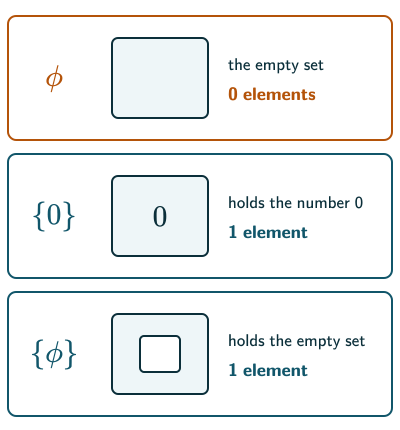
{0} is the solution set of x + 1 = 1 (NCERT Example 5, page 4): it has one element, the number zero, so it is not empty. {ϕ} is a box that contains an empty box: it has one element, which happens to be a set.
Solved examples
Example 1: Which are null sets? (NCERT Exercise 1.2, Q1)
Which of these are empty: (i) the odd natural numbers divisible by 2; (ii) the even prime numbers; (iii) {x : x is a natural number, x < 5 and x > 7}; (iv) {y : y is a point common to any two parallel lines}?
(i) An odd number is not divisible by 2. (ii) 2 is an even prime. (iii) No number is both less than 5 and greater than 7. (iv) Two distinct parallel lines never meet.
Answer: (i), (iii) and (iv) are empty; (ii) = {2} is not.
Example 2: Empty or not?
Decide whether each set is empty: (a) {x : x ∈ N and 2x − 1 = 0}; (b) {x : x ∈ Z and x2 = 9}; (c) {x : x ∈ R and x2 + 1 = 0}.
(a) x = 1/2 is not a natural number. (b) x = 3 or −3, both integers. (c) x2 = −1 has no real solution, since the square of a real number is never negative.
Answer: (a) empty (NCERT Example 6 (iii), page 7); (b) {−3, 3}, not empty; (c) empty.
Example 3: Counting elements
Find the number of elements of each set: A = ϕ, B = {0}, C = {ϕ} and D = {ϕ, {ϕ}}.
Count the distinct objects listed inside the outer braces, whatever they are.
Answer: n(A) = 0, n(B) = 1, n(C) = 1, n(D) = 2.
Common mistakes to avoid
Common mistake
Writing {ϕ} for the empty set
{ϕ} has one element, the empty set. The empty set itself is ϕ, or { } with nothing between the braces.
Common mistake
Thinking {0} is empty
{0} contains the number zero, so it has one element. Zero is a number, not “nothing”.
Common mistake
Ignoring the kind of number allowed
{x : x2 = 2} is empty if x must be rational, but {−√2, √2} if x may be any real number. Always read the whole condition.
Quick revision summary
- The empty (null, void) set has no elements; it is written ϕ, { } or ∅, and n(ϕ) = 0.
- A set is empty when no object can satisfy its defining property.
- ϕ, {0} and {ϕ} are three different sets; {0} and {ϕ} each have one element.
Formula sheet
- Empty set: ϕ = { }, with n(ϕ) = 0
- {0} and {ϕ} are not empty: each has 1 element
Questions students ask
Is there any difference between a null set and an empty set?
No, the null set, the empty set and the void set are three names for one and the same set, the set with no elements, written ϕ or { }. Two sets with no elements have exactly the same elements, none, so they are equal: the square numbers between 50 and 60 and the triangles with four sides both form ϕ. Only in university measure theory does “null set” sometimes mean something else, a set of measure zero that need not be empty; in Class 11 and JEE the names are interchangeable.
What is the empty set symbol called, and is it the Greek letter phi?
The empty set symbol ∅ is read “the empty set” or “the null set”, and it is not the Greek letter phi: it is a circle with a slash, modelled on the letter Ø of the Danish and Norwegian alphabets and introduced by André Weil of the Bourbaki group in 1939. NCERT, like many Indian books, prints the empty set with the Greek letter ϕ, which is why students usually read it as “phi”. Both symbols, and { } with nothing inside, name the same set.
Is the empty set finite or infinite?
The empty set is finite: NCERT calls a set finite if it is empty or has a definite number of elements, and ϕ has exactly 0 elements, so n(ϕ) = 0. It is also the only set with no elements, so any set S with n(S) = 0 is ϕ itself. The definition and more examples are in NCERT Section 1.4, Finite and Infinite Sets (pages 6–7).
What is the difference between an empty set and a singleton set?
An empty set has no elements, so n(ϕ) = 0, while a singleton set has exactly one element, so its number of elements is 1. For example, {x : x ∈ N and 3x = 12} = {4} is a singleton, but {x : x ∈ N and 3x = 10} is empty, because 10/3 is not a natural number. Only the count matters, not the size of the element: {100} and {{1, 2, 3}} are both singletons, as defined in NCERT Section 1.6, Subsets (page 10).
Is the solution set of an equation with no solution the empty set?
Yes, when an equation has no solution among the numbers allowed, its solution set is the empty set ϕ. For example, x + 3 = x is false for every real x, so {x : x ∈ R and x + 3 = x} = ϕ, while x + 3 = 3 + x is true for every real x, so its solution set is all of R. The same holds for simultaneous equations with no common solution: no pair of numbers satisfies both x + y = 2 and x + y = 5, so their solution set is ϕ.
Practice questions
Try each question first, then open the answer to check your working.
-
Q1. Is {x : x ∈ Z and 1 < 2x < 3} empty?
Show answerHide answer
No: 1/2 < x < 3/2, so x = 1 and the set is {1}.
-
Q2. Is {x : x ∈ N and x2 + x = 0} empty?
Show answerHide answer
Yes: x(x + 1) = 0 gives 0 or −1, and neither is a natural number.
-
Q3. Give the number of elements of ϕ, {ϕ} and {0, ϕ}.
Show answerHide answer
0, 1 and 2.
-
Q4. Is {x : x is a real number and x2 = −4} empty?
Show answerHide answer
Yes: the square of a real number is never negative, so no real x has x2 = −4.