Complex numbers
NCERT Class 11 Mathematics Chapter 4 Sections 4.1–4.2
Quick answer
A complex number is a number z = a + ib, where a and b are real and i is the imaginary unit with i = −1. The real number a is the real part, Re z, and the real number b is the imaginary part, Im z. Two complex numbers are equal exactly when their real parts are equal and their imaginary parts are equal.
With your textbook
NCERT Mathematics (Class 11), Chapter 4 “Complex Numbers and Quadratic Equations”, Sections 4.1–4.2 “Introduction” and “Complex Numbers”, pages 76–77.
Open the official NCERT chapter (PDF, 1.6 MB, ncert.nic.in) (opens in a new tab)
Checked against the 2026-27 reprint on .
Why complex numbers?
The equation x2 + 1 = 0 has no real solution, because x2 = −1 and the square of every real number is non-negative (NCERT Section 4.1, page 76). The same happens for any quadratic ax2 + bx + c = 0 with real a, b, c (a ≠ 0) whose discriminant b2 − 4ac is negative.
So the real numbers are extended to a larger system in which x2 = −1 has a solution.
Complex number
- The symbol i stands for √−1, so i2 = −1 and i is a solution of x2 + 1 = 0 (NCERT Section 4.2, page 76).
- A complex number is a number of the form a + ib, where a and b are real numbers.
- For z = a + ib, a is the real part, Re z, and b is the imaginary part, Im z.
In plain words: a complex number is a pair of real numbers glued together by i; NCERT’s historical note (page 88) records that Hamilton treated a + ib as the ordered pair (a, b). NCERT’s examples (page 76) are 2 + i3, (−1) + i√3 and 4 + i(−1/11). Every real number a is the complex number a + i0, so the real numbers sit inside the complex numbers. Two names here go beyond the NCERT text, which does not use them: a number with real part 0, such as 5i = 0 + i5, is purely imaginary, and one with imaginary part 0 is purely real. So 0 = 0 + i0 is both (some books also require b ≠ 0 for a purely imaginary number).
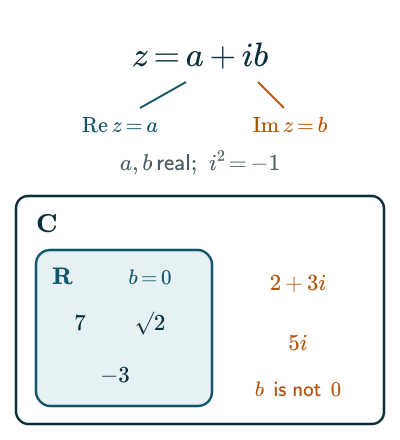
For the complex number z = a + ib, a is called the real part, denoted by Re z and b is called the imaginary part denoted by Im z of the complex number z.
NCERT Mathematics (Class 11), Section 4.2, page 76
For z = 2 + i5, Re z = 2 and Im z = 5 (NCERT page 76). Notice that the imaginary part is the real number 5, not 5i.
The imaginary unit i
i is not a real number: no real number squares to −1. It is a new number with exactly one rule, i2 = −1, and everything else follows from the usual rules of addition and multiplication (but not √a × √b = √(ab), which fails when a and b are both negative). For example, i3 = i2 × i = −i and i4 = (i2)2 = 1, so the powers of i repeat in fours: i, −1, −i, 1, … (NCERT Section 4.3.5 works these out).
Writing a + ib or a + bi means the same thing; NCERT uses both, for example 2 + i3 and 2 + 3i.
Equality of complex numbers
Two complex numbers z1 = a + ib and z2 = c + id are equal if a = c and b = d.
NCERT Mathematics (Class 11), Section 4.2, page 76
So one equation between complex numbers gives two equations between real numbers: equate the real parts and equate the imaginary parts. This is how unknowns are found.
Equality
a + ib = c + id ⇔ a = c and b = d (a, b, c, d real)
There is no “greater than” for complex numbers: statements such as 2 + 3i > 1 + i have no meaning. Here is why. Since i ≠ 0, an order with the usual rules would need i > 0 or i < 0. If i > 0, multiplying by i gives i2 > 0, that is −1 > 0. If i < 0, then −i > 0, and multiplying by −i gives (−i)2 > 0, again −1 > 0. Both are false. So an inequality such as a + ib > c + id has a meaning only when b = d = 0.
Solved examples
Example 1: Equating parts (NCERT Example 1, page 77)
If 4x + i(3x − y) = 3 + i(−6), where x and y are real, find x and y.
Real parts: 4x = 3, so x = 3/4. Imaginary parts: 3x − y = −6, so y = 3x + 6 = 9/4 + 6.
Answer: x = 3/4, y = 33/4.
Example 2: Real and imaginary parts
Write the real and imaginary parts of (i) −3 + 7i; (ii) √2 − i; (iii) 8; (iv) −4i.
Read off a and b in a + ib, writing a missing part as 0.
Answer: (i) Re = −3, Im = 7; (ii) Re = √2, Im = −1; (iii) Re = 8, Im = 0; (iv) Re = 0, Im = −4.
Example 3: Two unknowns in both parts
Find real x and y if (x + y) + i(x − y) = 6 + 2i.
x + y = 6 and x − y = 2. Adding, 2x = 8, so x = 4 and y = 6 − 4 = 2.
Answer: x = 4, y = 2.
Common mistakes to avoid
Common mistake
Calling bi the imaginary part
For z = 3 − 4i the imaginary part is −4, a real number. Im z never contains i.
Common mistake
Equating before checking that the unknowns are real
Equating real and imaginary parts works only when the letters stand for real numbers. If x could itself be complex, 4x would have an imaginary part too.
Common mistake
Comparing complex numbers with < or >
2i > i is meaningless. Only real numbers can be compared; later you will compare the moduli |z|, which are real.
Quick revision summary
- i = √−1 and i2 = −1.
- A complex number is z = a + ib with a, b real; Re z = a and Im z = b.
- a + ib = c + id exactly when a = c and b = d.
Formula sheet
- i = −1
- z = a + ib, Re z = a, Im z = b
- a + ib = c + id ⇔ a = c and b = d
Questions students ask
What is the difference between real, imaginary and complex numbers?
Every real number and every purely imaginary number is a complex number: a complex number is any a + ib with a and b real, a real number is one with b = 0, such as 6 = 6 + i0, and a purely imaginary number is one with a = 0, such as −2i = 0 + i(−2). So 4 + 9i is complex but neither real nor purely imaginary. Books use “imaginary number” in two ways, for any complex number that is not real (b ≠ 0) or only for the purely imaginary ones (a = 0), so check which meaning a question intends.
What is iota in maths, and what is the value of i?
Iota is the name commonly used in India for the imaginary unit i, a number whose square is −1, so i = √−1 and i2 = −1. The value of i is not a real number, because the square of every real number is 0 or positive: i is a new number added to the reals, with no decimal value, and it is neither positive nor negative. NCERT’s historical note (page 88) records that Euler was the first to introduce the symbol i for √−1; strictly the symbol is the Latin letter i, not the Greek letter iota (ι), but the name has stuck.
Why is i equal to −1 and not 1?
The square of i is −1, not 1, because i is defined as a number whose square is −1: no real number has that property, so i is introduced to supply one. The tempting working i2 = √−1 × √−1 = √((−1) × (−1)) = √1 = 1 is wrong, since √a × √b = √(ab) holds only when a and b are not both negative. Done correctly, √−1 × √−1 = i × i = −1; the smallest positive power of i that gives 1 is i4.
Where are complex numbers used in real life?
Complex numbers are used wherever something oscillates or rotates: electrical engineers write alternating currents and voltages as complex numbers, with impedance Z = R + jX (they write j because i stands for current), and the same idea runs signal processing and control systems. Quantum mechanics describes particles by complex-valued wave functions. Multiplying by a complex number of modulus 1 turns a point about the origin, so complex numbers also handle rotations in a plane. In mathematics, every polynomial equation of degree n ≥ 1 has n complex roots, counted with repetition, as Girard foresaw in about 1625 (NCERT historical note, page 88).
Are complex numbers in the JEE Main syllabus?
Yes, complex numbers are in Unit 2, Complex Numbers and Quadratic Equations, of the JEE Main 2027 Mathematics syllabus published by NTA, which lists complex numbers as ordered pairs of reals, the form a + ib and the Argand diagram, the algebra of complex numbers, and the modulus and argument (or amplitude). The same unit covers quadratic equations in real and complex number systems, the relations between roots and coefficients, the nature of roots and forming equations with given roots. It does not name square roots of a complex number, cube roots of unity or De Moivre’s theorem.
What are the main formulas of complex numbers for Class 11?
The main formulas of complex numbers for Class 11 start from i2 = −1 and z = a + ib with a, b real, and two complex numbers are equal exactly when their real parts and imaginary parts are equal. The rules for sums, products, inverses and powers of i are in NCERT Section 4.3, Algebra of Complex Numbers (pages 77–79), and those for the modulus and conjugate in the modulus summary. For JEE, add the polar form and the quadratic formula.
Practice questions
Try each question first, then open the answer to check your working.
-
Q1. Find Re z and Im z for z = −1 + i√3 and for z = 4 + i(−1/11) (NCERT page 76).
Show answerHide answer
−1 + i√3: Re = −1, Im = √3. 4 + i(−1/11): Re = 4, Im = −1/11.
-
Q2. Find real x and y if 3x + 2iy = 6 − 8i.
Show answerHide answer
3x = 6 and 2y = −8, so x = 2 and y = −4.
-
Q3. For which real a is (a − 2) + i(a2 − 4) a real number? For which is it purely imaginary?
Show answerHide answer
Real when the imaginary part is 0: a2 = 4, so a = ±2. Purely imaginary when the real part is 0: a = 2, but then the number is 0 + i0 = 0, which is also real. So no value of a gives a non-zero purely imaginary number.
-
Q4. Show that i is a solution of x2 + 1 = 0. Is −i a solution too?
Show answerHide answer
i2 + 1 = −1 + 1 = 0. Also (−i)2 = i2 = −1, so −i is a solution too: the equation has exactly the two solutions i and −i.