Modulus and conjugate of a complex number
NCERT Class 11 Mathematics Chapter 4 Section 4.4
Quick answer
For z = a + ib, the modulus is |z| = √(a + b), a non-negative real number, and the conjugate of z is a − ib. Their key link is that z times its conjugate is |z|, which gives the inverse of a non-zero z as its conjugate divided by |z| and the rule for dividing: multiply the top and bottom by the conjugate of the bottom.
With your textbook
NCERT Mathematics (Class 11), Chapter 4 “Complex Numbers and Quadratic Equations”, Section 4.4 “The Modulus and the Conjugate of a Complex Number”, pages 81–83.
Open the official NCERT chapter (PDF, 1.6 MB, ncert.nic.in) (opens in a new tab)
Checked against the 2026-27 reprint on .
Modulus and conjugate
Let z = a + ib be a complex number.
NCERT Mathematics (Class 11), Section 4.4, page 81
Modulus and conjugate
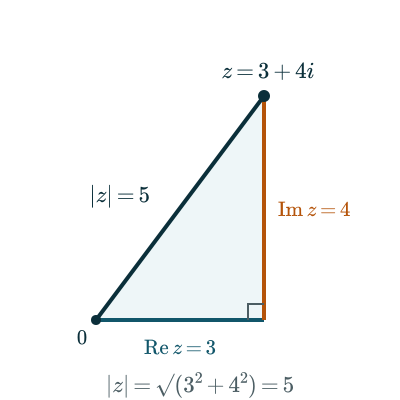
- The modulus of z = a + ib, written |z|, is the non-negative real number √(a2 + b2).
- The conjugate of z, written (“z bar”), is a − ib: the sign of the imaginary part is changed.
- Both definitions are on NCERT page 81.
In plain words: the modulus measures the size of z, and the conjugate is z with i replaced by −i. NCERT’s examples (page 81):
- |3 + i| = √(32 + 12) = √10 and |2 − 5i| = √(22 + (−5)2) = √29;
- the conjugates of 3 + i, 2 − 5i and −3i − 5 are 3 − i, 2 + 5i and 3i − 5.
For a real number a = a + i0, the modulus is √(a2 + 02) = √(a2), the usual absolute value |a|, so the modulus extends the modulus function of real numbers.
The product of z and its conjugate
Multiplying z by its conjugate always gives a non-negative real number:
(a + ib)(a − ib) = a2 − (ib)2 = a2 + b2.
z and its conjugate
z = |z|
z + = 2 Re z
z − = 2i Im z
This is why dividing by a complex number works: multiplying the top and bottom of a fraction by the conjugate of the bottom makes the bottom real.
Multiplicative inverse
NCERT (page 81) observes that the multiplicative inverse of a non-zero complex number z = a + ib is z−1 = 1/(a + ib) = (a − ib)/(a2 + b2), that is:
Inverse
1/z = /|z|, for z ≠ 0
NCERT Example 5 (page 82): for z = 2 − 3i, = 2 + 3i and |z|2 = 22 + (−3)2 = 13, so z−1 = (2 + 3i)/13 = 2/13 + (3/13)i. Check: (2 − 3i)(2 + 3i)/13 = 13/13 = 1.
Properties
Furthermore, the following results can easily be derived.
NCERT Mathematics (Class 11), Section 4.4, page 81
For any complex numbers z1 and z2 (NCERT page 81):
- |z1z2| = |z1| |z2|, and |z1/z2| = |z1|/|z2| when z2 ≠ 0;
- the conjugate of z1z2 is , and the conjugate of z1 ± z2 is ± ;
- the conjugate of z1/z2 is /, when z2 ≠ 0.
Two more facts are used constantly: || = |z|, and the conjugate of is z again. Moduli are real, so unlike complex numbers they can be compared; the modulus of a sum is not the sum of the moduli: |3 + 4i| = 5, but |3| + |4i| = 7. In general |z1 + z2| ≤ |z1| + |z2| (the triangle inequality), with equality when one is a non-negative real multiple of the other.
Solved examples
Example 1: A quotient with square roots (NCERT Example 6 (i), page 82)
Express (5 + √2 i)/(1 − √2 i) in the form a + ib.
Multiply the top and bottom by 1 + √2 i. Bottom: 1 − (√2 i)2 = 1 + 2 = 3. Top: 5 + 5√2 i + √2 i + 2i2 = 3 + 6√2 i.
Answer: (3 + 6√2 i)/3 = 1 + 2√2 i.
Example 2: Conjugate of a quotient (NCERT Example 7, page 85)
Find the conjugate of (3 − 2i)(2 + 3i)/
Top: (3 − 2i)(2 + 3i) = 6 + 9i − 4i + 6 = 12 + 5i. Bottom: (1 + 2i)(2 − i) = 2 − i + 4i + 2 = 4 + 3i. Multiply the top and bottom by 4 − 3i, the conjugate of the bottom; the bottom becomes 42 + 32 = 25: (12 + 5i)(4 − 3i)/25 = (48 − 36i + 20i + 15)/25 = (63 − 16i)/25.
Answer: the number is 63/25 − (16/25)i, so its conjugate is 63/25 + (16/25)i.
Example 3: Inverses (NCERT Exercise 4.1, Q11–Q13)
Find the multiplicative inverses of (i) 4 − 3i; (ii) √5 + 3i; (iii) −i.
Use z−1 = /|z|2. (i) |z|2 = 16 + 9 = 25. (ii) |z|2 = 5 + 9 = 14. (iii) |z|2 = 1 and = i.
Answer: (i) 4/25 + (3/25)i; (ii) √5/14 − (3/14)i; (iii) i.
Example 4: A modulus (NCERT Miscellaneous Exercise, Q5)
If z1 = 2 − i and z2 = 1 + i, find |(z1 + z2 + 1)/(z1 − z2 + 1)|.
z1 + z2 + 1 = 4 and z1 − z2 + 1 = 2 − 2i. The modulus of a quotient is the quotient of the moduli: 4/|2 − 2i| = 4/√(4 + 4) = 4/(2√2) = √2.
Answer: √2.
Common mistakes to avoid
Common mistake
Writing |a + ib| = a + b
|3 − 4i| = √(9 + 16) = 5, not 3 + 4 = 7 or 3 − 4 = −1. The modulus is never negative.
Common mistake
Changing the sign of the real part
The conjugate of −3 + 2i is −3 − 2i, not 3 − 2i. Only the imaginary part changes sign.
Common mistake
Writing z = |z|
z = |z|2, but z2 is usually not real: for z = 1 + i, z2 = 2i while |z|2 = 2. They are equal only when z is real.
Common mistake
Forgetting to square in the inverse
z−1 = /|z|2, not /|z|. For z = 2 − 3i, divide by 13, not by √13.
Quick revision summary
- |z| = √(a2 + b2) ≥ 0 and = a − ib for z = a + ib.
- z = |z|2, so z−1 = /|z|2 for z ≠ 0; to divide, multiply the top and bottom by the conjugate of the bottom.
- |z1z2| = |z1| |z2|; the conjugate of a sum, product or quotient is the sum, product or quotient of the conjugates.
Formula sheet
- |z| = √(a + b), = a − ib
- z = |z|
- 1/z = /|z|, z ≠ 0
- |z1z2| = |z1| |z2|
Questions students ask
What is the difference between the modulus and the conjugate of a complex number?
The modulus of a complex number is a real number, its size, while the conjugate is another complex number: for z = a + ib, |z| = √(a2 + b2) and the conjugate is a − ib. For z = 6 − 8i, the modulus is √(36 + 64) = 10 and the conjugate is 6 + 8i. The two are linked, since z times its conjugate is |z|2, here (6 − 8i)(6 + 8i) = 100. In the Argand plane the modulus is the distance from 0 and the conjugate is the mirror image in the real axis.
Is the modulus of a complex number always positive?
The modulus of a complex number is never negative, but it is not always positive: |z| = √(a2 + b2) ≥ 0, and |z| = 0 only for z = 0, because a2 + b2 = 0 forces a = b = 0. Every non-zero complex number has a positive modulus; a purely imaginary number ib has modulus |b|, so |−7i| = 7 and |i| = 1. So |z| > 0 is the same condition as z ≠ 0, which is exactly when the inverse 1/z exists.
Why do we take the conjugate of a complex number?
The conjugate is used mainly because a complex number times its conjugate is real, (a + ib)(a − ib) = a2 + b2, so it clears i from a denominator in division and gives the inverse 1/z. It also picks out parts and tests numbers: z plus its conjugate is 2 Re z, z equals its conjugate exactly when z is real, and z equals minus its conjugate exactly when z is purely imaginary. For example, if |z| = 1 then 1/z is the conjugate of z, so z + 1/z = 2 Re z is real.
What is the multiplicative inverse of 3 + 4i?
The multiplicative inverse of 3 + 4i is 3/25 − (4/25)i: divide its conjugate 3 − 4i by |3 + 4i|2 = 9 + 16 = 25. Check: (3 + 4i)(3 − 4i) = 9 + 16 = 25, so (3 + 4i) × (3 − 4i)/25 = 1. The same rule, the conjugate divided by |z|2, gives the inverse of every non-zero z; for z = 1 + i it is (1 − i)/2.
Practice questions
Try each question first, then open the answer to check your working.
-
Q1. Find |z| and for z = −5 + 12i.
Show answerHide answer
|z| = √(25 + 144) = 13; = −5 − 12i.
-
Q2. Express i−35 in the form a + ib (NCERT Example 6 (ii), page 82).
Show answerHide answer
i−35 = 1/i35 = 1/((i2)17 i) = 1/(−i) = i, that is 0 + 1i.
-
Q3. Express (3 + i√5)(3 − i√5)/
((√3 + √2 i) − (√3 − i√2)) in the form a + ib (NCERT Exercise 4.1, Q14). Show answerHide answer
Top: 9 − (i√5)2 = 9 + 5 = 14. Bottom: 2√2 i. So 14/(2√2 i) = 7/(√2 i) = −7i/√2 = 0 − (7√2/2)i.
-
Q4. Find the modulus of (1 + i)/(1 − i) − (1 − i)/(1 + i) (NCERT Miscellaneous Exercise, Q9).
Show answerHide answer
(1 + i)/(1 − i) = (1 + i)2/2 = i, and (1 − i)/(1 + i) = −i. The difference is 2i, whose modulus is 2.