Quadratic equations
Beyond NCERT In the JEE Main syllabus; the Class 11 book has no section for it.
Quick answer
The roots of ax + bx + c = 0 (a ≠ 0) are x = (−b ± √D)/(2a), where D = b − 4ac. With a, b, c real: if D > 0 the roots are real and different, if D = 0 they are equal, and if D < 0 they are a pair of complex conjugates. For roots α and β, α + β = −b/a and αβ = c/a, so the equation with roots α and β is x − (α + β)x + αβ = 0.
Quadratic equations with complex roots
NCERT’s Chapter 4 opens (Section 4.1, page 76) by saying that quadratic equations were studied in earlier classes, and that the main reason for complex numbers is to solve ax2 + bx + c = 0 when the discriminant b2 − 4ac is negative. The 2026–27 book has no separate section on quadratic equations; the JEE Main syllabus (Unit 2) lists “Quadratic equations in real and complex number systems and their solutions”, the relations between roots and coefficients, the nature of roots and the formation of quadratic equations. This page covers those.
Quadratic equation and its roots
- A quadratic equation is ax2 + bx + c = 0 with a ≠ 0. Here a, b, c are real.
- Its discriminant is D = b2 − 4ac.
- Its roots are x = (−b ± √D)/(2a). When D < 0, √D means i√(−D), so the roots are (−b ± i√(−D))/(2a).
In plain words: completing the square turns ax2 + bx + c = 0 into (x + b/(2a))2 = D/(4a2). In the real numbers this has no solution when D < 0, because no real square is negative. In the complex numbers it always has solutions, since −k = (i√k)2 for any k > 0.
Roots of ax + bx + c = 0
x = (−b ± √D)/(2a), D = b − 4ac
if D < 0: x = (−b ± i√(−D))/(2a)
Nature of the roots
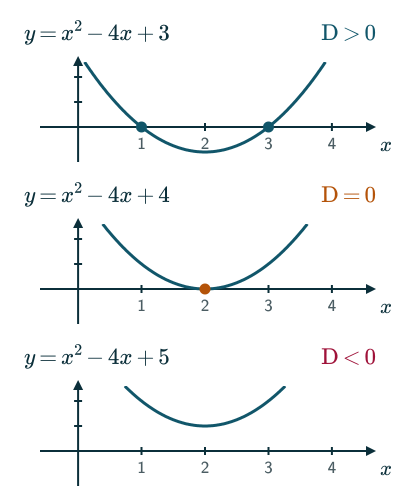
The sign of D decides what kind of roots the equation has (a, b, c real):
| D | Roots |
|---|---|
| D > 0 | two different real roots |
| D = 0 | two equal real roots, −b/(2a) |
| D < 0 | two non-real roots, conjugates of each other |
When D < 0 the roots are p + iq and p − iq with p = −b/(2a) and q = √(−D)/(2a): non-real roots of an equation with real coefficients always come in conjugate pairs.
If a, b, c are rational and D > 0, the roots are rational when D is the square of a rational number and irrational otherwise. If D is an integer, this is the familiar perfect-square test. For example, x2 − (1/4)x = 0 has D = 1/16 and rational roots 0 and 1/4. Irrational roots in this case come in pairs p ± √q, with p, q rational and q > 0.
The graph of y = ax2 + bx + c shows the same thing: the real roots are where the parabola meets the x-axis.
See also the graph of y = x2 among the standard functions.
Roots and coefficients
If α and β are the roots, then ax2 + bx + c = a(x − α)(x − β) = a(x2 − (α + β)x + αβ). Comparing coefficients:
Sum and product of the roots
α + β = −b/a
αβ = c/a
These hold whether the roots are real or complex. Many expressions in α and β can then be found without solving:
- α2 + β2 = (α + β)2 − 2αβ;
- 1/α + 1/β = (α + β)/(αβ), when αβ ≠ 0;
- (α − β)2 = (α + β)2 − 4αβ = D/a2.
Forming an equation from its roots
Reading the factorisation a(x − α)(x − β) backwards (with a = 1), the quadratic with roots α and β is
Equation with roots α and β
x − (α + β)x + αβ = 0
that is, x2 − (sum of roots)x + (product of roots) = 0. Multiplying by any non-zero constant gives the same roots.
Solved examples
Example 1: Two purely imaginary roots
Solve x2 + 3 = 0.
x2 = −3, and the square roots of −3 are ±√3 i (NCERT Section 4.3.6).
Answer: x = √3 i or x = −√3 i.
Example 2: Using the formula
Solve x2 + x + 1 = 0 and 2x2 + x + 1 = 0.
For the first, D = 1 − 4 = −3, so x = (−1 ± i√3)/2. For the second, D = 1 − 8 = −7, so x = (−1 ± i√7)/4.
Answer: (−1 ± i√3)/2; (−1 ± i√7)/4.
Example 3: Nature of the roots
Describe the roots of (i) 3x2 − 4x + 2 = 0; (ii) 4x2 − 12x + 9 = 0; (iii) x2 − 5x + 3 = 0.
(i) D = 16 − 24 = −8 < 0. (ii) D = 144 − 144 = 0. (iii) D = 25 − 12 = 13 > 0.
Answer: (i) two non-real conjugate roots; (ii) two equal real roots, 3/2; (iii) two different real roots, (5 ± √13)/2 (irrational, since 13 is not a perfect square).
Example 4: Without solving
If α and β are the roots of x2 − 5x + 6 = 0, find α2 + β2 and the equation whose roots are 2α and 2β.
α + β = 5 and αβ = 6. So α2 + β2 = 25 − 12 = 13. For the new roots, the sum is 2(α + β) = 10 and the product is 4αβ = 24.
Answer: α2 + β2 = 13; x2 − 10x + 24 = 0 (roots 4 and 6, double the roots 2 and 3).
Example 5: From complex roots to the equation
Form the quadratic equation with real coefficients whose roots are 3 + 2i and 3 − 2i.
Sum = 6; product = 32 + 22 = 13.
Answer: x2 − 6x + 13 = 0.
What if the coefficients are complex?
The quadratic formula and the sum/product rules still hold for complex coefficients, provided a ≠ 0. But D can then be non-real, so the tests D > 0, D = 0 and D < 0 cannot classify the roots as above. Complete the square or find a complex square root of D.
Example 6: Complex coefficients
Solve x2 − 2ix − 2 = 0.
Since (x − i)2 = x2 − 2ix − 1, the equation becomes (x − i)2 = 1. Thus x − i = ±1.
Answer: x = 1 + i or −1 + i. Their sum is 2i = −b/a and their product is −2 = c/a. They are not conjugates, because the coefficients are not all real.
Common mistakes to avoid
Common mistake
Saying “no roots” when D < 0
A quadratic with D < 0 has no real roots, but it still has two complex (non-real) roots, and α + β = −b/a, αβ = c/a still hold for them. Read the question: if it asks for real roots, or x is real, the answer is ‘none’.
Common mistake
Sign errors in the sum of roots
α + β = −b/a, with a minus sign: for 2x2 − 7x + 3 = 0 the sum is 7/2, not −7/2. The product is +c/a = 3/2.
Common mistake
Forgetting that a must not be 0
For kx2 + kx + 1 = 0 to have equal roots, D = k2 − 4k = 0 gives k = 0 or 4. Reject k = 0 (then the equation is 1 = 0, not a quadratic), so k = 4, with the root −1/2.
Common mistake
Missing the second common root
If x2 + 2x + 3 = 0 and ax2 + bx + c = 0 (a, b, c real) share one root, they share both, because the roots of the first are a non-real conjugate pair; so a : b : c = 1 : 2 : 3.
Common mistake
Getting the signs of the roots wrong
Both roots are positive when D ≥ 0, −b/a > 0 and c/a > 0. The roots have opposite signs when c/a < 0, and then D > 0 automatically.
Common mistake
Assuming conjugate pairs for any equation
Non-real roots come in conjugate pairs only when the coefficients are real. x2 − (1 + i)x + i = 0 has the roots 1 and i, which are not conjugates.
Quick revision summary
- The roots of ax2 + bx + c = 0 are (−b ± √D)/(2a) with D = b2 − 4ac; for D < 0 they are (−b ± i√(−D))/(2a).
- D > 0: two different real roots; D = 0: equal roots; D < 0: a pair of complex conjugate roots (for real coefficients).
- α + β = −b/a and αβ = c/a; the equation with roots α and β is x2 − (α + β)x + αβ = 0.
Formula sheet
- x = (−b ± √D)/(2a), D = b − 4ac
- α + β = −b/a, αβ = c/a
- x − (α + β)x + αβ = 0
Questions students ask
Can a quadratic equation have one real root and one imaginary root?
A quadratic equation with real coefficients cannot have one real root and one imaginary (non-real) root: if D ≥ 0 both roots are real, and if D < 0 both are non-real and conjugates of each other. The sum of the roots shows it too: α + β = −b/a is real, so if α is real, then β = −b/a − α is real as well. A mixed pair is possible only when some coefficient is non-real, as in the example under common mistakes.
What is the difference between a quadratic equation, a quadratic expression and a quadratic function?
A quadratic expression, or quadratic polynomial, is ax2 + bx + c with a ≠ 0; a quadratic function is the rule y = ax2 + bx + c, whose graph is a parabola; and a quadratic equation is the statement ax2 + bx + c = 0, true only for its roots. The roots of the equation are the zeros of the polynomial, and the real ones are where the parabola meets the x-axis. For example, x2 − 25 is an expression, y = x2 − 25 is a function, and x2 − 25 = 0 is an equation with the roots 5 and −5.
What is the formula for the difference of the roots of a quadratic equation?
For ax2 + bx + c = 0 with real coefficients and real roots α and β, the difference of the roots is |α − β| = √D/|a|, where D = b2 − 4ac, because (α − β)2 = D/a2 (roots and coefficients). For example, x2 − 7x + 10 = 0 has D = 9, so its roots differ by 3 without solving; they are 5 and 2. When D < 0 the same identity gives the non-real difference ±i√(−D)/a: ±8i for the roots −3 ± 4i of x2 + 6x + 25 = 0.
When is ax + bx + c positive for every real x?
For real a, b, c, the quadratic expression ax2 + bx + c is positive for every real x exactly when a > 0 and D = b2 − 4ac < 0: the parabola opens upwards and never meets the x-axis, like the third graph under nature of the roots. It is negative for every real x when a < 0 and D < 0, while if D = 0 it keeps the sign of a except at x = −b/(2a), where it is 0. For example, x2 + 3x + 5 has a = 1 > 0 and D = 9 − 20 = −11 < 0, so it is positive for all real x; indeed it equals (x + 3/2)2 + 11/4.
What are the sum and product of the roots of a cubic equation?
For a cubic equation ax3 + bx2 + cx + d = 0 (a ≠ 0) with roots α, β and γ, the sum of the roots is −b/a, the sum of their products in pairs, αβ + βγ + γα, is c/a, and the product αβγ is −d/a. These come from comparing coefficients in a(x − α)(x − β)(x − γ), exactly as α + β = −b/a and αβ = c/a do for a quadratic, so the signs alternate. For example, x3 − 6x2 + 11x − 6 = 0 has the roots 1, 2 and 3: their sum is 6, the products in pairs add to 2 + 6 + 3 = 11, and their product is 6.
Can a quadratic equation have more than two roots?
No, a quadratic equation ax2 + bx + c = 0 with a ≠ 0 has exactly two roots in the complex numbers, counting a repeated root twice, and so at most two real roots. If ax2 + bx + c = 0 holds for three different values of x, then a = b = c = 0, so it is not a quadratic equation at all but an identity, true for every x. So an expression which looks quadratic can be proved constant by showing that it takes the same value at three different points.
Practice questions
Try each question first, then open the answer to check your working.
-
Q1. Solve x2 − 2x + 5 = 0.
Show answerHide answer
D = 4 − 20 = −16, so x = (2 ± 4i)/2 = 1 ± 2i.
-
Q2. For what values of k does x2 + kx + 9 = 0 have equal roots?
Show answerHide answer
D = k2 − 36 = 0, so k = 6 or k = −6 (roots −3 and 3 respectively, each repeated).
-
Q3. If α and β are the roots of 2x2 − 3x − 5 = 0, find 1/α + 1/β.
Show answerHide answer
α + β = 3/2 and αβ = −5/2, so 1/α + 1/β = (α + β)/(αβ) = (3/2)/(−5/2) = −3/5.
-
Q4. Form the quadratic equation whose roots are −1 + i and −1 − i.
Show answerHide answer
Sum = −2 and product = (−1)2 + 12 = 2, so x2 + 2x + 2 = 0.