Inequalities
NCERT Class 11 Mathematics Chapter 5 Sections 5.1–5.2
Quick answer
An inequality is formed when two real numbers or algebraic expressions are related by <, >, ≤ or ≥. Inequalities with < or > are strict, and those with ≤ or ≥ are slack, because they also allow the two sides to be equal. An inequality such as ax + b < 0 with a ≠ 0 is a linear inequality in one variable.
With your textbook
NCERT Mathematics (Class 11), Chapter 5 “Linear Inequalities”, Sections 5.1–5.2 “Introduction” and “Inequalities”, pages 89–90.
Open the official NCERT chapter (PDF, 1.4 MB, ncert.nic.in) (opens in a new tab)
Checked against the 2026-27 reprint on .
What is an inequality?
Inequality
Two real numbers or two algebraic expressions related by the symbol ‘<’, ‘>’, ‘≤’ or ‘≥’ form an inequality.
NCERT Mathematics (Class 11), Section 5.2, page 90
- < means “less than”, > “greater than”, ≤ “less than or equal to” and ≥ “greater than or equal to”.
- An equation says two things are equal; an inequality says how they compare.
- Only real quantities can be compared this way: complex numbers have no “greater than”.
In plain words: many real situations give a bound rather than an exact value. NCERT’s first situation, (i) (page 89): Ravi has ₹200 and rice costs ₹30 a packet. If he buys x packets he spends ₹30x, and since rice comes only in whole packets and 200 is not a multiple of 30 (30 × 6 = 180, 30 × 7 = 210), he cannot spend exactly ₹200, so
30x < 200.
Clearly the statement (i) is not an equation as it does not involve the sign of equality.
NCERT Mathematics (Class 11), Section 5.2, page 89
Strict and slack inequalities
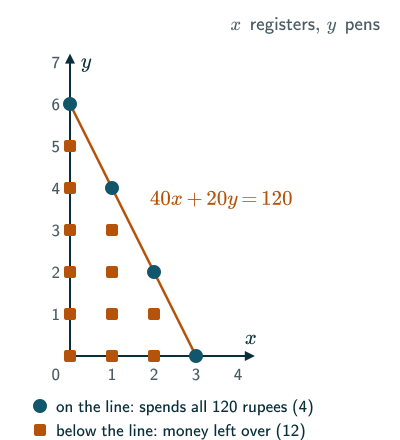
NCERT’s second situation (pages 89–90): Reshma has ₹120 to spend on registers at ₹40 and pens at ₹20. With x registers and y pens, she can spend up to ₹120, so
40x + 20y ≤ 120.
This one statement is really two: 40x + 20y < 120 (she has money left), which NCERT numbers (3), or 40x + 20y = 120 (she spends it all), numbered (4).
Statement (3) is not an equation, i.e., it is an inequality while statement (4) is an equation.
NCERT Mathematics (Class 11), Section 5.2, page 90
An inequality with < or > is strict: equality is not allowed, so it is false when the two sides are equal. One with ≤ or ≥ is slack (also called non-strict): equality is allowed (NCERT page 90).
Kinds of inequalities
NCERT (page 90) sorts inequalities by what they contain:
- numerical: only numbers, such as 3 < 5 and 7 > 5;
- literal: with letters, such as x < 5, y > 2, x ≥ 3 and y ≤ 4;
- double: two inequalities that must both hold, such as 3 < 5 < 7, 3 ≤ x < 5 (read “x is greater than or equal to 3 and less than 5”) and 2 < y ≤ 4.
Double inequalities describe intervals: for real x, 3 ≤ x < 5 is the half-open interval [3, 5); if x must be a whole number it allows only 3 and 4.
With a ≠ 0, the forms ax + b < 0, > 0, ≤ 0 and ≥ 0 are linear inequalities in one variable, and ax + by < c (and the other three signs), with a ≠ 0 and b ≠ 0, are linear inequalities involving both variables, as NCERT describes them. More generally, in the coordinate plane, ax + by < c is linear when a and b are not both 0: allowing one coefficient to be 0 includes axis-parallel boundaries, such as x < 3. ax2 + bx + c ≤ 0 and ax2 + bx + c > 0 are not linear: with a ≠ 0 they are quadratic inequalities (NCERT page 90).
In this Chapter, we shall confine ourselves to the study of linear inequalities in one and two variables only.
NCERT Mathematics (Class 11), Section 5.2, page 90
The 2026–27 NCERT book in fact solves only inequalities in one variable (NCERT Section 5.3; see solving linear inequalities).
Solved examples
Example 1: Strict or slack?
Classify each as strict or slack, and as linear or not: (i) 2x − 5 ≥ 0; (ii) 3x + 4y < 12; (iii) x2 − 1 > 0; (iv) 7 ≤ 9.
Look at the sign (≤ or ≥ is slack) and the highest power of the variable.
Answer: (i) slack, linear in one variable; (ii) strict, linear in two variables; (iii) strict, quadratic, not linear; (iv) slack, numerical (no variable, so not linear).
Example 2: Writing a statement as an inequality
A lift can carry at most 480 kg. Children of 40 kg each get in. Write an inequality for the number n of children, and find the largest n.
“At most” allows equality: 40n ≤ 480, so n ≤ 12.
Answer: 40n ≤ 480; at most 12 children.
Example 3: Ravi’s rice
Ravi’s inequality is 30x < 200 with x a whole number of packets. Which values of x are possible?
Try x = 0, 1, 2, …: 30 × 6 = 180 < 200, but 30 × 7 = 210, which is not less than 200 (NCERT page 91). NCERT calls these values the solutions and {0, 1, 2, 3, 4, 5, 6} the solution set.
Answer: x = 0, 1, 2, 3, 4, 5 or 6.
Common mistakes to avoid
Common mistake
Reading “at most” as <
“At most 12” means ≤ 12 (12 itself is allowed); “less than 12” means < 12. Likewise “at least” is ≥ and “more than” is >.
Common mistake
Mistaking two lower bounds for a bounded interval
To say that x is between 1 and 3, write 1 < x < 3 (or 3 > x > 1). The mixed chain 3 < x > 1 instead means x > 3 and x > 1, so it simplifies to x > 3; it does not put x between 1 and 3.
Common mistake
Calling ax + b < 0 linear when a = 0
With a = 0 the inequality b < 0 has no variable left: it is simply true or false. NCERT requires a ≠ 0 for a linear inequality in one variable.
Quick revision summary
- Two numbers or expressions joined by <, >, ≤ or ≥ form an inequality.
- < and > give strict inequalities; ≤ and ≥ give slack ones, which allow equality.
- ax + b < 0 (and the other signs) with a ≠ 0 is linear in one variable; ax + by < c is linear in the plane when a and b are not both 0; both variables occur when both coefficients are non-zero.
Formula sheet
- strict: <, >; slack: ≤, ≥
- linear in one variable: ax + b < 0, a ≠ 0
- linear in the plane: ax + by < c, a and b not both 0
Questions students ask
What is the difference between an equation and an inequality?
An equation says that two expressions are equal, while an inequality compares them with <, >, ≤ or ≥, so a linear equation ax + b = 0 with a ≠ 0 has exactly one solution but a linear inequality in real x has a whole interval of solutions. For example, 2x + 1 = 9 holds only for x = 4, while 2x + 1 < 9 holds for every real x < 4, the interval (−∞, 4). Both are solved with the same moves, except that multiplying or dividing an inequality by a negative number reverses its sign.
What is the difference between a linear and a quadratic inequality?
A linear inequality has the variable only to the first power, so its solution is a single ray of the number line: 3x − 6 > 0 gives x > 2. A quadratic inequality has an x2 term and is solved from the roots of the matching equation: (x − 3)(x + 3) changes sign at −3 and 3, so x2 − 9 < 0 gives the bounded interval −3 < x < 3, and x2 − 9 > 0 gives two separate rays, x < −3 or x > 3, which a single linear inequality never gives. NCERT’s Chapter 5 names quadratic inequalities (page 90) but solves only linear ones.
Is a double inequality the same as a compound inequality?
A double inequality is one kind of compound inequality: a compound inequality, a term common in American textbooks, is two inequalities joined by “and” or “or”, and a double inequality such as −1 < x ≤ 4 is an “and” pair, −1 < x and x ≤ 4, written as one chain. An “or” pair such as x < −1 or x > 4 cannot be written as a double inequality, because no number is both less than −1 and greater than 4; its solution set is the union of two intervals, (−∞, −1) ∪ (4, ∞).
What are some real-life examples of inequalities?
Inequalities describe real situations that set a limit or a range rather than an exact value. A machine specified to run at no more than 50 revolutions per minute has v ≤ 50; an event with a minimum age of 18 years requires A ≥ 18; and a storage box specified to stay from 2 °C to 8 °C, including both endpoints, must satisfy 2 ≤ T ≤ 8.
Are linear inequalities in the JEE Main syllabus?
Linear inequalities are not a unit of the JEE Main Mathematics syllabus published by NTA: its 14 units run from Sets, Relations and Functions to Trigonometry, and none of them names inequalities, so this chapter is studied for Class 11 (CBSE/NCERT). The skill is still used inside JEE topics: finding the domain of a function such as √(3 − x) means solving 3 − x ≥ 0, so x ≤ 3, and questions on quadratic expressions and the modulus function lead to inequalities too.
Practice questions
Try each question first, then open the answer to check your working.
-
Q1. Write as inequalities: (i) the height h of every student is less than 160 cm; (ii) the room holds at most 60 tables or chairs or both, t tables and c chairs (NCERT page 89).
Show answerHide answer
(i) h < 160; (ii) t + c ≤ 60.
-
Q2. Write 40x + 20y ≤ 120 as two statements and say which one is an equation.
Show answerHide answer
40x + 20y < 120 or 40x + 20y = 120; the second is the equation (NCERT page 90).
-
Q3. Write the double inequality −2 < x ≤ 3 as an interval, and say whether it is strict, slack or mixed.
Show answerHide answer
(−2, 3]. It is mixed: strict at −2 (−2 is left out) and slack at 3 (3 is included).
-
Q4. Which of these are linear inequalities in one variable: (i) 4x − 7 > 0; (ii) 0x + 3 < 5; (iii) x2 ≥ 4; (iv) 5 − 2x ≤ x?
Show answerHide answer
(i) and (iv). (ii) has a = 0, and (iii) is quadratic. (iv) can be rewritten 5 − 3x ≤ 0.