Solving linear inequalities
NCERT Class 11 Mathematics Chapter 5 Section 5.3
Quick answer
A linear inequality in one variable is solved like an equation, using two rules: the same number may be added to or subtracted from both sides, and both sides may be multiplied or divided by the same positive number. Multiplying or dividing by a negative number reverses the sign of the inequality. On a number line, a hollow circle marks an end that is left out and a filled circle an end that is included.
With your textbook
NCERT Mathematics (Class 11), Chapter 5 “Linear Inequalities”, Section 5.3 “Algebraic Solutions of Linear Inequalities in One Variable and their Graphical Representation”, pages 91–96.
Open the official NCERT chapter (PDF, 1.4 MB, ncert.nic.in) (opens in a new tab)
Checked against the 2026-27 reprint on .
Solutions of an inequality
NCERT (Section 5.3, page 91) starts with Ravi’s inequality 30x < 200, where x is a number of rice packets. Trying x = 0, 1, 2, … shows that 0, 1, 2, 3, 4, 5 and 6 make it true, while 30 × 7 = 210 does not. These values are its solutions, and {0, 1, 2, 3, 4, 5, 6} is its solution set. (NCERT introduces it as “the inequality (1) of Section 6.2”; it is in Section 5.2 of this chapter.)
Thus, any solution of an inequality in one variable is a value of the variable which makes it a true statement.
NCERT Mathematics (Class 11), Section 5.3, page 91
Trial and error is slow and sometimes not feasible, so inequalities are solved by rules, like equations, with one important difference.
The two rules
Rule 1 Equal numbers may be added to (or subtracted from) both sides of an inequality without affecting the sign of inequality.
NCERT Mathematics (Class 11), Section 5.3, page 92
Rule 2 Both sides of an inequality can be multiplied (or divided) by the same positive number. But when both sides are multiplied or divided by a negative number, then the sign of inequality is reversed.
NCERT Mathematics (Class 11), Section 5.3, page 92
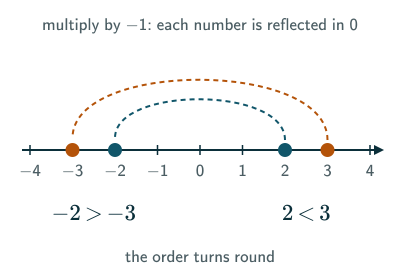
Why the sign turns round: 3 > 2, but −3 < −2; and −8 < −7, but (−8)(−2) = 16 > 14 = (−7)(−2) (NCERT page 91). Multiplying by a negative number reflects the number line in 0 (and stretches or shrinks it), so the order of any two numbers is reversed.
The answer also depends on where x may come from: natural numbers, integers or real numbers.
Henceforth, unless stated otherwise, we shall solve the inequalities in this Chapter in the set of real numbers.
NCERT Mathematics (Class 11), Section 5.3, page 92
Solving step by step
Collect the x terms on one side and the numbers on the other (Rule 1), then divide by the coefficient of x (Rule 2), turning the sign round if it is negative. Fractions are cleared first by multiplying by a positive common denominator.
NCERT’s examples (pages 92–93):
- NCERT Example 1. 30x < 200 gives x < 20/3. For natural numbers the solution set is {1, 2, 3, 4, 5, 6}; for integers it is {…, −3, −2, −1, 0, 1, 2, 3, 4, 5, 6}.
- NCERT Example 2. 5x − 3 < 3x + 1 gives 2x < 4, so x < 2: the integers …, −2, −1, 0, 1, or the real interval (−∞, 2).
- NCERT Example 3. 4x + 3 < 6x + 7 gives −2x < 4. Dividing by −2 reverses the sign: x > −2, the interval (−2, ∞).
- NCERT Example 4. (5 − 2x)/3 ≤ x/6 − 5. Multiply by 6: 2(5 − 2x) ≤ x − 30, so 10 − 4x ≤ x − 30 and −5x ≤ −40. Dividing by −5: x ≥ 8, the interval [8, ∞).
The answers are written as intervals: a round bracket for an end that is left out, a square bracket for an end that is included, and always a round bracket at ∞.
Showing solutions on the number line
NCERT’s summary (page 99) gives the drawing rule: for x < a or x > a, put a circle (hollow) at a; for x ≤ a or x ≥ a, put a dark (filled) circle at a; then darken the line to the left (for < or ≤) or to the right (for > or ≥). The hollow circle shows that a itself is not a solution of a strict inequality.
NCERT Example 5 (page 93): 7x + 3 < 5x + 9 gives 2x < 6, so x < 3 (top line of the figure). NCERT Example 6 (pages 93–94): (3x − 4)/2 ≥ (x + 1)/4 − 1. Multiply by 4: 2(3x − 4) ≥ x − 3, so 6x − 8 ≥ x − 3, 5x ≥ 5 and x ≥ 1 (middle line).
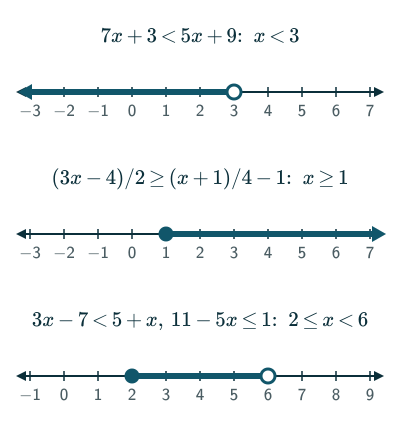
Systems of inequalities. When x must satisfy two inequalities at once, solve each and keep the values common to both. NCERT Example 11 (pages 96–97): 3x − 7 < 5 + x gives x < 6, and 11 − 5x ≤ 1 gives −5x ≤ −10, so x ≥ 2. Together: 2 ≤ x < 6 (bottom line of the figure). A double inequality such as −8 ≤ 5x − 3 < 7 is solved the same way, working on all three parts at once: −5 ≤ 5x < 10, so −1 ≤ x < 2 (NCERT Example 9).
Solved examples
Example 1: Natural-number and integer solutions (NCERT Exercise 5.1, Q1 and Q2)
Solve (i) 24x < 100; (ii) −12x > 30, when x is a natural number and when x is an integer.
(i) x < 100/24 = 25/6 ≈ 4.17. (ii) Divide by −12 and reverse: x < −30/12 = −5/2.
Answer: (i) natural numbers {1, 2, 3, 4}; integers {…, −1, 0, 1, 2, 3, 4}. (ii) no natural number; integers {…, −5, −4, −3}.
Example 2: Fractions on both sides (NCERT Exercise 5.1, Q15)
Solve x/4 < (5x − 2)/3 − (7x − 3)/5 for real x.
Multiply by 60, which is positive: 15x < 20(5x − 2) − 12(7x − 3) = 100x − 40 − 84x + 36 = 16x − 4. So −x < −4, and multiplying by −1 reverses the sign.
Answer: x > 4, the interval (4, ∞).
Example 3: An average (NCERT Example 7, page 94)
A student scored 62 and 48 in two terminal examinations. What is the least annual score that gives an average of at least 60?
(62 + 48 + x)/3 ≥ 60 gives 110 + x ≥ 180, so x ≥ 70.
Answer: at least 70 marks.
Example 4: Consecutive odd numbers (NCERT Example 8, page 94)
Find all pairs of consecutive odd natural numbers, both larger than 10, whose sum is less than 40.
With x and x + 2: x > 10 and 2x + 2 < 40, so 10 < x < 19, and x is odd.
Answer: (11, 13), (13, 15), (15, 17) and (17, 19).
Example 5: A temperature range (NCERT Example 12, page 97)
A solution must be kept strictly between 30 °C and 35 °C, with neither endpoint included. Find the range in °F, using C = (5/9)(F − 32).
30 < (5/9)(F − 32) < 35. Multiply all three parts by 9/5: 54 < F − 32 < 63, so 86 < F < 95.
Answer: between 86 °F and 95 °F.
Example 6: Mixing solutions (NCERT Example 13, pages 97–98)
600 litres of a 12% acid solution are mixed with x litres of a 30% solution. For which x is the mixture more than 15% but less than 18% acid?
0.30x + 0.12 × 600 > 0.15(x + 600). Multiply by 100: 30x + 7200 > 15x + 9000, so 15x > 1800 and x > 120. Likewise 30x + 7200 < 18x + 10 800 gives 12x < 3600, so x < 300.
Answer: more than 120 litres but less than 300 litres.
Common mistakes to avoid
Common mistake
Forgetting to reverse the sign
−2x < 4 gives x > −2, not x < −2. Check with a number: x = 0 satisfies −2x < 4, and 0 > −2 is true.
Common mistake
Multiplying by an expression of unknown sign
To clear 1/x from an inequality you cannot just multiply by x: if x is negative the sign turns round. Rule 2 needs a number whose sign is known.
Common mistake
Drawing the wrong circle
x < 3 has a hollow circle at 3, because 3 itself is not a solution; x ≤ 3 has a filled one. NCERT’s summary (page 99) ends its second drawing rule with “the number x”; it means the number a.
Quick revision summary
- A solution of an inequality is a value that makes it true; the set of all of them is the solution set.
- Rule 1: add or subtract the same number on both sides. Rule 2: multiply or divide by a positive number freely, but reverse the sign for a negative one.
- Hollow circle for < and >, filled circle for ≤ and ≥; for a system, keep the values common to all the inequalities.
Formula sheet
- a < b ⇒ a + c < b + c
- a < b, k > 0 ⇒ ka < kb
- a < b, k < 0 ⇒ ka > kb
Questions students ask
When does the inequality sign flip?
When solving a linear inequality, the sign flips when both sides are multiplied or divided by the same negative number (NCERT’s Rule 2): −3x ≤ 12 gives x ≥ −4. Adding or subtracting a number never flips it, even when the number is negative: x − 5 > 2 gives x > 7. Two other moves also turn the sign round: taking reciprocals of two numbers with the same sign (2 < 5, but 1/2 > 1/5) and swapping the two sides, since a < b says the same as b > a.
Can you add or subtract two inequalities?
Two inequalities that point the same way can be added but not subtracted: a < b and c < d give a + c < b + d, but 5 < 7 and 1 < 4 would give 5 − 1 < 7 − 4, that is 4 < 3, which is false. To subtract, first reverse one of them: c < d means −d < −c, and adding gives a − d < b − c. Multiplying term by term is safe when all four numbers are positive, as 2 < 3 and 4 < 5 give 8 < 15, but not in general: −3 < −2 and −5 < 1 would give 15 < −2.
Can a linear inequality have no solution?
A linear inequality ax + b < 0 with a ≠ 0 always has infinitely many real solutions, all the numbers on one side of −b/a, so it can have no solution only when x is restricted: for natural numbers, 3x + 7 < 1 gives x < −2, which no natural number satisfies. If the x terms cancel, the inequality is no longer linear and holds for no x or for every x: 2(x + 3) < 2x + 5 reduces to 6 < 5, so its solution set is ϕ, while 4x − 1 ≤ 4(x + 1) reduces to −1 ≤ 4, true for every real x. A system has no solution when its solution sets do not overlap, as with x > 6 and x < 2.
How do you solve an inequality with modulus, such as |x − 3| < 2?
To solve a modulus inequality, read |x − a| as the distance of x from a: for r > 0, |x − a| < r becomes the double inequality a − r < x < a + r, and |x − a| > r becomes x < a − r or x > a + r. So |x − 3| < 2 gives 1 < x < 5, the interval (1, 5), while |x − 3| ≥ 2 gives x ≤ 1 or x ≥ 5. Modulus inequalities go beyond the 2026–27 NCERT chapter, but they need only the modulus function and NCERT’s two rules for inequalities.
How do you solve a linear inequality in two variables?
A linear inequality in two variables, such as x + 3y ≤ 6, is solved graphically: draw the line x + 3y = 6 (solid for ≤ or ≥, dashed for < or >), test a point not on the line, usually (0, 0), and shade the side on which the test point makes the inequality true. Here 0 + 3(0) = 0 ≤ 6 is true, so the solution set is the half-plane containing the origin, together with the line itself. The 2026–27 NCERT book no longer teaches this graphical method in Chapter 5, but it is used in Class 12 linear programming, where the feasible region is the common part of several such half-planes.
Practice questions
Try each question first, then open the answer to check your working.
-
Q1. Solve for real x: (i) 4x + 3 < 5x + 7; (ii) 3x − 7 > 5x − 1; (iii) 3(x − 1) ≤ 2(x − 3) (NCERT Exercise 5.1, Q5–Q7).
Show answerHide answer
(i) −x < 4, so x > −4: (−4, ∞). (ii) −2x > 6, so x < −3: (−∞, −3). (iii) 3x − 3 ≤ 2x − 6, so x ≤ −3: (−∞, −3].
-
Q2. Solve x + x/2 + x/3 < 11 for real x (NCERT Exercise 5.1, Q9).
Show answerHide answer
11x/6 < 11, so x < 6: (−∞, 6).
-
Q3. Solve 3(1 − x) < 2(x + 4) and show the solution on a number line (NCERT Exercise 5.1, Q19).
Show answerHide answer
3 − 3x < 2x + 8, so −5x < 5 and x > −1: a hollow circle at −1 and the line darkened to the right.
-
Q4. Ravi scored 70 and 75 in two unit tests. Find the least score in the third test for an average of at least 60 (NCERT Exercise 5.1, Q21).
Show answerHide answer
(70 + 75 + x)/3 ≥ 60 gives x ≥ 35: at least 35 marks.