Fundamental principle of counting
NCERT Class 11 Mathematics Chapter 6 Sections 6.1–6.2
Quick answer
The fundamental principle of counting, or multiplication principle, says that if one event can happen in m ways and then another in n ways for each first choice, the two can happen in that order in m × n ways. It extends to any number of events. Counting problems are solved by filling places one at a time and multiplying the number of choices; counts of disjoint cases are added.
With your textbook
NCERT Mathematics (Class 11), Chapter 6 “Permutations and Combinations”, Sections 6.1–6.2 “Introduction” and “Fundamental Principle of Counting”, pages 100–104.
Open the official NCERT chapter (PDF, 2.4 MB, ncert.nic.in) (opens in a new tab)
Checked against the 2026-27 reprint on .
What is the fundamental principle of counting?
Multiplication principle
If an event can occur in m different ways, following which another event can occur in n different ways, then the total number of occurrence of the events in the given order is m×n.
NCERT Mathematics (Class 11), Section 6.2, page 102
- It is also called the multiplication principle.
- It extends to any finite number of events: m × n × p ways for three events, and so on.
In plain words: when a choice is made in stages, multiply the number of options at each stage, provided that number does not depend on what was chosen earlier. NCERT’s first problem (page 100): Mohan has 3 pants and 2 shirts. For each of the 3 pants there are 2 shirts, so there are 3 × 2 = 6 different pant-and-shirt pairs. These pairs are exactly the elements of the Cartesian product of the set of pants and the set of shirts, which has 3 × 2 elements. Deciding “in” or “out” for each element of a set with n elements gives 2 × 2 × … × 2 = 2n ways: the 2n subsets of the set.
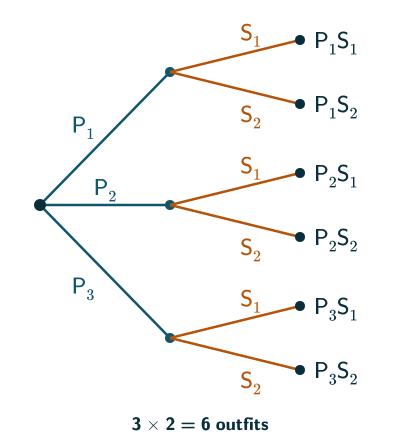
NCERT’s second problem (page 101): Sabnam chooses one of 2 school bags, one of 3 tiffin boxes and one of 2 water bottles. The three choices give 2 × 3 × 2 = 12 ways (NCERT Fig 6.2 draws all twelve).
The principle counts the events in a chosen order: decide the order of the stages first (pants then shirt, or shirt then pants), and count the ways in that order. For Mohan either order works: 3 × 2 = 2 × 3 = 6. When a place is restricted, choose the order in which every stage has a fixed number of options.
Filling places one by one
Most counting problems become “in how many ways can these places be filled?”. Fill the places one at a time and multiply.
- Without repetition, each place has one option fewer than the last. Four-letter words (with or without meaning) from the letters of ROSE, no letter repeated: 4 × 3 × 2 × 1 = 24 (NCERT Example 1, page 102). Such ordered arrangements are permutations.
- With repetition, every place has the full set of options: 4 × 4 × 4 × 4 = 256 words from ROSE if letters may repeat (NCERT page 103).
- Restricted places first. Two-digit even numbers from 1, 2, 3, 4, 5 with repetition: the unit’s place must be 2 or 4 (2 ways), then the ten’s place has 5 ways: 2 × 5 = 10 (NCERT Example 3, page 103).
Adding when cases do not overlap
When a problem splits into separate cases, count each case by the multiplication principle and add the results. NCERT Example 4 (pages 103–104): signals made with at least 2 of 5 different flags, one below the other. A signal uses 2, 3, 4 or 5 flags:
- 2 flags: 5 × 4 = 20; 3 flags: 5 × 4 × 3 = 60;
- 4 flags: 5 × 4 × 3 × 2 = 120; 5 flags: 5 × 4 × 3 × 2 × 1 = 120.
The total is 20 + 60 + 120 + 120 = 320 signals. Use × for “and then” (successive stages of one choice). Use + only for cases that do not overlap and that together cover every possibility.
Solved examples
Example 1: Flag signals (NCERT Example 2, page 103)
With 4 flags of different colours, how many signals can be made using 2 flags one below the other?
The upper place: 4 ways; the lower place: 3 ways (the flag above cannot be reused).
Answer: 4 × 3 = 12 signals.
Example 2: Three-digit numbers (NCERT Exercise 6.1, Q1)
How many 3-digit numbers can be formed from 1, 2, 3, 4 and 5 if (i) repetition is allowed; (ii) repetition is not allowed?
(i) Each of the 3 places has 5 choices. (ii) The places have 5, 4 and 3 choices.
Answer: (i) 5 × 5 × 5 = 125; (ii) 5 × 4 × 3 = 60.
Example 3: Even numbers with repetition (NCERT Exercise 6.1, Q2)
How many 3-digit even numbers can be formed from 1, 2, 3, 4, 5, 6 if digits may be repeated?
Fill the unit’s place first: 2, 4 or 6 (3 ways). The ten’s and hundred’s places then have 6 ways each.
Answer: 3 × 6 × 6 = 108.
Example 4: Telephone numbers (NCERT Exercise 6.1, Q4)
How many 5-digit telephone numbers start with 67 and use no digit more than once?
The first two places are fixed as 6 and 7. The remaining three places use the 8 other digits: 8, then 7, then 6 choices.
Answer: 8 × 7 × 6 = 336.
Common mistakes to avoid
Common mistake
Adding instead of multiplying
3 pants and 2 shirts give 3 × 2 = 6 outfits, not 3 + 2 = 5. Add only when the cases are alternatives that cannot happen together.
Common mistake
Filling a restricted place last
Without repetition, fill the unit’s place first. For 3-digit even numbers from 1–6 with no repeated digit: unit’s place 3 ways, then 5, then 4: 3 × 5 × 4 = 60. If the hundred’s and ten’s places are filled first, the unit’s place is left with 1, 2 or 3 even digits depending on what was used, so no single product works.
Common mistake
Swapping base and exponent
5 letters are posted into 3 letter boxes. Each letter chooses a box, so there are 35 = 243 ways, not 53 = 125.
Common mistake
Forgetting that 0 cannot lead
A 3-digit number cannot start with 0. With the digits 0 to 5 and no repetition, the hundred’s place has only 5 choices, not 6.
Quick revision summary
- If one event can happen in m ways and then another in n ways, the two happen in order in m × n ways; this extends to any number of events.
- Count by filling places in order; without repetition, each place has one option fewer.
- Multiply the options at successive stages; add the counts of cases that do not overlap and together cover every possibility.
Formula sheet
- m ways, then n ways: m × n ways
- m, n, p ways in turn: m × n × p ways
- n options for each of r places: nr ways
Questions students ask
What is the difference between the addition and multiplication principles of counting?
The multiplication principle, which NCERT calls the fundamental principle of counting, applies when a task is done in successive stages and multiplies the numbers of ways at each stage, while the addition principle applies when the task is done in exactly one of several separate cases and adds the counts of the cases. In short, “and then” means multiply and “or” means add, provided the cases cannot happen together and between them cover every possibility. A reader who takes one book from 7 novels and 5 comics has 7 + 5 = 12 choices, but one who takes a novel and a comic has 7 × 5 = 35.
What is the difference between the fundamental principle of counting and permutation?
The fundamental principle of counting, also called the fundamental counting principle, is the general rule for counting choices made in stages, while a permutation is one kind of problem it solves: an arrangement of objects in a definite order. Filling r places from n different objects gives n, n − 1, …, n − r + 1 choices, so the principle produces the formula for nPr: the first, second and third prizes among 12 runners can be awarded in 12 × 11 × 10 = 1320 ways. The principle also counts choices that are not permutations, such as one item from each of several different sets.
How many 4-digit PIN codes are possible?
There are 104 = 10 000 four-digit PIN codes when each digit can be any of 0 to 9 and digits may repeat, because each of the 4 places is filled in 10 ways, independently of the others. A PIN may start with 0, so every code from 0000 to 9999 counts, while a 4-digit number cannot start with 0 and so has only 9 × 10 × 10 × 10 = 9000 possibilities. Order matters, since 1234 and 4321 are different PINs, so a PIN, like the code of a so-called combination lock, is an ordered arrangement in which digits may repeat, not a combination.
How is the counting principle used to find probability?
The fundamental principle of counting helps find probabilities by counting outcomes: when every outcome is equally likely, the probability of an event is the number of favourable outcomes divided by the total number of outcomes, a rule met later in NCERT Chapter 14, Probability. For a 3-digit code whose digits are chosen at random from 0 to 9, repeats allowed, there are 10 × 10 × 10 = 1000 equally likely codes, and 10 × 9 × 8 = 720 of them have three different digits, so the probability that no digit repeats is 720/1000 = 0.72. The outcomes counted must be equally likely: for two dice, count the 6 × 6 = 36 ordered pairs, not the 11 possible totals, which are not equally likely.
Is the fundamental principle of counting in the JEE Main syllabus?
The fundamental principle of counting is in the JEE Main syllabus as the first item of Unit 4, Permutations and Combinations, which reads “The fundamental principle of counting, permutations and combinations; Meaning of P(n, r) and C(n, r). Simple applications.” In the NCERT Class 11 Mathematics book it is Sections 6.1–6.2 of Chapter 6. It counts numbers, codes, words and signals, including ones with a restricted place, such as a first digit that cannot be 0 or a last digit that must be even, or with separate cases to add.
Practice questions
Try each question first, then open the answer to check your working.
-
Q1. How many 4-letter codes can be formed from the first 10 letters of the English alphabet if no letter is repeated (NCERT Exercise 6.1, Q3)?
Show answerHide answer
10 × 9 × 8 × 7 = 5040.
-
Q2. A coin is tossed 3 times and the outcomes are recorded. How many outcomes are possible (NCERT Exercise 6.1, Q5)?
Show answerHide answer
Each toss has 2 outcomes: 2 × 2 × 2 = 8.
-
Q3. With 5 flags of different colours, how many signals use 2 flags, one below the other (NCERT Exercise 6.1, Q6)?
Show answerHide answer
5 × 4 = 20.
-
Q4. A lock has 4 wheels, each with the digits 0 to 9, and the code uses 4 different digits. You remember that the first digit is 7. How many sequences may you have to try (NCERT Section 6.1, page 100)?
Show answerHide answer
The remaining three wheels use 3 of the other 9 digits, in order: 9 × 8 × 7 = 504.