Combinations
NCERT Class 11 Mathematics Chapter 6 Section 6.4
Quick answer
A combination is a selection of objects in which the order does not matter. The number of combinations of n different objects taken r at a time, written nCr, is n factorial divided by the product of r factorial and (n − r) factorial, because each selection of r objects can be arranged in r factorial ways, so nPr = nCr × r factorial. Choosing r objects is the same as leaving out n − r, so nCr equals nC(n − r).
With your textbook
NCERT Mathematics (Class 11), Chapter 6 “Permutations and Combinations”, Section 6.4 “Combinations”, pages 114–119.
Open the official NCERT chapter (PDF, 2.4 MB, ncert.nic.in) (opens in a new tab)
Checked against the 2026-27 reprint on .
What is a combination?
NCERT (Section 6.4, page 114) starts with three tennis players X, Y and Z, from whom a team of 2 is chosen. The team of X and Y is the same as the team of Y and X, so there are only 3 teams: XY, YZ and ZX.
Here, each selection is called a combination of 3 different objects taken 2 at a time.
NCERT Mathematics (Class 11), Section 6.4, page 115
Combination
In a combination, the order is not important.
NCERT Mathematics (Class 11), Section 6.4, page 115
- The number of combinations of n different objects taken r at a time is written nCr.
- A permutation is an arrangement (order matters); a combination is a selection (order does not matter).
In plain words: when only which objects are chosen matters, not the order in which they are picked, you are counting combinations. Twelve people each shaking hands with all the others make one handshake per pair, and seven points on a circle give one chord per pair: both are combinations taken 2 at a time (NCERT page 115). A combination of r objects is just an r-element subset of the n objects.
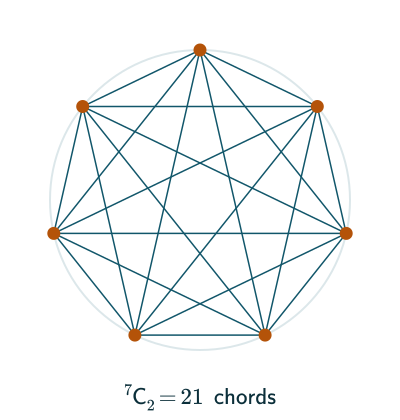
The same counting answers other geometry questions. The seven points make 7C3 = 35 triangles, since no three points of a circle lie on a line. A polygon with n vertices has nC2 − n diagonals, because n of the pairs of vertices are sides: a hexagon has 15 − 6 = 9.
From permutations to combinations
With 4 objects A, B, C, D taken 2 at a time there are 6 combinations: AB, AC, AD, BC, BD, CD. Each can be arranged in 2! ways, and that gives every permutation exactly once, so 4P2 = 4C2 × 2!, that is 12 = 6 × 2 (NCERT page 115).
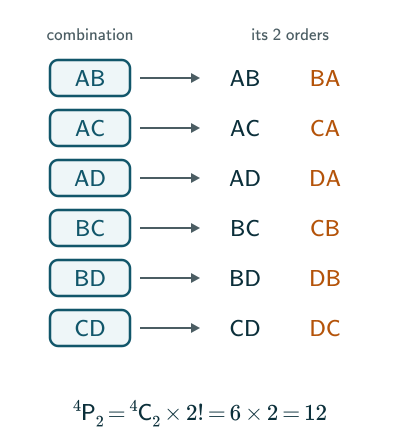
The same reasoning works for any n and r: each combination of r objects gives r! permutations (NCERT Theorem 5, page 116). Since nPr = n!/(n − r)! (see the formula for permutations), dividing both sides by r! gives the formula for nCr.
Combinations
P = C × r!
C = n!/(r! (n − r)!)
0 ≤ r ≤ n; C = C = 1
nC0 = 1 because there is exactly one way to choose nothing (NCERT page 116). For example, 5C3 = 5!/(3! 2!) = 10.
Properties of C
Choosing is the same as leaving out. Choosing r objects decides which n − r are left, so
Complementary choices
C = C
i.e., selecting r objects out of n objects is same as rejecting (n – r) objects.
NCERT Mathematics (Class 11), Section 6.4, page 117
So if a + b = n, then nCa = nCb. The converse needs one more fact: going from nCr−1 to nCr multiplies by (n − r + 1)/r, which is more than 1 while r < (n + 1)/2. So the values rise strictly to the middle and fall back symmetrically, and if nCa = nCb, then a = b or a + b = n (NCERT page 117). The largest value is in the middle: for n = 10 it is 10C5 = 252.
Pascal’s rule (NCERT Theorem 6, page 117), true for 1 ≤ r ≤ n:
Pascal’s rule
C + C = C
A counting reason: to choose r objects from n + 1, fix one object X. The selections that leave X out number nCr; those that include X choose r − 1 more from the other n, in nCr−1 ways. Every selection is of one kind or the other, which gives the rule. NCERT proves it with factorials: it takes out the common factor n!/((r − 1)! (n − r)!) and adds 1/r + 1/(n − r + 1).
Solved examples
Example 1: Two equal combinations (NCERT Example 17, page 117)
If nC9 = nC8, find nC17.
9 ≠ 8, so 9 + 8 = n, that is n = 17.
Answer: 17C17 = 1.
Example 2: A committee (NCERT Example 18, pages 117–118)
A committee of 3 is to be formed from 2 men and 3 women. In how many ways? How many have 1 man and 2 women?
Any 3 of the 5 people: 5C3. One man and two women: choose the man, then the women, and multiply: 2C1 × 3C2.
Answer: 10 committees; 2 × 3 = 6 of them have 1 man and 2 women. If the committee is chosen at random, the probability of 1 man and 2 women is 6/10 = 3/5.
Example 3: Cards (NCERT Example 19, pages 118–119)
In how many ways can 4 cards be chosen from a pack of 52? In how many are (i) all four of the same suit; (ii) one from each suit; (iii) all face cards; (iv) two red and two black; (v) all of the same colour?
Total: 52C4. (i) Choose the suit, then 4 of its 13 cards: 4 × 13C4. (ii) One card from each suit: 13 × 13 × 13 × 13. (iii) There are 12 face cards (J, Q, K of each suit): 12C4. (iv) 26C2 × 26C2. (v) All red or all black: 2 × 26C4.
Answer: 270 725; (i) 2860; (ii) 28 561; (iii) 495; (iv) 325 × 325 = 105 625; (v) 29 900.
Example 4: Choose, then arrange (NCERT Example 20, pages 119–120)
How many words of 3 vowels and 2 consonants can be formed from the letters of INVOLUTE?
INVOLUTE has 4 vowels (I, O, U, E) and 4 consonants (N, V, L, T). Choose the letters: 4C3 × 4C2 = 4 × 6 = 24. Then arrange each choice of 5 letters: 5! = 120.
Answer: 24 × 120 = 2880.
Example 5: At least and at most (NCERT Example 21, page 120)
From 4 girls and 7 boys, a team of 5 is chosen. How many teams have (i) no girl; (ii) at least one boy and one girl; (iii) at least 3 girls?
(i) 7C5 = 21. (ii) Add the cases 1, 2, 3 or 4 girls: 4 × 35 + 6 × 35 + 4 × 21 + 1 × 7 = 140 + 210 + 84 + 7. (iii) 3 girls and 2 boys, or 4 girls and 1 boy: 4 × 21 + 1 × 7.
Answer: (i) 21; (ii) 441; (iii) 91.
Common mistakes to avoid
Common mistake
Using P when the order does not matter
A committee, a team, a set of cards or a handshake is a selection: use nCr. Use nPr only when positions or roles differ (captain and vice-captain, digits of a number).
Common mistake
Counting “at least one” case by case and missing cases
For Example 5(ii), the opposite of “at least one boy and one girl” is “no girl or no boy”. An all-girl team of 5 is impossible (only 4 girls), so the answer is 11C5 − 7C5 = 462 − 21 = 441. Choosing one girl first and then any 4 others gives 4 × 10C4 = 840, which counts teams more than once.
Common mistake
Missing the second solution when two combinations are equal
nCa = nCb does not force a = b: 10C2 = 10C8 = 45.
Common mistake
Treating equal groups as labelled
Splitting A, B, C, D into two teams of 2 is not 4C2 = 6 ways: choosing {A, B} and choosing {C, D} give the same split. Divide by 2!, the number of orders of the two unlabelled teams: 6/2 = 3 ways.
Common mistake
Using C for identical objects
nCr counts selections of different objects. From 3 identical red balls, 2 can be chosen in just 1 way, not 3C2 = 3.
Quick revision summary
- A combination is a selection in which order does not matter; nPr = nCr × r!.
- nCr = n!/(r! (n − r)!), with nC0 = nCn = 1.
- nCr = nCn−r, and nCr + nCr−1 = n+1Cr.
Formula sheet
- C = n!/(r! (n − r)!)
- P = C × r!
- C = C
- C + C = C
Questions students ask
What is the difference between permutation and combination?
A permutation is an arrangement, where order matters, while a combination is a selection, where it does not: a captain and a vice-captain can be chosen from 11 players in 11P2 = 11 × 10 = 110 ways, but 2 players for a training camp in only 11C2 = 55. A quick test is to swap two of the chosen objects: if the outcome changes, count permutations; if not, count combinations. Each selection of r objects can be ordered in r! ways, so nPr = nCr × r!, and there are never fewer permutations than combinations, the two being equal only for r = 0 or 1.
What is the formula for the number of diagonals of a polygon?
A polygon with n sides has nC2 − n = n(n − 3)/2 diagonals, because each of the nC2 pairs of its n vertices is joined by a segment, and n of these segments are sides. So a pentagon has 5 diagonals, an octagon 20 and a decagon 35, while a triangle has none. The same count comes from the vertices: each vertex is joined by diagonals to the n − 3 vertices that are neither itself nor its two neighbours, and dividing n(n − 3) by 2 removes the double count, since each diagonal has two ends.
How many triangles can be formed from n points if some of them are collinear?
From n points with no three collinear, nC3 triangles can be formed, since every choice of 3 points gives one triangle. If m of the points lie on one line, with 3 ≤ m ≤ n, and no other three are collinear, the mC3 choices taken from the line give no triangle, so there are nC3 − mC3 triangles; likewise there are nC2 − mC2 + 1 straight lines, the 1 being the common line. For 11 points of which 4 are collinear, that gives 165 − 4 = 161 triangles and 55 − 6 + 1 = 50 lines.
What is the formula for combinations with repetition?
When r objects are chosen from n different kinds, with each kind available as often as needed, the number of selections is n+r−1Cr, not nCr. For example, 2 scoops from 5 ice-cream flavours, repeats allowed, can be picked in 6C2 = 15 ways: 5 with both scoops alike and 5C2 = 10 with two flavours. Each selection is a row of r objects and n − 1 dividers between kinds; choosing which r of the n + r − 1 places hold objects gives the formula. It is beyond NCERT, and it also counts the non-negative integer solutions of x1 + … + xn = r.
How do you calculate C quickly by hand?
To calculate nCr by hand, first use nCr = nCn−r to replace r by n − r when that is smaller, then multiply the r numbers counting down from n and divide by r!: nCr = n(n − 1) … (n − r + 1)/r!. For example, 20C17 = 20C3 = (20 × 19 × 18)/(3 × 2 × 1) = 1140, with no need to write out 20! or 17!. Cancel as you go to keep the numbers small; the result is always a whole number, because the product of any r consecutive positive integers is divisible by r!.
Practice questions
Try each question first, then open the answer to check your working.
-
Q1. If nC8 = nC2, find nC2 (NCERT Exercise 6.4, Q1).
Show answerHide answer
8 ≠ 2, so n = 8 + 2 = 10 and 10C2 = 45.
-
Q2. How many chords can be drawn through 21 points on a circle (NCERT Exercise 6.4, Q3)?
Show answerHide answer
One chord per pair of points: 21C2 = 210.
-
Q3. In how many ways can a team of 3 boys and 3 girls be selected from 5 boys and 4 girls (NCERT Exercise 6.4, Q4)?
Show answerHide answer
5C3 × 4C3 = 10 × 4 = 40.
-
Q4. A student must choose 5 courses from 9, and 2 particular courses are compulsory. In how many ways can the programme be chosen (NCERT Exercise 6.4, Q9)?
Show answerHide answer
The 2 compulsory courses are fixed; the other 3 come from the remaining 7: 7C3 = 35.