Axiomatic approach to probability
NCERT Class 11 Mathematics Chapter 14 Section 14.2
Quick answer
In the axiomatic approach, probability is a rule P that gives every event E of a finite sample space S a number, with P(E) ≥ 0, P(S) = 1 and P(E ∪ F) = P(E) + P(F) for mutually exclusive E and F. From these follow P(ϕ) = 0, P(not A) = 1 − P(A) and P(A ∪ B) = P(A) + P(B) − P(A ∩ B). When all the outcomes are equally likely, P(E) = n(E)/n(S).
With your textbook
NCERT Mathematics (Class 11), Chapter 14 “Probability”, Section 14.2 “Axiomatic Approach to Probability”, pages 295–308.
Open the official NCERT chapter (PDF, 2.3 MB, ncert.nic.in) (opens in a new tab)
Checked against the 2026-27 reprint on .
What is the axiomatic approach?
Probability (axiomatic approach)
Axiomatic approach is another way of describing probability of an event.
NCERT Mathematics (Class 11), Section 14.2, page 296
For a finite sample space S, a probability is a rule P that gives every event E a real number P(E), such that:
- (i) P(E) ≥ 0 for every event E;
- (ii) P(S) = 1;
- (iii) if E and F are mutually exclusive, P(E ∪ F) = P(E) + P(F).
For infinite sample spaces the full theory also requires countable additivity and a suitable collection of measurable events; the finite setting below needs only the stated rules.
In plain words: probabilities are never negative, something in S is certain to happen, and for events that cannot happen together the chances simply add. Any assignment of numbers that obeys these three rules is a valid probability; every other rule on this page follows from them.
NCERT (page 296) describes P as a function whose domain is the power set of S and whose “range is the interval [0,1]”. The values of P do lie in [0, 1], but they need not fill it. For one toss of a fair coin, P takes only the values 0, 1/2 and 1, so its range is {0, 1/2, 1}. By NCERT’s own definition, “The range of the function is the set of images” (Chapter 2, page 42), so [0, 1] is a codomain that contains the values, not the range.
What the axioms give
- P(ϕ) = 0. Take F = ϕ in axiom (iii): E and ϕ are mutually exclusive, so P(E) = P(E ∪ ϕ) = P(E) + P(ϕ), and P(ϕ) = 0.
- Outcomes. If S = {ω1, …, ωn}, then each P(ωi) lies between 0 and 1, the P(ωi) add up to 1, and P(A) is the sum of P(ωi) over the outcomes ωi in A. (P(ωi) is short for P({ωi}).)
- Larger events. If A ⊂ B, then B is A together with B − A, two mutually exclusive events, so P(B) = P(A) + P(B − A) ≥ P(A), since P(B − A) ≥ 0 by axiom (i). Taking B = S gives P(A) ≤ 1, so every probability lies in [0, 1]. In particular P(A ∩ B) can never exceed P(A) or P(B).
The axioms do not say which numbers to use. For a coin, P(H) = P(T) = 1/2 is valid, and so is P(H) = 1/4, P(T) = 3/4; in fact any p with 0 ≤ p ≤ 1 and P(H) = p, P(T) = 1 − p works.
Hence, we can say that there are many ways (rather infinite) to assign probabilities to outcomes of an experiment.
NCERT Mathematics (Class 11), Section 14.2, page 297
The axioms only check that an assignment is consistent; which one describes a real coin is a question about the coin.
NCERT Example 4 (pages 297–298). For S = {ω1, …, ω6}:
- (a) 1/6 each: valid, since each value lies in [0, 1] and they add up to 1.
- (b) 1, 0, 0, 0, 0, 0: valid for the same reason.
- (c) 1/8, 2/3, 1/3, 1/3, −1/4, −1/3: not valid, since two values are negative.
- (d) 1/12, 1/12, 1/6, 1/6, 1/6, 3/2: not valid, since 3/2 > 1.
- (e) 0.1, 0.2, 0.3, 0.4, 0.5, 0.6: not valid, since they add up to 2.1.
Probability of an event
The probability of an event is the sum of the probabilities of its outcomes. NCERT (page 298) examines three pens, each good (G) or bad (B), with all 8 outcomes given 1/8. Exactly one bad pen, {BGG, GBG, GGB}, has probability 3/8, and at least two bad pens has 4/8 = 1/2.
A zero probability does not by itself prove that an event is the empty set: Example 4(b) assigns zero to five non-empty simple events. Likewise P(E) = 1 need not mean E = S.
The outcomes need not be equally likely. For two tosses with P(HH) = 1/4, P(HT) = 1/7, P(TH) = 2/7 and P(TT) = 9/28 (these add up to 1), the event that both tosses give the same result, {HH, TT}, has probability 1/4 + 9/28 = 16/28 = 4/7.
Equally likely outcomes
For the counting examples below, assume fair coins and dice with independent tosses or throws, uniform random selections, and card or marble hands drawn without replacement unless stated otherwise. These assumptions make the listed elementary outcomes equally likely.
If all n outcomes of S are equally likely, each has the same probability p, and np = 1 gives p = 1/n. An event E with m outcomes then has probability m/n:
Equally likely outcomes
P(E) = n(E)/n(S)
that is, the number of outcomes favourable to E divided by the total number of outcomes. This is the classical rule from earlier classes, now a consequence of the axioms; it applies only when the outcomes really are equally likely.
NCERT Example 5 (pages 302–303). One card from a well-shuffled deck of 52: P(diamond) = 13/52 = 1/4, P(black) = 26/52 = 1/2, P(not an ace) = 1 − 4/52 = 12/13, P(not a diamond) = 3/4 and P(not black) = 1/2.
NCERT Example 6 (pages 303–304). A bag has 4 red, 3 blue and 2 yellow discs, and one is drawn at random: P(red) = 4/9, P(yellow) = 2/9, P(blue) = 3/9 = 1/3, P(not blue) = 2/3, and P(red or blue) = 4/9 + 3/9 = 7/9, since red and blue are mutually exclusive.
NCERT Example 8 (page 305). A committee of two is chosen uniformly at random from two men and two women. There are 4C2 = 6 equally likely committees (counted with combinations), so P(no man) = 1/6, P(one man) = (2 × 2)/6 = 2/3 and P(two men) = 1/6.
Probability of ‘A or B’
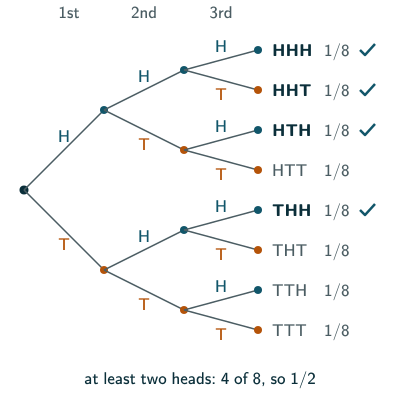
For three tosses, take A = {HHT, HTH, THH} and B = {HTH, THH, HHH} (NCERT pages 299–300). Then A ∪ B = {HHT, HTH, THH, HHH}, so P(A ∪ B) = 4/8 = 1/2, but P(A) + P(B) = 3/8 + 3/8 = 3/4. The outcomes HTH and THH, in A ∩ B, were counted twice.
The addition rule. A ∪ B is A together with B − A, and B is A ∩ B together with B − A, each pair mutually exclusive. By axiom (iii), P(A ∪ B) = P(A) + P(B − A) and P(B) = P(A ∩ B) + P(B − A). Subtracting removes P(B − A):
Addition rule
P(A ∪ B) = P(A) + P(B) − P(A ∩ B)
This matches the count n(A ∪ B) = n(A) + n(B) − n(A ∩ B) for sets. For mutually exclusive events A ∩ B = ϕ, so P(A ∪ B) = P(A) + P(B), which is axiom (iii) again.
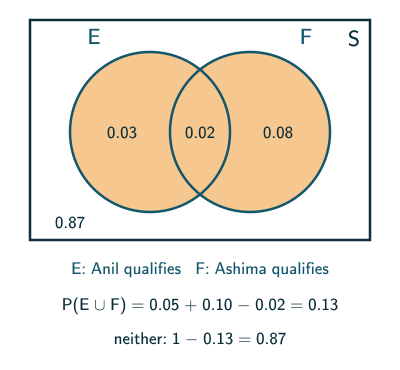
NCERT Example 7 (pages 304–305). Anil qualifies in an examination with probability 0.05, Ashima with 0.10, and both with 0.02. Then P(at least one qualifies) = 0.05 + 0.10 − 0.02 = 0.13, so neither qualifies with probability 1 − 0.13 = 0.87. At least one fails with probability 1 − 0.02 = 0.98, and exactly one qualifies with probability (0.05 − 0.02) + (0.10 − 0.02) = 0.11.
Three events. Put E = B ∪ C. The addition rule gives P(A ∪ E) = P(A) + P(E) − P(A ∩ E). Use it again for P(E) = P(B ∪ C), and a third time for A ∩ E = (A ∩ B) ∪ (A ∩ C), whose overlap is A ∩ B ∩ C (NCERT Miscellaneous Example 11, pages 309–310):
Addition rule for three events
P(A ∪ B ∪ C) = P(A) + P(B) + P(C)
− P(A ∩ B) − P(B ∩ C)
− P(A ∩ C) + P(A ∩ B ∩ C)
Probability of ‘not A’
A and A′ are mutually exclusive and together make up S, so by axioms (ii) and (iii), P(A) + P(A′) = 1. NCERT’s example (pages 301–302): from cards numbered 1 to 10, A = {2, 4, 6, 8} has P(A) = 4/10 = 2/5, and P(not A) = 1 − 2/5 = 3/5, which agrees with counting the six cards in A′.
Complement and related events
P(A′) = 1 − P(A)
P(A ∩ B′) = P(A) − P(A ∩ B)
P(A′ ∩ B′) = 1 − P(A ∪ B)
The middle line holds because A is A ∩ B together with A ∩ B′, which are mutually exclusive. The complement is often the quicker way. “At least one” is the complement of “none”, so P(at least one) = 1 − P(none). For two tosses of a coin, P(at least one tail) = 1 − P(HH) = 1 − 1/4 = 3/4. The last line is De Morgan’s law: “neither A nor B” is the complement of “A or B”.
Solved examples
Example 1: Valid assignments? (NCERT Exercise 14.2, Q1)
For S = {ω1, …, ω7}, which of these are valid: (a) 0.1, 0.01, 0.05, 0.03, 0.01, 0.2, 0.6; (c) 0.1, 0.2, …, 0.7; (e) 1/14, 2/14, 3/14, 4/14, 5/14, 6/14, 15/14?
(a) All values lie in [0, 1] and add up to 1.00. (c) They add up to 2.8. (e) 15/14 > 1, and the sum is 36/14.
Answer: only (a). (In the same exercise, (b), 1/7 each, is valid and (d) has negative values.)
Example 2: Winnings (NCERT Exercise 14.2, Q7)
A fair coin is tossed four times. A person wins ₹1 for each head and loses ₹1.50 for each tail. Which amounts can he have, and with what probabilities?
With h heads out of 4, he has h − 1.5(4 − h) = 2.5h − 6 rupees. Of the 16 equally likely outcomes, 1, 4, 6, 4, 1 have h = 4, 3, 2, 1, 0 heads.
Answer: five amounts: ₹4 (1/16), ₹1.50 (4/16 = 1/4), a loss of ₹1 (6/16 = 3/8), a loss of ₹3.50 (1/4) and a loss of ₹6 (1/16).
Example 3: Letters (NCERT Exercise 14.2, Q10)
One of the 13 letter positions in ASSASSINATION is chosen uniformly at random. Find the probability that it is a vowel.
The 13 letters include 6 vowels: A, A, A, I, I, O.
Answer: 6/13; a consonant has probability 7/13.
Example 4: Consistent or not? (NCERT Exercise 14.2, Q12)
Are these consistent: (i) P(A) = 0.5, P(B) = 0.7, P(A ∩ B) = 0.6; (ii) P(A) = 0.5, P(B) = 0.4, P(A ∪ B) = 0.8?
(i) A ∩ B ⊂ A, so P(A ∩ B) cannot exceed P(A) = 0.5. (ii) The addition rule gives P(A ∩ B) = 0.5 + 0.4 − 0.8 = 0.1, which is allowed.
Answer: (i) not consistent; (ii) consistent.
Example 5: Two examinations (NCERT Exercise 14.2, Q20)
A student passes both English and Hindi with probability 0.5 and neither with probability 0.1. P(passing English) = 0.75. Find P(passing Hindi).
Let E and H be passing English and Hindi. P(E ∪ H) = 1 − 0.1 = 0.9, and the addition rule gives 0.9 = 0.75 + P(H) − 0.5.
Answer: P(H) = 0.65.
Example 6: Orders of visits (NCERT Miscellaneous Example 9)
Veena visits four cities A, B, C, D in a random order. Find the probability that (iii) A is first and B last, (iv) A is first or second, (v) A is just before B.
There are 4! = 24 equally likely orders. (iii) The middle two can be C, D in 2 ways: 2/24. (iv) A has 4 equally likely places, and 2 of them qualify: 1/2. (v) Treat AB as one block: 3! = 6 orders, so 6/24.
Answer: 1/12, 1/2 and 1/4. (NCERT works out (i) 1/2 and (ii) 1/6 and leaves these three to the reader.)
Example 7: Kings in a hand (NCERT Miscellaneous Example 10)
A hand of 7 cards is drawn from a well-shuffled deck. Find the probability of exactly 3 kings.
Choose 3 of the 4 kings and 4 of the other 48 cards: 4C3 × 48C4 hands out of 52C7.
Answer: 9/1547. With 4 kings it is 1/7735, so at least 3 kings has probability 46/7735.
Common mistakes to avoid
Common mistake
Adding probabilities of events that overlap
P(A) + P(B) counts A ∩ B twice. Subtract P(A ∩ B) unless the events are mutually exclusive.
Common mistake
Using n(E)/n(S) when outcomes are not equally likely
The sums 2, 3, …, 12 of two dice are 11 outcomes, but they are not equally likely: P(sum 2) = 1/36, not 1/11. Count the 36 ordered pairs instead.
Common mistake
Accepting impossible numbers
A probability below 0 or above 1, a set of outcome probabilities that does not add up to 1, or P(A ∩ B) larger than P(A), signals an error.
Common mistake
Reading “at least one” as “exactly one”
“At least one” includes the case where both happen: it is the event A ∪ B. “Exactly one” leaves that case out: P(exactly one) = P(A) + P(B) − 2P(A ∩ B).
Quick revision summary
- Axioms: P(E) ≥ 0, P(S) = 1, and P(E ∪ F) = P(E) + P(F) when E and F are mutually exclusive.
- Consequences: P(ϕ) = 0, every probability lies in [0, 1], and P(A) is the sum of the probabilities of its outcomes. NCERT calls [0, 1] the range of P; strictly, the range is the set of values P takes, which can be smaller.
- Equally likely outcomes: P(E) = n(E)/n(S).
- Addition rule: P(A ∪ B) = P(A) + P(B) − P(A ∩ B); for mutually exclusive events, P(A ∪ B) = P(A) + P(B).
- Complement: P(not A) = 1 − P(A); use it for “at least one”.
- Three events: add P(A), P(B) and P(C), subtract the three pairwise intersections, and add back P(A ∩ B ∩ C).
Formula sheet
- P(E) ≥ 0, P(S) = 1
- P(E ∪ F) = P(E) + P(F) if E ∩ F = ϕ
- P(ϕ) = 0
- equally likely: P(E) = n(E)/n(S)
- P(A ∪ B) = P(A) + P(B) − P(A ∩ B)
- P(not A) = 1 − P(A)
- P(A ∩ B′) = P(A) − P(A ∩ B)
- P(A′ ∩ B′) = 1 − P(A ∪ B)
Questions students ask
Who introduced the axiomatic approach to probability?
The axiomatic approach to probability is credited to the Russian mathematician Andrey Nikolaevich Kolmogorov (1903–1987), who set it out in a 1933 book written in German, known in English as Foundations of the Theory of Probability; NCERT’s historical note to Chapter 14 (page 313) calls it ‘Foundations of Probability’. Its three axioms, P(E) ≥ 0, P(S) = 1 and additivity for mutually exclusive events, are also called Kolmogorov’s axioms. Kolmogorov treated probability as a set function, a number attached to each event, as NCERT does when it defines P on the power set of S; for infinite sample spaces his theory also needs additivity over an infinite sequence of mutually exclusive events.
What is the addition theorem of probability, and why is it called a theorem?
The addition theorem of probability states that for any two events A and B of a sample space, P(A ∪ B) = P(A) + P(B) − P(A ∩ B): the probability of “A or B” is the sum of the two probabilities minus the probability that both happen. It is called a theorem, the name used in the JEE Main syllabus (Unit 13), because it is proved from the three axioms rather than assumed, while an axiom is a starting rule accepted without proof; the complement rule for P(not A) is a theorem in the same way. Axiom (iii) is its special case for mutually exclusive events, and the proof is in the addition rule section.
What is the difference between classical, empirical and axiomatic probability?
Classical, empirical and axiomatic probability are three ways of assigning probabilities: classical probability is n(E)/n(S) for a finite sample space of equally likely outcomes, empirical (experimental) probability is the fraction of trials in which the event happened, and axiomatic probability is any assignment that obeys the three axioms. If a die shows a six in 18 of 100 throws, the empirical probability of a six is 0.18, while the classical value for a fair die is 1/6 ≈ 0.17. The axiomatic approach covers both, since equally likely outcomes give the classical rule as a theorem and relative frequencies obey the axioms. The 2026–27 NCERT Class 11 book studies only the axiomatic approach.
What are odds in favour and odds against an event?
The odds in favour of an event E are the ratio P(E) : P(not E), which for equally likely outcomes is the number of favourable outcomes to the number of unfavourable ones, and the odds against E are the reverse ratio. So odds in favour of a : b mean P(E) = a/(a + b). For one card from a well-shuffled deck of 52, there are 12 face cards and 40 other cards, so the odds in favour of a face card are 12 : 40 = 3 : 10, the odds against are 10 : 3, and P(face card) = 3/13. Odds are not in the 2026–27 NCERT chapter and the JEE Main syllabus (Unit 13) does not name them, and the ratio is a useful alternative way to state a probability.
What is the difference between the addition and multiplication theorems of probability?
The addition theorem of probability gives P(A ∪ B), the chance that at least one of A and B happens, while the multiplication theorem gives P(A ∩ B), the chance that both happen, as P(A) × P(B|A) when P(A) ≠ 0, where P(B|A) is the probability of B given that A has happened. Use the addition theorem for “or” and “at least one” questions and the multiplication theorem for “and” questions: for two cards drawn without replacement, P(both hearts) = 13/52 × 12/51 = 1/17. The multiplication theorem needs conditional probability, so it is taught in NCERT Class 12, Chapter 13 (Section 13.3); in this Class 11 chapter the same 1/17 comes from counting pairs of cards.
Is probability in the JEE Main syllabus?
Probability is in the JEE Main syllabus, in Unit 13, Statistics and Probability, which lists “Probability of an event, addition and multiplication theorems of probability” together with Bayes’ theorem and the probability distribution of a random variable. This Class 11 chapter (NCERT Chapter 14) covers the probability of an event, the axioms and the addition theorem, while conditional probability, the multiplication theorem, independent events and Bayes’ theorem are in NCERT Class 12, Chapter 13 (Sections 13.2 to 13.5). The 2026–27 NCERT books only define a random variable, in a remark, and give its probability distribution no section.
Practice questions
Try each question first, then open the answer to check your working.
-
Q1. A die is thrown. Find the probability that (i) a prime number, (ii) a number at least 3, (iii) a number more than 6 appears (NCERT Exercise 14.2, Q3 (i), (ii) and (iv)).
Show answerHide answer
(i) {2, 3, 5}: 3/6 = 1/2. (ii) {3, 4, 5, 6}: 4/6 = 2/3. (iii) No outcome: 0, the impossible event.
-
Q2. Fill in the blanks: (i) P(A) = 1/3, P(B) = 1/5, P(A ∩ B) = 1/15, P(A ∪ B) = ?; (ii) P(A) = 0.35, P(A ∩ B) = 0.25, P(A ∪ B) = 0.6, P(B) = ?; (iii) P(A) = 0.5, P(B) = 0.35, P(A ∪ B) = 0.7, P(A ∩ B) = ? (NCERT Exercise 14.2, Q13).
Show answerHide answer
(i) 1/3 + 1/5 − 1/15 = 7/15. (ii) 0.6 − 0.35 + 0.25 = 0.5. (iii) 0.5 + 0.35 − 0.7 = 0.15.
-
Q3. Events E and F are such that P(not E or not F) = 0.25. Are E and F mutually exclusive (NCERT Exercise 14.2, Q16)?
Show answerHide answer
“Not E or not F” is the complement of E ∩ F, so P(E ∩ F) = 1 − 0.25 = 0.75. This is not 0, so E and F are not mutually exclusive.
-
Q4. In a class, 40% of the students study Mathematics, 30% study Biology and 10% study both. Find the probability that a student chosen at random studies Mathematics or Biology (NCERT Exercise 14.2, Q18).
Show answerHide answer
0.4 + 0.3 − 0.1 = 0.6.