Events
NCERT Class 11 Mathematics Chapter 14 Section 14.1
Quick answer
An event is any subset of the sample space S of a random experiment, and it occurs when the outcome of the experiment lies in it. Events combine like sets: not A is A′ = S − A, A or B is A ∪ B, A and B is A ∩ B, and A but not B is A − B. Two events A and B are mutually exclusive when A ∩ B = ϕ, and events are exhaustive when together they make up S.
With your textbook
NCERT Mathematics (Class 11), Chapter 14 “Probability”, Section 14.1 “Event”, pages 289–295.
Open the official NCERT chapter (PDF, 2.3 MB, ncert.nic.in) (opens in a new tab)
Checked against the 2026-27 reprint on .
What is an event?
Event
Any subset E of a sample space S is called an event.
NCERT Mathematics (Class 11), Section 14.1, page 289
- An outcome (or sample point) is one possible result of a random experiment, and the sample space S is the set of all its outcomes.
- An event is a set of outcomes. It occurs when the actual outcome is one of its elements.
We work with finite sample spaces here, for which every subset can be taken as an event.
In plain words: an event is a question you can answer “yes” or “no” once the experiment is over, written as the set of outcomes for which the answer is “yes”. For two tosses of a coin, “exactly one head” is the event {HT, TH}: it happens if the tosses come out HT or TH, and not otherwise.
Random experiments and sample spaces
NCERT’s 2026–27 chapter opens with events. It says on page 289 that random experiments and sample spaces have already been studied, and on page 295 that “earlier sections” considered them, but no section of the 2026–27 book covers them. Here is what the chapter assumes.
- A random experiment has more than one possible outcome, and you cannot say in advance which one will occur: tossing a coin, rolling a die, drawing a card.
- Its sample space S lists every possible outcome once. Two tosses of a coin give S = {HH, HT, TH, TT}; three tosses give 8 outcomes; two throws of a die give the 36 ordered pairs (x, y) with x, y = 1, 2, …, 6.
- One experiment can have more than one sample space, depending on what is recorded. For two tosses you could also record only the number of heads, {0, 1, 2}. NCERT therefore says “an associated sample space”.
Every subset of S is an event, so a sample space with n outcomes has 2n events, one for each subset in its power set. For one toss of a coin, S = {H, T} has 22 = 4 events: ϕ, {H}, {T} and S itself.
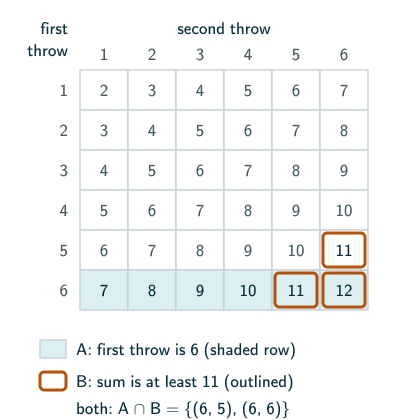
When does an event occur?
Thus, the event E of a sample space S is said to have occurred if the outcome ω of the experiment is such that ω ∈ E.
NCERT Mathematics (Class 11), Section 14.1.1, page 290
For one roll of a die, let E be “a number less than 4 appears”, so E = {1, 2, 3}. If the die shows 1, 2 or 3, E has occurred; if it shows 4, 5 or 6, E has not occurred. Several events can occur together: a roll of 3 makes “less than 4”, “odd” and “prime” all occur at once.
Types of events
- Impossible event: the empty set ϕ. No outcome makes it happen, such as “the die shows a multiple of 7”.
- Sure event: the whole sample space S. Every outcome makes it happen, such as “the die shows an odd or an even number”.
- Simple (elementary) event: an event with exactly one outcome, such as {TT} for two tosses.
- Compound event: an event with more than one outcome, such as “at least one head” = {HTT, THT, TTH, HHT, HTH, THH, HHH} for three tosses.
In a sample space containing n distinct elements, there are exactly n simple events.
NCERT Mathematics (Class 11), Section 14.1.2, page 290
Algebra of events
Because events are sets, they combine like the union, intersection and difference of sets, and “not A” is the complement of A in S. Each English phrase becomes a set:
| In words | Set | Occurs when the outcome is |
|---|---|---|
| not A | A′ = S − A | not in A |
| A or B | A ∪ B | in A, in B, or in both |
| A and B | A ∩ B | in both A and B |
| A but not B | A − B = A ∩ B′ | in A but not in B |
| neither A nor B | A′ ∩ B′ = (A ∪ B)′ | in neither |
“A or B” always includes the case where both happen. The last row is one of De Morgan’s laws: the outcomes in neither A nor B are exactly those outside A ∪ B.
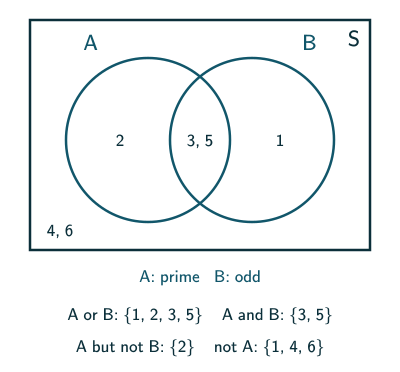
NCERT Example 1 (page 292). Roll a die, with A = “a prime number” = {2, 3, 5} and B = “an odd number” = {1, 3, 5}. Then A ∪ B = {1, 2, 3, 5}, A ∩ B = {3, 5}, A − B = {2} and A′ = {1, 4, 6}.
Mutually exclusive events
In general, two events A and B are called mutually exclusive events if the occurrence of any one of them excludes the occurrence of the other event, i.e., if they can not occur simultaneously.
NCERT Mathematics (Class 11), Section 14.1.4, page 292
So A and B are mutually exclusive exactly when A ∩ B = ϕ. For one roll of a die, “odd” {1, 3, 5} and “even” {2, 4, 6} are mutually exclusive, but “odd” and “less than 4” {1, 2, 3} are not, since both contain 1 and 3. Different simple events are always mutually exclusive, because each holds a single, different outcome. For mutually exclusive events, probabilities simply add: P(A ∪ B) = P(A) + P(B), the third axiom of probability.
NCERT Example 2 (pages 293–294). Two dice are thrown, with A: the sum is even, B: the sum is a multiple of 3, C: the sum is less than 4, D: the sum is greater than 11. Only C = {(1, 1), (2, 1), (1, 2)} and D = {(6, 6)} have no outcome in common. Every other pair shares at least one outcome; for example, (1, 5) has an even sum that is also a multiple of 3, so A and B are not mutually exclusive.
Exhaustive events
Events E1, E2, …, En are exhaustive if together they cover the sample space, E1 ∪ E2 ∪ … ∪ En = S. In NCERT’s words (page 293), they
are said to be exhaustive if atleast one of them necessarily occurs whenever the experiment is performed.
NCERT Mathematics (Class 11), Section 14.1.5, page 293
If they are also pairwise disjoint (Ei ∩ Ej = ϕ for i ≠ j), they are mutually exclusive and exhaustive: exactly one of them occurs every time. An event and its complement, A and A′, are always such a pair. Conversely, if A and B are mutually exclusive and exhaustive, then B = A′. Because exactly one of A and A′ occurs, their probabilities add up to 1.
NCERT Example 3 (page 294). Toss a coin three times, with A: no head = {TTT}, B: exactly one head = {HTT, THT, TTH} and C: at least two heads = {HHT, HTH, THH, HHH}. They have no outcome in common, and together they hold all 8 outcomes, so they are mutually exclusive and exhaustive.
Solved examples
Example 1: Mutually exclusive? (NCERT Exercise 14.1, Q1)
A die is rolled. E: “the die shows 4”, F: “the die shows an even number”. Are E and F mutually exclusive?
E = {4} and F = {2, 4, 6}, so E ∩ F = {4} ≠ ϕ.
Answer: no; both occur when the die shows 4.
Example 2: Describing events (NCERT Exercise 14.1, Q2)
A die is thrown. A: less than 7, B: greater than 7, C: a multiple of 3, D: less than 4, E: an even number greater than 4, F: not less than 3. Find A ∪ B, A ∩ B, E ∩ F, A − C and F′.
A = S, B = ϕ, C = {3, 6}, D = {1, 2, 3}, E = {6} and F = {3, 4, 5, 6}.
Answer: A ∪ B = S, A ∩ B = ϕ, E ∩ F = {6}, A − C = {1, 2, 4, 5} and F′ = {1, 2}.
Example 3: Pairs of dice (NCERT Exercise 14.1, Q3)
A pair of dice is rolled. A: the sum is greater than 8; B: 2 occurs on either die; C: the sum is at least 7 and a multiple of 3. Which pairs are mutually exclusive?
With a 2 on one die the sum is at most 8, so B shares no outcome with A or with C. C means a sum of 9 or 12, so C lies inside A.
Answer: A and B, and B and C, are mutually exclusive; A and C are not.
Example 4: Three coins (NCERT Exercise 14.1, Q4)
Three coins are tossed. A: three heads; B: two heads and one tail; C: three tails; D: a head on the first coin. Which events are mutually exclusive, which simple, which compound?
A = {HHH}, B = {HHT, HTH, THH}, C = {TTT}, D = {HHH, HHT, HTH, HTT}.
Answer: the mutually exclusive pairs are A and B, A and C, B and C, and C and D; A and C are simple; B and D are compound.
Example 5: True or false? (NCERT Exercise 14.1, Q6 and Q7)
Two dice are thrown. A: an even number on the first die; B: an odd number on the first die; C: the sum is at most 5. Are A and C mutually exclusive? Are A′, B′ and C mutually exclusive and exhaustive?
(2, 1) is in A and in C. A′ = B and B′ = A, and (1, 1) is in both A′ and C.
Answer: no to both. (A and B themselves are mutually exclusive and exhaustive, and A = B′.)
Example 6: Counting events
How many events does the sample space S = {HH, HT, TH, TT} of tossing a coin twice have, and how many of them are simple?
S has 4 outcomes, so there are 24 = 16 subsets, from ϕ to S.
Answer: 16 events, of which 4 are simple.
Common mistakes to avoid
Common mistake
Reading “A or B” as “exactly one of them”
A ∪ B includes the outcomes in both. “Exactly one of A and B” is (A − B) ∪ (B − A).
Common mistake
Confusing mutually exclusive with exhaustive
Mutually exclusive means no overlap; exhaustive means nothing is left out. “Shows 1” and “shows 2” are mutually exclusive but not exhaustive; “at most 4” and “at least 3” are exhaustive but not mutually exclusive.
Common mistake
Thinking mutually exclusive events must be complements
“Odd” and “shows 2” are mutually exclusive, but neither is the complement of the other. Complements are mutually exclusive and exhaustive.
Common mistake
Writing an outcome instead of an event
An event is a set: write {6}, not 6, for “the die shows 6”. The impossible event is ϕ, not {ϕ}; it has no outcome, so it is neither simple nor compound.
Common mistake
Checking only A ∩ B ∩ C = ϕ
Three or more events are mutually exclusive only when every pair is disjoint. On a die, {1, 2}, {2, 3} and {1, 3} have A ∩ B ∩ C = ϕ, yet no pair is disjoint.
Quick revision summary
- A random experiment has more than one possible outcome, and which one occurs cannot be predicted; its sample space S lists them all.
- An event is any subset of S; it occurs when the outcome lies in it. S with n outcomes has 2n events and n simple events.
- ϕ is the impossible event and S the sure event; a simple event has one outcome, a compound event more than one.
- not A = A′ = S − A; A or B = A ∪ B; A and B = A ∩ B; A but not B = A − B = A ∩ B′.
- Mutually exclusive: A ∩ B = ϕ. Exhaustive: E1 ∪ … ∪ En = S. Both together: exactly one of the events occurs.
Formula sheet
- not A = A′ = S − A
- A or B = A ∪ B; A and B = A ∩ B
- A but not B = A − B = A ∩ B′
- neither A nor B = A′ ∩ B′ = (A ∪ B)′
- mutually exclusive: A ∩ B = ϕ
- exhaustive: E ∪ E ∪ … ∪ E = S
Questions students ask
What is the difference between mutually exclusive and independent events?
Mutually exclusive events cannot happen together, so A ∩ B = ϕ and P(A ∩ B) = 0, while for independent events the occurrence of one does not change the probability of the other, so P(A ∩ B) = P(A) × P(B). Being mutually exclusive depends only on the outcomes in the events, but independence depends on their probabilities and is a Class 12 idea, defined in NCERT Class 12, Chapter 13 (Section 13.4). For one card drawn from a well-shuffled deck of 52, “a king” and “a heart” are not mutually exclusive, since both contain the king of hearts, but they are independent: P(king and heart) = 1/52 = 1/13 × 1/4.
Can mutually exclusive events be independent?
Mutually exclusive events can be independent only when one of them has probability 0: NCERT Class 12, Chapter 13 (Section 13.4), where independence is taught, notes that two mutually exclusive events with non-zero probabilities cannot be independent. For mutually exclusive events P(A ∩ B) = 0, but independence needs P(A ∩ B) = P(A) × P(B), which is greater than 0 when both probabilities are non-zero: knowing that one event happened tells you that the other did not. For one card, “a heart” and “a spade” each have probability 1/4, yet P(heart and spade) = 0, not 1/16. The impossible event ϕ is the exception: it is mutually exclusive with, and independent of, every event.
What is the difference between an outcome, an event and a sample space?
An outcome is a single result of a random experiment, the sample space S is the set of all the outcomes, and an event is any subset of S: an outcome is an element, S is the whole set, and an event is a part of it, from ϕ to S. For one card drawn from a deck of 52, “the queen of spades” is an outcome, S has 52 outcomes, and “a red king” is the event {king of hearts, king of diamonds}, which occurs if either of those cards is drawn. Each trial gives exactly one outcome, but several events can occur on it: the queen of spades makes “a queen”, “a spade” and “a black card” all occur.
How do you find the sample space when coins are tossed or dice are thrown?
To find the sample space of an experiment done in stages, write each outcome as the ordered list of the results of the stages and count them with the multiplication principle: n tosses of a coin give 2n outcomes and n throws of a die give 6n. So 4 tosses give 24 = 16 outcomes and 3 throws give 63 = 216 ordered triples. Keep the order, so that HT and TH are two outcomes: for independent tosses or throws of fair coins and dice the ordered outcomes are equally likely, while recording only the number of heads, {0, 1, 2, 3, 4} for 4 tosses, gives a valid sample space whose outcomes are not.
What are mutually inclusive events in probability?
Mutually inclusive events are events that can happen together, so that A ∩ B ≠ ϕ; NCERT does not use the term and simply calls such events not mutually exclusive. For one roll of a die, “an even number” {2, 4, 6} and “a number greater than 3” {4, 5, 6} are mutually inclusive, because a roll of 4 or 6 makes both occur. When the overlap has positive probability, P(A or B) differs from P(A) + P(B); in general use the addition rule, which counts the common outcomes only once.
Practice questions
Try each question first, then open the answer to check your working.
-
Q1. Write a sample space for tossing a coin twice, and the events “at least one tail”, “at most one head” and “second toss is not a head” (NCERT page 289).
Show answerHide answer
S = {HH, HT, TH, TT}. At least one tail and at most one head are both {HT, TH, TT}; second toss not a head is {HT, TT}.
-
Q2. A die is thrown, with D: less than 4, E: an even number greater than 4, F: not less than 3. Find D ∩ E, D − E and E ∩ F′ (NCERT Exercise 14.1, Q2).
Show answerHide answer
D = {1, 2, 3}, E = {6}, F′ = {1, 2}. So D ∩ E = ϕ, D − E = {1, 2, 3} and E ∩ F′ = ϕ.
-
Q3. Three coins are tossed. Give two events that are mutually exclusive, and three that are mutually exclusive and exhaustive (NCERT Exercise 14.1, Q5).
Show answerHide answer
For example, “three heads” {HHH} and “three tails” {TTT}; and “no head”, “exactly one head” and “at least two heads”, as in NCERT Example 3.
-
Q4. For one roll of a die, are “a prime number” and “an even number” mutually exclusive? Are they exhaustive?
Show answerHide answer
Neither: they share 2, and together they give {2, 3, 4, 5, 6}, which leaves out 1.