Power set
Beyond NCERT In the JEE Main syllabus; the Class 11 book has no section for it.
Quick answer
The power set P(A) of a set A is the set of all its subsets, including the empty set and A itself. If A has n elements, P(A) has 2n elements, because each element is either in or out of a subset. So a set with n elements has 2n − 1 proper subsets, and P(ϕ) = {ϕ} has one element.
What is the power set?
Power set
The power set of a set A, written P(A), is the set of all subsets of A, including the empty set ϕ and A itself.
- P({1, 2}) = {ϕ, {1}, {2}, {1, 2}}.
- If A has n elements, P(A) has 2n elements: n[P(A)] = 2n.
- The power set is in the JEE Main syllabus (Unit 1); the 2026–27 NCERT book asks for all the subsets of four small sets in Exercise 1.3, Q4 (page 12), but has no section on the power set itself.
In plain words: the power set collects every way of choosing some elements of A, from choosing none (ϕ) to choosing all of them (A). Its elements are sets, so the power set is a set of sets. Each element of A is either chosen or not, two choices per element, which is why the count doubles every time A gets one element bigger.
Listing a power set
List the subsets by size: no elements, one element, two elements, and so on up to the whole set. For A = {a, b, c}:
- 0 elements: ϕ;
- 1 element: {a}, {b}, {c};
- 2 elements: {a, b}, {a, c}, {b, c};
- 3 elements: {a, b, c}.
So P(A) has 1 + 3 + 3 + 1 = 8 elements. NCERT Exercise 1.3, Q4 asks for exactly these lists for {a}, {a, b}, {1, 2, 3} and ϕ; they are worked in the solved examples on the subsets page.
Why there are 2n subsets
To build a subset, go through the elements of A one at a time and decide for each: in or out. Every choice is independent, so by the multiplication principle, with n elements there are 2 × 2 × … × 2 (n factors) = 2n ways to decide, and each way gives a different subset. Choosing “out” every time gives ϕ, the empty set; choosing “in” every time gives A. As n goes 0, 1, 2, 3, …, the counts 1, 2, 4, 8, … form a geometric progression with common ratio 2.
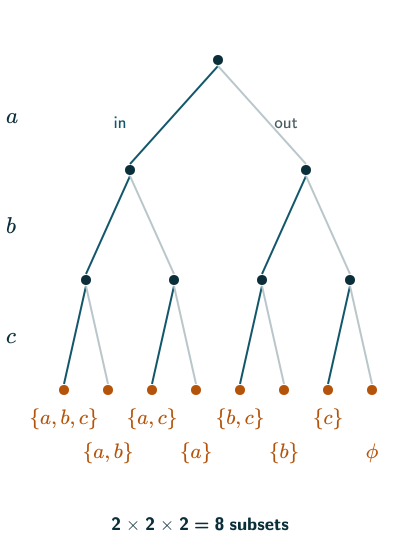
Some counts follow at once:
- proper subsets (all except A itself): 2n − 1;
- non-empty proper subsets (leaving out ϕ and A): 2n − 2 for n ≥ 1; for n = 0, the count is 0;
- subsets with exactly r elements: the number of ways to choose r of the n elements, written nCr (see combinations). For n = 3 and r = 0, 1, 2, 3 these are 1, 3, 3 and 1, adding up to 8; in general nC0 + nC1 + … + nCn = 2n.
The 2n count also gives the number of relations: if n(A) = p and n(B) = q, the Cartesian product A × B has pq elements, so there are 2pq relations from A to B.
In probability, the subsets of a sample space are its events, so a sample space of n outcomes has 2n events.
The same idea appears in physics: every SI derived unit is a product of powers of some of the seven base units. The newton, kg m s−2, uses the subset {kg, m, s}. The base units have 27 = 128 subsets, but a subset does not fix the unit: the joule, kg m2 s−2, uses the same {kg, m, s}.
Solved examples
Example 1: Writing power sets
Write the power sets of (i) {x, y}; (ii) {1, {2}}; (iii) {2, 4, 6}.
List by size each time. In (ii) the set has two elements, the number 1 and the set {2}; the one-element subset that contains {2} is {{2}}.
Answer: (i) {ϕ, {x}, {y}, {x, y}}; (ii) {ϕ, {1}, {{2}}, {1, {2}}}; (iii) {ϕ, {2}, {4}, {6}, {2, 4}, {2, 6}, {4, 6}, {2, 4, 6}}. The sizes are 4, 4 and 8, that is 22, 22 and 23.
Example 2: Counting
A set A has 5 elements. How many (a) subsets, (b) proper subsets, (c) non-empty proper subsets and (d) subsets with exactly 2 elements does it have?
(a) 25 = 32. (b) Leave out A itself: 31. (c) Leave out ϕ and A: 30. (d) Choose 2 of the 5 elements: 5 × 4 = 20 ordered picks (first, then second); each pair turns up in 2 orders, so 20 ÷ 2 = 10.
Answer: 32, 31, 30 and 10.
Example 3: Working back from the count
The power set of A has 64 elements. How many elements does A have?
2n = 64 = 26.
Answer: 6.
Example 4: The power set of the empty set
Find P(ϕ) and P(P(ϕ)), and the number of elements of each.
The only subset of ϕ is ϕ itself, so P(ϕ) = {ϕ}, with 1 = 20 element. P(ϕ) has one element, so its power set has 21 = 2 elements: ϕ and {ϕ}.
Answer: P(ϕ) = {ϕ}, 1 element; P(P(ϕ)) = {ϕ, {ϕ}}, 2 elements.
Common mistakes to avoid
Common mistake
Leaving out ϕ or A
Both are subsets of A, so both belong to P(A). For a non-empty A they are distinct: forgetting one gives 2n − 1, and forgetting both gives 2n − 2, instead of 2n. For A = ϕ, however, A and ϕ are the same subset. There is only one subset to exclude, so ϕ has 0 non-empty proper subsets, not 20 − 2 = −1.
Common mistake
Writing elements instead of subsets
For A = {1, 2}, P(A) contains {1}, not 1: its elements are sets. 1 ∈ A, but {1} ∈ P(A).
Common mistake
Thinking P(ϕ) is empty
P(ϕ) = {ϕ} has one element, the empty set. It is not ϕ.
Quick revision summary
- P(A) is the set of all subsets of A, including ϕ and A.
- If n(A) = n, then n[P(A)] = 2n: each element is either in or out.
- Proper subsets: 2n − 1; non-empty proper subsets: 2n − 2 for n ≥ 1, and 0 for n = 0.
- P(ϕ) = {ϕ}.
Formula sheet
- P(A) = {S : S ⊂ A}
- n[P(A)] = 2n when n(A) = n
- Proper subsets: 2n − 1; non-empty proper subsets: 2n − 2 for n ≥ 1, and 0 for n = 0
Questions students ask
What is the difference between a subset and the power set?
A subset of A is a single set whose elements all come from A, while the power set P(A) is the one set whose elements are all the subsets of A. So “S is a subset of A” and “S is an element of P(A)” say the same thing, S ⊂ A ⇔ S ∈ P(A): since {7} ⊂ {5, 7, 9}, {7} ∈ P({5, 7, 9}). A set can have many subsets but has only one power set, which has 2n elements when the set has n.
Is the power set the same as the universal set?
No, the power set and the universal set are different: the universal set U is the background set whose elements are the objects of a problem, while the power set P(A) is a set of sets, the subsets of A. They are linked in one way: every set under discussion is a subset of U, so each of them is an element of P(U). For U = {1, 2, …, 10}, {1, 4, 9} ⊂ U, so {1, 4, 9} ∈ P(U), which has 210 = 1024 elements.
Is the power set deleted from Class 11 NCERT, and is it in the JEE Main syllabus?
Yes, NCERT dropped the power set from its Class 11 Mathematics book in the rationalised syllabus of 2022, and the current 2026–27 reprint has no section on it, so school courses that follow NCERT may leave it out. It is still in the JEE Main 2027 syllabus, which lists “Power set” in Unit 1, Sets, Relations and Functions, next to union, intersection and complement of sets. JEE aspirants should therefore learn it, with n[P(A)] = 2n and the counts of proper subsets that follow from it.
How many subsets does the Cartesian product A × B have?
If n(A) = p and n(B) = q, the Cartesian product A × B, the set of ordered pairs (a, b) with a ∈ A and b ∈ B, has pq elements, so it has 2pq subsets. Each subset of A × B is a relation from A to B, so this is also the number of relations from A to B. For n(A) = 3 and n(B) = 4, A × B has 12 elements and 212 = 4096 subsets.
What is the cardinality of a power set?
The cardinality of the power set of A, its number of elements, is 2n when A has n elements: n[P(A)] = 2n, where n(S) is the number of elements of a finite set S. Some books write the power set as 2A instead of P(A), a notation that recalls this count. Since 2n > n for every whole number n, the power set of a finite set has more elements than the set itself, and Georg Cantor proved that no set, finite or infinite, can be put in one-to-one correspondence with its power set (a result beyond NCERT and the JEE Main syllabus).
Practice questions
Try each question first, then open the answer to check your working.
-
Q1. Write the power set of {0, 1}.
Show answerHide answer
{ϕ, {0}, {1}, {0, 1}}: 4 elements.
-
Q2. How many elements does P(A) have if A = {x : x is a vowel in the English alphabet}?
Show answerHide answer
A = {a, e, i, o, u} has 5 elements, so P(A) has 25 = 32.
-
Q3. Is {1} ∈ P({1, 2, 3})? Is 1 ∈ P({1, 2, 3})?
Show answerHide answer
{1} ∈ P({1, 2, 3}), because {1} is a subset of {1, 2, 3}. 1 ∉ P({1, 2, 3}): the elements of a power set are sets, and 1 is not a set.
-
Q4. A set has 7 elements. How many of its subsets have at least one element?
Show answerHide answer
All subsets except ϕ: 27 − 1 = 127.