Finite and infinite sets
NCERT Class 11 Mathematics Chapter 1 Section 1.4
Quick answer
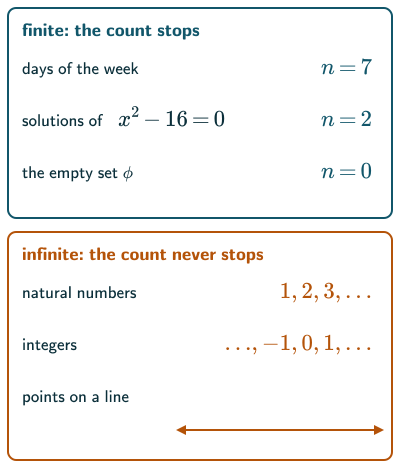
A set is finite if it is empty or has a definite number of elements, and infinite otherwise. For a finite set S, n(S) is the number of distinct elements, so n(ϕ) = 0 and the days of the week give 7. The natural numbers, the primes and the points on a line are infinite; some infinite sets can be written with dots, such as {1, 3, 5, …}, but the real numbers cannot be listed at all.
With your textbook
NCERT Mathematics (Class 11), Chapter 1 “Sets”, Section 1.4 “Finite and Infinite Sets”, pages 6–7.
Open the official NCERT chapter (PDF, 2.2 MB, ncert.nic.in) (opens in a new tab)
Checked against the 2026-27 reprint on .
Finite and infinite sets
Finite and infinite sets
A set which is empty or consists of a definite number of elements is called finite otherwise, the set is called infinite.
NCERT Mathematics (Class 11), Section 1.4, page 6
- n(S), the number of elements of a finite set S, counts its distinct elements (NCERT page 6).
- If n(S) is a natural number, S is a non-empty finite set; the empty set is finite too, with n(ϕ) = 0.
In plain words: a set is finite if, given enough time, you could count its elements and the count would stop. The days of the week (7), the letters of the alphabet (26) and the people alive in the world today (a huge but definite number) are finite. The natural numbers are not: whatever number you reach, there is always a next one.
Counting with n(S)
NCERT’s examples (Section 1.4, page 6): A = {1, 2, 3, 4, 5} has n(A) = 5, and B = {a, b, c, d, e, g} has n(B) = 6. For C = {men living presently in different parts of the world}, we do not know n(C), but it is some definite natural number, so C is finite.
Only distinct elements are counted: the letters of the word LOYAL form {L, O, Y, A}, so the set has 4 elements, not 5. Another finite set: the chemical elements known today, numbered 1 to 118, all of which now have official names.
Examples of each kind
NCERT’s examples (page 6):
- W, the days of the week: finite, n(W) = 7;
- S, the solutions of x2 − 16 = 0: finite, S = {−4, 4};
- G, the points on a line: infinite.
Writing an infinite set in roster form. List enough elements to show the pattern and add three dots (NCERT page 7): {1, 2, 3, …} is the natural numbers, {1, 3, 5, 7, …} the odd natural numbers, and {…, −3, −2, −1, 0, 1, 2, 3, …} the integers.
All infinite sets cannot be described in the roster form. For example, the set of real numbers cannot be described in this form, because the elements of this set do not follow any particular pattern.
NCERT Mathematics (Class 11), Section 1.4, page 7
Read “all … cannot” as “not all … can”: NCERT has just written three infinite sets in roster form. R is described in words or in set-builder form, {x : x is a real number}, instead.
Solved examples
Example 1: Finite or infinite? (NCERT Example 6, page 7)
Which are finite: (i) {x : x ∈ N and (x − 1)(x − 2) = 0}; (ii) {x : x ∈ N and x2 = 4}; (iii) {x : x ∈ N and 2x − 1 = 0}; (iv) {x : x ∈ N and x is prime}; (v) {x : x ∈ N and x is odd}?
(i) = {1, 2}. (ii) = {2}, since −2 is not natural. (iii) = ϕ, since x = 1/2 is not natural. (iv) There are infinitely many primes. (v) There are infinitely many odd numbers.
Answer: (i), (ii) and (iii) are finite (the empty set counts as finite); (iv) and (v) are infinite.
Example 2: Finite or infinite? (NCERT Exercise 1.2, Q2)
(i) The months of a year; (ii) {1, 2, 3, …}; (iii) {1, 2, 3, …, 99, 100}; (iv) the positive integers greater than 100; (v) the prime numbers less than 99.
(iii) stops at 100, so the dots only abbreviate a finite list. (v) Every element is below 99, so there are at most 98 of them; in fact there are 25.
Answer: (i) finite (12); (ii) infinite; (iii) finite (100); (iv) infinite; (v) finite (25).
Example 3: Finite or infinite? (NCERT Exercise 1.2, Q3)
(i) The lines parallel to the x-axis; (ii) the letters of the English alphabet; (iii) the numbers that are multiples of 5; (iv) the animals living on the earth; (v) the circles through the origin (0, 0).
(i) One line y = c for every real number c. (iii) 5, 10, 15, … never stop. (v) One circle for every centre other than the origin.
Answer: (i) infinite; (ii) finite (26); (iii) infinite; (iv) finite (a huge but definite number); (v) infinite.
Common mistakes to avoid
Common mistake
Thinking the empty set is not finite
The empty set has a definite number of elements, 0, so it is finite. NCERT’s definition names it explicitly.
Common mistake
Calling a very large set infinite
The grains of sand on a beach or the animals on the earth are hard to count, but the count is a definite number, so the set is finite. Infinite means the counting never ends.
Common mistake
Reading “…” as always infinite
{1, 2, 3, …, 100} is finite: the dots only shorten a list that ends at 100. Dots at the end with no last element, as in {1, 2, 3, …}, mean an infinite set.
Common mistake
Thinking a set between two numbers is finite
{x : x ∈ R and 0 < x < 1} is infinite, but {x : x ∈ N and 0 < x < 1} = ϕ is finite. Always check which numbers x may be.
Common mistake
Counting repeated elements
n({L, O, Y, A, L}) is 4, not 5: n(S) counts distinct elements.
Quick revision summary
- Finite set: empty, or with a definite number of elements; n(S) is that number (n(ϕ) = 0).
- Infinite set: not finite; for example N, Z, the primes, the points on a line.
- Some infinite sets can be written {1, 3, 5, …}; R cannot be written in roster form at all.
Formula sheet
- n(S) = number of distinct elements of a finite set S; n(ϕ) = 0
- Finite: n(S) = 0, 1, 2, …; otherwise infinite
Questions students ask
What is the cardinal number of a set?
The cardinal number of a finite set S is the number of distinct elements in it, written n(S) in NCERT and |S| or card(S) in many other books; it is also called the cardinality of S. The letters of the word INDIA form the set {I, N, D, A}, so its cardinal number is 4, and the cardinal number of the empty set is 0. Finite sets with the same cardinal number are called equivalent sets.
How do you decide whether a set is finite or infinite?
To decide whether a set is finite, try to count its distinct elements: if the count stops at some whole number, 0 included, the set is finite, and if there is always another element however far you go, it is infinite. Check first what kind of number the elements are: {x : x ∈ Z and x2 < 50} = {−7, −6, …, 7} is finite, with 15 elements, while the multiples of 7 in N, {7, 14, 21, …}, form an infinite set.
Is every subset of a finite set finite?
Yes, every subset of a finite set is finite: if B ⊂ A and A has n elements, B cannot have more, so n(B) ≤ n(A). Turned round, a set with an infinite subset must itself be infinite, which is a quick way to see that Q and R are infinite, since both contain N. An infinite set can still have finite subsets, such as {2, 4, 6} ⊂ N.
Does an infinite set have a cardinal number?
NCERT uses n(S) here only to count the elements of finite sets; this restriction of notation does not mean that an infinite set has no cardinality. Beyond NCERT and JEE Main, infinite cardinal numbers are studied: N, Z and Q are countably infinite, which means their elements can be listed as a first, second, third, … element, and all three have the cardinality ℵ0 (aleph-null). R is uncountable, as Georg Cantor proved in 1874: no list, with or without dots, can hold every real number, which is the deeper reason why R cannot be written in roster form.
Practice questions
Try each question first, then open the answer to check your working.
-
Q1. Find n(A) for A = {x : x is a letter of the word ASSESSMENT}.
Show answerHide answer
The distinct letters are A, S, E, M, N, T: n(A) = 6.
-
Q2. Is {x : x ∈ N and x < 1000} finite or infinite? Find its number of elements.
Show answerHide answer
Finite: it is {1, 2, …, 999}, with 999 elements.
-
Q3. Is the set of rational numbers between 0 and 1 finite?
Show answerHide answer
No: 1/2, 1/3, 1/4, … all lie between 0 and 1, and the list never ends. The set is infinite.
-
Q4. Find n(S) for S = {x : x ∈ N and x2 − 16 = 0}.
Show answerHide answer
−4 is not a natural number, so S = {4} and n(S) = 1.