Naming elements with atomic numbers above 100
NCERT Class 11 Chemistry Chapter 3 Section 3.4
Quick answer
Until a permanent name is approved, an element can be given a systematic name from its atomic number: each digit becomes a root, the roots are joined and “ium” is added, with prescribed spelling changes. For a three-digit atomic number, the symbol has three letters; element 120 is unbinilium, Ubn. All recognised elements up to 118 now have official names.
With your textbook
NCERT Chemistry Part I (Class 11), Chapter 3 “Classification of Elements and Periodicity in Properties”, Section 3.4 “Nomenclature of Elements with Atomic Numbers > 100”, pages 78–81.
Open the official NCERT chapter (PDF, 3.4 MB, ncert.nic.in) (opens in a new tab)
Checked against the 2026-27 reprint on .
How are elements above 100 named?
IUPAC systematic names
Until a new element’s discovery is confirmed and it gets an official name, IUPAC gives it a systematic name built from its atomic number (NCERT Section 3.4, pages 78–81):
- each digit of the atomic number becomes a root: 0 nil, 1 un, 2 bi, 3 tri, 4 quad, 5 pent, 6 hex, 7 sept, 8 oct, 9 enn;
- the roots are joined in the order of the digits and “ium” is added;
- the three-letter symbol is made of the first letters of the roots.
For example, element 120 is unbinilium, Ubn. Later, IUPAC approves a permanent name and symbol.
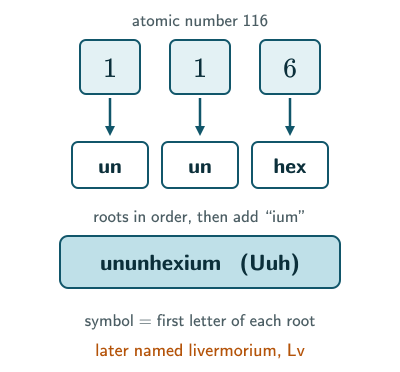
In plain words: when a laboratory makes a new element, it may be months or years before other laboratories confirm it, and rival teams have sometimes claimed the same element under different names. So until things settle, the element is simply named after its number, read out in Latin and Greek roots. For example, element 116 formerly used “one-one-six-ium”: ununhexium; its approved name is now livermorium.
Why systematic names are needed
Naming a new element was traditionally the privilege of its discoverers, and IUPAC then ratified the name (NCERT page 78). Elements with very high atomic numbers are so unstable that only minute amounts, sometimes only a few atoms, are ever made. Making and identifying them needs costly, sophisticated equipment, and only a few laboratories in the world do this work, in a competitive spirit. Scientists have sometimes claimed a discovery before collecting reliable data (page 80).
Element 104 is NCERT’s example: American scientists named it rutherfordium and Soviet scientists named it kurchatovium. To avoid such disputes, IUPAC recommended a temporary systematic name for every new element:
the IUPAC has made recommendation that until a new element’s discovery is proved, and its name is officially recognised, a systematic nomenclature be derived directly from the atomic number of the element using the numerical roots for 0 and numbers 1-9.
NCERT Chemistry Part I (Class 11), Section 3.4, page 80
The rules
| Digit | Root | Letter |
|---|---|---|
| 0 | nil | n |
| 1 | un | u |
| 2 | bi | b |
| 3 | tri | t |
| 4 | quad | q |
| 5 | pent | p |
| 6 | hex | h |
| 7 | sept | s |
| 8 | oct | o |
| 9 | enn | e |
The roots are put together in order of digits which make up the atomic number and “ium” is added at the end.
NCERT Chemistry Part I (Class 11), Section 3.4, page 80
The symbol is the first letter of each root, with the first one capitalised: a temporary symbol always has three letters (page 81). IUPAC’s 1978 rules add two spelling rules (beyond the NCERT text); NCERT’s Table 3.5 shows the first in 102, 103, 112 and 113:
- when “bi” or “tri” is the last root, its i merges with “ium”: 112 is ununbium, not ununbiium (120 keeps it: unbinilium);
- “enn” before “nil” drops one n: 190 is unennilium, not unennnilium.
Official names
After discovery and priority have been established, the credited discoverers are invited to propose a name and symbol. IUPAC reviews the proposal, holds a public review and formally approves it. Permitted inspirations include a mythological concept, mineral, place, property or scientist (IUPAC Recommendations 2016; NCERT page 81 gives examples). As NCERT says, elements up to atomic number 118 have been discovered and all have official names. The last four, nihonium, moscovium, tennessine and oganesson, were named in 2016 (beyond the NCERT text).
| Z | Systematic name | Official name |
|---|---|---|
| 101 | Unnilunium (Unu) | Mendelevium (Md) |
| 102 | Unnilbium (Unb) | Nobelium (No) |
| 103 | Unniltrium (Unt) | Lawrencium (Lr) |
| 104 | Unnilquadium (Unq) | Rutherfordium (Rf) |
| 105 | Unnilpentium (Unp) | Dubnium (Db) |
| 106 | Unnilhexium (Unh) | Seaborgium (Sg) |
| 107 | Unnilseptium (Uns) | Bohrium (Bh) |
| 108 | Unniloctium (Uno) | Hassium (Hs) |
| 109 | Unnilennium (Une) | Meitnerium (Mt) |
| 110 | Ununnilium (Uun) | Darmstadtium (Ds) |
| 111 | Unununium (Uuu) | Roentgenium (Rg) |
| 112 | Ununbium (Uub) | Copernicium (Cn) |
| 113 | Ununtrium (Uut) | Nihonium (Nh) |
| 114 | Ununquadium (Uuq) | Flerovium (Fl) |
| 115 | Ununpentium (Uup) | Moscovium (Mc) |
| 116 | Ununhexium (Uuh) | Livermorium (Lv) |
| 117 | Ununseptium (Uus) | Tennessine (Ts) |
| 118 | Ununoctium (Uuo) | Oganesson (Og) |
Three spellings in NCERT’s Table 3.5 (page 80) differ from IUPAC’s: it prints “Ununnillium” for 110 (IUPAC: ununnilium), “Unununnium” for 111 (unununium) and “Rontgenium” for 111’s official name (roentgenium). The table above uses IUPAC’s spellings.
Solved examples
Example 1: Element 120 (NCERT Problem 3.1, page 81)
What would be the IUPAC name and symbol of the element with atomic number 120?
Digits 1, 2, 0: roots un, bi, nil. Name: un + bi + nil + ium = unbinilium. Symbol: U, b, n.
Answer: unbinilium, Ubn.
Example 2: Element 119
Name element 119 and give its symbol.
Digits 1, 1, 9: un, un, enn. Name: ununennium. Symbol: Uue.
Answer: ununennium, Uue.
Example 3: From name to number
Which element was called unnilpentium, and what is its official name?
un-nil-pent-ium: digits 1, 0, 5.
Answer: element 105, now dubnium (Db).
Example 4: The spelling rule
Write the systematic name of element 112.
Roots un, un, bi, then “ium”. After “bi”, one i is dropped: ununbium, not ununbiium.
Answer: ununbium, Uub (now copernicium, Cn).
Example 5: Who named which? (NCERT Exercise 3.7, page 96)
Which element names are associated with (i) Lawrence and Berkeley and (ii) Glenn T. Seaborg? This clarifies the intended name associations in NCERT Exercise 3.7; a name alone does not identify who proposed it.
Names often honour a laboratory, place or scientist.
Answer: (i) lawrencium (Lr, 103), after Ernest Lawrence, the laboratory’s founder, and berkelium (Bk, 97), after Berkeley; (ii) seaborgium (Sg, 106), named after Glenn T. Seaborg himself.
Common mistakes to avoid
Common mistake
Writing a two-letter temporary symbol
For three-digit atomic numbers, temporary symbols have three letters, one per digit: element 114 was Uuq, not Uq. Only the first letter is a capital: Uue, not UUE or uue.
Common mistake
Changing the order of the roots
The roots follow the digits from left to right: 105 is un-nil-pent-ium (unnilpentium), not pent-nil-un-ium.
Common mistake
Forgetting the elision
Element 112 is ununbium and 113 ununtrium; the i of “bi” or “tri” merges with “ium”.
Common mistake
Using systematic names for named elements
All elements up to 118 now have official names. Use them; systematic names are only for elements not yet named, such as 119 and 120.
Quick revision summary
- Disputes over discovery (element 104: rutherfordium against kurchatovium) led IUPAC to recommend temporary systematic names.
- Roots: 0 nil, 1 un, 2 bi, 3 tri, 4 quad, 5 pent, 6 hex, 7 sept, 8 oct, 9 enn; join in digit order and add “ium”.
- Symbol: first letters of the roots, three letters (120: Ubn).
- Permanent names are approved by IUPAC and may honour a place or scientist; all elements up to 118 are named.
- NCERT misspells three names in Table 3.5: ununnilium, unununium, roentgenium are correct.
Formula sheet
- Name = roots of the digits in order + “ium”
- 0 nil, 1 un, 2 bi, 3 tri, 4 quad, 5 pent, 6 hex, 7 sept, 8 oct, 9 enn
- Symbol = first letter of each root (3 letters)
- bi/tri + ium → bium/trium; enn + nil → ennil
Questions students ask
Why are elements 117 and 118 called tennessine and oganesson, not tennessium and oganessium?
Elements 117 and 118 end in “ine” and “on” because IUPAC’s 2016 naming rules give a new element the ending of its group: “ine” for group 17, like the halogens fluorine to astatine, “on” for group 18, like the noble gases neon to radon, and “ium” for groups 1 to 16. Tennessine (Ts) honours the US state of Tennessee, home of Oak Ridge National Laboratory, Vanderbilt University and the University of Tennessee, which took part in its discovery, and oganesson (Og) honours the Russian nuclear physicist Yuri Oganessian, a leader in making the heaviest elements.
Which elements are named after scientists?
Elements named after scientists include curium (96, Marie and Pierre Curie), einsteinium (99, Albert Einstein), fermium (100, Enrico Fermi), mendelevium (101, Dmitri Mendeleev), nobelium (102, Alfred Nobel), rutherfordium (104, Ernest Rutherford), bohrium (107, Niels Bohr), meitnerium (109, Lise Meitner), roentgenium (111, Wilhelm Röntgen), copernicium (112, Nicolaus Copernicus) and oganesson (118, Yuri Oganessian). Nearly all are heavy, man-made elements, since the teams that made them proposed the names and often chose to honour scientists. Oganesson is one of only two elements named after a scientist who was alive when it was named; the other is seaborgium (106).
Is oganesson a noble gas?
Oganesson (Og, Z = 118) is placed in group 18 with the noble gases, because its predicted configuration, [Rn] 5f14 6d10 7s2 7p6, ends in a full outer s and p set like theirs. Whether it behaves like one is not known: only a few atoms have ever been made, and the observed isotope oganesson-294 has a half-life of roughly a millisecond. Half-life belongs to a particular isotope, not to an element as a whole. Calculations that allow for relativistic effects suggest it would be a solid at room temperature and more reactive than xenon or radon, so it may be neither a gas nor noble.
How are superheavy elements such as tennessine and oganesson made?
Superheavy elements such as tennessine and oganesson are made by firing a beam of lighter nuclei from a particle accelerator at a heavy target, so that very occasionally two nuclei fuse into one: oganesson was made at Dubna, Russia, from californium-249 and calcium-48 (98 + 20 = 118 protons), and tennessine from berkelium-249 and calcium-48 (97 + 20 = 117 protons). Only a few atoms are produced in months of running, and they decay within a fraction of a second, so each is identified from its chain of radioactive decays.
Practice questions
Try each question first, then open the answer to check your working.
-
Q1. Give the systematic name and symbol of element 114, and say where you would place it in the periodic table (NCERT Exercise 3.5, page 96).
Show answerHide answer
Digits 1, 1, 4: ununquadium, Uuq (now flerovium, Fl). Period 7 runs from 87 to 118; 118 is in group 18, so 114 is four places earlier, in group 14 (below lead). Likewise 119 and 120 would start period 8 (8s1, 8s2): group 1 (alkali metal) and group 2 (alkaline earth metal).
-
Q2. What was the temporary symbol of element 118, and what is its official name?
Show answerHide answer
Uuo (ununoctium); official name oganesson, Og.
-
Q3. Which atomic number did the name unnilhexium stand for?
Show answerHide answer
un-nil-hex: 1, 0, 6, so element 106, now seaborgium (Sg).