Why do we classify elements?
NCERT Class 11 Chemistry Chapter 3 Section 3.1
Quick answer
Chemists classify the elements because there are too many elements and compounds to study one by one: 31 elements were known in 1800, 63 by 1865 and 118 today. A classification groups elements with similar properties, which organises known facts and predicts new ones, such as undiscovered elements. This search led to the periodic table.
With your textbook
NCERT Chemistry Part I (Class 11), Chapter 3 “Classification of Elements and Periodicity in Properties”, Section 3.1 “Why do we Need to Classify Elements?”, page 74.
Open the official NCERT chapter (PDF, 3.4 MB, ncert.nic.in) (opens in a new tab)
Checked against the 2026-27 reprint on .
Why do we classify elements?
Classifying the elements
To classify the elements is to arrange them so that elements with similar properties fall together. Chemists did this because there were too many elements, and far too many compounds, to study one by one. A good classification sums up known facts and predicts new ones; the periodic table is the result (NCERT Section 3.1, page 74).
In plain words: imagine a library with thousands of books piled on the floor. You could read them one at a time, or you could shelve them by subject, so that knowing one book on a shelf tells you roughly what the others are about. Chemists shelved the elements in the same way. Once sodium’s behaviour is known, its shelf-mates, such as potassium and rubidium, hold few surprises.
NCERT opens the unit with these words of the American chemist Glenn T. Seaborg:
The Periodic Table is arguably the most important concept in chemistry, both in principle and in practice.
NCERT Chemistry Part I (Class 11), Chapter 3, Introduction, page 74
The need for a periodic table
The elements are the basic units of all matter (NCERT page 74), and the number known kept growing:
- in 1800, 31 elements were known;
- by 1865 the number had more than doubled, to 63;
- today 118 elements are known, all of them named by IUPAC, as NCERT itself says on page 81. (NCERT’s page 74 says “At present 114 elements are known”; that figure is out of date.)
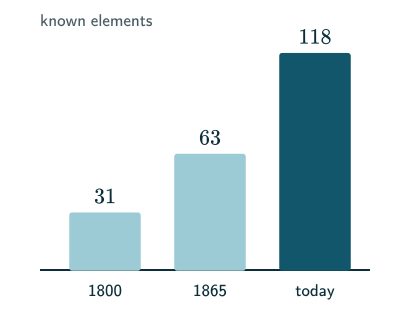
The recently discovered elements are man-made, and efforts to make new ones continue. Together the elements form innumerable compounds, so studying every element and every compound separately would be nearly impossible. Scientists therefore looked for a systematic way to organise what they knew, by classifying the elements (page 74).
What a classification does
Not only that it would rationalize known chemical facts about elements, but even predict new ones for undertaking further study.
NCERT Chemistry Part I (Class 11), Section 3.1, page 74
A good classification does two jobs:
- It organises known facts. Elements in the same family behave alike, so one family’s chemistry can be learnt as a pattern instead of as a list. Lithium, sodium and potassium, for example, all react with water to give a hydroxide and hydrogen, and all form chlorides of the formula MCl.
- It predicts new facts. Gaps in a good arrangement point to elements not yet discovered, and an element’s place suggests how it should behave. Mendeleev used this to predict gallium and germanium before they were found, as the next topic shows.
Biologists classify living organisms into taxa for the first of these jobs: say ‘mammals’ and you already think of animals with mammary glands and hair at some stage of life (NCERT Biology, Class 11, page 5).
We now know why families exist: elements in a family have similar outer electron configurations (NCERT page 74; Section 3.5).
The attempts that led to the modern periodic table, Döbereiner’s triads, Newlands’ octaves and Mendeleev’s table, are traced in the genesis of periodic classification (NCERT Section 3.2). Like Dalton’s atomic theory, the periodic table is an idea that turned scattered facts into a system.
Solved examples
Example 1: “More than doubled”
NCERT says the number of known elements more than doubled between 1800 and 1865. Check this.
63 ÷ 31 ≈ 2.03, which is a little more than 2.
Answer: yes; 63 is just over twice 31.
Example 2: Elements found since 1865
How many more elements are known today than in 1865?
118 − 63 = 55.
Answer: 55 elements, almost as many again as were known in 1865.
Example 3: Predicting formulas from a family
Sodium forms the chloride NaCl and the oxide Na2O. Potassium is in the same family. Predict the formulas of potassium chloride and potassium oxide.
Elements of one family form compounds of the same type, so replace Na by K.
Answer: KCl and K2O, the actual formulas of the chloride and normal oxide. This does not predict the main product of burning potassium in oxygen: potassium commonly forms the superoxide KO2 under those conditions.
Example 4: The basic theme (NCERT Exercise 3.1, page 96)
What is the basic theme of organisation in the periodic table?
The periodic table arranges the elements so that elements with similar properties come in the same vertical column (group), while properties change in a regular way along each row. It does this by placing the elements in order of atomic number, so that similar properties recur as successive valence subshells fill; the intervals need not be equal.
Answer: grouping elements with similar properties together, with properties recurring periodically as the atomic number increases. This makes the study of the elements and their compounds simple and systematic, which is the need NCERT describes in Section 3.1.
Common mistakes to avoid
Common mistake
Quoting an old count of elements
NCERT’s page 74 says 114 elements are known. Its own page 81, and IUPAC, give 118, all named. Use 118.
Common mistake
Thinking classification is only for memory
Classification does more than make facts easy to remember: it predicts. Mendeleev left gaps for undiscovered elements; when gallium and germanium were found, they had the properties he had forecast.
Common mistake
Expecting identical elements in a family
Elements of one family are similar, not identical. Their properties change steadily down the family; reaction with water generally becomes more vigorous from lithium to caesium. This is not a universal ranking for every reaction or medium.
Quick revision summary
- Known elements: 31 in 1800, 63 by 1865, 118 today (all named by IUPAC; NCERT page 74’s “114” is out of date).
- Too many elements and compounds to study one by one, so chemists classified the elements.
- A classification organises known facts and predicts new ones, such as undiscovered elements and their properties.
- Elements of one family behave alike and form similar compounds (NaCl, KCl; Na2O, K2O).
- The search for a classification led to the periodic table, which Seaborg called arguably the most important concept in chemistry.
Formula sheet
- Known elements: 31 (1800), 63 (1865), 118 (today)
- Same family, same type of compound: NaCl, KCl; NaO, KO
Questions students ask
How many elements are there in the periodic table?
There are 118 elements in the periodic table, from hydrogen (Z = 1) to oganesson (Z = 118), and all of them have official IUPAC names; the last four, nihonium, moscovium, tennessine and oganesson, were named in 2016. About 94 of them occur in nature, some only in traces, and the rest have been made only in laboratories. No element beyond 118 has yet been made and confirmed.
What are man-made elements, and why are they all radioactive?
Man-made (synthetic) elements are elements produced by nuclear reactions in reactors or particle accelerators, because they are not found in nature in usable amounts; the first was technetium (Z = 43), made in 1937, and elements after plutonium (Z = 94) are obtained primarily by artificial production. All of them are radioactive: the elements after lead (Z = 82) have nuclei too large for the strong nuclear force to hold their many mutually repelling protons together for ever, and technetium and promethium (Z = 61), the only lighter ones, happen to have no stable isotope. The heaviest, such as oganesson, are made only a few atoms at a time and decay within a fraction of a second.
What is the importance of the periodic table?
The periodic table is important because an element’s position gives a strong guide to its electronic configuration and chemistry: the period usually identifies the highest occupied shell, and main-group columns usually identify the number of outer electrons (one in group 1, seven in group 17). There are exceptions, such as palladium’s empty 5s subshell in period 5 and helium’s two electrons in group 18. From the position you can predict whether an element is a metal, non-metal or metalloid, its usual valency and the formulas of its compounds, and how its size, ionisation enthalpy and reactivity compare with its neighbours’. Chemists still reason this way to design materials: gallium arsenide, GaAs, a semiconductor like silicon, pairs gallium from group 13 with arsenic from group 15, on either side of silicon’s group 14.
Is classification of elements in the JEE Main 2027 and NEET (UG) 2026 syllabuses?
Yes, Classification of Elements and Periodicity in Properties is Unit 9 of both the JEE Main 2027 and the NEET (UG) 2026 Chemistry syllabuses. The unit lists the modern periodic law and the present form of the periodic table, the s, p, d and f block elements, and periodic trends in atomic and ionic radii, ionisation enthalpy, electron gain enthalpy, valence, oxidation states and chemical reactivity. The need for classification, NCERT Class 11 Section 3.1, is not named in either syllabus, so it matters mainly for school exams.
Practice questions
Try each question first, then open the answer to check your working.
-
Q1. Give two reasons why chemists needed to classify the elements.
Show answerHide answer
(1) There were too many elements and compounds to study one at a time: 63 elements by 1865, 118 today. (2) A classification organises known facts into patterns and lets chemists predict new ones, such as undiscovered elements and their properties.
-
Q2. Magnesium forms MgO and MgCl2. Calcium belongs to the same family. Predict the formulas of calcium oxide and calcium chloride.
Show answerHide answer
Same family, same type of compound: CaO and CaCl2.
-
Q3. What fraction of today’s elements was known in 1800?
Show answerHide answer
31 ÷ 118 ≈ 0.26, about a quarter.