Diversity in the living world
NCERT Class 11 Biology Chapter 1 Section 1.1
Quick answer
Biodiversity is the number and types of organisms on earth; NCERT cites about 1.7–1.8 million described species as a textbook figure, not a current census. Biologists identify organisms, name them under international codes and classify them into taxa; a species binomial has a capitalised genus and lowercase specific epithet, both italicised. Codes regulate accepted names, while synonyms and taxonomic changes can occur.
With your textbook
NCERT Biology (Class 11), Chapter 1 “The Living World”, Section 1.1 “Diversity in the Living World”, pages 3–6.
Open the official NCERT chapter (PDF, 2.3 MB, ncert.nic.in) (opens in a new tab)
Checked against the 2026-27 reprint on .
What is biodiversity?
Biodiversity
Each different kind of plant, animal or organism that you see, represents a species.
NCERT Biology (Class 11), Section 1.1, page 3
The number of species that are known and described range between 1.7-1.8 million.
NCERT Biology (Class 11), Section 1.1, page 3
NCERT goes on (pages 3–4): this is biodiversity, the number and types of organisms present on earth.
In plain words: biodiversity is the variety of life, counted as the number of different kinds (species) of organisms and the range of their types. NCERT cites about 1.7–1.8 million known and described species; this is the textbook’s figure, not a current global census. The text emphasises continuing discovery:
We should remember here that as we explore new areas, and even old ones, new organisms are continuously being identified.
NCERT Biology (Class 11), Section 1.1, page 4
With so many organisms, biologists need three things: a way to name each one so that everyone means the same organism, a way to recognise it, and a way to group organisms so that they can be studied. This page covers all three.
Nomenclature and identification
The same plant or animal has different local names in different places, even within one country, which causes confusion.
Hence, there is a need to standardise the naming of living organisms such that a particular organism is known by the same name all over the world. This process is called nomenclature.
NCERT Biology (Class 11), Section 1.1, page 4
Naming depends on first knowing exactly which organism you have:
Obviously, nomenclature or naming is only possible when the organism is described correctly and we know to what organism the name is attached to. This is identification.
NCERT Biology (Class 11), Section 1.1, page 4
The international codes. Scientific names follow agreed rules. For plants, NCERT names the International Code for Botanical Nomenclature (ICBN); for animals, the International Code of Zoological Nomenclature (ICZN) (page 4). Beyond NCERT: the plant code’s formal title was the International Code of Botanical Nomenclature (“of”, not “for”), and it has since been renamed the International Code of Nomenclature for algae, fungi, and plants (ICN). NCERT still uses ICBN, so know both names. The codes aim to make names unambiguous and stable. NCERT summarises that aim as follows:
The scientific names ensure that each organism has only one name.
NCERT Biology (Class 11), Section 1.1, page 4
Beyond NCERT: this is an idealised summary, not a claim that synonyms never exist. The ICN gives a taxon with a particular circumscription, position and rank one correct name, subject to its rules; the ICZN likewise regulates valid zoological names. Older names may remain as synonyms, and accepted names can change with taxonomic evidence. The codes are independent, so uniqueness is not an unrestricted guarantee across every nomenclatural code.
Binomial nomenclature
Each name has two components – the Generic name and the specific epithet. This system of providing a name with two components is called Binomial nomenclature.
NCERT Biology (Class 11), Section 1.1, page 4
This two-word system was given by Carolus Linnaeus and is used by biologists all over the world. The scientific name of mango is Mangifera indica: Mangifera is the genus and indica the specific epithet. NCERT’s rules (pages 4–5) are:
- Biological names are generally in Latin and written in italics. They are Latinised or derived from Latin, whatever their origin.
- The first word is the genus; the second is the specific epithet.
- When handwritten, the two words are underlined separately; in print they are in italics, to show their Latin origin.
- The genus starts with a capital letter, and the specific epithet with a small letter, as in Mangifera indica.
The name of the author comes after the specific epithet, at the end of the name, in an abbreviated form: Mangifera indica Linn.
It indicates that this species was first described by Linnaeus.
NCERT Biology (Class 11), Section 1.1, page 5
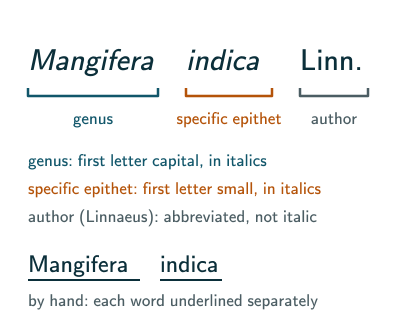
Other binomials in NCERT’s chapter are Homo sapiens (human being), Panthera leo (lion), Solanum tuberosum (potato), Musca domestica (housefly) and Triticum aestivum (wheat). Beyond NCERT: once a genus has been written out in full, it may be shortened to its capital initial and a full stop; NCERT does this on page 7 with P. pardus (leopard) and P. tigris (tiger).
Classification and taxa
Since it is nearly impossible to study all the living organisms, it is necessary to devise some means to make this possible. This process is classification.
NCERT Biology (Class 11), Section 1.1, page 5
Chemists classify the elements for the same reason: there are far too many to study one by one.
Classification is the process by which anything is grouped into convenient categories based on some easily observable characters.
NCERT Biology (Class 11), Section 1.1, page 5
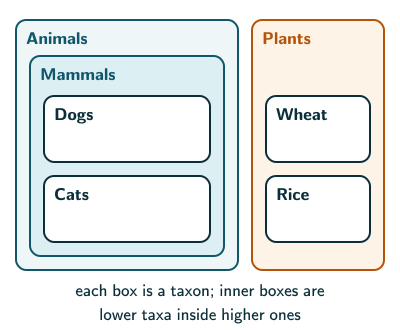
Groups such as plants, animals, mammals, dogs, cats, wheat and rice are such categories:
The scientific term for these categories is taxa.
NCERT Biology (Class 11), Section 1.1, page 5
Taxa can be at very different levels. A dog is a mammal and mammals are animals, so ‘dogs’, ‘mammals’ and ‘animals’ are taxa at three different levels, the levels that the taxonomic categories name. One group is a taxon; two or more are taxa. NCERT also uses the word for a rank: each category “is commonly termed as taxon” (page 6). Beyond NCERT: strictly, a taxon is a group, such as Mammalia, and its rank is class. NCERT writes “‘Plants’ – also form a taxa” and “‘Wheat’ is also a taxa” on page 5; since taxa is the plural, each of these should read “a taxon”, the singular NCERT itself gives on page 6.
Taxonomy and systematics
Hence, based on characteristics, all living organisms can be classified into different taxa. This process of classification is taxonomy.
NCERT Biology (Class 11), Section 1.1, page 5
Modern taxonomy uses external and internal structure, cell structure, development and ecological information (page 5). Its basic processes are:
Hence, characterisation, identification, classification and nomenclature are the processes that are basic to taxonomy.
NCERT Biology (Class 11), Section 1.1, page 5
The earliest classifications were based on the uses of organisms, for food, clothing and shelter. People have long wanted to know not only the different kinds of organisms and their diversity, but also the relationships among them; this branch of study is systematics, from the Latin systema, systematic arrangement of organisms (Linnaeus titled his publication Systema Naturae). Its scope later grew to include identification, nomenclature and classification:
Systematics takes into account evolutionary relationships between organisms.
NCERT Biology (Class 11), Section 1.1, page 6
In short:
- Taxonomy classifies organisms into taxa on the basis of their characters; its basic processes are characterisation, identification, classification and nomenclature.
- Systematics studies the kinds and diversity of organisms and the relationships among them; it includes identification, nomenclature and classification, and also takes into account evolutionary relationships.
Solved examples
Example 1: The correct way to write mango (NCERT Exercise Q5)
Which is written correctly: Mangifera Indica or Mangifera indica?
The specific epithet must start with a small letter, and the whole binomial is in italics.
Answer: Mangifera indica.
Example 2: Parts of a name
In Panthera tigris, name the genus and the specific epithet. What does “P.” stand for in P. pardus?
The first word is the genus and the second the specific epithet.
Answer: genus Panthera, specific epithet tigris; “P.” is Panthera, shortened once it has been written out (leopard, P. pardus).
Example 3: Correcting a name
A student writes “homo Sapiens” for the human being. Correct it, and say how it should look when handwritten.
The genus needs a capital letter and the specific epithet a small one.
Answer: Homo sapiens; by hand, the genus and the specific epithet are each underlined separately.
Example 4: Why classify? (NCERT Exercise Q1)
Why are living organisms classified?
There are far too many organisms to study one by one. Grouping them into categories on the basis of easily observable characters makes the study possible.
Answer: because it is nearly impossible to study all living organisms individually; classification makes their study possible (NCERT page 5).
Example 5: Taxon or taxa?
Are ‘mammals’ and ‘wheat’ taxa? Use the correct singular and plural.
Each is a category of organisms, at a different level.
Answer: yes: ‘mammals’ is a taxon and ‘wheat’ is a taxon, so together they are two taxa.
Example 6: Identification before naming
Why must an organism be identified before it is named?
A name is useful only if everyone attaches it to the same organism.
Answer: nomenclature is only possible when the organism is described correctly and we know which organism the name belongs to (NCERT page 4).
Common mistakes to avoid
Common mistake
Capitalising the specific epithet
Write Mangifera indica, not Mangifera Indica. Only the genus starts with a capital letter.
Common mistake
Underlining the binomial as one unit
By hand, underline the genus and the specific epithet separately, not with one line under both.
Common mistake
Writing “a taxa”
Taxa is the plural. One group is a taxon.
Common mistake
Treating taxonomy and systematics as the same
Taxonomy classifies; systematics also takes into account evolutionary relationships between organisms.
Common mistake
Italicising the author’s name
In Mangifera indica Linn., only the binomial is in italics; the abbreviated author is not.
Quick revision summary
- Biodiversity is the number and types of organisms on earth; NCERT cites about 1.7–1.8 million described species and notes continued discovery; treat the number as the textbook’s estimate.
- Identification is describing an organism correctly so that we know which one it is; nomenclature is giving it a standard name used all over the world.
- Plant names follow the ICBN (now the ICN) and animal names the ICZN; the codes regulate accepted names, while synonyms and later taxonomic changes can occur.
- Binomial nomenclature (Linnaeus): genus plus specific epithet, in italics or underlined separately by hand, the genus with a capital letter and the epithet with a small one; the abbreviated author may follow.
- Classification groups organisms into taxa (singular taxon) at different levels; taxonomy is classifying organisms into taxa on the basis of their characteristics, and its basic processes are characterisation, identification, classification and nomenclature.
- Systematics studies the diversity of organisms and the relationships among them, including evolutionary relationships.
Formula sheet
- scientific name = generic name + specific epithet
- genus: capital first letter; specific epithet: small first letter
- printed in italics; handwritten: each word underlined separately
- ICBN (now ICN): plants; ICZN: animals
- taxonomy: characterisation, identification, classification, nomenclature
- one taxon, two or more taxa
- NCERT’s cited described-species count: about 1.7–1.8 million
Questions students ask
Who is the father of taxonomy?
Carolus Linnaeus (Carl Linnaeus), the Swedish naturalist who gave the binomial system of naming organisms, is commonly called the father of taxonomy, or of modern taxonomy. NCERT does not use the title, but it credits him with binomial nomenclature and notes that he titled his publication Systema Naturae. Aristotle, whom NCERT calls the earliest to attempt a more scientific basis for classification, is sometimes given the title instead, but it usually goes to Linnaeus.
Why is binomial nomenclature important?
Binomial nomenclature is important because it provides a standard species name under an international code, understood by biologists around the world, whereas local names vary from place to place, even within one country. The two-word form also carries information: the first word places the species in its genus, so organisms that share a generic name, such as the lion Panthera leo and the leopard Panthera pardus, are known at once to be closely related. And because the rules fix the form, Latinised words in italics with a capital letter only for the genus, a scientific name is recognised whatever the language around it.
Why are scientific names written in Latin?
Scientific names are written in Latin, or in Latinised form, because Latin was the shared language of scholars in Europe when Linnaeus set up the binomial system, and the codes of nomenclature kept it as the one form for names, whatever the scientist’s own language. Latin has no native speakers today, so the meanings of its words change little, which helps keep names stable. NCERT states it as a rule: biological names are generally in Latin, are Latinised or derived from Latin irrespective of their origin, and are printed in italics to indicate their Latin origin.
Are taxonomy and classification the same thing?
Taxonomy and classification overlap but are not the same: classification is the process by which anything is grouped into convenient categories based on some easily observable characters, while taxonomy is the classification of living organisms into taxa on the basis of their characteristics, and it includes more than grouping. NCERT names characterisation, identification, classification and nomenclature as the processes basic to taxonomy, so classification is one part of taxonomy. For example, placing the potato in the family Solanaceae is classification, writing its name as Solanum tuberosum is nomenclature, and both belong to its taxonomy.
What is the difference between binomial and trinomial nomenclature?
Binomial nomenclature names a species with two words, the genus and the specific epithet, while trinomial nomenclature adds a third word to name a subspecies: the leopard is Panthera pardus, and the Indian leopard, one of its subspecies, is Panthera pardus fusca. In zoology, under the ICZN, the three words stand alone; in plant names, under the ICBN (now ICN), a word showing the rank, such as subspecies or variety, comes before the third word. NCERT’s Chapter 1 uses only binomials, so trinomials go beyond the NCERT text.
Why was ICBN renamed ICN?
The International Code of Botanical Nomenclature (ICBN) was renamed the International Code of Nomenclature for algae, fungi, and plants (ICN) at the International Botanical Congress in Melbourne in 2011, to make clear that it covers algae and fungi as well as plants. The code had long governed the names of algae and fungi, and fungi have a kingdom of their own in NCERT’s five-kingdom system, so the word ‘Botanical’ in the old title was misleading. NCERT still uses the older name, which it writes as International Code for Botanical Nomenclature.
Practice questions
Try each question first, then open the answer to check your working.
-
Q1. Define nomenclature and identification, and say which must come first.
Show answerHide answer
Identification is describing an organism correctly so that we know which organism a name belongs to; nomenclature is giving it a standard name known all over the world. Identification comes first (NCERT page 4).
-
Q2. Which code governs the scientific names of animals, and which those of plants?
Show answerHide answer
Animals: the International Code of Zoological Nomenclature (ICZN). Plants: the code NCERT calls ICBN, now the International Code of Nomenclature for algae, fungi, and plants (ICN).
-
Q3. Write the scientific name of wheat correctly, and name its genus and specific epithet.
Show answerHide answer
Triticum aestivum: genus Triticum, specific epithet aestivum (NCERT Table 1.1, page 8).
-
Q4. What does systematics take into account that a purely use-based classification does not?
Show answerHide answer
The relationships among organisms, including their evolutionary relationships (NCERT pages 5–6). Use-based classifications grouped organisms only by what people used them for.