What is living?
Beyond NCERT In the NEET syllabus; the Class 11 book has no section for it.
Quick answer
Cellular life combines cellular organisation, metabolism and biological responsiveness, called consciousness in school terminology without implying self-awareness. Growth and reproduction are typical life-cycle features, but sterile individuals and inactive viable seeds are still living; a size increase alone does not prove life. NCERT does not count viruses as truly living when life is defined by cellular structure.
What is living?
NCERT’s chapter opens by asking “what indeed is life?” (page 3) and goes on:
This question has two implicit questions within it. The first is a technical one and seeks answer to what living is as opposed to the non-living, and the second is a philosophical one, and seeks answer to what the purpose of life is.
NCERT Biology (Class 11), Chapter 1, Introduction, page 3
We will try to reflect on – what is living?
NCERT Biology (Class 11), Chapter 1, Introduction, page 3
The 2026–27 chapter asks this but has no section that answers it, while the NEET (UG) 2026 syllabus lists “What is living?” first in Unit 1. This page collects what NCERT says about living things in its other chapters, cited to those pages, and marks the rest as beyond the NCERT text.
Living organisms
Living organisms show a set of features together:
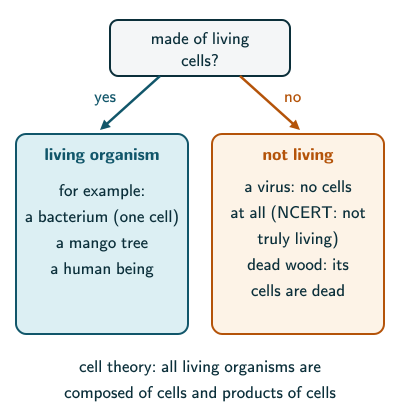
- Cellular organisation: they are made of one or more cells.
- Metabolism: their cells carry out organised chemical reactions during active life; activity can be greatly reduced in quiescent states.
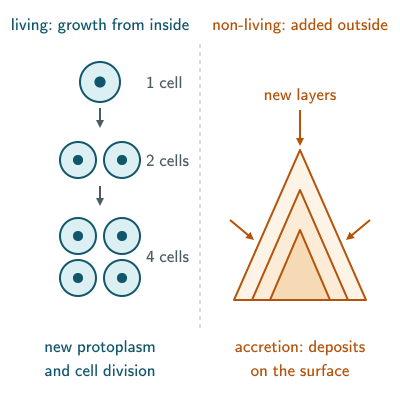
- Growth: during their life cycle, they increase in size from inside, through new protoplasm and cell division.
- Reproduction: living populations continue by producing new individuals, although some individuals never reproduce.
- Response to surroundings (consciousness): they sense changes around them and respond (beyond the NCERT text).
In this school-level framework, cellular organisation, metabolism and biological response are treated together as defining features of cellular life. They are capacities of a living system, not a requirement that every individual be actively growing, reproducing or responding at every moment. A dead leaf retains cellular structures without being a living organism. Growth and reproduction, on their own, do not define life (beyond the NCERT text).
In plain words: no single feature makes something alive. A living thing is built of cells, runs chemical reactions inside them, grows from within, can produce offspring and reacts to its surroundings. Some non-living things imitate one feature, and some living things lack one, which is why biologists look at the features together.
Growth
Growth is regarded as one of the most fundamental and conspicuous characteristics of a living being.
NCERT Biology (Class 11), Section 13.1, page 167
Growth can be defined as an irreversible permanent increase in size of an organ or its parts or even of an individual cell.
NCERT Biology (Class 11), Section 13.1, page 167
NCERT says that growth, at a cellular level, is principally a consequence of an increase in the amount of protoplasm (page 168). In a multicellular body cells also divide, so it gains cells and mass from inside (beyond the NCERT text). NCERT adds that growth is usually accompanied by metabolism, at the expense of energy (page 167), and that in plants it goes on throughout life:
Growth is indeterminate in higher plants.
NCERT Biology (Class 11), Chapter 13, Summary, page 178
Why growth alone is not defining (beyond the NCERT text). Non-living things can also get bigger, for example by material being added to their outer surface (accretion): a crystal in a solution, a sand mound or an icicle. NCERT itself asks how you would describe the swelling of a piece of wood placed in water (page 167). For dead, dried wood, it is an increase in size, but by taking in water, not by making new protoplasm, so it is not growth. And many animals stop growing in size once they are adult, yet they are clearly alive.
Reproduction
Growth and reproduction are characteristics of cells, indeed of all living organisms.
NCERT Biology (Class 11), Chapter 10, Introduction, page 120
Cells reproduce by dividing into two (page 120). Beyond the NCERT text: for a single-celled organism, this division is both its growth in number and its reproduction, so the two cannot be told apart.
Why reproduction alone is not defining (beyond the NCERT text). Some living individuals do not reproduce: a mule, the usually sterile offspring of a male donkey and a female horse, worker bees, which normally do not breed, and infertile human beings. They are all alive. So reproduction, though typical of life, does not on its own decide whether something is living.
Metabolism
Beyond the NCERT text: the sum of all the chemical reactions in an organism, building up (anabolic) and breaking down (catabolic), is its metabolism. NCERT describes the cytoplasm as the main site of these reactions:
Various chemical reactions occur in it to keep the cell in the ‘living state’.
NCERT Biology (Class 11), Section 8.3, page 88
An actively metabolising cell takes in nutrients or raw materials and gives out wastes and heat; in the language of chemistry it is an open system, exchanging matter and energy with its surroundings. Metabolism is a feature of cellular life, from bacteria to trees. This does not mean a constant, readily detectable rate: NCERT describes seeds suspending growth and resuming metabolic activities on germination (Chapter 13, page 166). A viable dry seed should not be classified as dead merely because it appears inactive. Isolated metabolic reactions can be run in a test tube; they are reactions of life, but the tube is not a living thing, so metabolism defines life only as reactions going on inside cells (beyond the NCERT text).
Cellular organisation
At the start of Chapter 8, NCERT asks “what is it that makes an organism living” and answers:
The answer to this is the presence of the basic unit of life – the cell in all living organisms.
NCERT Biology (Class 11), Chapter 8, Introduction, page 87
The cell theory, as NCERT states it today, says that all living organisms are composed of cells and products of cells, and that all cells arise from pre-existing cells (Section 8.2, page 88). This is why viruses sit on the borderline:
Viruses did not find a place in classification since they are not considered truly ‘living’, if we understand living as those organisms that have a cell structure.
NCERT Biology (Class 11), Section 2.6, page 19
Viruses are inert outside their specific host cell, but once inside they take over the host cell’s machinery to make copies of themselves (NCERT pages 19–20).
Response to surroundings (consciousness)
Beyond the NCERT text: living systems can detect environmental changes and respond through cellular processes. A plant bends towards light, a motile bacterium swims towards food, and an animal uses its sense organs. The school term consciousness here means biological responsiveness; it does not establish conscious experience or self-awareness in plants or bacteria. Nor does any response by itself prove life: a thermostat detects temperature and switches a heater on, but has no living cells or metabolism. Evaluate biological response together with cellular organisation and metabolism, allowing for inactive stages such as viable dry seeds.
Which features define life?
- Defining in the school framework: cellular organisation, the capacity for cellular metabolism, and biological responsiveness (called consciousness in this context). These are considered together, across the life cycle.
- Not defining on their own: growth (non-living things can also increase in size) and reproduction (some living individuals do not reproduce).
Solved examples
Example 1: The wet wood question (NCERT page 167)
A piece of dead, dried wood placed in water swells. Is this biological growth?
NCERT defines growth as an irreversible permanent increase in size, usually with metabolism. Wood swells by taking in water and shrinks again when it dries, so the increase is not irreversible; no new protoplasm is made and no metabolism is involved.
Answer: no, it is only an increase in size, not growth.
Example 2: A mule
A mule usually cannot reproduce. Is it a living organism?
It is made of cells, carries out metabolism and responds to its surroundings.
Answer: yes. Reproduction is not a defining feature, so a sterile individual is still living.
Example 3: Are viruses living?
Use NCERT’s account to decide whether viruses are living.
Viruses have no cell structure and are inert outside their host cell, but inside a host cell they make copies of themselves.
Answer: NCERT says they are not considered truly living, if living means having a cell structure; inside a host they show one feature of life, replication.
Example 4: Growth in one cell and in many
How do growth and reproduction differ in a single-celled organism and in a human being?
In a single-celled organism, one cell dividing into two is both growth in number and reproduction. In a human being, cell division makes the body grow, and reproduction is the separate production of a new individual.
Answer: in single-celled organisms they are the same process; in multicellular organisms they are different.
Example 5: A growing crystal
A salt crystal hanging in a concentrated solution gets bigger. Is it growing in the biological sense?
It gains material only on its outer surface and has no cells or metabolism.
Answer: no; this is accretion, not biological growth.
Example 6: The defining features
Which of these is a defining feature of living organisms: growth, reproduction, cellular organisation, movement?
Non-living things can increase in size, some living individuals do not reproduce, and many living things (most plants) do not move from place to place.
Answer: cellular organisation.
Common mistakes to avoid
Common mistake
Calling every increase in size growth
Growth in the biological sense is an irreversible permanent increase from within, with new protoplasm. Swelling wood or a growing crystal does not qualify.
Common mistake
Making reproduction the test of life
Sterile individuals such as mules are alive. Reproduction is typical of life but not defining on its own.
Common mistake
Saying viruses are simply living
NCERT does not consider them truly living, if living means having a cell structure; they are also inert outside a host cell.
Common mistake
Forgetting that metabolism needs the cell
Chemical reactions in a test tube are not life. Metabolism defines life as the reactions going on inside cells.
Quick revision summary
- NCERT asks “what is living?” (page 3); the 2026–27 book answers it only through other chapters.
- Growth: an irreversible permanent increase in size (NCERT page 167), from inside, with new protoplasm and cell division; indeterminate in higher plants. Non-living things can increase in size by accretion, swelling or thermal expansion, without biological growth or new protoplasm.
- Reproduction: growth and reproduction are characteristics of all living organisms (page 120), but sterile individuals are alive, so it is not defining on its own.
- Metabolism: the chemical reactions that keep the cell in the living state (page 88); a defining feature.
- Cellular organisation: the cell is the basic unit of life (page 87); viruses, with no cell structure, are not considered truly living (page 19).
- Response to surroundings (consciousness in the school terminology): biological responsiveness, considered with cellular organisation and metabolism; not a claim that all organisms have self-awareness (beyond the NCERT text).
Formula sheet
- defining: cellular organisation, metabolism, consciousness (response)
- not defining alone: growth, reproduction
- growth: irreversible permanent increase in size, from inside
- non-living size increase: accretion, swelling or expansion, no new protoplasm
- cell theory: cells and products of cells; cells from pre-existing cells
- viruses: non-cellular, inert outside a host cell
Questions students ask
Is ‘What is living?’ in the NEET 2026 syllabus?
‘What is living?’ is in the NEET (UG) 2026 Biology syllabus: it is the first topic of Unit 1, Diversity in Living World, listed before biodiversity, the need for classification, and taxonomy and systematics. The 2026–27 NCERT book only asks the question, on page 3 of Chapter 1, and has no section that answers it. Its features are therefore learnt from what NCERT says about living things in other chapters, such as Chapter 13 on plant growth and Chapter 8 on the cell.
What is the difference between living and non-living things?
Living things differ from non-living things in three defining ways: they are made of cells, they carry out metabolism inside those cells, and they sense and respond to their surroundings, while a non-living object such as a stone does none of these. Both can get bigger, but a living body grows from inside by making new protoplasm, whereas a non-living object such as an icicle gets bigger only as material is added to its surface. Living things can also produce offspring of their own kind, though not every individual does, and a non-living object never can.
What is the difference between dead and non-living things?
Dead means once alive but no longer alive; it is one kind of non-living state. Never-living objects such as stones were never organisms. Dead wood may retain cell walls, so merely finding cellular structures is not enough to show life. Also, death of an organism need not mean every cell dies simultaneously. School activities therefore often distinguish living, dead (once living) and never living.
Is fire living or non-living?
Fire is non-living: it is the heat and light given out by combustion, a fast reaction of a fuel with oxygen, and it has no cells. It seems alive because it takes in oxygen, gives out heat, grows and spreads, but it grows only by catching more fuel from outside and makes no new protoplasm. Aerobic cellular respiration also oxidises food, but does so through controlled biochemical reactions in living cells; fire senses and responds to nothing, and a new fire inherits nothing from the old one, so its spreading is not reproduction.
What are the 7 characteristics of living organisms?
The 7 characteristics of living organisms in many school courses, remembered as MRS GREN, are movement, respiration, sensitivity, growth, reproduction, excretion and nutrition. Under NEET’s topic ‘What is living?’, the features of living things are growth, reproduction, metabolism, cellular organisation and consciousness (response to surroundings), and the last three are taken as defining. The lists overlap: both have growth and reproduction, respiration is part of metabolism, nutrition and excretion supply and clear its materials, and sensitivity is response to surroundings, but movement is only in MRS GREN and cellular organisation only in the NEET list.
Practice questions
Try each question first, then open the answer to check your working.
-
Q1. State NCERT’s definition of growth, and explain why a growing mound of sand does not fit it.
Show answerHide answer
Growth is an irreversible permanent increase in size of an organ or its parts or even of an individual cell (NCERT page 167), coming from inside with new protoplasm. A sand mound grows only by material deposited on its surface, with no cells or metabolism.
-
Q2. Why is reproduction not a defining feature of living organisms?
Show answerHide answer
Some living individuals, such as mules, worker bees and infertile people, do not reproduce, yet they are alive.
-
Q3. What, according to NCERT Chapter 8, makes an organism living?
Show answerHide answer
The presence of the basic unit of life, the cell, in all living organisms (NCERT page 87).
-
Q4. State the two parts of the cell theory as NCERT gives it.
Show answerHide answer
All living organisms are composed of cells and products of cells; all cells arise from pre-existing cells (NCERT Section 8.2, page 88).